
30 Most Valuable 1989 Donruss Baseball Cards

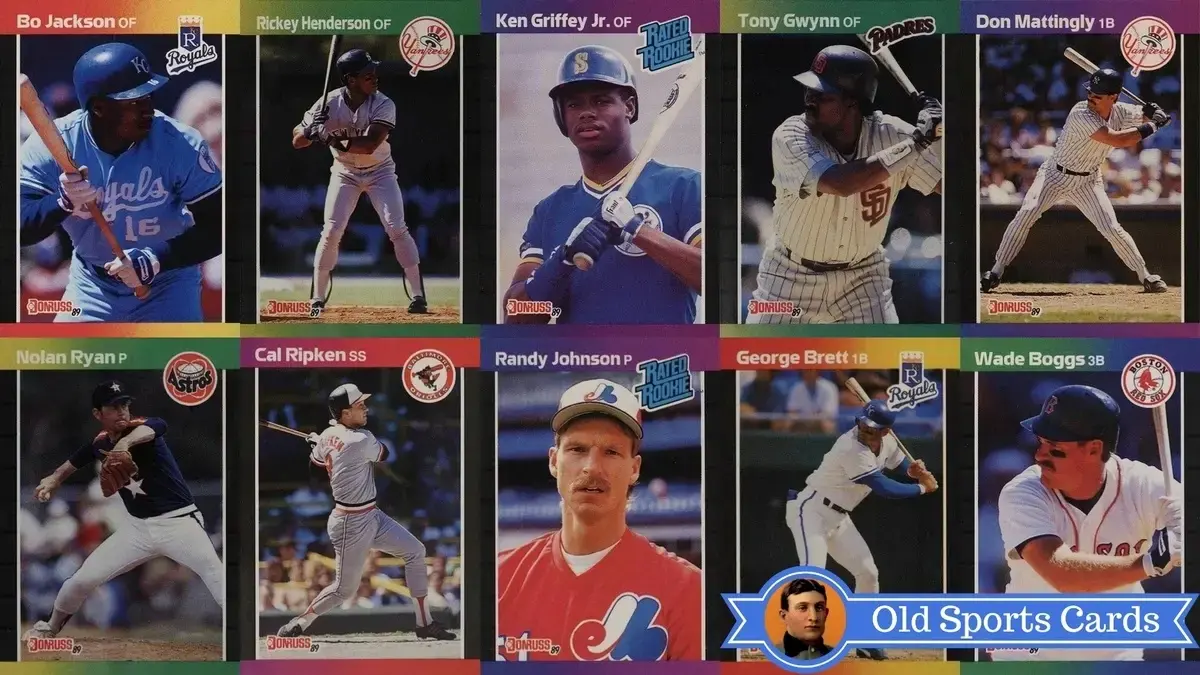
During the late 1980s, there seemed to be no shortage of 1989 Donruss baseball cards around the hobby…
And that’s because there wasn’t.
These cards were some of the most heavily produced during an era of overproduction.
Today, you can find full boxes of these for $5 or so.
But, while most of them may be worthless these days, that doesn’t mean some cards from this set can’t still hold some value.
And in this guide, we’ll take a look at the 30 most valuable.
Let’s jump right in!
1989 Donruss Baseball Set Snapshot
SET DETAILS
660
Ken Griffey Jr., Randy Johnson, John Smoltz, Craig Biggio
GRADING ANALYSIS
94,033
TOTAL GRADED BY PSA
11,931
PSA 10 Population
12.7%
PSA 10 Grade Rate
MOST GRADED CARDS
1
#33 Ken Griffey Jr.
57.1%
53,734
2
#42 Randy Johnson
12.1%
11,366
3
#635 Curt Schilling
8.4%
7,865
Stay On Top Of The Card Market
Weekly pricing updates, grading insights, and new card guides — straight to your inbox. For free.
Join thousands of collectors. Unsubscribe anytime.

Ross Uitts – Owner
- #1
1989 Donruss #33 Ken Griffey Jr. Rookie Card
Rookie CardPSA 10 Value $1025 – $1100Total PSA Population 53,734PSA 10 Population 2,123PSA 10 Grade Rate 4.0% (Set Avg: 12.7%)The hype surrounding Griffey in 1989 was incredible and everyone was after this and his other rookie cards of the day.
Today, demand remains high and the value of this card has steadily risen in recent years.
Prior to his induction into the Hall of Fame, I remember seeing these sell for around $40 or so in PSA 10 condition.
Nowadays, they consistently sell for $600 or more.
Along with the market for his infamous 1989 Upper Deck #1 rookie card, prices for this card have skyrocketed recently.
His Donruss rookie may not be as popular as his iconic Upper Deck card, but I’ve always loved the look and feel of this one.
The purple and black borders can easily show wear and chipping preventing most from achieving the lofty PSA 10 standard.

- #2
1989 Donruss #42 Randy Johnson Rookie Card
Rookie CardPSA 10 Value $145 – $155Total PSA Population 11,366PSA 10 Population 1,494PSA 10 Grade Rate 13.1% (Set Avg: 12.7%)As far as pitchers are concerned, they don’t get much more dominant than Randy Johnson.
I used to love watching him pitch and pile up strikeout after strikeout.
His slider was one of the most devastating pitches the game will ever see and left many professional hitters looking helpless at the plate.
While not nearly as valuable as the Griffey Jr. rookie, Johnson’s rookie still holds respectable value in top grade.
- #3
1989 Donruss #154 Nolan Ryan
PSA 10 Value $125 – $135Total PSA Population 1,455PSA 10 Population 382PSA 10 Grade Rate 26.3% (Set Avg: 12.7%)Following a contract dispute with the Houston Astros in the wake of the 1988 MLB season, the 42-year-old righty signed with the Texas Rangers with plenty left to prove and plenty left in the gas tank.
Ryan threw absolute darts all year in his sixth and final 300-strikeout campaign.
With 301 strikeouts in 1989, Ryan became (and remains) the oldest pitcher in baseball history to hit the 300-strikeout plateau in a season.
He finished the 1989 campaign with a 16-10 record, a solid 3.20 ERA, and led the Majors in hits allowed per 9 innings (6.092).
He also finished fifth in the Majors in strikeout-to-walk ratio (3.071) and tied for fourth in walks given up (98).
Remarkably enough, this was the first of five seasons for the 42-year-old flamethrower in a Texas Rangers uniform.
Ryan hung up his cleats after the 1993 campaign following a UCL tear in his throwing arm, ending his career at 46 years of age as the all-time MLB leader in strikeouts (5,714), walks allowed (2,795), and hits allowed per 9 innings (6.6).
Also, the Hall of Famer’s seven no-hitters are three clear of second place (Sandy Koufax, 4) for the most in Major League Baseball history.
- #4
1989 Donruss #208 Bo Jackson
PSA 10 Value $100 – $110Total PSA Population 854PSA 10 Population 189PSA 10 Grade Rate 22.1% (Set Avg: 12.7%)1989 marked the beginning of the iconic “Bo Knows” advertising campaign and also stands as Jackson’s best overall year on a baseball diamond.
With his popularity surging and celebrity at its undeniable peak, the Kansas City Royals outfielder made his first and only MLB All-Star Game appearance in 1989.
He dazzled during the showcase in Anaheim, picking up MVP honors thanks to a mammoth 448-foot first-inning home run off Rick Reuschel and a highlight-reel catch in left-center, which stole two RBIs away from slugger Pedro Guerrero.
Jackson finished fourth in the American League in home runs (32) and RBIs (105), ultimately finishing tenth in the A.L.
MVP race, his only MVP placement during parts of eight MLB seasons.
Bo did finish first in the Majors in one category, striking out a whopping 171 times, tied for the tenth-most strikeouts by a right-handed batter since 1893.
His patience at the plate may have been lacking, but his defensive prowess during the 1989 MLB campaign dominated highlight packages.
- #5
1989 Donruss #26 Don Mattingly Diamond Kings
PSA 10 Value $100 – $110Total PSA Population 323PSA 10 Population 111PSA 10 Grade Rate 34.4% (Set Avg: 12.7%) - #6
1989 Donruss #373 Greg Maddux
PSA 10 Value $90 – $100Total PSA Population 226PSA 10 Population 49PSA 10 Grade Rate 21.7% (Set Avg: 12.7%) - #7
1989 Donruss #105 Ryne Sandberg
PSA 10 Value $90 – $95Total PSA Population 215PSA 10 Population 48PSA 10 Grade Rate 22.3% (Set Avg: 12.7%)The 1989 Chicago Cubs remain a special team for the Wrigley faithful.
From 1946 to 1997, a span of over five decades, the Cubs made exactly two playoff appearances, one in 1984 and one in 1989.
Both of those teams had one very important thing in common.
His name was Ryne Sandberg.
In 1984, Sandberg had the best year of his Hall-of-Fame career, capped off by an NL MVP award.
Five years later, Sandberg was still a top-five MVP finisher and the right guy to carry the usually woeful Cubs across the finish line.
The 29-year-old second baseman slashed .290/.356/.497 for the NL East champs with 30 home runs, 15 stolen bases, 76 RBIs, and an NL-best 104 runs scored in 157 games.
Sandberg made his sixth All-Star team and pulled off the Gold Glove/Silver Slugger combo for the fourth time.
He carried it over to October with a .400 average against San Francisco, but the Cubs were still ousted with a five-game NLCS loss.
- #8
1989 Donruss #68 Wade Boggs
PSA 10 Value $70 – $80Total PSA Population 146PSA 10 Population 53PSA 10 Grade Rate 36.3% (Set Avg: 12.7%)Wade Boggs’ streak of four consecutive AL batting titles ended in 1989.
A couple more multi-hit games here or there, and he would have extended to five.
The ’89 AL batting crown came down to three contestants in September: eventual winner Kirby Puckett, Oakland’s Carney Lansford, and Boggs.
The Boston Red Sox third baseman pulled ahead several times in the second half, but was undone by a mid-September slump.
Boggs concluded the campaign at .330, nine points behind Puckett.
Regardless of his batting title miss, Boggs was still among the most elite of the elite.
Named to his fifth All-Star team and earning his fourth Silver Slugger, the 31-year-old paced the Majors in plate appearances (742), runs (113), doubles (51), and on-base percentage (.430).
Boggs simply did everything well, placing second in the AL in offensive WAR (6.3), fourth in defensive WAR (2.4), and second in total WAR among position players (8.4).
- #9
1989 Donruss #193 Mike Schmidt
PSA 10 Value $70 – $75Total PSA Population 247PSA 10 Population 115PSA 10 Grade Rate 46.6% (Set Avg: 12.7%)Mike Schmidt’s seemingly out-of-nowhere retirement announcement stopped baseball in its tracks.
In 1987, the Philadelphia Phillies legend put the finishing touches on his 12th All-Star season.
Even at the age of 37, he remained one of the most valuable players in the game, both by standard and advanced metrics.
Just 18 months later, though, Schmidt dropped his goodbye bomb, a late-May 1989 declaration that he, in his mind, didn’t have it anymore.
“I was wondering if I could compete with those guys,” Schmidt said later.
“I’m watching them and feeling like a shadow of the player I used to be.” To be fair, Schmidt had his worst season in 15 years in ’88 and was mired in a two-month slump to start the ’89 campaign.
By the time of his announcement, the Hall-of-Famer was hitting .203 with six homers in 42 games.
However, nobody seemed to doubt that he would figure it out sooner or later.
Nobody, it seems, except Schmidt.
- #10
1989 Donruss #35 Gregg Jefferies Rookie Card
Rookie CardPSA 10 Value $60 – $65Total PSA Population 136PSA 10 Population 26PSA 10 Grade Rate 19.1% (Set Avg: 12.7%)The late 1980s New York Mets were the wrong team at the wrong time for Gregg Jefferies to break in with.
At the turn of the nineties, the Mets clubhouse was a walking tabloid.
Drug use ran rampant, in-fighting was a daily occurrence, and the New York media swirled around it all 24/7/365.
Jefferies, a sensitive and quiet young kid from Northern California, was an immediate outsider.
“The veterans were hard on him,” teammate David Cone said.
“Once you were on the wrong side with that group, it was impossible to recover.” Veterans like Cone and Keith Hernandez mended fences with Jefferies in later years, but the dynamic was still incredibly toxic.
And it was a waste of what the young second/third baseman was capable of.
In 1989, his second of two eligible rookie campaigns, Jefferies slashed .258/.314/.392 with 12 home runs, 21 stolen bases, and 56 RBIs in 141 games.
The 21-year-old played spooked most of the year, and that tightness was evident in an underwhelming (re)debut campaign.
- #11
1989 Donruss #104 Dale Murphy
PSA 10 Value $60 – $65Total PSA Population 144PSA 10 Population 62PSA 10 Grade Rate 43.1% (Set Avg: 12.7%)What looked like a season-long slump in 1988 became the new normal for Dale Murphy in 1989.
It’s a shame it went that way.
Injuries cut the Atlanta Braves slugger down as the Eighties came to a close, and the seeming Hall-of-Fame lock from the early part of the decade was now a shell of his former self.
In 1989, Murphy slashed .228/.306/.361 with 20 home runs and 84 RBIs in 154 games.
The 33-year-old was able to stay on the field through his constant knee issues, but it was easy to see how they were cutting into his power and overall presence at the plate.
The trend would only continue from there.
The Braves were obviously alarmed by Murphy’s sudden decline and ended up dealing him to Philadelphia in the middle of the 1990 campaign.
He would never again come close to the MVP highs of his early career.
- #12
1989 Donruss #635 Curt Schilling Rookie Card
Rookie CardPSA 10 Value $55 – $60Total PSA Population 7,865PSA 10 Population 1,548PSA 10 Grade Rate 19.7% (Set Avg: 12.7%)Had Schilling’s career not gotten off to such a slow start, he’d likely be in the Hall of Fame.
And, you could probably still argue his case to be inducted since some of his stats are better than some pitchers who did make it into the Hall.
Regardless, Schilling left a legacy on the game for huge strikeout totals and postseason dominance.
When he paired up with Randy Johnson in Arizona and then Pedro Martinez in Boston, you were hard-pressed to find a better one-two punch.
His 1989 Donruss rookie card remains popular among collectors and still holds respectable value in PSA 10 condition.
- #13
1989 Donruss #74 Don Mattingly
PSA 10 Value $55 – $60Total PSA Population 447PSA 10 Population 213PSA 10 Grade Rate 47.7% (Set Avg: 12.7%)Although he never quite put up Hall of Fame numbers, Don Mattingly was one of the most popular players of his era.
And his cards during the late ’80s and early ’90s were as hot as anyone’s.
His 1989 Donruss card seems to have held up a bit better than his cards from some of the other sets of this time period for some reason.
It’s not hugely expensive, but it’s still a great-looking card as it features a great action shot of him mid-swing in his Yankee pinstripes.
- #14
1989 Donruss #642 John Smoltz Rookie Card
Rookie CardPSA 10 Value $55 – $60Total PSA Population 1,932PSA 10 Population 669PSA 10 Grade Rate 34.6% (Set Avg: 12.7%)Smoltz was a key to those amazing Atlanta pitching staffs of the 1990’s that helped them dominate that decade.
I was always impressed how Smoltz dominated as a starter through the early part of his career, became a dominant reliever for a few years, and then went back to being a starter again.
That’s not easy to do.
Clearly the guy knew how to pitch and his success eventually landed him a spot in the Hall of Fame.
His rookie card is one of the keys to this set but unfortunately is only worth about $12 or so in high grade.
- #15
1989 Donruss #643 Jose Canseco
PSA 10 Value $50 – $55Total PSA Population 324PSA 10 Population 70PSA 10 Grade Rate 21.6% (Set Avg: 12.7%) - #16
1989 Donruss #245 Rickey Henderson
PSA 10 Value $45 – $50Total PSA Population 379PSA 10 Population 128PSA 10 Grade Rate 33.8% (Set Avg: 12.7%)During his first stint in Oakland from 1979-1984, Rickey Henderson received American League MVP votes four times, including a second-place finish in 1981.
However, Rickey’s brash personality rubbed many the wrong way, and he was traded to the New York Yankees following the 1984 season.
After four-and-a-half stellar campaigns in pinstripes, Henderson came back to Oakland on June 21st, 1989.
Traded for the trio of Luis Polonia, Greg Cadaret, and Eric Plunk, Henderson was absolutely electric in his return to the defending American League champs.
Henderson ended up leading the Majors with 113 runs scored and 77 stolen bases between his time with the Yankees and A’s while also pacing the American League with 129 walks.
His 8.7 WAR also topped the American League for position players, trailing only the Atlanta Braves’ Lonnie Smith (8.8) for the best mark in the MLB.
Most importantly, perhaps, Henderson was named ALCS MVP in the A’s five-game triumph over the Toronto Blue Jays after slashing .400/.609/1.000 with two home runs, five RBIs, seven walks, and eight steals.
He followed that up with a sterling .474/.524/.895 slash line against the Giants, swiping three bases and driving in three during the team’s championship sweep.
- #17
1989 Donruss #91 Jose Canseco
PSA 10 Value $40 – $45Total PSA Population 234PSA 10 Population 98PSA 10 Grade Rate 41.9% (Set Avg: 12.7%)1989 was the most productive October of Jose Canseco’s career.
It was also the only productive October of Jose Canseco’s career.
This didn’t seem likely early in the campaign.
The Oakland A’s suffered a stress fracture in his left wrist before the year and reinjured it in May.
During all of this, he was arrested for carrying a loaded handgun while heading into treatment at a university medical center.
This was months after one of his friends was stopped for carrying a loaded gun onto a flight.
Add in another speeding ticket, and it was an absolute mess for everyone involved.
Still, Canseco got better and did damage down the stretch, slashing .269/.333/.542 with 17 home runs and 67 RBIs in just 57 RBIs in just 65 games.
He followed that up with a .323 average and two monster home runs in Oakland’s nine-game run to a World Series championship.
Canseco would have just three more playoff hits in his career.
- #18
1989 Donruss #92 Barry Bonds
PSA 10 Value $40 – $45Total PSA Population 647PSA 10 Population 182PSA 10 Grade Rate 28.1% (Set Avg: 12.7%)1989 was the last year you could call Barry Bonds a good player, not a great one.
And even then, it was a major stretch.
Four years into his MLB career, the Pittsburgh Pirates left fielder wasn’t living up to the billing of his revered godfather, at least in the media’s eye.
The weight of expectations on Bonds was heavy in Willie Mays’ shadow, and the exploits of his father, Bobby, didn’t help either.
By the turn of the 1990s, Bonds would evolve into the multi-time All-Star, potential GOAT force of a generation.
In ’89, he was between stages, slashing .248/.351/.426 with 19 home runs, 96 runs, 93 walks, and 32 stolen bases in 159 games.
His 126 OPS+ wasn’t among the best of the best, but his 8.0 WAR was a new career high that placed him third among NL position players.
The media stayed critical of Bonds regardless of the evidence in front of them, further stretching a divide that would remain for his entire career.
- #19
1989 Donruss #6 Tony Gwynn Diamond Kings
PSA 10 Value $35 – $40Total PSA Population 271PSA 10 Population 85PSA 10 Grade Rate 31.4% (Set Avg: 12.7%)It didn’t take long for Tony Gwynn to reach the magical 3,000 hits milestone.
In fact, it took the fewest games in National League history.
Gwynn collected his 3,000th in his 2,284th game, trailing only the Deadball Era duo of Ty Cobb and Nap Lajoie on the all-time liSt. It was years like 1989 that made this possible, masterful campaigns when Gwynn gobbled up hits any way he could, blooping, lining, and blasting balls everywhere where fielders were not.
The 29-year-old San Diego Padres outfielder collected an NL-high 203 hits on the way to his fourth batting title (.336) in six seasons.
Gwynn topped 200 hits five times during his Hall-of-Fame career, and he tacked four more batting titles before he called it quits.
In an era marked by up-and-down offense and pitching dominance, Gwynn was a consistent throughline.
No one racked them up like him, or has since.
- #20
1989 Donruss #51 Cal Ripken Jr.
PSA 10 Value $35 – $40Total PSA Population 411PSA 10 Population 145PSA 10 Grade Rate 35.3% (Set Avg: 12.7%)Cal Ripken Jr. was one of my favorite players to watch as a kid.
As the owner of the record for most consecutive games played, his dedication to the game was obvious.
And that’s what I liked about him: he consistently brought his best day in and day out.
His rookie cards are some of the most expensive of the 1980s but his cards from other sets like this one won’t set you back nearly as much.
- #21
1989 Donruss #128 Tony Gwynn
PSA 10 Value $35 – $40Total PSA Population 240PSA 10 Population 91PSA 10 Grade Rate 37.9% (Set Avg: 12.7%)Tony Gwynn got the crown, but Will Clark got what Gwynn truly wanted.
On the season’s final day, the San Diego Padres faced the San Francisco Giants in an otherwise meaningless game.
San Francisco had already clinched the division earlier in the series, relegating the Padres to a disappointing second-place finish.
The game did have stakes, though.
Gwynn and Clark were virtually tied for the NL batting title, with Clark holding a lead by less than a point.
Gwynn went 3-for-4, Clark went 1-for-4, and Gwynn got the crown, his third straight and fourth overall.
It was one heck of an achievement.
Yet, Gwynn still wasn’t satisfied.
“It’s no big deal,” Gwynn said to Clark.
“You’re going where I want to go.
I’d trade a batting title to be going to the playoffs.” The Giants went on to win the NL pennant.
Gwynn would have to wait seven more years for another crack at one.
- #22
1989 Donruss #182 Kirby Puckett
PSA 10 Value $35 – $40Total PSA Population 266PSA 10 Population 115PSA 10 Grade Rate 43.2% (Set Avg: 12.7%)Both the American League and National League batting titles came down to the final day of the 1989 regular season.
In the NL, Tony Gwynn broke a virtual tie with a 3-for-4 day, edging out San Francisco’s Will Clark for the honor.
It was Gwynn’s fourth batting championship.
In the AL, two potential first-time winners chased the title down to the last game: Minnesota’s Kirby Puckett and Oakland’s Carney Lansford.
The two entered the day essentially tied, with the Twins visiting Seattle and the A’s hosting the Royals.
Similar to the National League, it was a player from an eliminated team who got a measure of revenge against a division winner.
Puckett cleared a pair of doubles in the finale while Lansford went hitless, handing Kirby his first and only batting crown at .339.
Lansford got the real last laugh, though, winning a World Series title with the AL West champs.
Minnesota finished 80-82, nineteen games behind.
- #23
1989 Donruss #31 Gary Sheffield Rookie Card
Rookie CardPSA 10 Value $35 – $40Total PSA Population 2,324PSA 10 Population 556PSA 10 Grade Rate 23.9% (Set Avg: 12.7%)Sheffield was a nine-time All-Star and an absolute force at the plate as he’d go on to belt 509 home runs over his career.
However, his connections with the BALCO PED scandal have tarnished his legacy like those of many other players of his era.
Even so, his 1989 Donruss rookie card remains a collector favorite but is only worth about $12 or so in high grade.
- #24
1989 Donruss #63 Ozzie Smith
PSA 10 Value $35 – $40Total PSA Population 147PSA 10 Population 78PSA 10 Grade Rate 53.1% (Set Avg: 12.7%)The St. Louis Cardinals settled into a near-decade of mediocrity after their 1987 pennant win.
While they still hovered around .500 and posted four winning records, the eight-year playoff drought put a damper on some of the best years of Ozzie Smith’s career.
“The Wizard” already had three pennants and a World Series ring.
Yet, seasons like the 1989 campaign were still an exercise in frustration.
Smith was individually brilliant in ’89, posting the best WAR (7.3) of his 19-year career.
The 34-year-old shortstop posted a .273/.335/.361 slash line with a near-average OPS+ (97).
That’s not exactly elite stuff, but was still good for a solid 2.5 oWAR.
As always, though, it was Smith’s defense that did the talking.
He posted an MLB-best 4.8 dWAR in 155 games, partially thanks to his NL-leading 483 assists.
However, Smith was only one player.
The Cardinals stayed above water in the division race for most of the campaign, but faded to 86-76 and third in the NL EaSt.
- #25
1989 Donruss #5 Robin Yount Diamond Kings
PSA 10 Value $30 – $35Total PSA Population 130PSA 10 Population 58PSA 10 Grade Rate 44.6% (Set Avg: 12.7%) - #26
1989 Donruss #55 Robin Yount
PSA 10 Value $30 – $35Total PSA Population 141PSA 10 Population 71PSA 10 Grade Rate 50.4% (Set Avg: 12.7%)In a hotly-contested American League MVP race, the Milwaukee Brewers’ veteran outfielder narrowly beat out three other standouts for the trophy: Ruben Sierra, Cal Ripken Jr., and George Bell.
It was Yount’s second MVP award, seven years removed from taking home the honors as the Brewers’ starting shortstop in 1982.
Yount’s MVP triumph was a historic one.
He became the third MLB player (at the time) to secure MVP awards at two different positions, following only Hank Greenberg and Stan Musial.
He also became the first American League player with multiple MVP campaigns since Mickey Mantle took home honors for the third (and last) time in 1962.
Yount did not lead the American League in any offensive category, but he did post an impressive .318/.384/.511 slash line, marking the highest on-base percentage of his career and his best batting average and slugging marks since his iconic 1982 MVP season.
Sixteen years into his MLB career, Yount headed into the offseason following the 1989 MLB campaign as a free agent with extra MVP clout.
Despite serious interest from the California Angels, Yount re-signed with the Brewers on a three-year, $9.6 million deal.
- #27
1989 Donruss #95 Mark McGwire
PSA 10 Value $30 – $35Total PSA Population 659PSA 10 Population 139PSA 10 Grade Rate 21.1% (Set Avg: 12.7%)It took one more year than everyone thought, but the Bash Brothers got their ring in 1989.
In 1988, Mark McGwire and Jose Canseco headlined an Oakland A’s team that was heavily favored to beat the injury-stricken Dodgers.
And then, Kirk Gibson rewrote history with a Game 1 walkoff, kicking a five-game upset into high gear.
McGwire, Canseco, and the A’s returned to camp in 1989 with a Southern California-sized chip on their shoulders.
Anything but a World Series title would be a buSt. It took some left turns and a reunion with the great Rickey Henderson to do it, but the A’s pushed through an AL West and ripped through the playoffs for the franchise’s first World Series title in fifteen years.
McGwire hit 33 home runs and drove in 95 on the year, doing most of the heavy lifting as Canseco sat out the first half with a wrist injury.
- #28
1989 Donruss #204 George Brett
PSA 10 Value $30 – $35Total PSA Population 197PSA 10 Population 97PSA 10 Grade Rate 49.2% (Set Avg: 12.7%)The Kansas City Royals’ 1989 season took a nasty twist and turn at the end of April.
It had been a thrilling start.
Kansas City opened at 17-8 and looked like a legit threat to the defending division champion Oakland A’s.
That’s when the black cat crossed paths.
Franchise cornerstone and ’88 Silver Slugger George Brett tore a ligament in his right knee while planting to make a routine throw, sending the Royals’ season into immediate panic mode.
“Obviously, I’m disappointed,” Brett said in a press release.
“I work hard every day to keep in shape, and then I tear up a knee because I catch a spike in the turf.” Brett missed about a month.
And while the Royals stayed within relative striking distance of the A’s for most of the year, the compromised state of their legendary third baseman did them no favors.
Brett ended ’89 with his lowest WAR (1.7) and batting average (.282) since 1974, and KC finished seven games back in second place.
- #29
1989 Donruss #257 Barry Larkin
PSA 10 Value $30 – $35Total PSA Population 54PSA 10 Population 32PSA 10 Grade Rate 59.3% (Set Avg: 12.7%)The death of the All-Star Game Skills Competition came with the cost of Barry Larkin’s arm.
1989 started with an absolute bang for the Cincinnati Reds shortstop.
Larkin played 97 regular-season games and was a favorite to win the batting title heading into the second half.
He entered his second All-Star weekend slashing .342/.375/.446 with four home runs and ten stolen bases.
What was supposed to be a fun, relaxing stay in Anaheim turned out to be anything but come workout day.
During the customary relay throw competition, Larkin tore a ligament in his throwing elbow, ending his season on the spot.
“I heard a pop off in the distance as a gunshot had gone off,” Larkin said.
“I was like, something is going on.
Then I realized it was my elbow.
That wasn’t good.” If a healthy Larkin had maintained his .342 pace for the final two months, he would have beaten Tony Gwynn for his first (and only) batting championship.
- #30
1989 Donruss #561 Craig Biggio Rookie Card
Rookie CardPSA 10 Value $30 – $35Total PSA Population 3,778PSA 10 Population 1,277PSA 10 Grade Rate 33.8% (Set Avg: 12.7%)Few players have been as versatile as Craig Biggio was.
Whether he was at second base, in the outfield, or behind home plate, Biggio was an incredible defender.
And on offense he racked up a ton of hits, stole many bases and scored a lot of runs.
He was just a great all-around ball player.
When he surpassed the 3,000 career hit mark that solidified his well-earned spot in the Hall of Fame.
His rookie card may not be expensive but it’s still very much one of the keys to own in this set.

Ross’s Take
I’ve always loved the 1989 Donruss set so writing this article was a great trip down memory lane.
Aside from the Griffey rookie, most of these cards can be had for a relatively low dollar figure.
But, like you saw, it will take them being professionally graded in gem mint condition to be worth much at all.
There were just too many of them printed during an era of over-saturation so their values have been severely impacted.
But, it’s a great set, nonetheless.
Within the set were also several different subsets, including: All-Stars Checklists Diamond Kings MVPs Rated Rookies If you grew up collecting these as a kid like I did, they’ll likely always hold a huge nostalgic factor to them, if nothing else.
Love old cards? Get weekly updates from a fellow collector.
Pricing updates, grading insights, and new guides on the cards you actually care about — the junk wax era, vintage, and everything in between. One email a week. No fluff.
Free. No spam. Unsubscribe anytime.
Ross Uitts – Owner
