
Ken Griffey Jr. Rookie Cards: Values, Grading and What’s Worth Buying

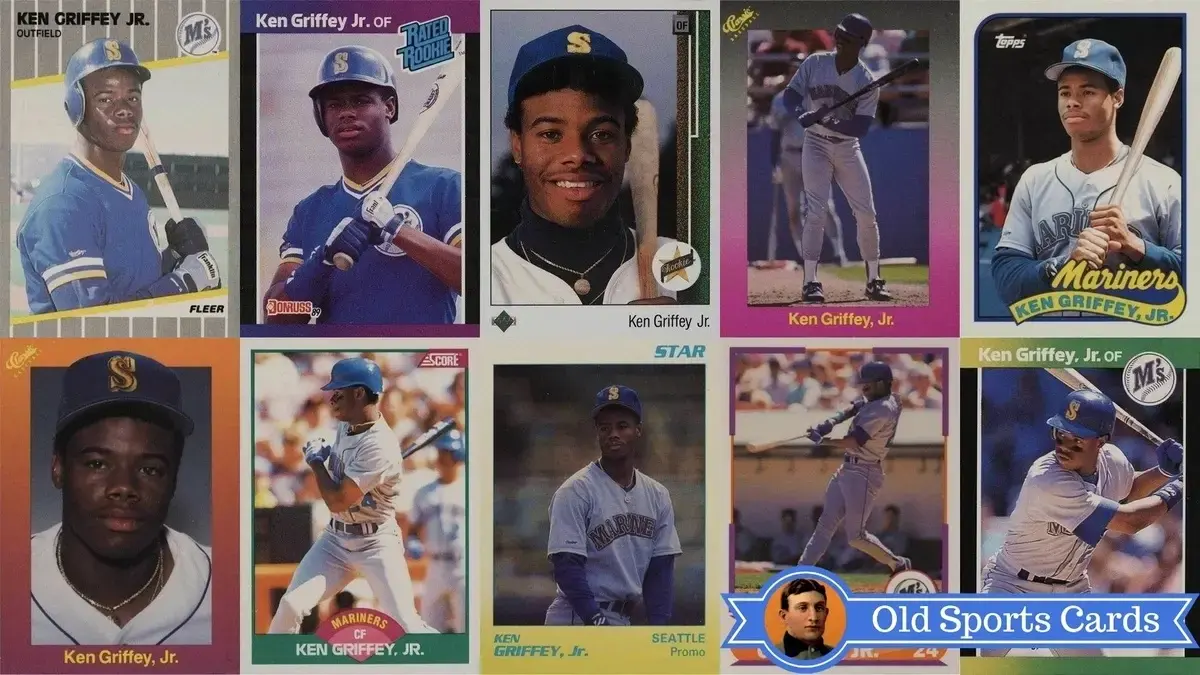
Growing up in the late 1980’s, there was nothing more that my friends and I would rather pull from a pack than a Ken Griffey Jr. rookie card.
But which one?
There were so many different ones produced by so many different companies that it was hard to pick a favorite.
That tells you all you need to know about just how much the card market ballooned in the late 1980’s with massive print runs.
Regardless, these cards will always hold a special place in the hobby and some of them are surprisingly still worth quite a bit.
And in this guide, we’ll take a detailed look at all of them.
Let’s jump right in!
QUICK FACTS
Most Valuable Rookie
1989 Upper Deck #1 Ken Griffey Jr. Rookie Card
$5,300
Most Graded Rookie
1989 Upper Deck #1 Ken Griffey Jr. Rookie Card
128,641
LEAST VALUABLE ROOKIE
1989 Score Traded #100T Ken Griffey Jr. Rookie Card
$180
Need Help Selling Your Sports Cards?
Fill out the form below and I’ll get back to you within 24 hours. No obligation.

Ross Uitts – Owner
Rookie Cards
Ken Griffey Jr. has some of the most beloved rookie cards of the entire junk wax era, and they all come from 1989, the year he debuted in Seattle at just 19 years old.
The headliner is the legendary 1989 Upper Deck #1, the very first card in Upper Deck’s debut set and an image so iconic it more or less defined a generation of collecting.
Around it sit his other mainstream rookies: the 1989 Bowman, Donruss, Fleer, Score Traded, and Topps Traded.
The beauty of Griffey rookies is accessibility.
Because these sets were printed in enormous numbers, you can own most of them in high grade for very little, and even a clean Upper Deck #1 is far more affordable than its fame suggests.
This is the rare iconic rookie that almost any collector can actually own, which is a big part of why it stays so widely loved.
Just because they’re accessible, though, doesn’t make them cheap in PSA 10 condition.
Prices in top grade have continued to soar recently.
-
1989 Bowman #220 Ken Griffey Jr. Rookie Card
PSA 10 Value $700 – $750Total PSA Population 33,817PSA 10 Population 2,689PSA 10 Grade Rate 8.0% (Set Avg: 17.3%)PSA Population Distribution
740592115468641,66511,55615,6132,68912345678910As the baseball card market heated up in the early 1950s, Topps and Bowman fought neck-and-neck for as much market share as possible.
Though they were fierce competitors, both had very different starts.
Bowman had been in the trading card business since the 1930s.
However, Topps didn’t enter the market until 1951, when it released its Red and Blue Backs set.
Despite the later start, Topps soon put a stranglehold on the market.
In 1956, Topps bought Bowman and effectively retired the brand for several decades.
For years, Topps was the only game in town.
But in 1981, Donruss and Fleer won a legal challenge against Topps and began producing baseball cards as well.
And as the hobby frenzy ballooned in the late 80s, Topps came up with an idea to help outduel Donruss and Fleer: revive the Bowman brand.
So, in 1989, the hobby got its first look at a Bowman baseball card set since 1955.
The oversized 2 1/2″ by 3 3/4″ cards gave Topps another foothold in the market and the 484-card checklist was well-received.
Not surprisingly, Griffey’s rookie is the top draw to the set.

-
1989 Donruss #33 Ken Griffey Jr. Rookie Card
PSA 10 Value $1025 – $1100Total PSA Population 53,734PSA 10 Population 2,123PSA 10 Grade Rate 4.0% (Set Avg: 12.7%)PSA Population Distribution
30561343421,0972,9226,56124,39014,9092,12312345678910Several years ago, you could find the ’89 Donruss Griffey rookie in PSA 10 condition for less than $50.
Their values have since skyrocketed since his Hall of Fame induction in 2016.
Some collectors consider the design to be a bit dark and bland overall.
But I don’t mind.
It’s been one of my favorite Ken Griffey Jr. rookie cards and one of my favorite cards of the “junk era” in general ever since I started collecting as a kid in the late 1980’s.
The black and dark purple borders and the iconic “Rated Rookie” logo perfectly complement the image of a young Griffey Jr. looking confident and ready to take the league by storm.
However, those borders can be susceptible to showing wear and chipping more easily than some of his other rookies.
And that’s party to explain why getting a PSA 10 grade on this card can be relatively more challenging.
Other Hall-of-Famers like Randy Johnson, John Smoltz, and Craig Biggio also made their rookie card debuts in this set.
But Griffey’s card is the most desirable in the 660-card checkliSt.

-
1989 Fleer #548 Ken Griffey Jr. Rookie Card
PSA 10 Value $375 – $400Total PSA Population 70,937PSA 10 Population 5,837PSA 10 Grade Rate 8.2% (Set Avg: 15.3%)PSA Population Distribution
2222701585671,1972,95022,44635,4715,83712345678910The 1989 Fleer baseball card set contained 660 cards featuring a gray and white pinstripe design.
At first glance, the set may seem bland to some.
But if you’ve been around this hobby long enough, you know that ’89 Fleer is anything but boring.
In fact, it was downright controversial.
And it all had to do with several interesting printing errors.
The Randy Johnson rookie card has several variations, some involving a visible Marlboro advertising sign in the background.
As you can imagine, parents weren’t thrilled that their kids were potentially exposed to cigarette ads.
But they were even less pleased by one variation of the Billy Ripken rookie card.
Some variations feature his bat knob covered in various ink formations.
Those ink formations were fixes to cover up what one variation didn’t: the infamous “F*ck Face” message.
Ripken’s card has transcended the hobby to become a bit of pop culture lore.
So, despite Griffey being the set’s biggest rookie name, his card isn’t the most expensive.
The rarer error variations of Johnson and Ripken’s rookies outclass Griffey regarding value.
But, had Griffey’s card contained any interesting rare variations of its own, the story would undoubtedly be different.
-
1989 Score Traded #100T Ken Griffey Jr. Rookie Card
PSA 10 Value $180Total PSA Population 30,258PSA 10 Population 5,508PSA 10 Grade Rate 18.2% (Set Avg: 20.9%)PSA Population Distribution
11117431495668,46615,2625,50812345678910Like Topps had done for years with its “Traded” series, Score’s “Rookie and Traded” set allowed the company to keep hobbyists up-to-date with any player called up or traded during the 1989 season.
The 110-card checklist featured seven Hall-of-Famers, with the Randy Johnson and Ken Griffey Jr. rookies being the most desirable.
You’ll notice that Score featured a fantastic action shot of Griffey following through on a swing.
All his other rookie cards show him in a pose or headshot.
So, this card is his only “true” rookie card that features him in action.
Still, despite that distinction, most collectors don’t typically point to this card as his best rookie overall.
It’s not his most valuable.
But, regardless of value, most hobbyists simply prefer the designs of his other rookies.
The ’89 Score Rookie and Traded design isn’t terrible.
But it lacks some of the color and visual punch that, say, his ’89 Donruss or ’89 Upper Deck rookies offer.
-
1989 Topps Traded #41T Ken Griffey Jr. Rookie Card
PSA 10 Value $300 – $310Total PSA Population 92,164PSA 10 Population 14,651PSA 10 Grade Rate 15.9% (Set Avg: 18.9%)PSA Population Distribution
729571545862,0512,69121,23050,43214,65112345678910The 1989 Topps Traded issue is considered one of his most popular rookie cards and features a young Griffey staring confidently with a bat over his shoulder.
I always liked the 1989 Topps design with the floating name banner and cursive team name in the lower right corner.
Of all Griffey’s rookies, this one is arguably the most “classic-looking” of them all.
Upper Deck had just entered the market in 1989, raising eyebrows with its innovative design and print quality.
But Topps was still churning out cards with a traditional look and feel.
Griffey is among six Hall-of-Famers to appear in the 132-card checklist and is the most desirable in the set.
Griffey would make his first flagship Topps appearance in the 1990 Topps release as one of the All-Star Rookie cards noted by the iconic Topps trophy cup in the corner.
Still, this is considered Griffey’s “true” Topps rookie card.
These are pretty easy to find in pristine condition, but they can still go for over $115, meaning they aren’t cheap.
-
1989 Upper Deck #1 Ken Griffey Jr. Rookie Card
PSA 10 Value $5,800 – $6,000Total PSA Population 132,527PSA 10 Population 4,252PSA 10 Grade Rate 3.2% (Set Avg: 16.5%)PSA Population Distribution
4094061,0473,1138,12615,18116,70747,43333,8734,25212345678910Upper Deck made headlines when it entered the card market in 1989, offering a premium product with a high-quality design.
The cards were glossier.
They featured beautiful full-color photography.
The modern design elements were second to none.
And the reverse even contained a hologram to prevent counterfeiting.
Collectors would have scoffed at Upper Deck if they had produced an ordinary design on card stock similar to Donruss, Fleer, and Topps.
Instead, they were blown away.
And just like that, an entirely new segment of premium cards had been born.
Perhaps most incredible was that Upper Deck struck gold by choosing Griffey to hold down the #1 spot in the 800-card checkliSt. Not only did the sport’s brightest future superstar become the face of the set.
This card became the face of the modern hobby.
It will never be as valuable as the T206 Honus Wagner or the 1952 Topps Mickey Mantle.
But it’s nearly as iconic.
Upper Deck had changed the hobby forever.
And this card embodied the entire movement.
Other Early Key Career Cards
This is where Griffey collecting turns into a rabbit hole, and it is a fun one.
The valuable chase pieces are the premium parallels: the 1989 Bowman Tiffany, Fleer Glossy, and Topps Traded Tiffany, all printed on better stock in tiny numbers next to their base versions, which is why they carry a steep premium and climb into the thousands in top grade.
From there it gets wonderfully weird.
You will find oddball and regional issues like the Classic Travel Updates, Mother’s Cookies, Scoremasters, the Topps Heads Up test card, and the Donruss boxed-set rookies, many of them scarce and a few genuinely tough to track down.
None of these are his mainstream rookie, but for the collector who already owns the 1989 base cards and wants something most people have never seen, this is the most rewarding part of the chase.
-
1989 Bowman Tiffany #220 Ken Griffey Jr.
PSA 10 Value $17,000Total PSA Population 1,871PSA 10 Population 156PSA 10 Grade Rate 8.3% (Set Avg: 0.0%)PSA Population Distribution
31228615589850815612345678910Bowman had not released a set since 1955 after they were bought out by their largest competitor, Topps.
But Griffey Jr. and the hype that surrounded him helped to immediately increase the popularity of this set.
The cards were larger than normal, measuring in at 2 1/2″ x 3 3/4″, and featured full color photography and facsimile signatures of the players.
A young Griffey Jr. poses with a rather serious look, kneeling in his Mariners uniform.
In recent years, this card has soared to become one of the most valuable baseball cards of the 1980s.
-
1989 Classic Travel Update I #131 Ken Griffey Jr.
PSA 10 Value $220Total PSA PopulationPSA 10 PopulationPSA 10 Grade Rate 0.0% (Set Avg: 0.0%)Classic produced two blister pack sets in 1989 that each featured Ken Griffey Jr. inside.
The orange version was the first of the two and is fairly straightforward in design.
-
1989 Classic Travel Update II #193 Ken Griffey Jr.
PSA 10 Value $230Total PSA PopulationPSA 10 PopulationPSA 10 Grade Rate 0.0% (Set Avg: 0.0%)Classic’s purple version is much more interesting to look at than the orange as Griffey Jr. is showcased in an action shot at bat.
I’m not sure if they’re necessarily more rare than the orange but they do command a higher price, on average.
Perhaps it’s just because they’re a bit more fun to look at.
-
1989 Donruss Baseball’s Best #192 Ken Griffey Jr.
PSA 10 Value $900Total PSA PopulationPSA 10 PopulationPSA 10 Grade Rate 0.0% (Set Avg: 0.0%)Along with the flagship Donruss set, Griffey also appeared in the smaller (336 cards in total) “Baseball’s Best” box set that Donruss released through retail stores that year.
The design is much brighter than the flagship issue and features a great action shot of The Kid at the plate.
It’s not quite as valuable as his “Rated Rookie” but still has decent value in top condition.
-
1989 Donruss Rookies #3 Ken Griffey Jr.
PSA 10 Value $600Total PSA PopulationPSA 10 PopulationPSA 10 Grade Rate 0.0% (Set Avg: 0.0%)Donruss also released a “The Rookies” set in 1989 that was pretty much the same concept as Topps Traded.
The set contains 56 cards but Griffey’s is by far the key.
The design is much like the other Donruss issues that year but features a “The Rookies” logo in the upper right corner.
-
1989 Fleer Glossy #548 Ken Griffey Jr.
PSA 10 Value $6,000Total PSA Population 2,233PSA 10 Population 120PSA 10 Grade Rate 5.4% (Set Avg: 0.0%)PSA Population Distribution
11576719187870412012345678910Much like the Bowman and Topps Tiffany releases, Fleer also produced a premium version of their cards that year.
The design is exactly the same as the base card but the card stock itself is higher quality with a glossy look and feel.
Because a smaller amount of these were produced and because centering is a challenge, finding these in pristine condition can be tough.
-
1989 Mother’s Cookies #3 Ken Griffey Jr.
PSA 10 Value $210Total PSA PopulationPSA 10 PopulationPSA 10 Grade Rate 0.0% (Set Avg: 0.0%)Food issues are typically not as popular as mainstream cards since they were typically only released in certain regions.
But, the 1989 Mother’s Cookies Griffey cards are still great cards.
They were distributed as singles in packages of Mother’s Cookies and there are four different Griffey’s to collect.
The first card in the set shows The Kid posing with his arms crossed.
-
1989 Phoenix Magnetables Ken Griffey Jr.
PSA 10 Value $1,500Total PSA PopulationPSA 10 PopulationPSA 10 Grade Rate 0.0% (Set Avg: 0.0%)These are certainly one of the more odd Ken Griffey Jr. rookie issues.
And some collectors may even debate if they’re truly rookie “cards” or not since they’re actually magnets.
ln 1989 and 1990, a company called Phoenix IND.
based in Fetus, MO, distributed these magnets that featured many different baseball and basketball players in individual plastic bags.
For the collector who likes oddball issues like these, this is one of the more rare and pricier ones you’ll find.
-
1989 SCD Baseball Pocket Price Guides #3 Ken Griffey Jr.
PSA 10 Value $3,400Total PSA PopulationPSA 10 PopulationPSA 10 Grade Rate 0.0% (Set Avg: 0.0%)This small oddball set contained just fifteen cards in the checklist and had a look and feel to them reminiscent of the 1964 Topps set.
Collectors could find other big names of the era like Don Mattingly, Mark McGwire, Ryne Sandberg and others but the Griffey is by far and away the most valuable in the set.
The reverse of the card gives some interesting projections for his different rookie cards and even shows an image of his Donruss rookie in the upper right corner.
-
1989 Score Young Superstars Series 2 #18 Ken Griffey Jr.
PSA 10 Value $350Total PSA PopulationPSA 10 PopulationPSA 10 Grade Rate 0.0% (Set Avg: 0.0%)Part of a smaller 42 card set, this Griffey card packs a lot of punch.
The color scheme really makes the card pop as does the great shot of Griffey taking a huge cut.
It’s not hard to find but it does land a higher value than his other Score issues on this liSt.
-
1989 Scoremasters #30 Ken Griffey Jr.
PSA 10 Value $260Total PSA PopulationPSA 10 PopulationPSA 10 Grade Rate 0.0% (Set Avg: 0.0%)I’ve always liked the artwork of the 1989 Score Masters design.
And Griffey’s card, in particular, really captured his trademark swing in a unique format.
Not as popular as his other major releases, you could find these at hobby shops or by sending in for them in the mail.
It’s one of a very few Ken Griffey Jr. rookie cards to feature artwork of the rising start.
-
1989 Topps Heads Up Test #5 Ken Griffey Jr.
PSA 9 Value $15,000Total PSA PopulationPSA 9 PopulationPSA 9 Grade Rate 0.0% (Set Avg: 0.0%)Topps released this unusual test issue in 1989 that is a die-cut Griffey Jr. head that was meant to be stuck to a flat surface of your choice for display.
Notice the hole in Griffey’s cap–that’s where the little suction cup would be used to secure him to a window or wall.
This oddball item is not really a true baseball card but collectors go wild for them.
On the rare occasion these come up for sale, they can sell for huge money.
In 2017, one of these graded in PSA 9 condition sold for $4,651.
A PSA 10 would easily fetch five figures.

-
1989 Topps Traded Tiffany #41T Ken Griffey Jr.
PSA 10 Value $6,250Total PSA Population 2,488PSA 10 Population 344PSA 10 Grade Rate 13.8% (Set Avg: 0.0%)PSA Population Distribution
1141843714691,52034412345678910There weren’t as many 1989 Topps Tiffany Griffeys printed as there were Bowman Tiffany Griffeys but that doesn’t stop this card from being expensive.
In top condition they can still go for over $500.
Like other premium versions from the other manufacturers, these cards are easily distinguished from their base versions by the glossy, sharper card stock.

Ross’s Take
Ken Griffey Jr. burst onto the Major League scene in 1989, showcasing his remarkable talents as a promising five-tool phenom for the Seattle Mariners.
In 121 games, Griffey slashed .264/.329/.420 with 16 home runs, 61 RBIs, and 61 runs scored to capture third place in the AL Rookie of the Year race.
In addition to his hitting prowess, Griffey raised eyebrows with his incredible defensive skills and smarts on the base paths.
His charisma and style captured the hearts of fans across the league, laying the foundation for a career that would see him become one of the most iconic figures in baseball history.
