
30 Most Valuable 1989 Fleer Baseball Cards

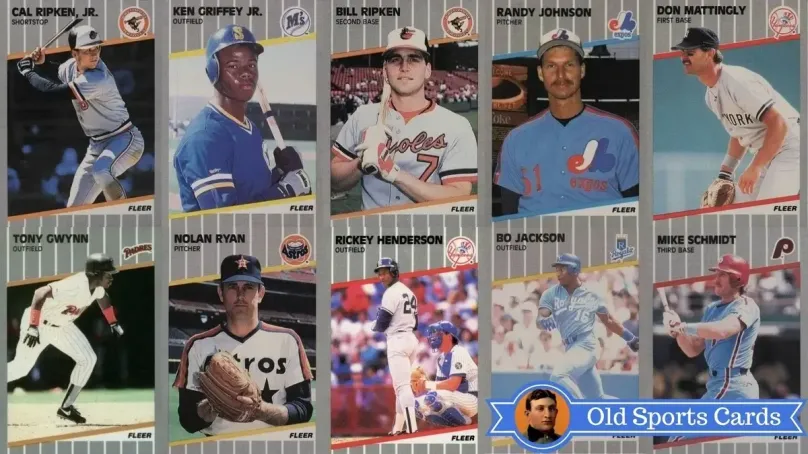
If there’s one thing that 1989 Fleer baseball cards are known for, it’s controversy.
During a time period in which manufacturers were rushing to produce as many cards as possible to keep up with demand, it seems that Fleer became a bit careless with its Billy Ripken and Randy Johnson cards.
The errors and variations that plagued those two cards are hobby icons.
But these two cards weren’t the only cards in the set with value as there are several rookies and stars that can also still be worth money in top grade today And in this guide, I will cover the 30 most valuable 1989 Fleer baseball cards that are still worth a decent amount.
Let’s jump right in!
1989 Fleer Baseball Set Snapshot
SET DETAILS
660
Ken Griffey Jr., Randy Johnson, John Smoltz, Craig Biggio
GRADING ANALYSIS
144,210
TOTAL GRADED BY PSA
22,114
PSA 10 Population
15.3%
PSA 10 Grade Rate
MOST GRADED CARDS
1
#548 Ken Griffey Jr.
48.6%
70,038
2
#616 Bill Ripken FF Error
17.0%
24,490
3
#381 Randy Johnson Ad Completely Blacked Out
5.1%
7,405
Stay On Top Of The Card Market
Weekly pricing updates, grading insights, and new card guides — straight to your inbox. For free.
Join thousands of collectors. Unsubscribe anytime.

Ross Uitts – Owner
- #1
1989 Fleer #616 Bill Ripken Scribbled Out in White
PSA 10 Value $5,000Total PSA Population 162PSA 10 Population 14PSA 10 Grade Rate 8.6% (Set Avg: 15.3%)And here it is: one of the most notorious error cards in the history of the baseball card collecting hobby.
When collectors began pulling Billy Ripken cards from 1989 Fleer packs that had the phrase “F*ck Face” on the knob of his bat, the hobby went nuts.
Fleer immediately tried to correct the issue by putting any number of things over it from white out, to black boxes, to black scribbles.
Prices for these cards soared and even to this day they can fetch a pretty penny in top grade condition–especially the white out variation since it’s the rarest of them all.
CNBC interviewed Ripken about 20 years later and he suspected that Fleer knowingly let the error into circulation to build hype and I wouldn’t doubt it…
Because of all the different tactics Fleer used to try and correct the error, there are several variations with the one featuring the bat knob scribbled out in white out being the rarest and most expensive.

- #2
1989 Fleer #616 Bill Ripken Whited Out Vulgarity
PSA 10 Value $3,500Total PSA Population 174PSA 10 Population 16PSA 10 Grade Rate 9.2% (Set Avg: 15.3%) - #3
1989 Fleer #381 Randy Johnson Marlboro Ad On Scoreboard Rookie Card
Rookie CardPSA 10 Value $1,200Total PSA Population 955PSA 10 Population 110PSA 10 Grade Rate 11.5% (Set Avg: 15.3%)Billy Ripken’s card wasn’t the only controversial card in this set.
Randy Johnso’n’s rookie card would also carry a fair bit of controversy as it involved different variations with a Marlboro cigarettes ad on the card.
The most notorious is the one with the ad positioned in the background over his left shoulder in full view.
Production of these were stopped and later print runs will show the ad either partially or completely blocked.
There are also variations of the card where the ad has a green or red tint to likely due to Fleer using a different printing facility or plate for them.
- #4
1989 Fleer #616 Bill Ripken FF Error
PSA 10 Value $800Total PSA Population 24,490PSA 10 Population 3,052PSA 10 Grade Rate 12.5% (Set Avg: 15.3%) - #5
1989 Fleer #616 Bill Ripken Black Scribble Over Error
PSA 10 Value $450Total PSA Population 2,312PSA 10 Population 288PSA 10 Grade Rate 12.5% (Set Avg: 15.3%) - #6
1989 Fleer #173 Jeff Treadway w/Target
PSA 10 Value $400Total PSA Population 132PSA 10 Population 4PSA 10 Grade Rate 3.0% (Set Avg: 15.3%) - #7
1989 Fleer #381 Randy Johnson Ad Tinted Green Rookie Card
Rookie CardPSA 10 Value $300Total PSA PopulationPSA 10 PopulationPSA 10 Grade Rate 0.0% (Set Avg: 15.3%) - #8
1989 Fleer #381 Randy Johnson Ad Partially Obscured Rookie Card
Rookie CardPSA 10 Value $185Total PSA Population 2,748PSA 10 Population 322PSA 10 Grade Rate 11.7% (Set Avg: 15.3%) - #9
1989 Fleer #548 Ken Griffey Jr. Rookie Card
Rookie CardPSA 10 Value $175Total PSA Population 70,038PSA 10 Population 5,816PSA 10 Grade Rate 8.3% (Set Avg: 15.3%)Demand for Ken Griffey Jr. rookie cards as strong as ever as you can tell by the price people are willing to pay for the glossy version of his 1989 Fleer rookie.
Griffey Jr. was one of those rare talents in any sport with enough star power to set himself apart on a whole different level.
He could hit, he could run, he could field, he could throw…the guy could do it all.
It was frustrating to watch those years during the early 2000’s when injury after injury kept him off the field.
Had he stayed healthy, there’s a good chance he would have had the numbers to put him high in the conversation for being the greatest player of all-time.
- #10
1989 Fleer #616 Bill Ripken Black Box Over Error
PSA 10 Value $80Total PSA Population 6,080PSA 10 Population 1,216PSA 10 Grade Rate 20.0% (Set Avg: 15.3%) - #11
1989 Fleer #368 Nolan Ryan
PSA 10 Value $50Total PSA Population 2,178PSA 10 Population 793PSA 10 Grade Rate 36.4% (Set Avg: 15.3%)Typically I like my Nolan Ryan cards with images of him mowing down a batter with his incredible fastball.
However, this is still a great-looking card due to that retro Astros jersey and logo in the upper right corner.
All of that color really makes this card pop, which isn’t easy considering the dull grey background.
Ryan actually wrapped up his stint with the Astros the year before and began his first of five seasons with the Texas Rangers in 1989.
- #12
1989 Fleer #285 Bo Jackson
PSA 10 Value $45Total PSA Population 1,095PSA 10 Population 359PSA 10 Grade Rate 32.8% (Set Avg: 15.3%)Given his status as one of the biggest sports icons of his era, Bo Jackson’s cards remain in solid demand throughout the hobby.
And the 1989 MLB season was when Jackson truly started to shine as he earned the only All-Star selection of his career that year on his way to finishing with 32 home runs, 105 RBI, and 86 runs scored.
Following the season, Jackson would keep the momentum going he built with the Royals as he parlayed his success into a Pro Bowl appearance for his work with the Raiders during the 1990 NFL season.
The late 80s and early 90s saw few athletes beam with the popularity that Jackson had and he will forever be remembered as one of the greatest athletes of all time.
- #13
1989 Fleer #381 Randy Johnson Rookie Card
Rookie CardPSA 10 Value $45Total PSA Population 5,760PSA 10 Population 211PSA 10 Grade Rate 3.7% (Set Avg: 15.3%)The Montreal Expos traded away a who’s who of good, great, and Hall-of-Fame players, perhaps none better than Randy Johnson.
In 1989, Johnson wasn’t yet a sure thing.
A second-round prospect with the unique claim of being the tallest pitcher (six-foot-ten) in MLB history, Johnson was an extremely live arm with an extreme control problem.
In seven appearances (six starts) for the ’89 Expos, the 25-year-old lefty walked 26 and surrendered 29 hits in just 29.2 innings, good for an abysmal 1.854 WHIP.
That, somehow, was enough of a sample size for the Expos to punt on Johnson.
Montreal dealt Johnson away to Seattle in midseason for veteran Mark Langston, effectively shipping off one of the greatest of all time for a four-month rental.
It did take Johnson a bit to round into form.
He improved slightly to end ’89, pitching to a 4.40 ERA and 1.435 ERA in 22 starts.
However, he was still more wild than he was truly effective.
- #14
1989 Fleer #17 Mark McGwire
PSA 10 Value $40Total PSA Population 594PSA 10 Population 165PSA 10 Grade Rate 27.8% (Set Avg: 15.3%) - #15
1989 Fleer #202 Barry Bonds
PSA 10 Value $40Total PSA Population 1,121PSA 10 Population 302PSA 10 Grade Rate 26.9% (Set Avg: 15.3%)No one doubted the young Barry Bonds’ talent during the 1989 season, but he had still yet to truly break out that year into the dominant player he’d later become.
On the season, Bonds batted a measly .248 with nineteen home runs, 58 RBI, 96 RBI, and 32 stolen bases.
His power wasn’t nearly what it would be later in his career, but he was definitely showing his speed and brilliance on the base paths.
A year later, Bonds went nuts during the 1990 season and earned his first trip to the All-Star Game while picking up his first MVP, Gold Glove, and Silver Slugger Awards as well.
Though his career was later filled with question marks due to PED use, his cards remain popular with collectors given his legacy as one of the game’s most extraordinary talents.
- #16
1989 Fleer #254 Rickey Henderson
PSA 10 Value $40Total PSA Population 448PSA 10 Population 184PSA 10 Grade Rate 41.1% (Set Avg: 15.3%)Rickey Henderson was one of the most exciting players to watch in the 1980’s and early 1990’s.
Once he got on base, there seemed to be no stopping him.
The 1989 season would see Henderson lead the league in both runs scored and stolen bases for the fourth time in his career up to that point.
On this card, Henderson appears to be looking towards his 3rd base coach for a sign.
- #17
1989 Fleer #582 Mike Schmidt
PSA 10 Value $40Total PSA Population 380PSA 10 Population 176PSA 10 Grade Rate 46.3% (Set Avg: 15.3%) - #18
1989 Fleer #617 Cal Ripken Jr.
PSA 10 Value $40Total PSA Population 561PSA 10 Population 196PSA 10 Grade Rate 34.9% (Set Avg: 15.3%)Cal Ripken Jr. was arguably the greatest shortstop in MLB history, and he has two MVP awards to prove it.
And after batting .257 with 21 home runs, 98 RBI, and 80 runs scored, he would finish third in the MVP vote, the highest finish of his career outside those two MVP seasons in 1983 and 1991.
He did pick up his fourth Silver Slugger as a bit of a consolation prize, however.
And of course, after playing in all 162 games that season, Ripken continued his march towards passing Lou Gehrig to set the record for most consecutive games played.
- #19
1989 Fleer #258 Don Mattingly
PSA 10 Value $35Total PSA Population 507PSA 10 Population 224PSA 10 Grade Rate 44.2% (Set Avg: 15.3%)Don Mattingly would earn his 6th and final trip to the All-Star game in 1989 as he’d go on to hit 23 home runs, drive in 113 runs and bat .303 that year.
Up to that season, Mattingly was one of the game’s most popular players and he seemed to be destined to make the Hall of Fame one day.
However, injuries began to pile up and weigh on his production and he just wasn’t the same player during the 1990’s.
When I was a kid collecting during this era, though, his cards were always among the hottest in any set and this was no exception.
Mattingly was a 9-time Gold Glove winner so it was great to see a card like this showing off his defensive skills.
- #20
1989 Fleer #437 Ryne Sandberg
PSA 10 Value $35Total PSA Population 256PSA 10 Population 111PSA 10 Grade Rate 43.4% (Set Avg: 15.3%)Ryne Sandberg wrapped up the NL East in 1989 and delivered it to a rabid, loyal Cubs fanbase.
After winning the division in ’84 and sending Chicago into delirium, the Cubbies settled back into a familiar groove of just-below-mediocrity.
They averaged just 75 wins from 1985 through 1988.
It looked like more of the same in ’89, at least to begin things.
35 games into the year, the Cubs were 17-18 and appeared just as inconsistent and frustrating as ever.
Chicago pushed back, though, weathering Sandberg’s trademark slow start to stay within arm’s length of the division by the All-Star break.
Then, it all clicked.
2.5 games out of first heading into July 29th, the Cubs embarked on a 37-24 closing stretch to take the East by a comfortable six games.
Sandberg was the end-all, be-all of Chicago’s division storm.
The fourth-place NL MVP finisher hit .348 with an eye-popping 18 homers over the final two months and did not commit an error past June 20th.
- #21
1989 Fleer #49 Darryl Strawberry
PSA 10 Value $30Total PSA Population 173PSA 10 Population 70PSA 10 Grade Rate 40.5% (Set Avg: 15.3%)The 1989 New York Mets were the most famous circus in town.
Before the season, there were already plenty of rumors about the team’s collective drug use and clubhouse infighting.
It was a star-studded roster full of diva attitudes, one that came together for 100 wins a year before, but seemed always on the edge of a complete collapse.
That collapse began, in earnest, in ’89.
During team photo day in February, right fielder Darryl Strawberry and first baseman Keith Hernandez got into an altercation that dominated the tabloids.
Weeks later, Strawberry walked out of camp as his contract dispute heated up.
“Someday, a Met will go on the disabled list with hurt feelings,” writer Mike Lupica said.
The Mets even kept a team psychiatrist around both at home and on the road.
It was yet another red flag in a season full of them, including diminished production and spotty effort from the controversial Strawberry.
- #22
1989 Fleer #81 Wade Boggs
PSA 10 Value $30Total PSA Population 158PSA 10 Population 57PSA 10 Grade Rate 36.1% (Set Avg: 15.3%) - #23
1989 Fleer #124 Kirby Puckett
PSA 10 Value $30Total PSA Population 197PSA 10 Population 80PSA 10 Grade Rate 40.6% (Set Avg: 15.3%)Known for his all-around play on both sides of the ball, Puckett had a fantastic season in 1989 and earned his fourth consecutive Gold Glove and Silver Slugger awards in the process.
He also earned the only batting title of his career with a .339 average that helped him smack a league-leading 215 hits as well.
As a ten-time All-Star, Puckett was nothing short of a hero in Minneapolis as he helped the Twins to two World Series titles over his Hall of Fame career.
- #24
1989 Fleer #277 George Brett
PSA 10 Value $30Total PSA Population 277PSA 10 Population 125PSA 10 Grade Rate 45.1% (Set Avg: 15.3%)There have been only four team captains in 57 seasons of Kansas City Royals baseball.
The first two were named as a duo in 1989.
Looking to spark a roster four years removed from World Series glory, second-year manager John Wathan selected veteran infielders Frank White and George Brett as joint captains.
White and Brett had spent the better part of seventeen seasons in the trademark powder blue, capturing seven AL pennants and a 1985 World Championship.
The hope was that this would be a reboot of sorts for a Royals squad settling into bridesmaid mode.
However, it wasn’t enough to bring postseason baseball back to KC.
White struggled through mounting injuries, hitting .256 with an 80 OPS+ in 135 games.
Brett’s performance was much better, yet limited by ailments: a .282/.362/.431 slash with 12 home runs, 14 stolen bases, 80 RBIs, and 123 OPS+ in 124 games.
The second-place Royals saw their October drought increase to four years.
It would stretch to nearly three decades.
- #25
1989 Fleer #305 Tony Gwynn
PSA 10 Value $30Total PSA Population 398PSA 10 Population 146PSA 10 Grade Rate 36.7% (Set Avg: 15.3%) - #26
1989 Fleer #353 Craig Biggio Rookie Card
Rookie CardPSA 10 Value $30Total PSA Population 2,651PSA 10 Population 1,041PSA 10 Grade Rate 39.3% (Set Avg: 15.3%)Another one of the key rookie cards in this set belongs to the incredibly versatile Craig Biggio.
Over his career, Biggio was a catcher, outfielder and infielder…and he played all those positions well.
Oh, and he just happens to be a member of the 3,000 hit club, too.
Biggio may never have reached superstar status but over 20 years with the Astros he just quietly went about his business of being a very consistently productive player year in and year out.
- #27
1989 Fleer #463 Ozzie Smith
PSA 10 Value $30Total PSA Population 201PSA 10 Population 85PSA 10 Grade Rate 42.3% (Set Avg: 15.3%)For nineteen years, Ozzie Smith did amazing things with his glove and built a legacy as one of the greatest defensive players in the game’s history.
His range and ability to twist and turn mid-air acrobatically made him a nearly-impenetrable force at shortstop, earning him thirteen Gold Gloves in the process.
During the 1989 season at the plate, Smith batted .273, hit two home runs, smacked 50 RBI, scored 82 runs, and stole 29 bases.
For Smith, it was just another average year for the superstar as those numbers nearly mirrored his career averages.
- #28
1989 Fleer #596 Dale Murphy
PSA 10 Value $30Total PSA Population 107PSA 10 Population 63PSA 10 Grade Rate 58.9% (Set Avg: 15.3%) - #29
1989 Fleer #602 John Smoltz Rookie Card
Rookie CardPSA 10 Value $25Total PSA Population 2,987PSA 10 Population 1,458PSA 10 Grade Rate 48.8% (Set Avg: 15.3%)One of the things that impresses me most about John Smoltz was how he dominated as a starter early in his career, then switched to being a dominant reliever, and then switched back to being a starter again.
Being a great starter or reliever is not easy to do, let alone both.
Mechanically, Smoltz was incredibly solid but it was his poise and concentration with which he pitched that really sticks out in my mind.
The 1989 season was his first full season in the Majors and he pitched well enough right out of the gate to earn his 1st of 8 All-Star appearances.
- #30
1989 Fleer #196 Gary Sheffield Rookie Card
Rookie CardPSA 10 Value $25Total PSA Population 2,707PSA 10 Population 830PSA 10 Grade Rate 30.7% (Set Avg: 15.3%)One of the biggest sluggers of his day, Gary Sheffield ended up 509 home runs and 9 trips to the All-Star game over his career.
His bat speed was incredible and it seemed he could wait until the very last millisecond to rip through the ball.
Sheffield’s career got off to a slow start during the first few seasons but from the mid-’90s onward he was a force to be reckoned with.
Still, a cloud hangs over him as his connections with the BALCO PED scandal have tarnished his legacy like those of many other players of his era.
That said, his rookie card is still a key to this set.

Ross’s Take
The 1989 Fleer baseball card set contained 660 cards in total and that’s before you count all the errors and variations scattered throughout.
Aside from the Billy Ripken and Randy Johnson variations, most of the cards in the set can be had for next to nothing these days.
But, like you saw, there are a few rookie cards and stars that can still have some value if graded in top condition.
One thing that always stood out to me was how teams in this set are in order based on how they performed in 1988 and within each team, players are listed alphabetically.
Within the set were also several different subsets, including: Specials (#628-639) Major League Prospects (#640-653) Checklists (#654-660) Some love this set, some hate it.
Regardless, you can’t argue that even though they were printed during an era of market saturation, there are still some iconic cards packed inside.
Love old cards? Get weekly updates from a fellow collector.
Pricing updates, grading insights, and new guides on the cards you actually care about — the junk wax era, vintage, and everything in between. One email a week. No fluff.
Free. No spam. Unsubscribe anytime.
Ross Uitts – Owner
