
25 Most Valuable 1990 Upper Deck Baseball Cards

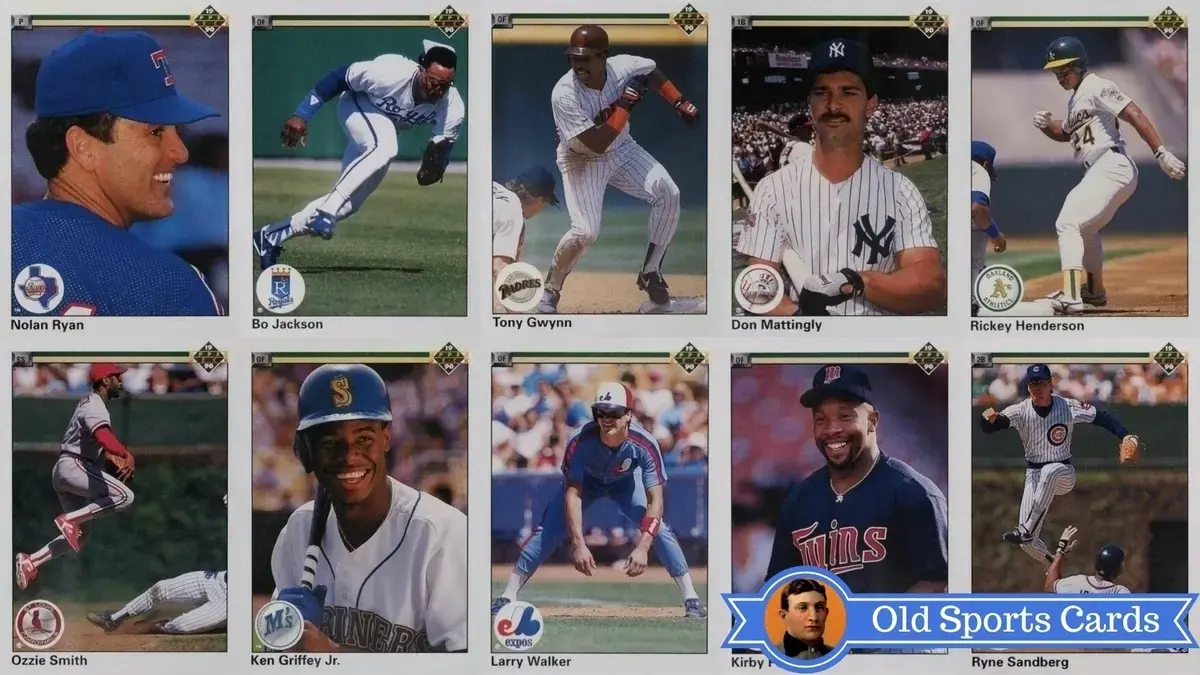
I’ve always thought that 1990 Upper Deck baseball cards have been somewhat overlooked in the hobby…
True, the set is lacking of any iconic rookie cards.
And most of the cards in the set have long since seen their values plummet.
But, the set did feature fantastic photography, some interesting errors/variations, and most significantly, the first pack-inserted cards with a player’s autograph (Reggie Jackson) on them.
Those autograph inserts forever changed the hobby as most every set produced these days contains autograph inserts.
But do any of the other cards in this hobby-changing set really have much value these days?
In this guide, I’ll take a look at the 25 most valuable and some of their values may surprise you.
Let’s jump right in!
1990 Upper Deck Baseball Set Snapshot
SET DETAILS
800
Larry Walker, Sammy Sosa, Deion Sanders, John Olerud
Ken Griffey Jr., Nolan Ryan, Bo Jackson, Rickey Henderson, Tony Gwynn, Cal Ripken Jr.
GRADING ANALYSIS
69,760
TOTAL GRADED BY PSA
17,561
PSA 10 Population
25.2%
PSA 10 Grade Rate
MOST GRADED CARDS
1
#17 Sammy Sosa Star Rookie
31.9%
22,231
2
#156 Ken Griffey Jr.
18.8%
13,091
3
#72 Juan Gonzalez Star Rookie
10.5%
7,305
Love old cards? Get weekly updates from a fellow collector!
Weekly pricing updates, grading insights, and new card guides — straight to your inbox. For free.
Join thousands of collectors. Unsubscribe anytime.

Ross Uitts – Owner
- #1
1990 Upper Deck Heroes Reggie Jackson Autograph
PSA 10 Value $4000 – $5000The 1990 Upper Deck set contained a monstrous 800-card checklist that was distributed in two series: the Low Series (#1-700) and the High Series (#701-800).
And within some of those high series packs, the company randomly inserted any one of the 10-card Reggie Jackson Heroes insert set.
What made these cards truly unique, though, was that Reggie Jackson had actually autographed 2,500 of them.
It was all part of the company’s “Find The Reggie” chase campaign that was created as a way to boost sales of the product by keeping collector interest high in the hope of pulling one of the autographed cards.
This practice is common today but this set marked the first time a company had every included autographed inserts making this a key milestone in the hobby.

- #2
1990 Upper Deck #702 Mike Witt Black Box Error
PSA 10 Value $250 – $300Total PSA Population 56PSA 10 Population 13PSA 10 Grade Rate 23.2% (Set Avg: 25.2%)Mike Witt spent twelve years in the Majors and had a decent stretch of seasons from 1984-1988 as he’d win 77 games over that span and would appear in two All-Star games.
However, what’s he’s most remembered for in the baseball card world is his 1990 Upper Deck issue upon which a large black box was placed on its reverse.
Apparently, the controversy had something to do with his pants being undone…
So, the company quickly pulled his card from production and replaced it with a card featuring three rookie studs for the Expos: Larry Walker, Marquis Grissom and Delino Deshields.
Originally it was believed that less than a dozen of these error cards made it into circulation until someone recently discovered hundreds of them at a flea market.
While that increase in supply did bring values down, this card can still sell for quite a bit in PSA 10 condition.

- #3
1990 Upper Deck #54 Ben McDonald Orioles Logo Variation Rookie Card
Rookie CardPSA 10 Value $205 – $210Total PSA Population 136PSA 10 Population 48PSA 10 Grade Rate 35.3% (Set Avg: 25.2%) - #4
1990 Upper Deck #156 Ken Griffey Jr.
PSA 10 Value $180 – $185Total PSA Population 13,091PSA 10 Population 2,678PSA 10 Grade Rate 20.5% (Set Avg: 25.2%)While the 1989 Upper Deck Ken Griffey Jr. rookie card took the hobby by storm when it was first released, his second-year Upper Deck card was also a hobby favorite.
The imagery on the front of the card is fantastic as it features a young Griffey with a big, bright smile on his face.
However, the reverse side is actually what makes this card special as it appeared with one of two variations: with or without the copyright information.
If you look closely at the reverse of Griffey’s card, you’ll notice there is usually a copyright statement that reads “Copyright 1990 Upper Deck Co.
Printed in USA” just under the MLB logo.
However, there is a variation where that copyright statement is missing.
And that variation is much more scarce than the standard version–about 17x as rare in PSA 10 condition.
Therefore, the “No Copyright” variation is worth far more than the standard and you can expect to pay about double for that variation.
Interestingly, Griffey wasn’t the only star in the set whose card can be found without that copyright statement.
Stars like Bo Jackson, Don Mattingly, Mark McGwire, George Brett, Fred McGriff and several others also have a “No Copyright” variation.
You can safely assume those are rarer and pricier than their standard variations as well.
- #5
1990 Upper Deck #24 Ken Griffey Jr. Seattle Mariners Checklist
PSA 10 Value $80 – $90
- #5
1990 Upper Deck #24 Seattle Mariners Checklist
PSA 10 Value $135 – $140Total PSA Population 1,408PSA 10 Population 396PSA 10 Grade Rate 28.1% (Set Avg: 25.2%) - #6
1990 Upper Deck #105 Bo Jackson
PSA 10 Value $75 – $76Total PSA Population 854PSA 10 Population 207PSA 10 Grade Rate 24.2% (Set Avg: 25.2%)Another popular legend of the era, Bo Jackson will always be a favorite of any collector who grew up collecting in the late 80s and early 90s.
I always loved this card as it captured Jackson hustling to catch a fly ball as his hat is flying off his head.
But that’s what Jackson was known for: making incredible defensive plays like this.
That, and smashing the ball on the offensive side of the game.
As I mentioned earlier, like Ken Griffey Jr., Bo’s base card can also be found in a “No Copyright” variation with the copyright missing on the reverse side.
It’s rarer than the standard card and can be worth about 50% more or so.
- #7
1990 Upper Deck #13 Deion Sanders Rookie Card
Rookie CardPSA 10 Value $73 – $74Total PSA Population 3,695PSA 10 Population 952PSA 10 Grade Rate 25.8% (Set Avg: 25.2%)Most two-sport athletes who play both baseball and football tend to leave the latter earlier.
Players like Bo Jackson had the innate strength and power to hit home runs despite themselves.
When Jackson’s athleticism began to wane due to injuries, he could still slot into a DH or corner outfield role with limited drop-off.
That’s what makes a player like Deion Sanders so unique.
Sanders was always more of a finesse cornerback on the gridiron than one who relied on force.
He used angles to box receivers to the sidelines or to interrupt teammates’ routes.
In truth, Sanders’ power tool was less than average.
As such, he never hit double-digit homers in parts of nine MLB seasons.
Because he struggled to consistently hit for average, too, it was hard to hide his flaws.
This included the 1990 season, when he hit just .158 and earned himself a subsequent trip to the waiver wire.
His last official MLB season was 2001, four years before his NFL retirement.
- #8
1990 Upper Deck #34 Nolan Ryan 5000 Strikeouts
PSA 10 Value $71 – $72Total PSA Population 1,316PSA 10 Population 470PSA 10 Grade Rate 35.7% (Set Avg: 25.2%)This beautiful card commemorated Nolan Ryan’s incredible achievement of 5,000 career strikeouts when he fanned Rickey Henderson on August 22, 1989.
The artwork on the card is beautiful as it shows his transition from windup to delivery followed by a tip of the cap.
When you look back on Ryan’s career and what he was able to do for so long, it’s nothing short of jaw-dropping.
His legacy keeps pretty much all of his cards (especially in high grade) in demand from Ryan collectors throughout the hobby.
- #9
1990 Upper Deck #32 Kansas City Royals Checklist
PSA 10 Value $71 – $72Total PSA Population 408PSA 10 Population 155PSA 10 Grade Rate 38.0% (Set Avg: 25.2%) - #10
1990 Upper Deck #75 Bo Jackson
PSA 10 Value $59 – $60Total PSA Population 615PSA 10 Population 122PSA 10 Grade Rate 19.8% (Set Avg: 25.2%)Bo Jackson wasn’t just a two-sport phenomenon at the start of the 1990s.
He was also an entrepreneur and a dedicated college student.
Already making millions off his image and “Bo Knows” ad campaign, Jackson also began a Bachelor’s program in family and child development at Auburn University.
In doing so, he worked to keep a promise to his mother that he’d be the first in his family to earn a college degree.
Five years later, he made it happen.
“Hopefully, this will influence my younger relatives in the family, as far as nieces and nephews, to go on to college to try to be something or someone,” Jackson said.
Months after starting at Auburn, Jackson jumped into his best individual season as a Big League, slashing .272/.342/.523 with 28 home runs, 15 stolen bases, and 78 RBIs in 111 games.
This preceded Jackson’s first and last Pro Bowl season in the NFL.
- #11
1990 Upper Deck #544 Nolan Ryan
PSA 10 Value $53 – $54Total PSA Population 1,439PSA 10 Population 704PSA 10 Grade Rate 48.9% (Set Avg: 25.2%) - #12
1990 Upper Deck #555 Wade Boggs
PSA 10 Value $52 – $53Total PSA Population 214PSA 10 Population 92PSA 10 Grade Rate 43.0% (Set Avg: 25.2%)The 1990 Boston Red Sox won the franchise’s third AL East title in five years, but this time they did it with their best player in a season-long swoon.
Wade Boggs was under an intense media microscope at the turn of the decade, with the fallout from a tabloid-baiting 1988 palimony lawsuit weighing heavily on his shoulders.
That led to an uneven, frustrating individual campaign.
Boggs posted a .302/.386/.418 slash line in 155 games, all three numbers standing as new career worsts.
The 32-year-old’s 3.2 WAR was over five wins below his previous year’s output, and his defensive play at third base slipped from strong to problematic in a mere matter of months.
Regardless, the 88-win Red Sox still took a mediocre AL EaSt. Boggs did his best to push them further, going 7-for-16 (.438) with a home run against Oakland.
However, this time the rest of the offense failed to show up, scoring just four total runs in a four-game ALCS sweep.
- #13
1990 Upper Deck #734 Nolan Ryan
PSA 10 Value $51 – $52Total PSA Population 1,853PSA 10 Population 1,027PSA 10 Grade Rate 55.4% (Set Avg: 25.2%)As you can tell by now, this set had its fair share of variations…
Nolan Ryan’s card #734 was one of those.
The front of the card can appear with or without the “300th Win” stripe in the lower-right corner, with the version without the stripe being the rarer and more valuable of the two.
This card has always puzzled me not so much because of the variations but because the reverse of the card commemorates his 6th no-hitter, not his 300th win.
Therefore, a “6th No-Hitter” stripe on the front might be more appropriate…
- #14
1990 Upper Deck #17 Sammy Sosa Rookie Card
Rookie CardPSA 10 Value $47 – $48Total PSA Population 22,231PSA 10 Population 2,508PSA 10 Grade Rate 11.3% (Set Avg: 25.2%)Another slugger who terrorized opposing pitchers during the 1990s and into the 2000s, Sammy Sosa also appeared in the “Star Rookie” subset.
The imagery of the card is fantastic as it features a great shot of a young Sosa with his signature smile dawning a retro White Sox uniform.
It’s scary to think of the power numbers Sosa and Frank Thomas could have produced as a 1-2 punch had Sosa stayed on the south side of Chicago instead of moving north to join the Cubs.
Sosa’s legacy also hangs under a cloud as his association with PED use has also been well-documented.
- #15
1990 Upper Deck #227 Barry Bonds
PSA 10 Value $42 – $43Total PSA Population 559PSA 10 Population 189PSA 10 Grade Rate 33.8% (Set Avg: 25.2%)Combine any two (current or future) MLB Hall of Famers, and you still wouldn’t surpass Barry Bonds’ record seven MVP awards.
Other than Shohei Ohtani (4), no other player has won more than three MVP awards.
And Bonds did it as multiple versions of himself, transitioning from a speedy, all-around hitter in the early 1990s to a hulking, fearsome slugger by the mid-2000s.
Bonds’ first MVP came in 1990.
The 25-year-old Pittsburgh Pirates left fielder had yet to make an All-Star team, let alone pick up an MVP vote.
His surly attitude with the media didn’t help his case, but that didn’t stop Bonds from doing it his way and forcing his critics’ hands.
That’s what 1990 was all about.
Bonds was undeniable, pacing the National League in WAR (9.7), slugging percentage (.565), OPS (.970), and OPS+ (170).
He cracked 33 home runs and stole a career-best 52 bases, joining Eric Davis (1987) as the only members of the 30/50 Club.
- #16
1990 Upper Deck #191 Don Mattingly
PSA 10 Value $38 – $40Total PSA Population 321PSA 10 Population 170PSA 10 Grade Rate 53.0% (Set Avg: 25.2%)Mattingly’s card is also one of the several in the set that can be found with or without the copyright statement on the reverse.
In Mattingly’s case, the “No Copyright” variation has sold for around $200 in the paSt.
- #17
1990 Upper Deck #324 Ryne Sandberg
PSA 10 Value $35 – $36Total PSA Population 215PSA 10 Population 120PSA 10 Grade Rate 55.8% (Set Avg: 25.2%) - #18
1990 Upper Deck #72 Juan Gonzalez Rookie Card
Rookie CardPSA 10 Value $33 – $34Total PSA Population 7,305PSA 10 Population 1,213PSA 10 Grade Rate 16.6% (Set Avg: 25.2%)Throughout the 1990s, Gonzalez was one of the most feared hitters in the Major Leagues and arguably the greatest hitter to ever wear a Rangers uniform.
Every year he seemed capable of putting up 40+ home runs and 120+ RBI.
I’ll never forget his 1998 season in which he had 100 RBI by the All-Star break and excitement filled the air as many thought he would challenge Hack Wilson’s single season mark of 191 by the time the season was over.
However, he ended up falling short and finished with “only” 157…still an incredible total and one of the highest single-season marks ever.
While his talent was undeniable, Gonzalez’s career will always be overshadowed by the specter of PED use.
- #19
1990 Upper Deck #56 John Olerud Rookie Card
Rookie CardPSA 10 Value $32 – $33Total PSA Population 437PSA 10 Population 163PSA 10 Grade Rate 37.3% (Set Avg: 25.2%)John Olerud was a third-round pick with a first-round hitting acumen.
As soon as he made the jump to the Bigs, it was clear that a future All-Star was on the way.
“He has unbelievable ability,” teammate Pat Borders said.“It makes me mad, because I work so hard and I could never have a swing as nice as his.” Olerud stormed out of the gates during his 1990 debut, topping all rookies in on-base percentage (.375), OPS (.840), walks (35), home runs (10), and RBIs (33) at the All-Star break.
The 21-year-old did all of this while working in a DH platoon with Glenallen Hill, minus some spot starts at first base.
Pitchers started to figure Olerud out, though, as the second half progressed.
He hit just .256 after the break with a .737 OPS, clubbing four home runs to finish at 14.
Still, it was a thrilling rookie year, one well worth his fourth-place finish for AL Rookie of the Year.
- #20
1990 Upper Deck #466 Larry Walker Rookie Card
Rookie CardPSA 10 Value $30 – $31Total PSA Population 2,731PSA 10 Population 991PSA 10 Grade Rate 36.3% (Set Avg: 25.2%)As I mentioned earlier, Larry Walker appeared alongside fellow rookie teammates Delino DeShields and Marquis Grissom on card #702 that replaced the Mike Witt black box error.
But, he had his own standalone rookie card in this set as well.
The card features Walker on base, something he did quite well over his career as he’d go on to post an impressive career .400 OBP.
Will Walker eventually be elected into the Hall of Fame?
We’ll see…many will argue that the Coors Field bias worked heavily in his favor to help boost his career hitting totals.
Regardless, I always loved watching him play and will always remember his incredible 1997 MVP season when he smacked 49 home runs, drove in 130 RBI, scored 143 runs, and sported a .363 batting average.
- #21
1990 Upper Deck #334 Rickey Henderson
PSA 10 Value $29 – $30Total PSA Population 252PSA 10 Population 137PSA 10 Grade Rate 54.4% (Set Avg: 25.2%)There was nobody like Rickey Henderson before him, and it’s unlikely anyone will ever come close to what he brought to the table.
“For the period of time that I’ve been around, I think the most dangerous player is Rickey,” former A’s manager Tony La Russa said later.
“In our time, Rickey worried you in more ways than anyone.” Rickey’s true peak among several peaks came under La Russa during the 1990 season.
Sitting atop a dangerous A’s lineup dotted with power hitters, Henderson was historically productive.
Of course, there were the stolen bases.
Rickey led the American League with 65, half of his record output from 1982.
Yes, he was still 22 steals clear of runner-up Steve Sax, but it wasn’t the thefts that brought him his AL MVP award.
It was everything else.
Henderson topped multiple MLB categories for the AL champions, including WAR (9.9), runs (119), on-base percentage (.439), OPS (1.016), and OPS+ (189).
- #22
1990 Upper Deck #236 Kirby Puckett
PSA 10 Value $28 – $29Total PSA Population 178PSA 10 Population 95PSA 10 Grade Rate 53.4% (Set Avg: 25.2%)The troubles of the 1990 Minnesota Twins made it feel like the team’s ’87 World Series title was an anomaly, a one-and-done for an otherwise middling franchise.
Several of Minnesota’s most important pieces had down years in 1990, including Kent Hrbek, Gary Gaetti, and Kirby Puckett.
After finishing second in the Majors in runs per game in ’89 (4.57), the Twins dipped to 20th out of 26 clubs, scoring nearly a half-run less (4.11) per conteSt. According to multiple reports, the clubhouse was in disarray, and Minnesota’s veteran core failed to create a cohesive, team-first environment.
Everybody seemed disengaged or downright glum, including the normally effusive Puckett.
Struggling with his swing and lacking solid protection, the 30-year-old center fielder had one of the least impactful campaigns of his Hall-of-Fame career, slashing .298/.365/.446 with 12 homers, 80 RBIs, and 2.8 WAR in 146 games.
Puckett posted nearly five WAR the year before and a career-best 7.8 two years prior.
- #23
1990 Upper Deck #266 Cal Ripken Jr.
PSA 10 Value $28 – $29Total PSA Population 573PSA 10 Population 253PSA 10 Grade Rate 44.2% (Set Avg: 25.2%)Ozzie Smith got the headlines, and rightfully so.
But no shortstop in the history of Major League Baseball had a better defensive year at the position than his peer, Cal Ripken Jr. In 1990, Ripken was an automatic out.
In fact, he was historically amazing.
The 29-year-old set all-time records for the best fielding percentage at short (.996), the fewest errors (3), and the most consecutive games without an error (95).
He was also one of the few above-average hitters on the 76-win Orioles, slashing .250/.341/.415 with 21 home runs, 28 doubles, 78 runs, 82 walks, and 84 RBIs in 695 plate appearances (600 at-bats).
It was just enough hitting to get Ripken a down-ballot MVP mention.
Ripken’s true value, though, was his glove.
To put those kinds of numbers out there on a normal workload is extraordinary, let alone as a shortstop in the middle of an MLB-record streak of 2,632 consecutive games.
- #24
1990 Upper Deck #124 George Brett
PSA 10 Value $27 – $28Total PSA Population 285PSA 10 Population 158PSA 10 Grade Rate 55.4% (Set Avg: 25.2%)Consistency was the hallmark of George Brett’s run to Cooperstown.
There are, in fact, no other players who have spread the wealth across such a long career quite like the Kansas City Royals legend.
In 1990, Brett won his third batting title at the age of 37, becoming the third-oldest player in MLB history to win one.
His other two titles came in 1976 and 1980, making Brett the only hitter to take a batting championship in three different decades.
The 1990 title may have been the sweetest of all.
In April, Brett flailed through a month-long swoon.
Media members jumped on it as a story, deciding out loud that the veteran was on his way out.
“I started believing it,” Brett said.
“I think that’s why it took so long to come out of the slump.” Brett hit nearly .390 after the All-Star break, ultimately clipping Oakland’s Rickey Henderson for his crown.

Ross’s Take
Overall, the 1990 Upper Deck baseball card set is a pretty good one in terms of its collectibility compared to other sets of the era.
The errors/variations keep things interesting while there is some decent star power within the 800-card checkliSt. What makes it most special, though, are those randomly-inserted Reggie Jackson autograph cards.
Few sets can claim that they’ve changed the hobby as significantly as this one…
Love old cards? Get weekly updates from a fellow collector.
Pricing updates, grading insights, and new guides on the cards you actually care about — the junk wax era, vintage, and everything in between. One email a week. No fluff.
Free. No spam. Unsubscribe anytime.
Ross Uitts – Owner
