
25 Most Valuable 1991 Score Baseball Cards

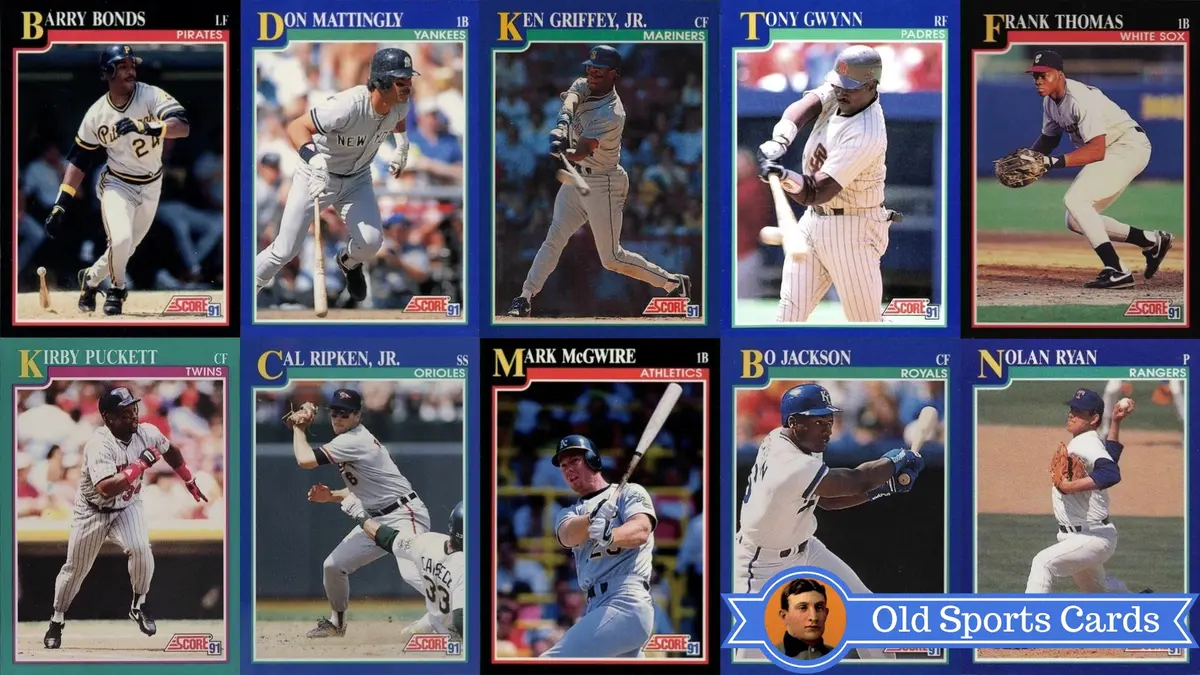
To understand the baseball card boom of the late 80s and early 90s, one needs only look at the 1991 Score baseball card set.
There were 11 different subsets within the massive 893-card checkliSt. Ken Griffey Jr. appeared on 8 different cards in the set.
Score and the other card manufacturers were in a dogfight throwing anything and everything at the market to come out on top.
However, despite its quirkiness, I think this was one of the better sets of the era in terms of design and the eye appeal of many cards in the set has held up well over time.
It’s true, many cards in this set aren’t worth anything, but some still do stick out in terms of value.
In this list, I take a look at the 25 most valuable.
Let’s jump right in!
1991 Score Baseball Set Snapshot
SET DETAILS
893
Chipper Jones, Mike Mussina
Ken Griffey Jr., Nolan Ryan, Rickey Henderson, Cal Ripken Jr., Tony Gwynn, Ryne Sandberg
GRADING ANALYSIS
36,071
TOTAL GRADED BY PSA
13,392
PSA 10 Population
37.1%
PSA 10 Grade Rate
MOST GRADED CARDS
1
#671 Chipper Jones
18.9%
6,830
2
#773 Bo Jackson
11.7%
4,223
3
#892 Ken Griffey Jr.
5.9%
2,119
Love old cards? Get weekly updates from a fellow collector!
Weekly pricing updates, grading insights, and new card guides — straight to your inbox. For free.
Join thousands of collectors. Unsubscribe anytime.

Ross Uitts – Owner
- #1
1991 Score #773 Bo Jackson Bo Breaker
PSA 10 Value $900 – $925Total PSA Population 4,223PSA 10 Population 261PSA 10 Grade Rate 6.2% (Set Avg: 37.1%)Usually, Bo Jackson was mashing the ball towards the outfield wall but on the occasion he would strikeout, he sometimes expressed his frustration by breaking his bat right there on the spot.
Sometimes he’d break the bat over his knee or sometimes he’d even break it over his head (wearing a helmet of course).
The practice was so famous that the White Sox even released a bobblehead of him snapping a bat over his knee.
Long before that bobblehead, though, Score paid tribute to Bo’s memorable bat-breaking practice with this instantly recognizable “Bo Breaker” card.

- #2
1991 Score #841 The Griffeys
PSA 10 Value $310 – $320Total PSA Population 1,107PSA 10 Population 102PSA 10 Grade Rate 9.2% (Set Avg: 37.1%) - #3
1991 Score #4 Nolan Ryan
PSA 10 Value $260 – $270Total PSA Population 508PSA 10 Population 88PSA 10 Grade Rate 17.3% (Set Avg: 37.1%)Speaking of guys with canons for arms, next on our list is none other than the legendary fireballer, Nolan Ryan.
The 1991 season marked his 25th in the Major Leagues, and while he didn’t quite have the innings to lead the league in strikeouts, he did lead the league in strikeouts per 9 innings with a rate of 10.6, the third-highest of his career.
And the guy was 44 years old not 24 years old when he did this.
If there’s anything as equally impressive as Ryan’s velocity and power, it was his longevity.
Still extremely popular among collectors, Ryan’s card can fetch $300 in top condition.
- #4
1991 Score #396 Ken Griffey Jr. All-Star
PSA 10 Value $220 – $230Total PSA Population 1,243PSA 10 Population 527PSA 10 Grade Rate 42.4% (Set Avg: 37.1%) - #5
1991 Score #324 Mark McGwire
PSA 10 Value $175 – $180Total PSA Population 109PSA 10 Population 9PSA 10 Grade Rate 8.3% (Set Avg: 37.1%)1991 was the precursor to what may be the greatest four-year stretch for any pitcher in the Modern Era.
Over the previous four seasons, Chicago Cubs starter Greg Maddux made incremental leaps, from target practice to innings eater to the borderline of ace status.
Maddux kicked the evolution into overdrive during the ’91 campaign, cutting his WHIP by nearly 200 points from the previous season (1.133).
This marked a massive jump, from below league-average to #5 on the National League leaderboards.
As it was for Maddux throughout his Cooperstown journey, the recipe for success was tight control and deceptive movement.
Years of getting hit around taught Maddux a lot about pitch sequencing and repetition, and in ’91 he started to master his craft as a true pitching “Professor.” Overall, Maddux finished 15-11 with a 3.35 ERA in an MLB-high 37 starts.
The 25-year-old righty also topped the NL in innings (263.0) and placed fourth in the circuit in complete games (7).
- #6
1991 Score #737 American Flag
PSA 10 Value $170 – $175Total PSA Population 1,309PSA 10 Population 558PSA 10 Grade Rate 42.6% (Set Avg: 37.1%)
- #7
1991 Score #892 Ken Griffey Jr. Dream Team
PSA 10 Value $170 – $175Total PSA Population 2,119PSA 10 Population 925PSA 10 Grade Rate 43.7% (Set Avg: 37.1%)Heading into only his 3rd season of Major League Baseball, Score was already including Griffey on their “Dream Team” subset roster as well as giving him a “Cooperstown Card” in their factory exclusive set.
That shows you what the company thought of his talent and potential.
Unlike Kirby Puckett and Jose Canseco, though, Griffey chose to keep his shirt on for this card.
- #8
1991 Score #330 Barry Bonds
PSA 10 Value $160 – $165Total PSA Population 321PSA 10 Population 24PSA 10 Grade Rate 7.5% (Set Avg: 37.1%)Aside from one unreal World Series run, Barry Bonds’ playoff resume was lacking.
Bonds made the playoffs seven times in his career, three with the Pittsburgh Pirates and four with the San Francisco Giants.
He only once even sniffed his career regular-season OPS (1.051), and that was the aforementioned 2002 pennant win with the Giants.
With the Pirates, Bonds went 0-for-3 on series wins and 0-for-3 on impact performances.
It was even more disappointing, considering the dynamic left fielder posted two MVP seasons and a runner-up finish in those three years of appearances (1990-92).
In 1991, Bonds entered the team’s NLCS showdown with the Braves under a media microscope.
He had just polished off a 25-homer, 43-steal season with over 100 RBIs (116) and walks (107).
Anything less than a Series berth was inexcusable.
Well, about that.
Bonds hit just .148 with no homers, and the Braves squeaked by the Pirates in seven.
- #9
1991 Score #697 Ken Griffey Jr. Rifleman
PSA 10 Value $100 – $105Total PSA Population 1,327PSA 10 Population 660PSA 10 Grade Rate 49.7% (Set Avg: 37.1%)The only thing that surprises me about Griffey Jr.’s inclusion in the “Rifleman” subset was his exclusion from the “Master Blaster” subset.
Looking back on the stats of the guys who were included, it looks like they needed at least one 30+ home run season to qualify.
But, after smacking 16 home runs in 1989 and another 22 in 1990, I guess it wasn’t quite so obvious that the Kid would transform into one of the greatest power hitters the game has ever seen.
However, after picking up a Gold Glove award in 1990, though, it was clear that Griffey had a monster glove and arm on defense even if his gaudy power numbers at the plate weren’t quite there yet.
As such, he rightfully earned this card and its vibrant imagery and coloration make it practically bounce off the card.
- #10
1991 Score #412 Bo Jackson Rifleman
PSA 10 Value $95 – $100Total PSA Population 918PSA 10 Population 401PSA 10 Grade Rate 43.7% (Set Avg: 37.1%)No explanation is needed for why Bo Jackson appeared in the “Rifleman” subset, just watch this video of him gunning down the speedy Harold Reynolds back in 1989:
- #11
1991 Score #2 Ken Griffey Jr.
PSA 10 Value $95 – $100Total PSA Population 596PSA 10 Population 113PSA 10 Grade Rate 19.0% (Set Avg: 37.1%)Considering all of the different subsets, Ken Griffey Jr. is featured on 8 different cards within the 1991 Score set.
Many of them are somewhat gimmicky in their look and feel but fortunately, his base card isn’t.
It’s arguably the best-looking card in the set and one of his personal bests of that era.
The full-color image of the Kid in the middle of his iconic, effortless swing surrounded by the blue borders is hard to beat.
Griffey Jr. was well on his way to stardom as he’d finish the 1991 season with his second straight All-Star appearance as well as Gold Glove and Silver Slugger honors, to boot.
- #12
1991 Score #692 Bo Jackson Master Blaster
PSA 10 Value $95 – $100Total PSA Population 826PSA 10 Population 369PSA 10 Grade Rate 44.7% (Set Avg: 37.1%)To recognize some of the game’s finest, Score released three subsets in “Master Blaster”, “K-Men”, and “Riflemen” to recognize power hitters, strikeout artists and players with canons for arms, respectively.
I believe Bo Jackson and Eric Davis were the only players to have both a Master Blaster and Riflemen card to their names.
And deservedly so, as those guys had amazing power on both sides of the ball.
The images of the players superimposed on backgrounds with explosive bursts of color have held up quite well over time.
- #13
1991 Score #5 Bo Jackson
PSA 10 Value $78 – $79Total PSA Population 281PSA 10 Population 45PSA 10 Grade Rate 16.0% (Set Avg: 37.1%)On March 18, 1991, the Kansas City Royals released two-sport megastar Bo Jackson in what was an expected move.
Jackson was two months removed from a nasty hip injury suffered in the Los Angeles Raiders’ AFC Divisional Round matchup against the Cincinnati Bengals.
At this point, Jackson’s NFL career remained up in the air.
After his release by the Royals, he was noncommittal about returning to the gridiron, yet confident about his MLB future.
“Don’t count me out,” Jackson said at the time.
“I’ll be back playing baseball this year.” He was right, but it would come after extraordinary hardship and work.
Jackson’s hip struggled through rehab, plowing his way through multiple setbacks.
His NFL career ended, and his new contract with the Chicago White Sox was team-friendly and contingent on his health.
Jackson finally got back to the field in September, but the juice wasn’t quite there.
The 28-year-old DH hit just .225 in 28 games with three homers in 71 at-bats.
- #14
1991 Score #671 Chipper Jones Rookie Card
Rookie CardPSA 10 Value $56 – $57Total PSA Population 6,830PSA 10 Population 2,500PSA 10 Grade Rate 36.6% (Set Avg: 37.1%)One of two Hall of Famers to make their debuts in this set, the Chipper Jones rookie card surprised me at first that it’s not more valuable than some of the others in this set.
Then I checked PSA’s population report and quickly learned why: there are well over 1,000 of these graded in PSA 10 condition while there are just a few dozen or more PSA 10 copies of the others on this liSt. On the one hand, it quickly tells you how popular Chipper Jones was while on the other, it’s a glaring example of what supply can quickly do to prices in this hobby.
At $35 for a PSA 10 specimen, this is a great bargain for a great-looking Hall of Fame rookie card of the iconic Atlanta Braves superstar.
- #15
1991 Score #10 Rickey Henderson
PSA 10 Value $55 – $56Total PSA Population 110PSA 10 Population 46PSA 10 Grade Rate 41.8% (Set Avg: 37.1%) - #16
1991 Score #890 Rickey Henderson Dream Team
PSA 10 Value $53 – $54Total PSA Population 477PSA 10 Population 217PSA 10 Grade Rate 45.5% (Set Avg: 37.1%) - #17
1991 Score #441 Jose Canseco Dream Team
PSA 10 Value $53 – $54Total PSA Population 502PSA 10 Population 194PSA 10 Grade Rate 38.6% (Set Avg: 37.1%)In a set loaded with tons of subset cards, this Jose Canseco card from the “Dream Team” subset stands alone as the most memorable.
Why Score chose to feature Canseco wearing nothing but a pair of jeans is anyone’s guess.
Kirby Puckett was also shirtless on his “Dream Team” card and Rickey Henderson was wearing nothing but biker shorts on his “Cooperstown Card” that was a factory set exclusive.
Apparently, half-naked ballplayers were Score’s way of trying to stand out from the crowd.
Whatever the reason, this card ended up being one of the most iconic of the early 1990s and collectors are still willing to pay decent money for high-grade specimens.
To be honest, I was stunned to see this card routinely selling for around $50 in PSA 10 condition.
- #18
1991 Score #840 Frank Thomas
PSA 10 Value $45 – $46Total PSA Population 302PSA 10 Population 91PSA 10 Grade Rate 30.1% (Set Avg: 37.1%)Frank Thomas was ready-made to bash baseballs.
With just 60 games of MLB experience behind him, Thomas entered the 1991 season with some question marks.
Would the young Chicago White Sox first baseman match up to his brilliant rookie performance, or would AL pitchers figure him out?
Thomas picked Option C instead: rip through the league at an even faster clip to become a legitimate MVP candidate.
The 23-year-old showed no sophomore hesitation whatsoever.
In fact, his only hesitation came on borderline pitches in the batter’s box.
Thomas took a career- and MLB-high 138 walks in ’91, showing incredible patience for any hitter, let alone a rookie.
When Thomas swung, he did ultimate damage.
The future Hall-of-Fame inductee hit 32 home runs, drove in 109, and topped all MLB hitters in on-base percentage (.453), OPS (1.006), and OPS+ (180).
- #19
1991 Score #701 Nolan Ryan No Hit Club
PSA 10 Value $39 – $40Total PSA Population 414PSA 10 Population 218PSA 10 Grade Rate 52.7% (Set Avg: 37.1%) - #20
1991 Score #23 Don Mattingly
PSA 10 Value $36 – $37Total PSA Population 178PSA 10 Population 91PSA 10 Grade Rate 51.1% (Set Avg: 37.1%) - #21
1991 Score #383 Mike Mussina Rookie Card
Rookie CardPSA 10 Value $35 – $36Total PSA Population 1,526PSA 10 Population 792PSA 10 Grade Rate 51.9% (Set Avg: 37.1%)For several years it wasn’t clear if Mussina would get his call to the Hall of Fame as he earned just 20.3% of the vote in his first year of eligibility in 2014.
However, just as sure and steady as the man himself was on the mound, he steadily climbed to breaking the 75% of the vote needed to be inducted in 2019.
One of the biggest knocks on Mussina was his 270 career wins, falling just 30 short of that magical 300 number.
It’s not like the guy was losing a ton, though, as many of his outings resulted in no-decisions in 18 years spent pitching in the ultra-competitive AL EaSt. Only four pitchers in history with more than 500 starts to their name had a better career winning percentage than Mussina: Christy Mathewson, Roger Clemens, Randy Johnson, and Pete Alexander.
- #22
1991 Score #95 Cal Ripken Jr.
PSA 10 Value $34 – $35Total PSA Population 141PSA 10 Population 64PSA 10 Grade Rate 45.4% (Set Avg: 37.1%)The Baltimore Orioles had only one thing going for them in 1991.
His name was Cal Ripken Jr. The O’s were an ill-constructed mess, nosediving to sixth in the AL East at 67-95.
Baltimore did nothing well, finishing near the bottom of the AL in batting average (.254) and dead last in ERA (4.59).
If Ripken hadn’t put together one of the most impressive MVP seasons of the era, it would have been much, much worse.
The 30-year-old shortstop was Baltimore’s only offensive weapon most nights, and it took him playing out of his mind to keep the O’s from 100 losses or more.
Ripken ended the year as the MLB leader in WAR (11.5) and total bases (368).
He played every regular-season game for a ninth consecutive campaign, slashing .323/.374/.566 with 34 home runs, 46 doubles, 210 hits, 99 runs, and 114 RBIs in 717 plate appearances (650 at-bats).
The now two-time MVP also captured his first Gold Glove and fifth Silver Slugger.
- #23
1991 Score #690 Jose Canseco Master Blaster
PSA 10 Value $29 – $30Total PSA Population 129PSA 10 Population 69PSA 10 Grade Rate 53.5% (Set Avg: 37.1%) - #24
1991 Score #200 Kirby Puckett
PSA 10 Value $27 – $28Total PSA Population 108PSA 10 Population 65PSA 10 Grade Rate 60.2% (Set Avg: 37.1%) - #25
1991 Score #500 Tony Gwynn
PSA 10 Value $24 – $25Total PSA Population 103PSA 10 Population 56PSA 10 Grade Rate 54.4% (Set Avg: 37.1%)Even at his least effective, Tony Gwynn was elite.
In 1990, the San Diego Padres outfielder had his worst statistical season since 1983, and he still hit over .300 while picking up an All-Star nod and a Gold Glove.
The only reason ’90 was so disappointing was that it snapped a streak of three consecutive NL batting titles.
So, when Gwynn failed to win a crown in 1991 as well, that disappointment only increased, often amplifying into pointed criticism about the legend’s rising weight and/or lack of a winning resume.
It’s silly, in retrospect.
Gwynn set a bar in the 1980s that no other NL hitter (save for maybe Honus Wagner) has cleared.
And he didn’t fall into the hole at the start of the 1990s, either.
His .309 average in 1990 placed eighth in the NL.
His .317 mark in 1991 landed third.
Still, no number of awards or All-Star appearances would stop the chatter until Gwynn won another batting title.

Ross’s Take
So there you have it, the ten most valuable 1991 Score cards and a decent dose of nostalgia.
This set contained a total of 893 cards which was a gigantic checklist even by today’s standards.
Much of that was due to the 11 different subsets that, in chronological order, included: Rookie Prospects (#331-379) First Draft Picks (#380-391, #671-682) AL All-Stars (#392-401) Master Blasters (#402-406, #689-693) K-Men (#407-411, #684-688) Rifleman (#412-416, #694-698) NL All-Stars (#661-670) No-Hitters (#699-707) Franchise (#849-874) Award Winners (#875-881) Dream Team (#882-893).
But like many sets of that era, 1991 Score was massively printed and with millions of copies of each card in circulation today, the values just haven’t held up well over time.
Like I’ve mentioned, they need to be graded in PSA 10 condition to be worth anything, sadly.
But, for those of us who grew up collecting these as kids, they’ll always have a huge nostalgic factor to them despite not having the highest monetary value.
Love old cards? Get weekly updates from a fellow collector.
Pricing updates, grading insights, and new guides on the cards you actually care about — the junk wax era, vintage, and everything in between. One email a week. No fluff.
Free. No spam. Unsubscribe anytime.
Ross Uitts – Owner
