
25 Most Valuable 1964 Topps Baseball Cards

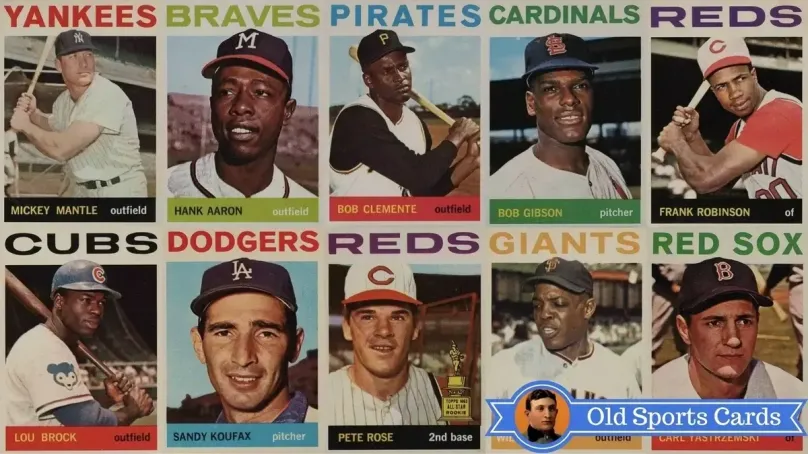
One of the more overlooked and often underrated sets of the vintage era, the 1964 Topps baseball card set packed plenty of star power and lots of color.
And the enormous team names across the top make its design instantly recognizable…
The size of the team names, though, is precisely the thing that leads to mixed opinions on this set as some feel it distracts from the fantastic player images.
Regardless, it still delivers a great checklist and it’s a fun set to collect.
And in this guide, I’ll run through the 25 most valuable.
Let’s jump right in!
1964 Topps Baseball Set Snapshot
SET DETAILS
587
Phil Niekro, Lou Pinella, Tommy John, Tony La Russa
Mickey Mantle, Hank Aaron, Roberto Clemente, Willie Mays, Sandy Koufax
GRADING ANALYSIS
268,975
TOTAL GRADED BY PSA
78,816
PSA 8 Population
29.3%
PSA 8 Grade Rate
MOST GRADED CARDS
1
#50 Mickey Mantle
4.9%
13,144
2
#125 Pete Rose All-Star Rookie
3.3%
8,826
3
#150 Willie Mays
2.4%
6,509
Need Help Selling Your Sports Cards?
Fill out the form below and I’ll get back to you within 24 hours. No obligation.

Ross Uitts – Owner
- #1
1964 Topps #50 Mickey Mantle
PSA 8 Value $5,800Total PSA Population 13,144PSA 8 Population 516PSA 8 Grade Rate 3.9% (Set Avg: 29.3%)Mickey Mantle fought with everything he had to extend his career as far as he could.
“With all of the injuries, coupled with the deteriorating legs, no doubt I could have called in sick and stayed away from the ballpark,” Mantle wrote of his early and mid-1960s days with the Yankees, “Yet somehow I’d get myself up one more time.” Mantle made it work when it otherwise shouldn’t have.
In 1964, it was clear that he was slowed considerably by his leg issues.
Yet, he still led all of baseball in on-base percentage (.423), OPS (1.015), and OPS+ (177), hitting .303 with 35 home runs, 92 runs, 99 walks, and 111 RBIs in 143 games.
It was enough to inch the Yankees ahead of Baltimore and Chicago for another AL pennant.
Yet, it wasn’t enough to deliver another Series title.
Mantle hit .333 with three big home runs against the Cardinals, but the Yankees eventually folded in a seven-game Series loss.

- #2
1964 Topps #125 Pete Rose
PSA 8 Value $5,250Total PSA PopulationPSA 8 PopulationPSA 8 Grade Rate 0.0% (Set Avg: 29.3%)While Rose made his rookie card debut in the 1963 Topps set, his second-year card featured the coveted “Topps All-Star Rookie” designation.
Topps first introduced the concept of its “All-Star Rookie Team” in its 1960 release.
For years afterward, Topps would either include a symbol of a gold trophy, gold cup or sometimes no symbol at all to mark these special cards.
Batting just .269, Rose fell into a bit of a sophomore slump during the 1964 season and sought to correct things by spending the 1964-1965 offseason playing in the Venezuelan Winter League.
Whatever he did worked as he came roaring back in the 1965 season to finish with a .312 batting average and 209 base hits, making it the first of ten seasons he’d finish with 200+ hits.
- #3
1964 Topps #440 Roberto Clemente
PSA 8 Value $2,000Total PSA PopulationPSA 8 PopulationPSA 8 Grade Rate 0.0% (Set Avg: 29.3%)Roberto Clemente’s reach was global, even before Major League Baseball truly embraced its international fan base.
Before the start of the 1964 campaign, Clemente’s Stateside reputation had been built on the back of over 1,400 MLB hits, seven All-Star appearances, and a 1960 World Championship.
The Pittsburgh Pirates icon was well on his way to a Cooperstown plaque.
Outside of the United States, though, is where Clemente’s full impact was truly felt.
His time playing winter ball in front of his fellow Puerto Ricans helped build the league and galvanize generations of baseball fans, both alive and forthcoming.
Clemente’s travels across Latin America also drew plenty of fans and rave reviews, including his time in Nicaragua during the 1963-64 International Series.
He grew fond of the citizens there, just as they grew fond of him, prompting him to return to the country multiple times to both visit and assist with aid efforts.
Just under a decade later, Clemente passed away after a plane crash while attempting to assist Nicaraguan citizens after a vicious earthquake.
- #4
1964 Topps #300 Hank Aaron
PSA 8 Value $1,800Total PSA Population 5,539PSA 8 Population 459PSA 8 Grade Rate 8.3% (Set Avg: 29.3%)The 1964 Milwaukee Braves had the unlucky task of mucking through an unusually stacked National League.
The ’64 NL standings featured five 88-win teams or better for the first time.
While the bottom of the Senior Circuit was awfully weak, it was more a testament to just how talent-rich the league was in the mid-1960s.
It also left many players outside of October who would otherwise have deserved the stage, including the great Hank Aaron.
Aaron had a trademark brilliant year in 1964, placing third in the NL in both batting average (.328) and on-base percentage (.393).
The 30-year-old right fielder also clocked 24 home runs to go along with 22 stolen bases, good for his third 20/20 season in four years.
However, Aaron could only do so much.
Milwaukee suffered multiple injuries in an under-.500 first half and wasn’t able to leapfrog multiple good-to-great teams in the NL pennant race.
The Braves finished 88-74, the best fifth-place record in league history.
- #5
1964 Topps #150 Willie Mays
PSA 8 Value $1,750Total PSA Population 6,509PSA 8 Population 440PSA 8 Grade Rate 6.8% (Set Avg: 29.3%)Willie Mays was placed in an unenviable situation during the 1964 MLB season.
Mays was the face of the San Francisco Giants.
His opinion held weight with everyone in and around the organization, including manager Alvin Dark.
Dark, however, had a dark side.
He repeatedly went to the media with racist opinions about Latino and Black ballplayers.
He even plainly stated that non-white players were “not able to perform up to the white ballplayer when it comes to mental alertness.” As you might expect, the Giants’ racially diverse clubhouse took exception, including Mays.
However, while his teammates planned a mutiny against Dark, the front office placed Mays in a mediating role.
He limited communication with Dark, yet pressed teammates to stay the course until Dark was eventually fired.
It made for a weird year.
Mays was steady in his absolute brilliance, including NL bests in WAR (11.0) and home runs (47).
San Francisco won 90 games, but those wins felt somewhat inconsequential in the lead-up to Dark’s offseason termination.
- #6
1964 Topps #331 A.L. Bombers
PSA 8 Value $950Total PSA PopulationPSA 8 PopulationPSA 8 Grade Rate 0.0% (Set Avg: 29.3%)I love the old multi-player cards that Topps came up with to pay tribute to some of the game’s biggest stars of the day.
The “Tops In N.L.” card that featured Willie Mays and Hank Aaron is another great one in this set.
But, I’ve always wondered at how Topps arrived at this particular quartet for this card.
Mantle broke his foot in 1963 and played in only 65 games while Maris played in only 90 games that year.
Neither one cracked the 25 home run mark in 1963.
Kaline and Cash finished among the bottom of the top 10 in home runs during the 1963 season with 27 and 26 home runs, respectively.
Harmon Killebrew (45), Dick Stuart (42), Bob Allison (35), and Jimmie Hall (33) were the top four home run leaders that year but let’s face it, those names don’t quite match up and market as well as the four guys who were selected.
Or, maybe Topps was banking on these guys having a massive 1964 season and, based on their resumes to that point, why wouldn’t they?
Or, maybe they were just able to conveniently get four of the game’s biggest power hitters together all at once before a Yankees versus Tigers game that Spring?
Who knows?
It’s a fantastic card…

- #7
1964 Topps #423 Tops In NL
PSA 8 Value $900Total PSA PopulationPSA 8 PopulationPSA 8 Grade Rate 0.0% (Set Avg: 29.3%) - #8
1964 Topps #200 Sandy Koufax
PSA 8 Value $875Total PSA Population 5,419PSA 8 Population 659PSA 8 Grade Rate 12.2% (Set Avg: 29.3%)Coming off a season in which Koufax won the Cy Young, regular and post-season MVPs, and the Triple Crown, expectations for his 1964 season were sky-high.
Early on, Koufax picked up right where he had left off and even tossed his third career no-hitter on June 4 against the Phillies.
However, injuries began to take a toll on Koufax and after his 19th win of the season, he couldn’t even straighten his arm.
After careful examination, Dodgers’ team physician, Robert Kerlan, diagnosed him with arthritis and it was then that Koufax’s long-term prospects began to look bleak.
Although his season may have ended on a disappointing note, this card is anything but as the bright colors and his beaming smile fit together perfectly.
- #9
1964 Topps #55 Ernie Banks
PSA 8 Value $675Total PSA Population 3,047PSA 8 Population 240PSA 8 Grade Rate 7.9% (Set Avg: 29.3%)“Mr. Cub” has many great cards to his name but this one has a certain aura to it that makes it seem almost more than just a baseball card.
The headshot of Banks looking off into the distance with the “Cubs” team name in bold across the top provide some imagery that seems meant to be plastered on a wall at Wrigley somewhere to honor their beloved hero.
Banks had a quality season in 1964 as he went on to hit 23 home runs and drove in 95 runs but Orlando Cepeda and Bill White beat him out to represent the National League at first base in the All-Star game that year.
- #10
1964 Topps #243 Dick Allen Rookie Card
Rookie CardPSA 8 Value $600Total PSA PopulationPSA 8 PopulationPSA 8 Grade Rate 0.0% (Set Avg: 29.3%)Dick Allen was both the pride and the scapegoat of the 1964 Philadelphia Phillies.
The rookie was thrust into an unenviable position, relocating to third base for the first time in his pro career.
Philadelphia manager Gene Mauch was desperate to get the kid’s right-handed power bat in the lineup, especially after dealing Don Demeter away in the offseason.
The only logical way was to shift Allen into unfamiliar territory.
It worked…
…and then, it also didn’t.
Allen’s bat was the foundation of a runaway NL Rookie-of-the-Year campaign.
The 22-year-old slashed .318/.382/.557 while playing all 162 games, notching 29 home runs, 201 hits, and 91 RBIs to go along with league bests in total bases (352), runs scored (125), and triples (13).
Now, for the bad news.
Allen committed 41 errors at third and struck out an NL-worst 138 times.
Philadelphia coughed up a seemingly unassailable lead in the standings with two weeks to go, and Phillies fans took their frustration out on the rookie as the season stumbled to a close.
- #11
1964 Topps #541 Phil Niekro Rookie Card
Rookie CardPSA 8 Value $525Total PSA PopulationPSA 8 PopulationPSA 8 Grade Rate 0.0% (Set Avg: 29.3%)In baseball, Phil Niekro is nearly synonymous with the knuckleball pitch as he went on to be known simply as “Knucksie.” His 318 career wins are the most by any knuckleballer and he would’ve had even more had he not started his career as a reliever, often splitting time between the Majors and Minors.
Niekro’s career didn’t begin to take its Hall of Fame shape until the 1967 season when he finished with 11 wins and ended up leading the league with a stingy 1.87 ERA.
His rookie card debut saw him split the space with teammate, Phil Roof, as the Braves’ “Rookie Stars” and it goes down as the key rookie card in the set to own.
- #12
1964 Topps #9 N.L. Home Run Leaders
PSA 8 Value $475Total PSA PopulationPSA 8 PopulationPSA 8 Grade Rate 0.0% (Set Avg: 29.3%) - #13
1964 Topps #4 A.L. Pitching Leaders With Apostrophe
PSA 8 Value $450Total PSA PopulationPSA 8 PopulationPSA 8 Grade Rate 0.0% (Set Avg: 29.3%)This card is an example of how subtle printing differences can influence baseball card values.
If you look at the back of this card, you may be lucky enough to find one variation that contains an apostrophe after the word “pitching” at the top and another that doesn’t.
So, this means you can find this card in two different versions.
The one with the apostrophe is a bit more rare and valuable than the other one, although neither is cheap in high grade.
- #14
1964 Topps #460 Bob Gibson
PSA 8 Value $425Total PSA Population 2,076PSA 8 Population 354PSA 8 Grade Rate 17.1% (Set Avg: 29.3%)The 1964 World Series marked the end of the greatest dynasty in modern sports history.
It was Bob Gibson and the upstart St. Louis Cardinals who performed the last rites.
Entering the ’64 Fall Classic, the New York Yankees were untouchable.
The Bronx Bombers won an unprecedented fifteen of the previous eighteen pennants, ten of which were converted into World Championships.
The Cardinals, on the other hand, were nearly two decades removed from their last pennant and world title (1946).
On paper, it was a mismatch between an upcoming St. Louis squad barely hitting its stride and a Yankees franchise in its own stratosphere.
The Cardinals were 6.5 games back of a pennant with twelve to play, and only made the Series thanks to a brutal Philadelphia Phillies collapse.
The Yankees were the Yankees.
The ending was easy to see.
Right?
Wrong.
A 28-year-old Gibson threw three complete games, winning two, including a gutsy Game 7 triumph.
The Cards got their ring and spoiled the final October for Hall-of-Famers Mickey Mantle and Whitey Ford.
- #15
1964 Topps #29 Lou Brock
PSA 8 Value $425Total PSA Population 2,173PSA 8 Population 246PSA 8 Grade Rate 11.3% (Set Avg: 29.3%)The Chicago Cubs weren’t just cursed from 1908 to 2016.
They were also the victims of some brain-dead front-office moves.
Take the 1964 season, for example.
The Cubs had Lou Brock leading off, a future first-ballot Hall-of-Famer going through some early-career hiccups.
Rather than waiting it out and nurturing Brock, the Cubs hastily traded him away to the St. Louis Cardinals for a package headlined by young starting pitcher Ernie Broglio.
Broglio won just seven games in three years as a Cub before fading into retirement.
Brock?
Well, all he did was become a St. Louis icon.
It started as soon as he put on a Cardinals uniform.
After hitting just .251 in 52 games for Chicago, Brock went nuclear, hitting .348 the rest of the way to push St. Louis to an improbable pennant win.
He wasn’t done there, either, adding a .300 performance and five RBIs in the Cards’ seven-game Series victory over the Yankees.
- #16
1964 Topps #473 Baltimore Orioles Team
PSA 8 Value $425Total PSA PopulationPSA 8 PopulationPSA 8 Grade Rate 0.0% (Set Avg: 29.3%)The Baltimore Orioles posted the third-best record in the American League on the 1964 season with 97 wins and 65 losses.
So, you may be wondering why this card finds itself this high on the list and why it’s worth around $1,000 in mint condition?
The answer is a simple case of supply and demand as this card has only achieved PSA 9 status three times as of the time of this writing.
That leads to big price tags when set builders looking to piece together the finest sets imaginable go toe to toe when bidding on an otherwise unremarkable card like this.
- #17
1964 Topps #136 Sandy Koufax Strikes Out 15
PSA 8 Value $375Total PSA PopulationPSA 8 PopulationPSA 8 Grade Rate 0.0% (Set Avg: 29.3%)As a Dodgers fan and collector of Sandy Koufax cards, this is probably my favorite card in the entire set as it commemorates his performance in Game 1 of the 1963 World Series.
In a complete game 5-2 victory, Koufax mowed down an incredible 15 batters in a New York Yankees lineup that featured the 1963 MVP, Elston Howard, and former MVPs Mickey Mantle and Roger Maris.
Koufax’s 15 strikeouts in a single World Series game were a record until Bob Gibson struck out 17 Detroit Tigers in the 1968 World Series.
In Game 4, Koufax turned in another impressive performance on his way to a 2-1 victory which sealed the sweep for the Dodgers.
For his efforts, Koufax was crowned the MVP of the 1963 Series.
- #18
1964 Topps #210 Carl Yastrzemski
PSA 8 Value $365Total PSA Population 2,656PSA 8 Population 354PSA 8 Grade Rate 13.3% (Set Avg: 29.3%)The 1964 season was a shipwreck for the Boston Red Sox.
It started early.
Boston dropped 16 of its first 26 games, each one more painful than the laSt. Second-year manager Johnny Pesky took every loss like it was Game 7 of the World Series, and repeatedly laid into his players to get it together.
They never could, and the clubhouse suffered.
According to multiple reports, fourth-year outfielder Carl Yastrzemski was at the center of several disputes and repeatedly complained to ownership about Pesky’s leadership style.
It all ended, mercifully, with Pesky receiving his pink slip with just two games remaining in the regular season.
The firing came with a collective sigh of relief.
It also helped Yaz snap out of a season-long funk.
The 24-year-old failed to earn an All-Star nod or MVP vote in ’64 after finishing sixth for the award the previous year.
He’d go on to make the next 15 All-Star Games, complete with an MVP win just three years later.
- #19
1964 Topps #225 Roger Maris
PSA 8 Value $325Total PSA Population 3,456PSA 8 Population 409PSA 8 Grade Rate 11.8% (Set Avg: 29.3%)Even a good year couldn’t stop the New York media from jumping down Roger Maris’ throat.
After he was held hitless in a 1963 World Series sweep at the hands of the rival Dodgers, Maris was once again lambasted in the papers.
Everything from his lack of clutch production to his reserved personality was put on blast, and Maris met the criticism with the shortest answers possible.
That only fanned the flames, even as the Yankees clawed their way to yet another AL pennant.
Maris, to his credit, had a strong bounceback, slashing .281/.364/.464 with 26 home runs, 71 RBIs, and 3.8 WAR in 141 games.
However, it all fell apart in the World Series once again.
Maris struggled mightily in the Fall Classic for the fourth straight year, hitting just .200 with one homer and a .526 OPS.
The Yankees staked themselves to a 2-1 series lead over the young Cardinals, but couldn’t close the deal in a gut-wrenching seven-game defeat.
- #20
1964 Topps #21 Yogi Berra
PSA 8 Value $325Total PSA Population 2,261PSA 8 Population 278PSA 8 Grade Rate 12.3% (Set Avg: 29.3%)Yogi Berra retired from active competition in 1963, but there was little rest for the three-time AL MVP.
After calling it quits following the ’63 World Series, Berra accepted a promotion to replace Ralph Houk as New York Yankees manager.
The deal was initially supposed to be for two years, but Berra insisted on a single season while he figured himself out.
And oh, what a year it was.
The Yankees were long in the tooth, old at nearly every position.
They were also a clubhouse full of drinkers, fighters, and all-night partiers who battled collective hangovers through a day game more than once.
Berra’s fiery demeanor was his undoing; for example, he slapped a harmonica out of infielder Phil Linz’s hands, sparking a heated confrontation.
Still, Berra willed the least put-together Yankees team of the previous two decades to another AL pennant and a World Series date with the St. Louis Cardinals.
The Yankees ended up losing that series in a back-and-forth seven-game classic, and Berra was unceremoniously fired days later.
- #21
1964 Topps #342 Willie Stargell
PSA 8 Value $275Total PSA Population 1,732PSA 8 Population 290PSA 8 Grade Rate 16.7% (Set Avg: 29.3%)1964 was the year that Willie Stargell started to find his signature power swing.
The Pittsburgh Pirates slugger went through hell in the Minors, fielding racial epithets left and right.
By the time he got to the Majors in late 1962, Stargell had work to do to get his nerves right and his eyes on the prize.
After trudging through 1963 in a haze of strikeouts and pop-ups, Stargell clicked into gear with a promising ’64.
The 24-year-old left fielder/first baseman crushed 21 home runs in just 117 games played, tacking on 19 doubles, 7 triples, 53 runs scored, and 78 RBIs.
Strikeouts remained an issue (98), and Stargell rarely walked (17 in 443 plate appearances).
In addition, his defense at both first and left was below-average at beSt. Regardless, Stargell came out of the ’64 campaign looking like a star.
An All-Star, to be exact.
The campaign marked the Hall-of-Famer’s first of seven trips to the Midsummer Classic.
- #22
1964 Topps #3 N.L. Pitching Leaders
PSA 8 Value $275Total PSA PopulationPSA 8 PopulationPSA 8 Grade Rate 0.0% (Set Avg: 29.3%)Of the three “Leaders” cards there are in this set featuring National League pitchers and their performances in the 1963 season, Koufax headlines all three of them.
Card #1 (which we saw earlier) saw him with a league-best ERA of 1.88, this card represents his 25 wins (Marichal had 25, too), and card #5 commemorates his 306 strikeouts which were 41 more than Jim Maloney’s second-best mark of 265 that year.
Not enough can be said about Koufax’s 1963 season as it was simply one of the best seasons for a pitcher in the history of the game.
Centering plagues this card and is the primary factor that keeps more examples of this card from achieving PSA 9 status.
- #23
1964 Topps #260 Frank Robinson
PSA 8 Value $250Total PSA Population 2,512PSA 8 Population 397PSA 8 Grade Rate 15.8% (Set Avg: 29.3%)The 1964 Cincinnati Reds were dealt a tragic dose of reality in the middle of a heated NL pennant race.
Led by former MVP and NL Rookie-of-the-Year Frank Robinson, the Reds started the year 60-49-1 to place themselves firmly in the October mix.
Sadly, manager Fred Hutchinson was forced to leave the team in August to deal with serious complications from his battle with lung cancer.
He passed away just months later.
It put baseball into immediate perspective.
It also lit a fire under the Reds, who finished the year 32-21 under replacement manager Dick Sisler.
Cincinnati was unable to overtake the St. Louis Cardinals for the World Series berth, but it was still one heck of a fight for a team on the emotional edge.
Much of the credit goes to Robinson for his MVP-caliber performance.
The 28-year-old outfielder placed fourth for the award, slashing .306/.396/.548 with 29 home runs, 23 stolen bases, 103 runs, 96 RBIs, and 7.9 WAR in 156 games.
- #24
1964 Topps #35 Ed Mathews
PSA 8 Value $225Total PSA PopulationPSA 8 PopulationPSA 8 Grade Rate 0.0% (Set Avg: 29.3%)Eddie Mathews spent the 1964 season in considerable pain.
For once, his production reflected it.
Mathews was dogged by neck and shoulder injuries well before the ’64 season, but had always clocked in and clocked out regardless, while putting up Hall-of-Fame amounts of walks and home runs.
In ’64, Mathews couldn’t quite outswing the discomfort he was in.
The 32-year-old still had a strong power year with 23 home runs and 74 RBIs, but it was a significant step backward from the league-leading numbers of previous years.
The real struggle, though, showed in what Mathews didn’t swing at.
In 1963, the Milwaukee Braves legend topped the National League in walks (124) for a third consecutive season, boosting his on-base percentage to a league-best .399.
One year later, Mathews finished with 85 walks.
It was still good for second in the Senior Circuit, but it was enough of a dip to drop his on-base percentage to .344, his worst since his 1952 debut.
- #25
1964 Topps #538 Minnie Minoso
PSA 8 Value $200Total PSA Population 428PSA 8 Population 111PSA 8 Grade Rate 25.9% (Set Avg: 29.3%)Minnie Minoso’s MLB career wound to a close in 1964, but his playing career was a different story.
The 40-year-old Minoso returned to the Chicago White Sox for a third go-around in ’64, joining a ready-made pennant contender as a pinch-hitter.
He played in just 30 games for the Sox, going 7-for-31 (.226) with a homer and five RBIs.
His patience proved valuable, with five walks upping his on-base percentage to a respectable .351.
Chicago fought diligently in a three-headed playoff race with the Yankees and Orioles, ultimately falling short of the pennant by a single game.
It seemed like the right time for Minoso to call it quits.
His speed was long gone, as was the gap-to-gap power that made him a 13-time All-Star.
However, Minoso wasn’t so sure.
Rather than fading into the distance, the Hall-of-Famer moved to his fifth different professional circuit, joining Jalisco of the Mexican League.
Minoso reinvented himself as a hard-hitting first baseman there, logging 715 hits over eight seasons.

Ross’s Take
Most collectors would probably not say the 1964 Topps set is their favorite in terms of design, but many would agree it is one of the more affordable of the vintage era.
Higher printing quality and the absence of any blockbuster rookie cards make it a little easier on the wallet.
And it certainly contains all of the biggest names of the era giving hobbyists plenty of Hall of Famers and stars to collect.
Within the 587-card checklist, there were also several different subsets, including: League Leaders (#1-12) World Series Highlights (#136-140) All-Stars Rookie Stars Team Cards Multi-Player Cards Checklists Overall, there’s a lot to love about this set and completing it can be quite a joy.
