
30 Most Valuable 1990 Donruss Baseball Cards

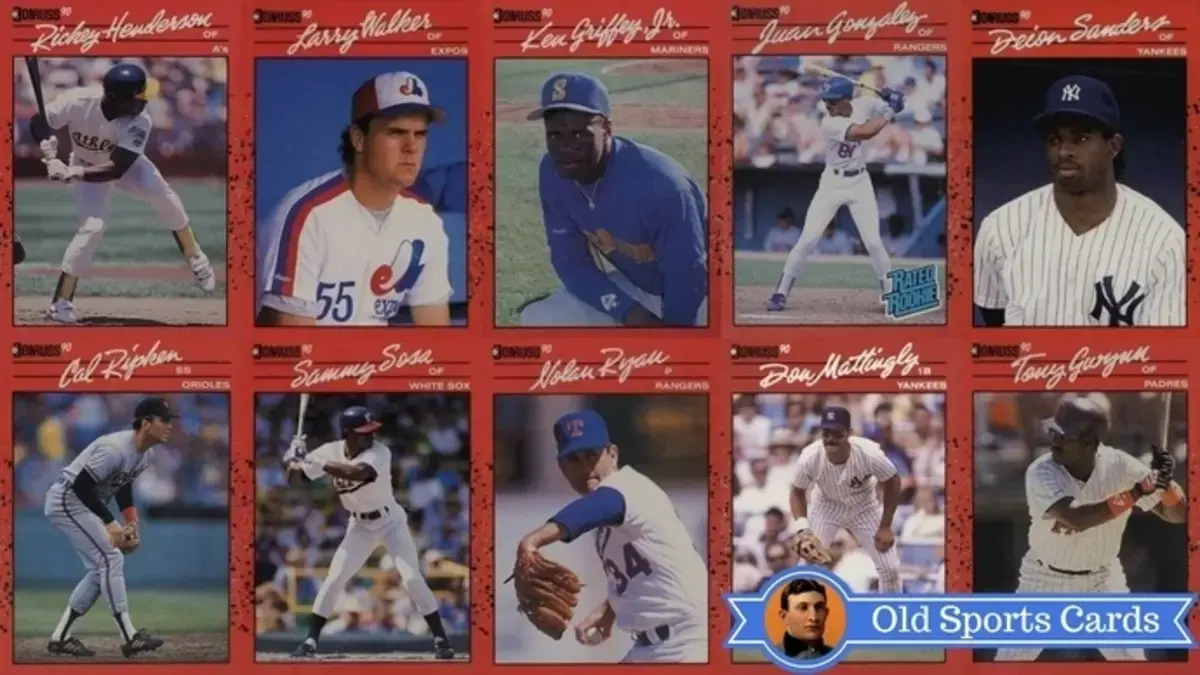
Growing up collecting these as a kid, the 1990 Donruss baseball cards were some of my favorites of the era.
Some collectors never liked the red design but I have always been a fan…
Either way, there’s no questioning that these cards are instantly recognizable.
The set is loaded with stars and Hall of Famers of the day, but are any of them really worth much anymore?
In this guide, we take a look at the 30 most valuable 1990 Donruss baseball cards.
Let’s jump right in!
1990 Donruss Baseball Set Snapshot
SET DETAILS
716
Larry Walker, Sammy Sosa, Bernie Williams
GRADING ANALYSIS
37,841
TOTAL GRADED BY PSA
6,834
PSA 10 Population
18.1%
PSA 10 Grade Rate
MOST GRADED CARDS
1
#489 Sammy Sosa
19.8%
7,490
2
#365 Ken Griffey Jr.
15.5%
5,866
3
#4 Ken Griffey Jr. Diamond Kings
7.0%
2,639
Stay On Top Of The Card Market
Weekly pricing updates, grading insights, and new card guides — straight to your inbox. For free.
Join thousands of collectors. Unsubscribe anytime.

Ross Uitts – Owner
- #1
1990 Donruss #4 Ken Griffey Jr. Diamond Kings
PSA 10 Value $850 – $900Total PSA Population 2,639PSA 10 Population 114PSA 10 Grade Rate 4.3% (Set Avg: 18.1%)Donruss has always been famous for its “Diamond Kings” subsets that featured some of the game’s top players in any given year.
Cards #1-26 in this set highlight a top player from every MLB team, with Ken Griffey Jr. representing the Mariners.
The reverse of the card discusses Griffey’s setback that he suffered during his rookie campaign in 1989 while also pointing out just how promising of a five-tool talent he was.
We all knew back then that “The Kid” was destined for greatness.
It was just a question of how high he would climb.

- #2
1990 Donruss #1 Bo Jackson Diamond Kings
PSA 10 Value $600 – $650Total PSA Population 887PSA 10 Population 34PSA 10 Grade Rate 3.8% (Set Avg: 18.1%)Bo Jackson’s “Diamond Kings” card was the first card in this set, likely because of how popular he was at the time.
He had just appeared in his first MLB All-Star game the year before and his reputation as a two-sport superstar was as hot as ever.
Perez’s fingerprints are once again all over this card with his beautifully-created artwork depicting the legendary Bo Jackson in his Royals uniform.
The reverse of the card mentions that Jackson’s baseball career was clearly on an upward trajectory and that he might be able to do even more on the baseball field if he were to give up football.
Unfortunately, he’d fall to injury during an NFL game against the Bengals in January 1991, derailing both his football and baseball careers forever.
- #3
1990 Donruss #33 Juan Gonzalez Reverse Negative Rookie Card
Rookie CardPSA 10 Value $550 – $600Total PSA Population 2,580PSA 10 Population 84PSA 10 Grade Rate 3.3% (Set Avg: 18.1%)Gonzalez was one of the most feared hitters of his era and seemed like a lock for 40+ homers and 100+ RBI every season.
His rookie card in this set appears in two forms: one with a correct image of him batting right-handed and another in which the negative was reversed, making it appear he’s batting lefty.
The reverse negative version is far more valuable since it is rarer and can sell for hundreds of dollars in a PSA 10 holder.
Even though he isn’t a Hall of Famer, his status as one of the biggest superstars of the era makes the regular version valuable in top condition, too.
- #4
1990 Donruss #665 Nolan Ryan King of Kings
PSA 10 Value $375 – $400Total PSA PopulationPSA 10 PopulationPSA 10 Grade Rate 0.0% (Set Avg: 18.1%)Famed artist, Dick Perez, created the artwork for this wonderful tribute to Nolan Ryan dubbed the “King of Kings” card.
You can actually find this card in three different forms, all having to do with variations of the reverse side.
The correct back features the correct card number (#665) as well as a write-up about Ryan.
Another version is missing the number 665.
And the third version actually contains the back of another Ryan card in the set, card #659, which is Donruss’s tribute to him reaching the 5,000 strikeout milestone.
- #5
1990 Donruss #365 Ken Griffey Jr.
PSA 10 Value $240 – $260Total PSA Population 5,866PSA 10 Population 546PSA 10 Grade Rate 9.3% (Set Avg: 18.1%)Ken Griffey Jr. was always a key to any late ’80s or early ’90s set and this one is no exception.
Shown kneeling in his Mariners uniform, it’s not his most exciting card you can own.
But, that didn’t stop collectors from tearing through packs in search of it back in the day.
Ever since Griffey’s induction into the Hall of Fame and the explosion of the card market in general, collectors have been back on the hunt for his cards, pushing their values up substantially in the process.
- #6
1990 Donruss #61 Bo Jackson
PSA 10 Value $225 – $250Total PSA Population 765PSA 10 Population 92PSA 10 Grade Rate 12.0% (Set Avg: 18.1%)1990 was the height of Bo Jackson’s two-sport superstardom.
The Kansas City Royals outfielder and LA Raiders running back was a cultural phenomenon.
And his quest to take over both the baseball and football worlds captivated casual and hardcore fans alike.
Jackson’s problem, as you might expect, was injuries.
The physical demands of an all-year athletic career, coupled with the violent hits he absorbed on the gridiron, eventually proved too much.
In ‘90, a shoulder injury cost him 38 games during what would stand as his best MLB season.
The 27-year-old hit .272 for 75-win Kansas City with a .866 OPS.
His 28 homers and 70 RBIs in 456 plate appearances were impressive.
His 128 strikeouts in 405 at-bats were less so.
Jackson had all the momentum in the world heading into the 1990 NFL season.
With the public narrative surrounding his two-sport odyssey shifted into a positive light, the Raiders RB grabbed his first-and-only Pro Bowl nod.
Sadly, it all crashed to earth when Jackson suffered a hip injury in the team’s AFC Divisional Round win over the Cincinnati Bengals.
The injury proved a career-ender.
Jackson never again played an NFL down.
The Royals dumped him onto waivers in March 1991, scared off by avascular necrosis diagnosis and a lack of progress with his rehab.
- #7
1990 Donruss #166 Nolan Ryan
PSA 10 Value $225 – $240Total PSA Population 774PSA 10 Population 165PSA 10 Grade Rate 21.3% (Set Avg: 18.1%)Nolan Ryan’s 300th win was an event for everyone else except Ryan himself.
On July 31st, 1990, the 43-year-old Texas Rangers ace held the Milwaukee Brewers to three runs (one earned) in 7.2 innings, walking two and striking out eight.
A late Rangers rally sealed the deal, making Ryan just the eighth pitcher since 1924 to reach 300 victories.
In typical Ryan fashion, he deferred credit to his teammates after the game before quickly leaving the media huddle.
“He’s a person who lets his actions speak for him,” Rangers pitching coach Tom House said.
“He’s the gunslinger who doesn’t flinch.” Ryan’s historic evening kicked off a molten hot stretch to finish the year.
The Hall-of-Famer struck out 97 batters in 91.2 innings to end the year, holding opposing hitters to a .182 batting average in his final 12 starts.
Ryan’s final stat line was impressive: a 13-9 record and a 3.44 ERA with an AL-best 232 strikeouts in 204 innings.
- #8
1990 Donruss #659 Nolan Ryan 5000 Strikeouts
PSA 10 Value $100 – $110Total PSA PopulationPSA 10 PopulationPSA 10 Grade Rate 0.0% (Set Avg: 18.1%)The 1990 Topps baseball card set went to great lengths to pay tribute to Nolan Ryan’s achievement of surpassing the 5,000 career strikeout mark.
But, Donruss had a tribute of their own, albeit less flashy.
Card #659 in the set features Ryan in his Rangers uniform with a yellow star next to his name at the top and “5,000 K’s” written in cursive along the bottom.
Like his “King of Kings” card, this one can also be found with different variations of the reverse side.
- #9
1990 Donruss #126 Barry Bonds
PSA 10 Value $90 – $100Total PSA Population 450PSA 10 Population 43PSA 10 Grade Rate 9.6% (Set Avg: 18.1%)The 1990 season was Barry Bonds’s first awards breakthrough, a breathtaking culmination of a life spent in and around the game.
The son of three-time All-Star Bobby Bonds and the godson of the immortal Willie Mays, Bonds came from baseball royalty.
He had the attitude to match.
The marriage between the young left fielder and the Pirates faithful was always contentious.
Fans raged at Bonds’ perceived lack of effort and swagger, and his me-first mentality rubbed plenty of people the wrong way.
None of this mattered in 1990, though.
With a historic flourish, Bonds became the first player in MLB history to bat .300 (.301) with at least 30 home runs (34), 100 RBIs (114), 100 runs scored (114), and 50 stolen bases (52).
Bonds also addressed the holes in his defensive game to win his first of eight Gold Glove awards.
He did it all.
And he did it better than anyone else in the National League, running away with his first NL MVP award on 23 of a possible 24 first-place votes.
And then, the postseason happened.
The 95-win Pirates cracked three runs just once in a tense six-game NLCS loss to the eventual World Series champion Cincinnati Reds.
Bonds went just 3-for-18 on the series with six walks and an RBI.
- #10
1990 Donruss #650 Bo Jackson All-Star
PSA 10 Value $85 – $95Total PSA PopulationPSA 10 PopulationPSA 10 Grade Rate 0.0% (Set Avg: 18.1%)Bo Jackson was one of the most popular athletes in the world at the time having gained notoriety for being a two-sport star across baseball and football.
1989 was particularly a great year for him as it would be the one and only time he’d make an MLB All-Star team.
So, by the time the 1990 Donruss set was released, his was one of the most sought after cards.
This guy was a hero to kids of that era and his popularity remains high to this day.
- #11
1990 Donruss #68 Wade Boggs
PSA 10 Value $70 – $80Total PSA Population 99PSA 10 Population 25PSA 10 Grade Rate 25.3% (Set Avg: 18.1%)Wade Boggs’ 1988 domestic scandal shook the foundation of his life and of his time with the Boston Red Sox.
“Any time you have any problems off the field, be it family, injuries, sickness, things like that, naturally you’re not going to concentrate the way you’re capable of,” Boggs said.
“This was no different.” It’s not that Boggs was bad with the Sox from 1989 to 1991.
Far from it.
He made the All-Star Game all three years and posted 18 combined WAR.
However, he was much less consistent than during his mid-1980s peak.
The 1990 season was a prime example.
After an on-brand April (.333), Boggs cratered in May (.240).
The Boston media (and let’s face it, the New York media) speculated out loud about how his ’88 palimony lawsuit and marriage problems factored in.
Altogether, the 32-year-old third baseman hit .302 in 155 games, the worst average in his nine seasons thus far.
His previous lowest was .325 (1984), 23 points more.
- #12
1990 Donruss #704 David Justice Rookie Card
Rookie CardPSA 10 Value $45 – $55Total PSA PopulationPSA 10 PopulationPSA 10 Grade Rate 0.0% (Set Avg: 18.1%)Why exactly was Dale Murphy expendable?
The answer, simply, is David Justice.
A natural right fielder, Justice took his lumps in parts of six minor-league seasons.
Regardless of his periodic struggles, Justice’s potential was easy to see.
He had the natural power and high-level athleticism that would play in the Bigs.
All he needed was some time and fine-tuning.
By 1990, it was Justice’s time.
The problem was that Murphy was still entrenched in right.
Rather than moving the veteran off his spot, manager Russ Nixon kept the holding pattern going and started Justice at firSt. Nixon was eventually fired after a 25-40 start, opening the door for the legendary Bobby Cox.
Just a few weeks after Cox was hired, Murphy was gone, and Justice was the Braves’ new starting right fielder.
Regardless of where he slotted in for the hapless Braves, Justice was the top hitter in the 1990 debut class.
A near-unanimous choice for NL Rookie of the Year, Justice slashed .282/.373/.535 with 28 homers, 23 doubles, 11 stolen bases, 76 runs scored, and 78 RBIs in 127 games.
- #13
1990 Donruss #190 Don Mattingly
PSA 10 Value $45 – $50Total PSA Population 276PSA 10 Population 120PSA 10 Grade Rate 43.5% (Set Avg: 18.1%)Just over three months after inking a five-year, $19.3 million extension, soon-to-be New York Yankees captain Don Mattingly found himself in an unenviable position.
Bedeviled by chronic back problems all season long (and all career long), Mattingly was confronted by manager Stump Merrill before a July 26th showdown with Nolan Ryan and the Texas Rangers.
“I said, ‘You’re hurt.
Let’s have a talk,'” Merrill said.
“He was honeSt. He said he was coming in to see me anyway.
He couldn’t play tonight, as much as he wanted to.” This kind of thing was uncharacteristic of Mattingly.
His willingness to play through pain was a defining part of his Yankee career.
And considering that Ryan was seeking his 300th win at New York’s expense, the decision had extra weight.
Mattingly missed most of New York’s remaining games, returning for a brief cameo late in the year.
Overall, he had his worst season as a pro, hitting .256 with a .643 OPS, five home runs, and 42 RBIs in 428 plate appearances (394 at-bats).
Injuries were a recurring theme in Mattingly’s career, casting a shadow over what could have been a surefire Hall-of-Fame career in the mid-to-late 1980s.
- #14
1990 Donruss #105 Ryne Sandberg
PSA 10 Value $40 – $45Total PSA Population 146PSA 10 Population 60PSA 10 Grade Rate 41.1% (Set Avg: 18.1%)As the Cubs dropped like a rock, Ryne Sandberg turned in the best individual effort of his Hall-of-Fame career.
After a 30-homer season in 1989, Sandberg followed up with a 40-bomb in 1990, becoming the first second baseman to post back-to-back years of 30 or more home runs.
He also became the first second baseman to lead the NL in home runs since Rogers Hornsby (1925).
Sandberg was an MVP-level force from Opening Day, even as the Cubs failed to capitalize on the previous year’s division title.
Headed into a home-field All-Star-Game, Ryno led all NL players in fan votes.
With the Midsummer Classic held at Wrigley, Sandberg was fated to start at second.
Not only that, but he also took the Home Run Derby in front of a delirious home crowd.
Things got hotter from there.
The Cubs’ pitching may have doomed them to 77 wins and a fourth-place finish, but Sandberg made them must-watch TV.
He led the NL in homers, runs scored (116), and total bases (344).
He posted his first-and-only season with a .900 OPS or better (.913) and joined Jose Canseco and Hank Aaron as the only members of the 40/25 club with his 25th stolen base.
Wait, there’s more.
The fourth-place MVP finisher reinforced his position as the era’s best defensive second baseman, snagging his eighth consecutive Gold Glove thanks to an MLB-record 123-game errorless streak.
- #15
1990 Donruss #144 George Brett
PSA 10 Value $40 – $45Total PSA Population 168PSA 10 Population 62PSA 10 Grade Rate 36.9% (Set Avg: 18.1%)George Brett looked washed up in the first half of the 1990 MLB season.
The Hall-of-Fame Kansas City Royals third baseman got off to an alarming start, hitting just two home runs with a pedestrian .267 batting average in the first half.
The pop appeared to be used up.
And Brett’s bat speed was noticeably slowed, a factor that attributed to his career-worst 63 strikeouts.
It looked like the 37-year-old was on his last legs.
(Appearances can be deceiving).
Whatever Brett did to rejuvenate himself during the All-Star break worked like a charm.
He sizzled from July through September, lifting a depleted Royals squad to a near-.500 record in the second half.
Altogether, Brett hit .388 with 12 home runs after the break.
The oomph returned, and the swing was just as sweet and violent as it had been at his peak.
Remarkably, Brett’s late-season heroics rocketed him up the AL charts to a second-and-final batting title (.329).
Finishing seventh in the league’s MVP race, the legend’s 1990 campaign was ultimately his final brush with baseball greatness.
- #16
1990 Donruss #689 Bernie Williams Rookie Card
Rookie CardPSA 10 Value $40 – $45Total PSA Population 641PSA 10 Population 184PSA 10 Grade Rate 28.7% (Set Avg: 18.1%)Signed by the New York Yankees on his 17th birthday, Bernie Williams essentially learned how to play baseball in the Yankees organization.
That’s not to say he wasn’t a fantastic talent before that.
In his native Puerto Rico, Williams dazzled scouts with his sizeable frame and raw abilities.
It’s why the Yankees took a shot on him in the first place.
Williams truly figured himself out, though, in the Yankees system.
By 1990, the young center fielder regularly added to his game with a studious glee, including finding his niche as a switch-hitter.
During his time with Albany-Colonie in the Double-A Eastern League, Williams tested out hitting left while playing Wiffle ball for fun.
In doing so, he learned he had a knack for swinging from both sides and immediately informed manager Buck Showalter.
Showalter signed off on the switch-hitting experiment.
It proved to be a signature addition to the arsenal of the future five-time All-Star.
Williams hit .281 on the year with a .823 OPS, eight homers, and 54 RBIs.
He also stole 39 bases and played immaculate ball in center field.
He came out of the year as the Eastern League’s #2 prospect and kept climbing.
One of the finest switch-hitters of the 1990s and early August, Williams averaged over 25 homers per year for the Yankees from 1996 to 2001.
- #17
1990 Donruss #125 Jose Canseco
PSA 10 Value $40 – $45Total PSA Population 155PSA 10 Population 28PSA 10 Grade Rate 18.1% (Set Avg: 18.1%)Well before the start of the “steroid era,” Jose Canseco was the first player to find himself in the anti-PED crosshairs of the press.
At the end of the Athletics’ third AL West championship season, Washington Post baseball writer Thomas Boswell called Canseco “the most conspicuous example of a player that made himself great with steroids.” The charges against Canseco were unsubstantiated and unclear.
Many in the game stood behind the hulking slugger, calling Boswell out for unethical journalistic practices.
Canseco also vehemently denied the allegations.
“It’s just not true,” Canseco said.
“It was an ignorant statement, and I usually don’t pay attention to ignorant statements.” While we know how this all played out, it was still an untimely black mark after a fantastic Canseco season.
The A’s right fielder finished 12th in the league MVP race, grabbing his fourth All-Star nod and second Silver Slugger.
He ended the year slashing .274/.371/.543 with 37 home runs, 14 doubles, two triples, 83 runs scored, 72 walks, 19 stolen bases, and 101 RBIs in 563 plate appearances (481 at-bats).
The steroid label dogged Canseco throughout the playoffs.
During the team’s four-game sweep of Boston, Red Sox fans jeered him to no end.
Canseco hit just .182 through the madness, following it up with a dismal 1-for-12 showing in the team’s four-game World Series loss to Cincinnati.
- #18
1990 Donruss #427 Deion Sanders Rookie Card
Rookie CardPSA 10 Value $40 – $45Total PSA Population 792PSA 10 Population 162PSA 10 Grade Rate 20.5% (Set Avg: 18.1%) - #19
1990 Donruss #86 Tony Gwynn
PSA 10 Value $40 – $45Total PSA Population 137PSA 10 Population 63PSA 10 Grade Rate 46.0% (Set Avg: 18.1%)Sometimes you can measure a hitter’s greatness by home runs.
Sometimes, it’s batting average.
Sometimes it’s something else.
Tony Gwynn was never a home run hitter.
Batting average was always his calling card, as evidenced by his NL-record eight batting titles.
However, to really grasp how consistent and unparalleled Gwynn’s production was, perhaps the best barometer is OPS+.
OPS+ works similarly to OPS in that it factors in a player’s slugging and on-base percentage.
However, it also adjusts these totals by ballpark and creates a baseline of 100 for league average.
If you post a 105, you were basically 5% better than average.
Gwynn wasn’t a power threat, so he leaned heavily on hits and on-base percentage to make things happen.
Even with lower slugging percentages, he still posted at least a 112 OPS+ in every season that he played at least 100 games.
That low point came in 1990, and Gwynn still hit .309, good for eighth in the NL.
- #20
1990 Donruss #489 Sammy Sosa Rookie Card
Rookie CardPSA 10 Value $40 – $45Total PSA Population 7,490PSA 10 Population 1,160PSA 10 Grade Rate 15.5% (Set Avg: 18.1%)Sosa’s career got off to a slow start so I don’t remember many collectors going crazy for this card when it was first released.
But as his career progressed and the home runs kept piling up, he turned into one of the most popular players in the league.
And, even though his reputation may forever be damaged by the PED controversy, his 1990 Donruss rookie still has its place among Sosa fans.
- #21
1990 Donruss #33 Juan Gonzalez Rookie Card
Rookie CardPSA 10 Value $35 – $40Total PSA Population 1,032PSA 10 Population 200PSA 10 Grade Rate 19.4% (Set Avg: 18.1%)Juan Gonzalez earned his one-way ticket to the MLB in 1990.
After a cup of coffee in ’89, the 20-year-old Texas Rangers prospect returned to Triple-A Oklahoma City for a full campaign of seasoning.
Gonzalez took full advantage of the experience, hitting .258 with 29 home runs and 101 RBIs in 128 games.
Once a skinny Puerto Rican prospect with a smooth swing, Gonzalez was now filling up his 6-foot-3 frame to become the generation slugger he was destined to be.
He showed off his evolving game during a September call-up, slashing .289/.316/.522 with four home runs and 12 RBIs in 25 games.
Gonzalez’s strikeouts remained a glaring issue (127 combined in 153 games), and he would never be known for drawing walks.
However, the kid was devastating when he connected.
And, it wouldn’t take long for the connections to get more frequent and the All-Star nods (and MVPs) to start piling up.
- #22
1990 Donruss #96 Cal Ripken Jr.
PSA 10 Value $35 – $40Total PSA Population 250PSA 10 Population 81PSA 10 Grade Rate 32.4% (Set Avg: 18.1%)In the National League, Ozzie Smith got all the headlines for his wizardry at short.
In the American League, Cal Ripken Jr. was doing him one better without receiving the credit he deserved.
The Baltimore Orioles superstar had a solid enough year at the plate in 1990.
He slashed .250/.341/.415 with 21 home runs, 28 doubles, four triples, 82 walks, 78 runs scored, and 84 RBIs in 161 games.
It was in the field, though, where Ripken made magic.
He was the closest thing to a sure out in Major League history, committing a microscopic three errors in 680 chances, including a 428-chance errorless streak.
The 29-year-old’s .996 fielding percentage at the six was the best in the annals of baseball.
So, how did the eight-time All-Star and down-ballot MVP candidate get snubbed for a Gold Glove?
Chicago White Sox star Ozzie Guillen took home the honors, likely because Ripken’s year was more steady than flashy.
It’s a shame.
The most impressive defensive effort by a shortstop in MLB lore went unrewarded, as highlight-reel oohs and ahhs won out over record-breaking brilliance.
- #23
1990 Donruss #304 Rickey Henderson
PSA 10 Value $35 – $40Total PSA Population 306PSA 10 Population 129PSA 10 Grade Rate 42.2% (Set Avg: 18.1%)Considering how dominant Rickey Henderson was, I’m surprised that he won only one MVP award.
He was an absolute monster on the base paths, going on to become the game’s all-time leader in stolen bases and runs scored.
But, he could also hit for power, too.
The excitement he brought to the game made him one of the most popular players of his day and his status as one of the game’s all-time greats helps keep the value of this card respectable in top condition.
- #24
1990 Donruss #578 Larry Walker Rookie Card
Rookie CardPSA 10 Value $35 – $40Total PSA Population 810PSA 10 Population 170PSA 10 Grade Rate 21.0% (Set Avg: 18.1%)No matter how stacked the deck was against Larry Walker, he still swung his way to a Hall-of-Fame induction.
Heck, things were tough before he made the Bigs.
Signed by the Montreal Expos in late 1984 off of Canada’s youth national team, Walker hammered through three minor-league seasons before losing the entire ’88 campaign to a severe knee injury.
It was the first of nine DL stints that would span over 536 games.
Across his seventeen MLB seasons, Walker missed over three campaigns’ worth of contests.
Walker bounced back from the first big injury and earned himself a late-season call-up in 1989.
However, it looked like he’d get a return trip to the farm in ’90 after ending the year in a dreadful 1-for-22 slump.
It didn’t go that way, though.
Walker earned Montreal’s starting right fielder job out of Spring Training and commanded serious NL Rookie-of-the-Year consideration, slashing .241/.326/.434 with 19 home runs, 21 stolen bases and 51 RBIs in 133 games.
- #25
1990 Donruss #184 Roger Clemens
PSA 10 Value $30 – $35Total PSA Population 161PSA 10 Population 36PSA 10 Grade Rate 22.4% (Set Avg: 18.1%)There’s no way Roger Clemens would have lost the 1990 Cy Young with current statistical parameters in place.
But ’90 was a different time.
Rather than measuring a pitcher’s impact by (barely) advanced stats like WAR and WHIP, counting stats meant more than anything.
So, when Oakland’s Bob Welch collected 27 of the MLB-best Athletics’ 99 wins, it was academic that he’d take home the Cy.
In reality, Clemens was much more valuable to the Boston Red Sox’s third division win in five years.
The 27-year-old righty pitched to his best single-season ERA (an MLB-best 1.93) until 2005.
Clemens topped the Majors in multiple other categories, including WAR (10.4), shutouts (4), HR/9 (0.3), and ERA+ (211).
Clemens was unable, however, to carry that statistical brilliance into the ALCS against Welch’s Athletics.
He surrendered three earned runs in two starts (across just 7.2 combined innings), and he also took the series-ending loss in a 3-1 Game 4 defeat.
- #26
1990 Donruss #168 Dale Murphy
PSA 10 Value $30 – $35Total PSA Population 124PSA 10 Population 82PSA 10 Grade Rate 66.1% (Set Avg: 18.1%) - #27
1990 Donruss #269 Kirby Puckett
PSA 10 Value $30 – $35Total PSA Population 163PSA 10 Population 74PSA 10 Grade Rate 45.4% (Set Avg: 18.1%)Kirby Puckett got his bag before the 1990 season and immediately started thinking about life after baseball.
Well aware that baseball is a business that will only employ you when you’re still of use, Puckett immediately looked at his three-year, $9 million contract as the means to make more money after he retired.
“I’ve always wanted to open my own hand car wash,” Puckett said.
“I’d hand-wash it for you.
I’d do it for a while – you never know.
I can’t just sit around.” It was a surprisingly refreshing perspective from a 29-year-old coming off a batting championship.
He still had five more years to go and another World Series to win.
That championship would come in ’91.
In 1990, the Twins struggled through injury and underperformance on their way to a last-place finish in the AL WeSt. Puckett made yet another All-Star team despite hitting under .300 (.298) for the first time since 1985.
- #28
1990 Donruss #711 John Olerud Rookie Card
Rookie CardPSA 10 Value $30 – $35Total PSA Population 143PSA 10 Population 74PSA 10 Grade Rate 51.7% (Set Avg: 18.1%)In 1989, John Olerud informed MLB teams not to select him in the upcoming draft, opting to return to Washington State for his senior season.
The Toronto Blue Jays weren’t so sure that Olerud was sure.
Rather than heeding his warning, the Jays selected him in the third round of the 1989 MLB Draft.
The 20-year-old stuck to his guns, declining a record $400,000 bonus to sign with the club.
Toronto’s front office persisted, though, offering Olerud the opportunity to join the big-league club right away on a three-year deal.
The WSU star relented and put pen to paper.
After six games in 1989, Olerud settled in as a platoon DH option and first baseman Fred McGriff’s backup.
It soon became clear why the Jays went through all that trouble to sign him.
Olerud was the cream of the rookie crop in the first half of the 1990 season.
While he tapered off late in the year, he was clearly a prized puzzle piece for a second-place Jays team ready to make a future championship push.
Finishing fourth in the AL Rookie of the Year balloting, Olerud ended 1990 with a .265/.364/.430 slash line, 14 homers, 15 doubles, 43 runs scored, and 48 RBIs in 111 games.
- #29
1990 Donruss #185 Mark McGwire
PSA 10 Value $30 – $35Total PSA Population 238PSA 10 Population 43PSA 10 Grade Rate 18.1% (Set Avg: 18.1%)Mark McGwire will never be remembered for his glove work.
As he chased down and obliterated the single-season home run record, McGwire was a mediocre first baseman at beSt. So, perhaps it will be surprising to most that McGwire won a Gold Glove in 1990.
McGwire was more graceful and athletic than in the “Steroid Era.” He had great awareness and the ability to seal close plays with digs and stretches.
It was just another wrinkle to his MVP-caliber game, and it provided an embarrassment of riches to an Oakland A’s franchise thinking dynasty.
At the plate, McGwire made up for a slight .235 average with elite pop (39 homers, 108 RBIs) and the best eye in baseball.
He led the Majors with 110 walks, the first of five seasons in which he would surpass 100 free passes.
Finishing 11th in the league’s MVP race, the four-time All-Star followed up his big-time regular season with a quiet postseason run.
He went just 2-for-17 against Boston in the ALCS and followed that up with a sleepy 3-for-14 effort in the team’s World Series loss.
- #30
1990 Donruss #201 Ozzie Smith
PSA 10 Value $30 – $35Total PSA Population 128PSA 10 Population 51PSA 10 Grade Rate 39.8% (Set Avg: 18.1%)1990 was an uncharacteristically light work year for Ozzie Smith, at least by his standards.
The St. Louis Cardinals were the most visible defensive shortstop of his era, in large part because of his star quality, talent, and sheer durability.
From 1982 to 1989, Smith registered fewer than 700 chances only once.
He also registered the best dWAR of the period for all players.
In ’90, Smith was just a little less healthy.
He battled a couple of nagging injuries here and there, dropping to his lowest total of games (140) since the 1984 season.
Overall, Smitgh registered 602 total chances, the lowest usage rate of his career thus far.
It’s no surprise that the Cardinals plummeted to 70-92 as Smith struggled, the club’s worst record since 1978.
It’s also no help that Smith’s hitting went into the toilet.
The 35-year-old slashed .254/.330/.305 for his worst adjusted OPS+ (77) since the 1981 strike-shortened campaign.

Ross’s Take
So there you have it, the ten most valuable 1990 Donruss cards…as well as a look at some other oddball issues that can have even greater value to them.
As you can see, it will take the base cards on this top ten list being professionally graded in gem mint condition to be worth much.
This set was a monster and contained a 716 card checklist in total.
Within the set were also several different subsets, including: All-Stars Bonus MVPs Checklists Diamond Kings Grand Slammers Rated Rookies The set is huge and with all of the errors, parallels and variations it can seem a bit overwhelming, to say the leaSt. But for those of us who grew up collecting these as kids, they’ll always have a huge nostalgic factor to them despite not having the most monetary value.
Love old cards? Get weekly updates from a fellow collector.
Pricing updates, grading insights, and new guides on the cards you actually care about — the junk wax era, vintage, and everything in between. One email a week. No fluff.
Free. No spam. Unsubscribe anytime.
Ross Uitts – Owner
