
25 Most Valuable 1987 Fleer Baseball Cards

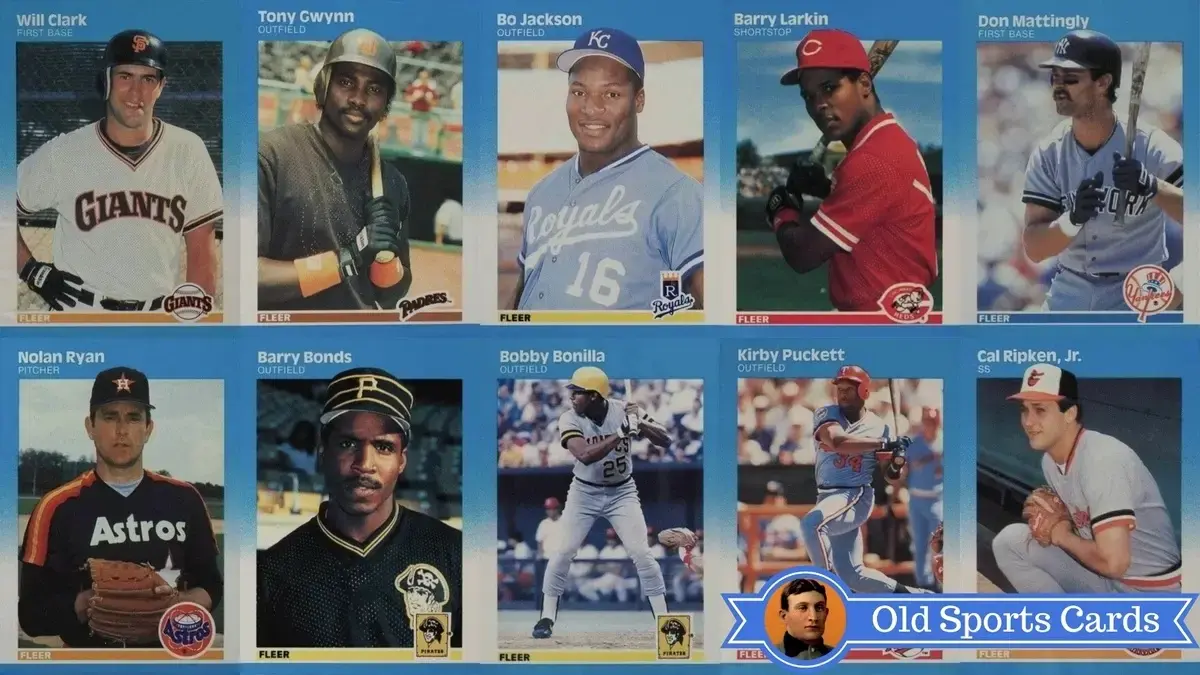
Whether you love them or hate them, there is one thing I think we can all agree on when it comes to 1987 Fleer baseball cards: Those two-tone blue borders are instantly recognizable…
You could hide the player images, names, team affiliations, etc.
and leave nothing showing but the borders and still be able to identify this set.
And, I think that counts for something.
While most of these cards’ values have suffered over time due to massive printing and market saturation, some are still worth a respectable amount.
And, in this guide, I’ll go through the 25 most valuable.
Let’s jump right in!
1987 Fleer Baseball Set Snapshot
Stay On Top Of The Card Market
Weekly pricing updates, grading insights, and new card guides — straight to your inbox. For free.
Join thousands of collectors. Unsubscribe anytime.

Ross Uitts – Owner
- #1
1987 Fleer #67 Nolan Ryan
PSA 10 Value $775 – $800Total PSA Population 856PSA 10 Population 124PSA 10 Grade Rate 14.5% (Set Avg: 12.5%)If there was ever a chance for Nolan Ryan to grab an elusive Cy Young Award, it came during the 1987 season.
Officially in his forties and heading into his penultimate season with the Houston Astros, Ryan recaptured the form and fireballs of his 1970s peak.
The Ryan Express steamrolled to a league ERA title for the second time in his two-decade-long career thus far, pitching to a 2.76 ERA in 211.2 innings (34 starts).
He struck out an MLB-leading 270 batters, the first of four straight campaigns that he’d at least pace the league.
Age meant little to Ryan.
How else can you explain his league bests in ERA+ (142), hits per 9 (6.5), strikeouts per 9 (11.5), and K/BB ratio (3.10)?
The Texas native outpitched nearly every other starter in the Majors despite a woeful lack of run support.
It could have been enough to win a Cy, but the Astros’ 76-win year relegated Ryan to fifth.
This marked the first time a pitcher failed to win the award despite leading the league in ERA and strikeouts.

- #2
1987 Fleer #604 Barry Bonds Rookie Card
Rookie CardPSA 10 Value $600 – $625Total PSA Population 30,697PSA 10 Population 1,295PSA 10 Grade Rate 4.2% (Set Avg: 12.5%)Long before the PED allegations began making headlines, Barry Bonds was racking up MVP awards, Gold Gloves, and Silver Sluggers.
Rarely had Major League Baseball seen such incredible five-tool talent wrapped into one player, seemingly on an unstoppable path towards Cooperstown.
But, the PED allegations did come, and Hall of Fame voters haven’t forgotten, keeping the door shut for the time being.
Despite the controversy surrounding him, most of his rookie cards can still be quite valuable in high grade, including this one.
While he spent the bulk of his career with the Giants, I loved watching Bonds, Bobby Bonilla, and Andy Van Slyke with those solid Pittsburgh teams of the early 90s.
And, how about those old Pirates uniforms?
From the striped hats to the cartoonish pirate logo, those uniforms are retro classics.
- #3
1987 Fleer #369 Bo Jackson Rookie Card
Rookie CardPSA 10 Value $400 – $410Total PSA Population 5,221PSA 10 Population 686PSA 10 Grade Rate 13.1% (Set Avg: 12.5%)Some may say there is too much blue occurring on this card because of how those old Royals uniforms mesh with the blue borders.
But, who cares?
It’s a Bo Jackson rookie card…
Jackson was one of the biggest names in sports during the late 80s and early 90s because of his ability to play baseball and football at the highest levels.
As a testament to his talents, Jackson was named both an MLB All-Star and NFL Pro Bowler at different points in his career.
Sadly, his greatness was derailed when he suffered a hip injury during a game against the Bengals in 1991.
However, his popularity among hobbyists certainly has not been derailed at all, as both his baseball and football cards remain desirable to those who grew up watching him.
Count me in as one of those Bo Jackson fans.
- #4
1987 Fleer #605 Bobby Bonilla Rookie Card
Rookie CardPSA 10 Value $250 – $260Total PSA Population 196PSA 10 Population 36PSA 10 Grade Rate 18.4% (Set Avg: 12.5%)The 1980s Pittsburgh Pirates were a cautionary tale, similar to the New York Mets (but without a title during the decade.) Cocaine and amphetamines were epidemic in the Majors, and it took an uneven toll on the Pirates locker room, leading to suspensions, underperformance, and missed opportunities in the wake of the team’s 1979 World Series win.
Foundational pieces like Dave Parker and Willie Stargell were implicated.
The game felt secondary.
Pirates fans were left holding the bag, watching the franchise flail in a mess of its own making.
Pittsburgh would right the ship once the 1990s rolled around, returning to the playoff stage with much less controversy.
Before that, they’d need to develop a new crop of talent to carry the club forward.
Enter Bobby Bonilla.
Acquired via a trade with the Chicago White Sox during the ’86 season, the Puerto Rican prospect showed flashes of his future MVP candidacy one year later, slashing .300/.351/.481 with 15 home runs and 77 RBIs in 141 games.
- #5
1987 Fleer #204 Barry Larkin Rookie Card
Rookie CardPSA 10 Value $240 – $250Total PSA Population 2,815PSA 10 Population 452PSA 10 Grade Rate 16.1% (Set Avg: 12.5%)Born and raised in Cincinnati, it seems only fitting that Larkin would spend his entire 19-year career in a Cincinnati Reds uniform.
One of the best of his era on both sides of the ball, Larkin would collect nine Silver Slugger and three Gold Glove awards during his Hall of Fame career.
He was particularly fantastic during the 1995 season when he batted .319 with 51 stolen bases, picking up an All-Star selection, Gold Glove, Silver Slugger, and an MVP award for his efforts.
It was the first time in over three decades that a shortstop earned MVP honors since Maury Wills did so in 1962.
One of my most vivid memories of Larkin was watching the Reds and him unexpectedly sweep the Oakland Athletics during the 1990 World Series.
- #6
1987 Fleer #572 Ryne Sandberg
PSA 10 Value $240 – $250Total PSA Population 157PSA 10 Population 60PSA 10 Grade Rate 38.2% (Set Avg: 12.5%)The durability of Ryne Sandberg during his Hall-of-Fame prime cannot be overstated.
Over a course of eleven seasons from 1982 through 1992, the legendary Chicago Cubs second baseman missed double-digit games just once.
And the thing that got him wasn’t a bum back, aching legs, or any real sign of overexertion.
It was simply a freak joint injury suffered in a June 1987 contest with the rival St. Louis Cardinals.
Sandberg swerved in an attempt to avoid a collision with Cardinals first baseman Jack Clark, ultimately coming down awkwardly and twisting his right ankle.
A replay showed the Cubs star’s ankle at a gruesome 90-degree angle.
All told, Sandberg missed 30 games for the ’87 Cubs.
He sat out 33 games in the previous five seasons combined.
Stats-wise, Sandberg slashed .294/.367/.442 with 16 home runs, 25 doubles, 81 runs scored, 59 walks, 21 stolen bases, and 59 RBIs in 587 plate appearances (523 at-bats).
- #7
1987 Fleer #104 Don Mattingly
PSA 10 Value $155 – $160Total PSA Population 386PSA 10 Population 104PSA 10 Grade Rate 26.9% (Set Avg: 12.5%)Not many players were hotter in the hobby during the late 80s than Don Mattingly.
Heading into his fourth full season in 1987, Mattingly already had a batting title, MVP, three All-Star selections, two Gold Gloves and two Silver Sluggers to his name.
The guy was on fire.
However, the 1987 season would be the last time he hit 30 or more home runs or had a slugging percentage over .500.
Although he still produced at a level worthy enough of two more All-Star selections in 1988 and 1989, his power just wasn’t the same.
Mattingly was still a Gold Glover for multiple years after that but, unfortunately, the injury bug caught up to him and threw off his offensive production enough to dampen his Hall of Fame hopes.
- #8
1987 Fleer #269 Will Clark Rookie Card
Rookie CardPSA 10 Value $140 – $145Total PSA Population 1,586PSA 10 Population 246PSA 10 Grade Rate 15.5% (Set Avg: 12.5%)Will Clark’s attitude often landed him in hot water with teammates.
He didn’t seem to mind.
In 1987, Clark led the San Francisco Giants to and through baseball’s glass ceiling en route to the team’s first division title since 1971.
The 23-year-old first baseman was named Player-of-the-Week on multiple occasions and even put together a stretch of eight home runs in 11 games.
After the Giants secured slugger Kevin Mitchell at the trade deadline, San Francisco soared, grabbing the NL West lead on August 21st and never looking back.
Clark ended the year as a top-five MVP finisher, slashing .308/.371/.580 with 35 home runs, 29 doubles, 89 runs, and 91 RBIs in 150 games.
The trade-off with Clark was that he was constantly griping, fuming, and slamming equipment around.
He wasn’t everyone’s favorite, but his theatrics were part of what made him great.
“Some people don’t like Will because he talks a lot,” Mitchell said.
“If you don’t hear Will, something’s wrong.
- #9
1987 Fleer #389 Jose Canseco
PSA 10 Value $83 – $84Total PSA Population 352PSA 10 Population 55PSA 10 Grade Rate 15.6% (Set Avg: 12.5%)Before they became the unwitting poster boys of baseball’s Steroid Generation, Jose Canseco and Mark McGwire were simply the “Bash Brothers”, two young kids who traded bombs and brought back the glory days of Oakland baseball.
In 1987, Canseco passed the AL Rookie-of-the-Year award on to McGwire, who shattered Frank Robinson and Wally Berger’s first-year home run record (38) with 49.
Canseco’s season, as you might expect, took a back seat to McGwire’s breakout in the headlines.
Perhaps it was for the better.
The 22-year-old brought the boom with 31 home runs and 113 RBIs to go along with 15 stolen bases.
However, that production was counterbalanced by the sixth-most strikeouts in the Majors (157) and sub-average play in left field.
Regardless, the Bash Brothers still combined for 80 of Oakland’s 199 homers, over 40% of the team’s output.
As the pieces around Canseco and McGwire fell into place, those round-trippers would soon be converted into pennants.
- #10
1987 Fleer #101 Rickey Henderson
PSA 10 Value $67 – $68Total PSA Population 337PSA 10 Population 115PSA 10 Grade Rate 34.1% (Set Avg: 12.5%)Before he became a “Nasty Boy,” Randy Myers was a critical piece of the New York Mets’ post-championship bullpen.
Baseball was a lot different in the Eighties, for many reasons.
One of those is how injuries were treated and stigmatized.
The adage “rub some dirt on it” was gospel for many managers, and players were often overworked when simple rest and rehab would have prevented further complications.
Take Rickey Henderson’s 1987 season.
The New York Yankees center fielder suffered a severe hamstring injury that nagged him all year long.
A sustained absence would have done him good, but new Yankees manager Lou Pinella wasn’t buying it.
Pinella antagonized his star in the clubhouse and the press, questioning his desire to help the team.
Henderson tried to suck it up multiple times, and it only led to more issues.
“I would probably have said ‘no’ in a couple of instances and prevented the injury from becoming worse,” Henderson said later.
The future stolen base champion missed a total of 67 games in ’87, yet still placed fifth in the AL with 41 swipes.
- #11
1987 Fleer #549 Kirby Puckett
PSA 10 Value $57 – $58Total PSA Population 255PSA 10 Population 83PSA 10 Grade Rate 32.5% (Set Avg: 12.5%)From 1986 until his retirement in 1995, Kirby Puckett was on an absolute tear during those ten seasons.
Not only was he a solid hitter, but he was also tough on defense, proving to be one of the best all-around players of his era.
Named an All-Star each year, Puckett picked up six Gold Gloves, six Silver Sluggers, a batting title, two World Series rings, and finished in the top-seven for MVP voting seven times.
He was brilliant.
Puckett’s 1984 Fleer Update rookie card remains a hobby icon, but this one in top condition is still popular among collectors as well.
- #12
1987 Fleer #416 Tony Gwynn
PSA 10 Value $54 – $55Total PSA Population 275PSA 10 Population 62PSA 10 Grade Rate 22.5% (Set Avg: 12.5%)There are many trivia tidbits about San Diego Padres icon Tony Gwynn that highlight just how special he was as a hitter.
One of those is that he joins the original GOAT, Ty Cobb, as the only players with multiple consecutive streaks of three batting titles or more.
He started the first of those in 1987.
Already with one batting crown to his name, the 27-year-old right fielder treaded water for a couple of months before going full supernova in June.
Gwynn went 44-for-93 during the month, good for a mind-melting .473 average.
He reached base over 52% of the time during that 25-game stretch.
That was enough to put Gwynn ahead for the long haul, even with a subpar July (.292) and a talent-bare supporting cast factored in.
The Hall-of-Fame finished with a baseball-best .370 average to go along with MLB highs in hits (.218) and WAR (8.6).
- #13
1987 Fleer #23 Darryl Strawberry
PSA 10 Value $52 – $54Total PSA Population 103PSA 10 Population 47PSA 10 Grade Rate 45.6% (Set Avg: 12.5%)With a healthy pitching staff, the 1987 New York Mets could have pushed the “dynasty” button.
The ’86 season was a whirlwind, an electric moment for a fan base desperate to shake their “little brother” label in the Big Apple.
Despite countless long nights and ample drug use, the star-studded Mets ascended to the top of the baseball mountain and looked nearly impossible to knock down.
And then, the great equalizers of injuries and underperformance reared their ugly heads.
Former Cy Young winner and staff ace Dwight Gooden missed over a quarter of the season with drug rehab concerns.
Veteran staff member Bob Ojeda sat out most of the year with a left elbow injury.
Add in bullpen regression, and the Mets were destined for disappointment, finishing as NL East runner-ups, three games behind the St. Louis Cardinals.
It was an epic waste of Darryl Strawberry’s best statistical year, an All-Star campaign featuring career bests in WAR (6.4), OPS (.981), home runs (39), RBIs (104), stolen bases (36), and more.
- #14
1987 Fleer #213 Pete Rose
PSA 10 Value $49 – $50Total PSA Population 460PSA 10 Population 145PSA 10 Grade Rate 31.5% (Set Avg: 12.5%)For all of his seemingly constant self-promotion, Pete Rose retired in a curiously reserved fashion.
In 1986, a 45-year-old Rose pumped the brakes on his playing time as he settled into his third full year as Cincinnati Reds manager.
He hit just .219 in 72 games, relegating himself to a platoon role at first base.
As Rose faded, the youth in the Reds’ organization blossomed, ultimately sidestepping his bad production to place second in the NL West for a second consecutive year.
It’s here where Rose called it a day.
Rather than blocking the progress of the team’s core with diminishing results, he took himself out of the lineup equation altogether for the 1987 campaign.
“He had seen most of our young players in spring training or the instructional league,” Reds GM Bill Bergesch said later.
“He looked at the names on the board and said, ‘Take me off.’” The Reds won 84 games in ‘87, placing runner-up for a third straight campaign.
Rose would never play again, but never officially retired either.
- #15
1987 Fleer #478 Cal Ripken Jr.
PSA 10 Value $47 – $48Total PSA Population 505PSA 10 Population 164PSA 10 Grade Rate 32.5% (Set Avg: 12.5%)Well before he became a legitimate threat to Lou Gehrig’s record for consecutive games played, Cal Ripken Jr. set another Ironman mark that is much less discussed.
On June 4th, 1982, the Baltimore Orioles’ rookie shortstop was lifted for a pinch-hitter in the ninth frame of a 6-0 loss to Minnesota.
The next day, he began an all-time record streak of 8,264 consecutive innings played.
Let’s put that into proper perspective.
On August 31st, 1985, Ripken passed pre-Deadball Era star George Pinkney with his 5,153rd inning in a row.
Pinkney’s record was set in 1890, and no one had even come close until Ripken came along.
That’s amazing enough on its own.
Yet, Ripken was far from done.
In fact, he didn’t rest until September 14th, 1987, over two years after breaking the record.
The 26-year-old shortstop played the first seven innings against Toronto before his manager (and dad), Cal Ripken Sr., pulled him for a replacement, ending his streak at 8,264.
- #16
1987 Fleer #366 George Brett
PSA 10 Value $43 – $44Total PSA Population 309PSA 10 Population 133PSA 10 Grade Rate 43.0% (Set Avg: 12.5%)As one injury healed for George Brett in 1987, another one came sneaking around the corner to put him back on the injured liSt. On April 19th, the star Kansas City Royals third baseman took a powerful cut and separated cartilage on the right side of his rib cage.
The injury made it hard to breathe, let alone swing a bat.
Brett was held out for 20 games, returning in mid-May as the Royals tried to assert themselves in a wide-open AL WeSt. However, he was sidelined once again three days later after suffering a partial MCL tear in his right knee on a relay throw home.
The 34-year-old ended up missing over a quarter of the season with both injuries, a critical absence that likely doomed the 83-win Royals to second place in an extremely winnable division.
Brett still made his 12th All-Star Game despite the interruptions, slashing .290/.388/.496 with 22 home runs and 78 RBIs in 115 games.
- #17
1987 Fleer #187 Mike Schmidt
PSA 10 Value $42 – $43Total PSA Population 269PSA 10 Population 134PSA 10 Grade Rate 49.8% (Set Avg: 12.5%)Put some (more) respect on Mike Schmidt’s name.
It’s not that the iconic Philadelphia Phillies third baseman has been forgotten.
He remains widely regarded as the dominant slugger of his era.
However, his name is often overshadowed in GOAT conversations in favor of Mount Rushmore hitters like Babe Ruth, Barry Bonds, and Willie Mays.
Doing so is essentially akin to a slap in the face when you consider how much damage Schmidt did and how quickly he did it.
On April 18th, 1987, Schmidt pulled his 500th home run deep over the left field wall at Pittsburgh’s Three Rivers Stadium.
The Hall-of-Famer reached his 500th homer faster than all but three players in MLB history – the aforementioned Ruth, Harmon Killebrew, and Mickey Mantle.
It was one of 35 homers that year for the All-Star – marking his 13th 30-bomb effort in his last 14 campaigns.
Schmidt also hit .293 and posted an OPS over .900 (.936) for the ninth consecutive season.
- #18
1987 Fleer #32 Roger Clemens
PSA 10 Value $37 – $38Total PSA Population 561PSA 10 Population 133PSA 10 Grade Rate 23.7% (Set Avg: 12.5%)There wasn’t much to the 1987 Boston Red Sox other than Roger Clemens.
(And the fan base didn’t even like him that much!) It was at least fun to watch.
Clemens was obviously the best pitcher in the world at that point, possessing one of the most overpowering fastball/splitter combos the game had ever seen.
Toss in a slider with crazy movement, and hitters looked silly as “The Rocket” flew past them.
Often, Red Sox fans seemed to clap with gritted teeth.
That’s what a diva attitude and countless distractions will get you.
But, they still had plenty to clap for.
The 24-year-old righty topped the Majors in WAR (9.4) and wins (20) en route to a second consecutive AL Cy Young, striking out 256 batters across 281.2 innings.
Most impressively, Clemens completed an MLB-best 18 of his 36 starts, seven of which ended in shutouts.
No other MLB starter had more than four shutouts.
- #19
1987 Fleer #308 Ozzie Smith
PSA 10 Value $34 – $35Total PSA Population 131PSA 10 Population 71PSA 10 Grade Rate 54.2% (Set Avg: 12.5%)On October 14th, 1985, “The Wizard” Ozzie Smith performed his greatest magic trick: an unlikely walk-off home run in Game 5 of the NLCS that pushed the St. Louis Cardinals to the brink of a pennant win.
It is still a shock to many Cardinals fans today and remains a required historical viewing decades later.
What people tend to forget is that this was the beginning of a mini-peak for Smith as a hitter, the apex of which came two years later.
In 1987, Smith put together his finest effort in the batter’s box, posting the only .300 season on his Cooperstown resume.
The 32-year-old shortstop slashed .303/.392/.383 on the year, failing to register a homer yet still posting the best OPS (.775) of his career.
It was a revelation of a year for a guy with a light-hitting reputation.
Coupled with his normal Gold Glove defense, it was also good enough to earn Smith his best-ever MVP placement (2nd).
- #20
1987 Fleer #361 Robin Yount
PSA 10 Value $31 – $32Total PSA Population 100PSA 10 Population 47PSA 10 Grade Rate 47.0% (Set Avg: 12.5%)Milwaukee Brewers legend Robin Yount was a model of consistency, not just in production, but in how he approached the game.
“I’ve only seen a couple of players that I haven’t seen dog it at least once,” Brewers coach Larry Haney said at the time.
“Robin’s one of them.” Yount was a high-effort player first as a Gold Glove shortstop and later as a center fielder.
He made only three All-Star teams across his 20-year MLB career, yet he still won two MVPs and earned a lasting reputation as one of baseball’s most complete performers.
The game evolved around Yount over his two decades, and he pushed hard to keep pace.
The fruits of that labor yielded two distinct peaks, the second beginning in 1987 and culminating in a late-career MVP win (1989).
Yount missed just six games over those three years and hit over .300 each time out, earning down-ballot MVP consideration in ’87 and ’88 before taking home the award to finish out the decade.
- #21
1987 Fleer #45 Tom Seaver
PSA 10 Value $26 – $27Total PSA Population 128PSA 10 Population 73PSA 10 Grade Rate 57.0% (Set Avg: 12.5%)Tom Seaver tried to give it one more go in a New York Mets uniform in 1987, to no avail.
At 41 years old in 1986, the former three-time Cy Young winner was more a back-end rotation guy than anything else, finishing 7-13 with a 4.03 ERA in split time with the Chicago White Sox and Boston Red Sox.
Despite eating up over 100 innings for the eventual AL champs, Seaver was left off of Boston’s postseason roster.
It was a huge disappointment, considering it would have been just his fourth playoff appearance and first since 1979.
Boston came up a win shy in the ’86 World Series, falling to Seaver’s former club in an epic seven-game duel.
Seaver was earmarked for free agency as that series played out, and a reunion with the Mets was very much in play for 1987.
However, it never materialized, and Seaver officially called it a Hall-of-Fame day on June 22nd.

Ross’s Take
Looking back through the 1987 Fleer set, it’s fun to reminisce about that era of the hobby as it brings back so many memories of the great players who were a part of it.
The set, featuring 660 cards in total, is every bit as instantly recognizable as its Donruss and Topps counterparts.
Each of them had unique designs, but those blue borders arguably made the Fleer set the warmest and brightest of the three.
The checklist also included a few subsets: SuperStar Specials (#625 – 643) Major League Prospects (#644 – 653) Checklists (#654 – 660) Inserts included: All-Stars (#1 – 12) Headliners (#1 – 6) World Series (#1 – 12) Team Stickers While many had written off this set as junk, collectors of that era searching for a bit of nostalgia are starting to show interest again.
Love old cards? Get weekly updates from a fellow collector.
Pricing updates, grading insights, and new guides on the cards you actually care about — the junk wax era, vintage, and everything in between. One email a week. No fluff.
Free. No spam. Unsubscribe anytime.
Ross Uitts – Owner
