
30 Most Valuable 1988 Fleer Baseball Cards

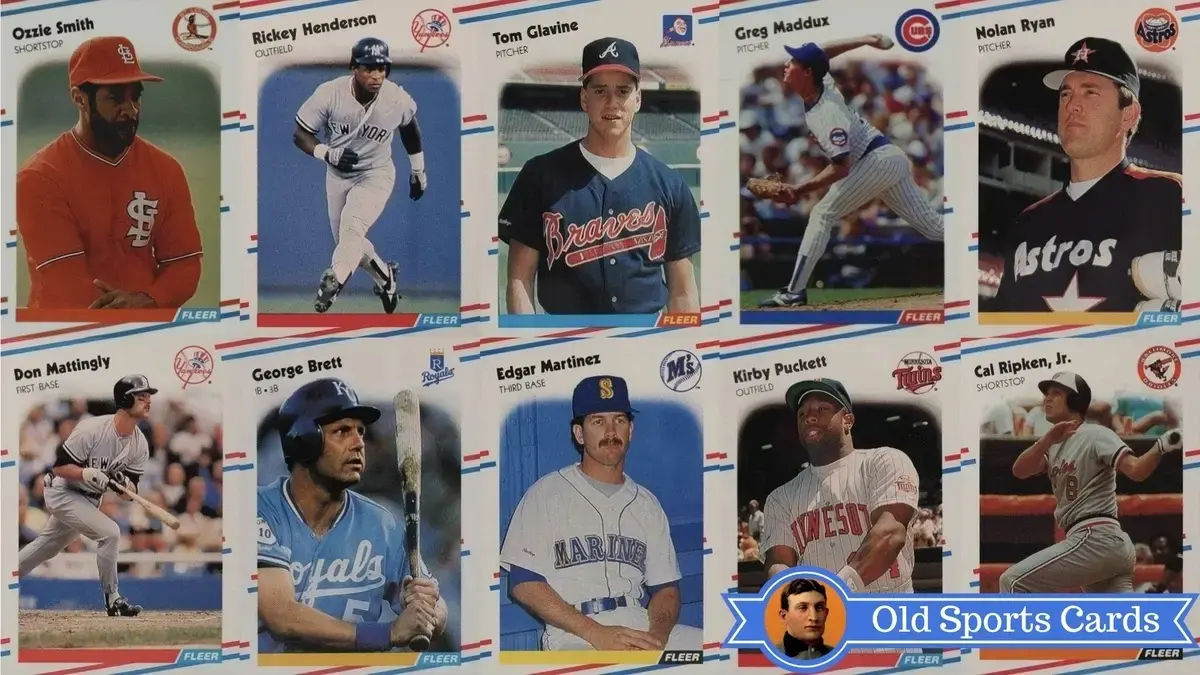
For all the mass production that occurred in the baseball card hobby in the late 1980s, I’ve always felt that the 1988 Fleer baseball cards still stood out…
The images were average but the red, white and blue design elements gave them a patriotic feel that made them pop.
Rookie cards of Edgar Martinez and Tom Glavine headline the checklist while many of the big name stars of the day are included as well.
And in this guide, I will cover the 30 most valuable cards in the set.
Let’s jump right in!
1988 Fleer Baseball Set Snapshot
Stay On Top Of The Card Market
Weekly pricing updates, grading insights, and new card guides — straight to your inbox. For free.
Join thousands of collectors. Unsubscribe anytime.

Ross Uitts – Owner
- #1
1988 Fleer #260 Bo Jackson
PSA 10 Value $125 – $135Total PSA Population 777PSA 10 Population 159PSA 10 Grade Rate 20.5% (Set Avg: 42.1%)Bo Jackson’s status as one of the most popular athletes in the world was at meteoric heights during the late 1980s and early 1990s.
The two-sport stud was all over the place thanks to Nike’s “Bo Knows” campaign and his legendary dominance in Nintendo’s “Tecmo Bowl”.
The fact that Jackson was able to play professional football and baseball at the same time was incredible enough.
The fact that he was both an NFL Pro Bowler and MLB All-Star, though, is just mind-blowing.
Kids who grew up idolizing him then are now adults who are always on the hunt for his cards in PSA 10 condition.

- #2
1988 Fleer #455 Nolan Ryan
PSA 10 Value $75 – $85Total PSA Population 1,108PSA 10 Population 395PSA 10 Grade Rate 35.6% (Set Avg: 42.1%)Another legend whose name you’ll routinely find at the top of any set in which he appeared, Nolan Ryan would spend his last year with the Astros in 1988.
Even at the age of 41, he led the National League in strikeouts with 228 and went on to win 12 games that season.
Fleer could’ve boosted this card’s appeal if they’d pictured Ryan throwing one of his blazing fastballs but apparently he was barely ready for a picture at all as he’s got his cleats tucked under his left arm.
Regardless, that retro Astros jersey and look on Ryan’s face help give this card some great pop.
- #3
1988 Fleer #214 Don Mattingly
PSA 10 Value $75 – $85Total PSA Population 368PSA 10 Population 144PSA 10 Grade Rate 39.1% (Set Avg: 42.1%)If you want to know just where Don Mattingly stood heading into the 1988 season, just read this headline from the April 3rd edition of the New York Times.
“EVERY PITCHER’S NIGHTMARE; Why Don Mattingly is Baseball’s Best Hitter” Over his previous four seasons, the New York Yankees icon hit a combined .337 with averages of 30 home runs and 121 RBIs per year.
Mattingly also did this with peak efficiency and patience, averaging a paltry 36 walks per year.
“I think he’s the greatest single player in our game,” Detroit Tigers manager Sparky Anderson said at the time.
Injuries would cut Mattingly’s Hall-of-Fame momentum in mid-stride, but things were still relatively on schedule in ’88.
The 27-year-old first baseman notched another All-Star appearance and Gold Glove, hitting .311 with 18 homers and 88 RBIs in 144 games.
The power numbers were down, and his OPS took a steep dive, but there didn’t seem to be too much to worry about.
At least, not yet.
- #4
1988 Fleer #322 Barry Bonds
PSA 10 Value $65 – $70Total PSA Population 744PSA 10 Population 186PSA 10 Grade Rate 25.0% (Set Avg: 42.1%)Like McGwire, Bonds’ career ended in controversy as he, too, was caught up in the PED scandal that rocked the sport for several years.
However, he’s still regarded as one of the most talented and skilled players who ever stepped onto the field.
His ability to hit, run, and field were off the charts even before he began using PEDs.
Like many of his early cards, Bonds is pictured here with a bright, beaming smile on his face looking primed to take over the league.
In his third full season that year, he’d go on to smack 24 home runs, drive in 58 RBI and score 97 runs.
- #5
1988 Fleer #378 Edgar Martinez Rookie Card
Rookie CardPSA 10 Value $50 – $55Total PSA Population 3,631PSA 10 Population 1,642PSA 10 Grade Rate 45.2% (Set Avg: 42.1%)To me, one of the most interesting things about Edgar Martinez is not that he was elected to the Hall of Fame as a designated hitter.
In fact, the DH tag doesn’t bother me one bit.
What surprises me most is how long it took for his career to really take off…
Martinez made his Minor League debut in 1983 at the age of 20 but it wasn’t until seven years later that he logged his first full season in the Majors.
His natural position was at third base and the Mariners for years were simply committed to other third basemen (namely Jim Presley) ahead of him until he finally got his shot in 1990.
However, Martinez will mostly be remembered for his work as a full-time DH that began during the 1995 season and tormented opposing pitchers for years to come.
- #6
1988 Fleer #624 Oakland Athletics Power Team
PSA 10 Value $45 – $50Total PSA Population 312PSA 10 Population 93PSA 10 Grade Rate 29.8% (Set Avg: 42.1%)While it may not be worth what it once was, this is a fantastic card that pictures one of the most iconic duos of the 1980s.
The “Bash Brothers” did nothing but send balls flying over the outfield wall during their prime time together and that’s one of the reasons the A’s would end up in the World Series that year.
That, and the fact that Canseco put up an MVP season and would enter the “40/40” club after belting 42 home runs and stealing 40 bases.

- #7
1988 Fleer #137 Gregg Jefferies Rookie Card
Rookie CardPSA 10 Value $45 – $50Total PSA Population 161PSA 10 Population 60PSA 10 Grade Rate 37.3% (Set Avg: 42.1%)It only took 29 games for Gregg Jefferies to get serious votes in the 1988 NL Rookie-of-the-Year balloting.
In fact, it was a small enough sample size that he qualified for RotY voting the next year, as well.
In just over a month of regular-season schedule time, Jefferies quickly emerged as one of the most valuable pieces of a star-studded roster.
With the NL East all but in the bag, manager Davey Johnson gave the 20-year-old plenty of run at both second and third base.
Jefferies paid Johnson back with a .321/.364/.596 slash, six homers, five stolen bases, and 17 RBIs in just 118 plate appearances (109 at-bats).
New York took the division by fifteen games, setting up a gargantuan NLCS showdown with the Los Angeles Dodgers.
Jefferies showed up with a similar level of punch.
He hit .333 during the seven-game tilt, reaching base nearly 44% (.438) of the time.
The Dodgers clipped the Mets in seven, ending Jefferies’ only career postseason series on a down note.
- #8
1988 Fleer #209 Rickey Henderson
PSA 10 Value $45 – $50Total PSA Population 290PSA 10 Population 119PSA 10 Grade Rate 41.0% (Set Avg: 42.1%)One of the most incredible things about Rickey Henderson’s 1988 season was not that he led the Majors with 93 stolen bases.
It’s that 93 stolen bases was just his fourth-highest total for a single season…
He’d already topped the 100 stolen base mark three times during his early years with Oakland.
Like Ripken’s record for consecutive games played, Henderson’s career records for stolen bases (1,406) and runs scored (2,295) will likely never be broken.
This is one of my favorite cards in the set as Rickey looks intensely-focused on stealing another bag.
- #9
1988 Fleer #276 Jose Canseco
PSA 10 Value $45 – $50Total PSA Population 158PSA 10 Population 49PSA 10 Grade Rate 31.0% (Set Avg: 42.1%)A decade or so before PED scandals ran rampant over baseball, the Steroid Era’s poster boy took one on the chin.
Oakland A’s slugger Jose Canseco bulked up considerably between his 1986 AL Rookie-of-the-Year campaign and the start of the 1988 season, raising eyebrows around the Majors.
Washington Post senior writer Thomas Boswell called him out for it on an episode of Charlie Rose’s Nightwatch, referring to the slugger’s assumed drug regimen as a “Canseco milkshake.” At this point, it was more of an eye test than anything else.
And while the tangible evidence seemed to support Boswell’s claim, Canseco still had the grounds to plausibly deny everything.
He also seemed to use the tabloid energy as fuel for a showcase season.
The first American League MVP since fellow Athletic Reggie Jackson (1973), Canseco topped the MLB leaderboards in home runs (42), RBIs (124), slugging percentage (.569), and OPS+ (170).
- #10
1988 Fleer #315 Mike Schmidt
PSA 10 Value $40 – $45Total PSA Population 266PSA 10 Population 142PSA 10 Grade Rate 53.4% (Set Avg: 42.1%)Mike Schmidt stuck it out with the Philadelphia Phillies through thick and thin.
From the highs of the team’s 1980 World Series win to the lows later in the decade, Schmidt stayed the course and kept hitting away.
That’s not to say that Schmidt was always happy.
After Philadelphia’s fourth consecutive playoff miss in 1987, the veteran slugger came out publicly to express his concern over the franchise’s trajectory.
However, considering he was entering his age-38 season, Schmidt still happily signed a two-year deal to ride off into the sunset as a Phillie.
Schmidt played only 108 games in ’88, his fewest in a non-strike-shortened season thus far.
Injuries were finally starting to pile up on him, and the Hall-of-Fame’s body didn’t have the same bounce-back that he was used to.
As such, Schmidt’s OPS dropped dramatically from .936 the year before to .742.
He’d play in just 42 more games before calling it quits.
- #11
1988 Fleer #539 Tom Glavine Rookie Card
Rookie CardPSA 10 Value $40 – $45Total PSA Population 4,495PSA 10 Population 1,913PSA 10 Grade Rate 42.6% (Set Avg: 42.1%)During the 1990’s, the Atlanta Braves had one of the most dominant starting rotations the game has ever seen.
And Tom Glavine was a big reason for that…
What he may have lacked in power, he more than made up for with intelligence and pinpoint control.
That consistency and discipline helped Glavine to win a total of 305 games placing him behind only Warren Spahn, Steve Carlton and Eddie Plank for most wins by a left-handed pitcher.
- #12
1988 Fleer #585 Tony Gwynn
PSA 10 Value $35 – $40Total PSA Population 265PSA 10 Population 99PSA 10 Grade Rate 37.4% (Set Avg: 42.1%) - #13
1988 Fleer #151 Darryl Strawberry
PSA 10 Value $35 – $40Total PSA Population 119PSA 10 Population 41PSA 10 Grade Rate 34.5% (Set Avg: 42.1%)Darryl Strawberry’s peak wasn’t long.
Drugs and personal issues made sure of that.
However, when he was at his best, few could claim to be better.
The very tippy top of Strawberry’s career came in 1988.
The New York Mets clubhouse was a mess, but there was still enough cohesion to reach 100 wins and secure a second NL East title in three years.
It was Strawberry’s bat that did a lot of the heavy lifting.
Second in the NL MVP race to eventual World Series hero Kirk Gibson, Strawberry led all NL hitters in home runs (39), slugging percentage (.545), OPS (.911), and OPS+ (165).
He struggled a bit in right field, but a near 40/30 season (29 stolen bases) more than made up for it.
Strawberry was also a reliable force in the NLCS, hitting .300 with a homer, five runs, and six RBIs.
However, the Mets still blew a 2-1 series lead, falling to the Dodgers in seven.
- #14
1988 Fleer #254 George Brett
PSA 10 Value $35 – $40Total PSA Population 220PSA 10 Population 114PSA 10 Grade Rate 51.8% (Set Avg: 42.1%) - #15
1988 Fleer #423 Greg Maddux
PSA 10 Value $35 – $40Total PSA Population 405PSA 10 Population 94PSA 10 Grade Rate 23.2% (Set Avg: 42.1%) - #16
1988 Fleer #570 Cal Ripken Jr.
PSA 10 Value $35 – $40Total PSA Population 417PSA 10 Population 201PSA 10 Grade Rate 48.2% (Set Avg: 42.1%)Baltimore Oriole legend, Cal Ripken Jr., will usually be found among the key cards of any set in which he appeared.
Arguably the greatest shortstop to ever play the game, Ripken will not only be remembered for his amazing playing abilities but for how long and consistently he was able to play.
In fact, his record for most consecutive games played of 2,632 is likely one of the records in all of sports that will never be surpassed again.
Many of the cards on this list and in this set were simple player poses so what I most enjoy about this particular card is the fantastic action shot of Ripken watching one fly off his bat.
- #17
1988 Fleer #286 Mark McGwire
PSA 10 Value $30 – $35Total PSA Population 639PSA 10 Population 142PSA 10 Grade Rate 22.2% (Set Avg: 42.1%)McGwire’s 1987 season was one of the best rookie seasons in the history of the game as he belted a then-rookie-record of 49 home runs.
That ability to hit the long ball made him a larger-than-life superstar.
From then on, McGwire was always one of the names kids were wanting to pull from packs.
We all know how his legacy will forever be tarnished by the PED scandal but there are collectors out there who still look for his cards in high grade.
- #18
1988 Fleer #19 Kirby Puckett
PSA 10 Value $30 – $35Total PSA Population 250PSA 10 Population 109PSA 10 Grade Rate 43.6% (Set Avg: 42.1%)Kirby Puckett took the Minnesota Twins’ 1987 world championship as a challenge.
Already the franchise’s golden boy after leading the Twins to their first Series win of the Minnesota era, Puckett leaned into fitness and conditioning in hopes of a repeat.
That included cutting red meat out completely and putting himself through a rigorous strength-training program with Minnesota Vikings punter Greg Coleman.
When Puckett emerged for the 1988 Spring Training slate, his body was transformed — leaner, more muscular, and quicker to everything.
It all funneled into the best individual season of Puckett’s career.
Finishing third for AL MVP with an All-Star nod and a Silver Slugger in his back pocket, the 28-year center fielder posted the highest batting average for an AL right-handed hitter (.356) since Joe DiMaggio in 1941.
Ultimately, Minnesota was unable to secure back-to-back rings.
Yet, each one of Puckett’s MLB-best 234 hits made it feel like they could.
- #19
1988 Fleer #47 Ozzie Smith
PSA 10 Value $30 – $35Total PSA Population 130PSA 10 Population 57PSA 10 Grade Rate 43.8% (Set Avg: 42.1%)When Ozzie Smith returned to Spring Training in 1988, he did it as a pariah to some.
The source of the stress was a preseason GQ interview in which the St. Louis Cardinals shortstop criticized multiple peers and colleagues, including Cards manager Whitey Herzog and soon-to-depart first baseman Jack Clark.
Smith took the latter to task for not attempting to play through injury during the 1987 Playoffs, stating that “a lot of players soured on Jack Clark when he didn’t try to come back.” Clark responded by ripping Smith in multiple interviews, even going so far as to say that Smith “must have done one too many backflips.” It was a petty feud and one of many distractions during a disappointing 76-win, fifth-place follow-up for St. Louis.
Smith acquitted himself well as the Cardinals slid, hitting .270, winning a Gold Glove, and posting more WAR (6.6 to 6.4) than during his run to runner-up for the ’87 MVP.
- #20
1988 Fleer #431 Ryne Sandberg
PSA 10 Value $30 – $35Total PSA Population 216PSA 10 Population 122PSA 10 Grade Rate 56.5% (Set Avg: 42.1%)Early in the 1988 season, Cal Ripken Jr. met the infamous Morganna the Kissing Bandit at home plate after a round-tripper.
An interloper who risked arrest nearly two dozen times in search of smooches, Morganna became a cult figure among baseball fans.
Later in the ’88 season, Morganna went for it again.
On August 8th, the Chicago Cubs tried to put the misery of another losing year behind them with the first-ever night game at Wrigley Field.
This was the franchise’s moment for a rare center-stage appearance, and it was also Morganna’s cue for a show.
Seconds before Cubs second baseman Ryne Sandberg stepped in for his first at-bat, Morganna leaped over the barricade and bee-lined for the Hall-of-Famer.
She was stopped short of her goal, but the interruption had a positive effect.
Sandberg homered on the first pitch he saw, a thrilling start to Wrigley’s night slate.
Sadly, the game was washed out by rain, and both Morganna’s and Sandberg’s efforts were all for naught.
- #21
1988 Fleer #641 Mark Grace Rookie Card
Rookie CardPSA 10 Value $30 – $35Total PSA Population 770PSA 10 Population 276PSA 10 Grade Rate 35.8% (Set Avg: 42.1%)Mark Grace may not be a Hall of Famer like the first two guys on this list but that doesn’t keep his rookie card from being much cheaper.
Kids who grew up collecting during the 1980s and 1990s remember how popular this guy and his rookie cards were.
The fact that he was a star for the Chicago Cubs, who have one of baseball’s most loyal fan following, certainly played into that.
Grace was a four-time Gold Glover at first base and could always be counted on for production at the plate.
Those kids who grew up watching him are now adults who still look for his rookie cards in high grade, which is why this one is worth around $30 in a PSA 10 holder.
- #22
1988 Fleer #544 Dale Murphy
PSA 10 Value $25 – $30Total PSA Population 126PSA 10 Population 84PSA 10 Grade Rate 66.7% (Set Avg: 42.1%) - #23
1988 Fleer #345 Wade Boggs
PSA 10 Value $25 – $30Total PSA Population 146PSA 10 Population 59PSA 10 Grade Rate 40.4% (Set Avg: 42.1%) - #24
1988 Fleer #567 Eddie Murray
PSA 10 Value $25 – $30Total PSA Population 87PSA 10 Population 45PSA 10 Grade Rate 51.7% (Set Avg: 42.1%)It didn’t matter that Eddie Murray put up Hall-of-Fame numbers in 1988.
There was no salvaging the relationship between the future 3,000 Hit Club member and the Baltimore Orioles.
Reports of tensions between Murray and the Baltimore front office had been swirling for years.
In 1987, a report came out that blasted Murray and painted him as sullen, combative, and desperate to be traded from the organization that drafted him.
Conditions only deteriorated from there.
As the Orioles skidded to a record 0-21 start, Baltimore fans turned their ire onto Murray.
It didn’t matter that the 32-year-old remained one of the game’s top sluggers, slashing .284/.361/.474 with 28 home runs, 27 doubles, and 84 RBIs.
Murray also showed up to work without fail, playing all 161 games for a directionless, basement-dwelling club.
Fans latched on to Murray’s reported disdain and fed it back, booing and jeering him until he was traded to Los Angeles in the offseason.
- #25
1988 Fleer #231 Eric Davis
PSA 10 Value $25 – $30Total PSA Population 48PSA 10 Population 28PSA 10 Grade Rate 58.3% (Set Avg: 42.1%)Was Eric Davis a victim of his own 1987 All-Star breakout?
If you listen to him recount things a year later after a frustrating follow-up, maybe.
“The way I started last year [1987], that doesn’t happen often,” Davis said.
“It was unfortunate, because that’s what people are going to expect me to do all the time.” In ’87, the Cincinnati Reds center fielder ascended to MLB superstardom with a near-40/40 effort that may have been even more impressive, considering it was actually 35/50 (37 home runs and 50 stolen bases).
Davis rode a torrid start to a top-ten MVP finish, a Gold Glove, and a Silver Slugger.
Now the bar was set incredibly high, and even more so in Reds fans’ eyes, considering the swirling rumors that he wanted out of Cincinnati.
So when Davis stumbled to start in ’88 on a freshly minted one-year deal, Reds fans got antsy.
Their anxiety affects his mood, and everything felt off, even with his 26 home runs, 35 stolen bases, and second Gold Glove.
- #26
1988 Fleer #239 Barry Larkin
PSA 10 Value $20 – $25Total PSA Population 125PSA 10 Population 37PSA 10 Grade Rate 29.6% (Set Avg: 42.1%)There was a moment when Barry Larkin was the most complete ballplayer in Major League Baseball.
1987 was that moment.
A first-time All-Star, Larkin led the Cincinnati Reds through a back-and-forth pennant race, a slog that ended with the Reds at 87 wins, second in the NL West for a fourth consecutive year.
The 24-year-old did it all to keep Cincy competitive, pacing the Senior Circuit with 7.0 Wins Above Replacement.
You want elite defense?
Larkin was a Gold Glover in waiting.
You want speed?
The future Cooperstown inductee swiped a career-best 40 bases.
Larkin also had the bat to back up everything else.
He slashed .296/.347/.429 on the year with twelve home runs, 32 doubles, five triples, and 91 runs scored in 652 plate appearances (588 at-bats).
He may not have had the Q-factor of the great Ozzie Smith, but it still was just a matter of time before Larkin took over the mantle as the NL’s best shortstop.
- #27
1988 Fleer #169 Paul Molitor
PSA 10 Value $20 – $25Total PSA Population 74PSA 10 Population 33PSA 10 Grade Rate 44.6% (Set Avg: 42.1%)Paul Molitor played just one game at second base in the first half of the 1988 season.
Yet, somehow, he was still voted in as the AL’s starter for the Midsummer Classic.
The Milwaukee Brewers played it extremely safe with Molitor after offseason elbow surgery, relegating him to a DH role to start the season.
He was fresh off signing a two-year, $2.8 million deal, and the Brewers’ brass wanted to keep his bat in the lineup at all costs.
Eventually, he was moved back to his customary third base spot.
However, he was still put on the All-Star ballot at second after playing a few games there to end the ’87 campaign.
It was a technicality, and made for a weird sight when Molitor opened the All-Star festivities at the four.
Positional weirdness aside, Molitor had another Hall-of-Fame caliber season, slashing .312/.384/.452 with 13 home runs, 41 stolen bases, 115 runs, and 60 RBIs in 154 games.
- #28
1988 Fleer #178 Robin Yount
PSA 10 Value $20 – $25Total PSA Population 117PSA 10 Population 67PSA 10 Grade Rate 57.3% (Set Avg: 42.1%)Robin Yount suited up every day and balled out in 1988.
It was the second year of a late-career Renaissance for the Milwaukee Brewers center fielder, one that culminated with a second MVP in ’89 (and subsequent trip to Cooperstown).
’88 was a big step in that direction.
Yount played all 162 games for the third-place Crew, the first and last time he suited up for an entire regular season.
He hit over .300 (.306) for the third consecutive year to go along with 13 home runs, 190 hits, 38 doubles, 63 walks, and 92 runs scored in 696 plate appearances (621 at-bats).
Yount also possessed top-shelf speed, even at 32 years old and fifteen years deep into his MLB career.
Not only did he steal a career-high 22 bases, but he also legged out eleven triples to pace the American League.
His 5.7 WAR placed him in the top ten of the superstar-laden Junior Circuit.
- #29
1988 Fleer #349 Roger Clemens
PSA 10 Value $20 – $25Total PSA Population 321PSA 10 Population 194PSA 10 Grade Rate 60.4% (Set Avg: 42.1%)No one could stop Roger Clemens in the 1980s.
Heck, there was no stopping Clemens throughout his unparalleled 24-year career.
Seven Cy Youngs, an MVP, two pitching Triple Crowns, and two World Series titles.
If not for his disgraced status due to PED usage, Clemens could have conceivably been a unanimous first-ballot Hall-of-Famer.
However, it always seemed that Clemens was insistent on shooting himself in the foot over and over again.
Whether it was minor kerfluffles like his choice to miss his son’s birth for a random start in 1988, or his “diva” comments about the rigors of travel and carrying your own bags after the season, there was no moment that Clemens wasn’t seemingly willing to stick his foot in his mouth.
Often, it made his pitching contributions feel less, somehow.
Even his AL-best 14 complete games and MLB-leading eight shutouts during the ’88 season weren’t enough to keep Clemens’ nose clean in the eyes of the baseball world.

Ross’s Take
While they may not have much value today, the 1988 Fleer set definitely packed a lot of star power.
And the design was truly unique..
Within the 660-card set, there were also several different subsets at the back-end, including: Super Star Specials (#622-640) Major League Prospects (#641-653) Checklists (#654-660) Add in a couple of Hall of Fame rookie cards in Martinez and Glavine and it really is a pretty decent set overall if for nothing else than nostalgia.
And for those of us who grew up collecting these as kids, they’ll always have a huge nostalgic factor to them despite not having the most monetary value.
Love old cards? Get weekly updates from a fellow collector.
Pricing updates, grading insights, and new guides on the cards you actually care about — the junk wax era, vintage, and everything in between. One email a week. No fluff.
Free. No spam. Unsubscribe anytime.
Ross Uitts – Owner
