
25 Most Valuable 1960 Topps Baseball Cards

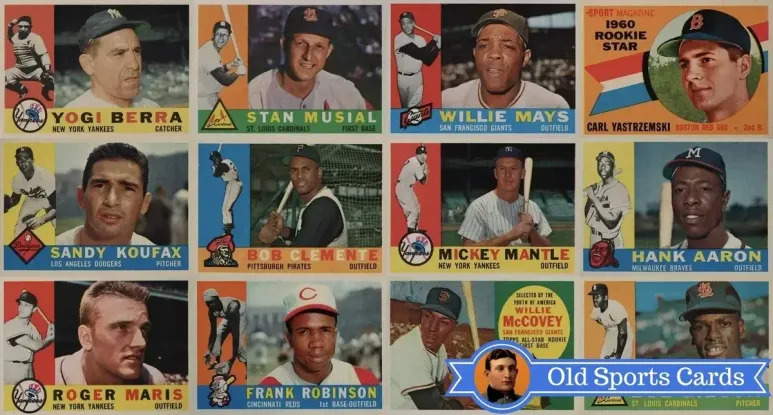
To kick off a new decade, 1960 Topps baseball cards hit the market with a new design concept that Topps hadn’t tried before.
Horizontal layouts were something they’d featured before, sure.
But this time, the cards featured a split-pane look, dual player images, and player names where every other letter alternated in color.
Along with the usual key cards of Mantle, Aaron, Mays, and Clemente the rookie cards of Carl Yastrzemski, Jim Kaat and Willie McCovey headline the set.
It’s a set full of color and great eye appeal that many collectors love and enjoy to this day.
And in this guide, we look at the 25 most valuable.
Let’s jump right in!
1960 Topps Baseball Set Snapshot
SET DETAILS
572
Carl Yastrzesmki, Willie McCovey, Jim Kaat
Mickey Mantle, Hank Aaron, Roberto Clemente, Willie Mays, Sandy Koufax
GRADING ANALYSIS
385,187
TOTAL GRADED BY PSA
84,191
PSA 8 Population
21.9%
PSA 8 Grade Rate
MOST GRADED CARDS
1
#148 Carl Yastrzemski Rookie Star
3.4%
12,941
2
#350 Mickey Mantle
3.4%
12,908
3
#326 Bob Clemente
2.3%
8,835
Need Help Selling Your Sports Cards?
Fill out the form below and I’ll get back to you within 24 hours. No obligation.

Ross Uitts – Owner
- #1
1960 Topps #350 Mickey Mantle
PSA 8 Value $10,000 – $10,250Total PSA Population 12,908PSA 8 Population 320PSA 8 Grade Rate 2.5% (Set Avg: 21.9%)The New York Yankees didn’t lose much with Mickey Mantle in pinstripes.
The times they did, though, stung him like nothing else.
In 1960, the underdog Pittsburgh Pirates upended the dynastic Yanks with one of the most replayed home runs in playoff history.
Bill Mazeroski’s walkoff blast denied the Bronx Bombers a third World Championship in five years, lifting the Buccos to their first title in 35 years.
Even Mantle’s five previous rings weren’t enough to soften the blow.
“I’m slumped in a stool, feeling so low that I can hardly peel off my uniform.
In all my World Series experience, that was the only time when I really thought the better team had loSt.” It was one heck of a gut kick.
Mantle finished second to teammate Roger Maris for AL MVP and followed that up with a .400 average and three homers against Pittsburgh.
Still, the Yankees coughed up a 2-1 series lead to squander a golden opportunity for another Fall Classic win.

- #2
1960 Topps #451 Curt Simmons
PSA 8 Value $6,250 – $6,500Total PSA Population 524PSA 8 Population 37PSA 8 Grade Rate 7.1% (Set Avg: 21.9%) - #3
1960 Topps #300 Hank Aaron
PSA 8 Value $4,400 – $4,500Total PSA Population 6,631PSA 8 Population 209PSA 8 Grade Rate 3.2% (Set Avg: 21.9%)Hank Aaron wasn’t the most prolific home run hitter year to year.
At one point, one of his Hall of Fame teammates had a significant edge in the chase for Babe Ruth’s hallowed career record.
On June 12th, 1957, Eddie Mathews crushed his 200th career home run in just his 779th career game.
At the time, the Milwaukee Braves legend was the second-fastest to 200 in MLB history, bypassing Ruth and trailing only Pittsburgh’s Ralph Kiner.
Three years later, Aaron launched his own 200th.
It took him nearly 200 more games than Mathews to reach that plateau, a pace that doesn’t even rank in the Top 50 all time.
Well, about that.
Mathews suffered a serious shoulder injury in his early 30s that likely cost him 100 home runs or more.
He ultimately finished with 512.
Aaron, on the other hand, hit at least 25 bombs in all but one year from 1955 to 1973 and bypassed Ruth’s 714 in 1974 at the age of 40.
- #4
1960 Topps #200 Willie Mays
PSA 8 Value $3,300 – $3,400Total PSA Population 8,672PSA 8 Population 332PSA 8 Grade Rate 3.8% (Set Avg: 21.9%)1960 was the equivalent of a loading screen for one of the best teams of the forthcoming decade.
In their third year on the West Coast, the San Francisco Giants continued to weave together the young talent that would carry them forward with the stalwarts from the team’s last New York hurrah.
Willie McCovey had a rough second year, and Orlando Cepeda did fine in his third, ultimately holding the Giants’ collective heads above water for their third consecutive winning season in California.
The slide back to fifth in the National League was concerning, but the promise of that 22-year-old duo and the presence of the GOAT, Willie Mays, made it easier to relax.
In his age-29 season, Mays led all of baseball in hits (190) while topping the game in WAR (9.5) for the second time in three seasons.
The third-place finisher for league MVP checked off the 100/100 box yet again (107 runs, 103 RBIs) and posted his sixth straight 20/20 campaign with 29 home runs and 25 steals.
- #5
1960 Topps #316 Willie McCovey Rookie Card
Rookie CardPSA 8 Value $3,300 – $3,400Total PSA Population 7,384PSA 8 Population 301PSA 8 Grade Rate 4.1% (Set Avg: 21.9%)Maybe Willie McCovey’s sophomore season didn’t jinx him in 1960.
Maybe it was San Francisco Giants manager Bill Rigney.
“If anyone’s immune to the sophomore jinx, it’s got to be McCovey,” Rigney said of the reigning NL Rookie-of-the-Year before the ’60 campaign.
“His hitting is fundamentally too sound.” Well, about that.
After 52 games of pure electricity in 1959, McCovey looked skittish.
He struggled to sit back on anything, especially if he was going lefty/lefty.
Pitchers got him out in front early, and it only got worse as the season progressed.
By June, McCovey’s mechanics tanked.
He was sent down to the Minors for a 17-game stay in July, but never truly got on track upon his return.
Overall, the 22-year-old slashed .238/.349/.469 with 13 home runs in 101 games.
He hit 13 home runs in nearly half the games (52) one year before.
McCovey’s awful .129 clip against lefties was a big reason for his regression.
- #6
1960 Topps #148 Carl Yastrzemski Rookie Card
Rookie CardPSA 8 Value $2,900 – $3,000Total PSA Population 12,941PSA 8 Population 591PSA 8 Grade Rate 4.6% (Set Avg: 21.9%)In 1960, Carl Yastrzemski got a first-hand glimpse at his future.
A year before his official Big League debut with the Boston Red Sox, 20-year-old Yaz got the chance to train with the Sox before his Minor-League assignment.
It was an eye-opening moment for the kid.
Boston’s management placed Yastrzemski’s spring locker next to that of the great Ted Williams, hoping he’d glean a few things from one of the greatest ever.
The 41-year-old Williams didn’t talk much to Yaz, but the mere presence of the GOAT next to him helped Yastrzemski sharpen his preparation for the seasons and decades to come.
It also helped plenty in the short term.
Yastrzemski burned through the competition for Triple-A Minneapolis, slashing .339/.391/.467 in 148 games with seven home runs, 36 doubles, 16 stolen bases, and 69 RBIs in 148 games.
Yastrzemski finished just short of 200 hits (193) and a league batting title (2nd by three points), yet earned a starting spot in 1961 and kept it for 22 more years.
- #7
1960 Topps #563 Mickey Mantle All-Star
PSA 8 Value $2,000 – $2,050Total PSA Population 5,898PSA 8 Population 562PSA 8 Grade Rate 9.5% (Set Avg: 21.9%) - #8
1960 Topps #326 Roberto Clemente
PSA 8 Value $1,800 – $1,850Total PSA Population 8,835PSA 8 Population 622PSA 8 Grade Rate 7.0% (Set Avg: 21.9%)Roberto Clemente was consistently great every day of the 1960 calendar.
After suffering through an arm injury that cost him a significant chunk of the ’59 campaign, Clemente came to Spring Training the healthiest he’d been in a long time.
He also returned to the club with a full season of winter ball under his belt.
So, when April hit, the 25-year-old right fielder was already in midseason form.
By the end of April, Clemente was flirting with .400 (.386) as the Pirates got off to a blistering 11-3 start.
Both Clemente and the Buccos cooled off somewhat, but not enough to deny them their destinies.
95-win Pittsburgh outdistanced an otherwise mediocre National League to take home the franchise’s first pennant in 33 years.
Clemente placed fourth in the NL batting race (.314), eleven points behind champ and teammate Dick Groat (.325).
Groat cooled off in October (.214), but Clemente did not, collecting a hit per game (.310) on the way to a legendary seven-game Series win over the Yankees.
- #9
1960 Topps #343 Sandy Koufax
PSA 8 Value $1,750 – $1,800Total PSA Population 7,765PSA 8 Population 536PSA 8 Grade Rate 6.9% (Set Avg: 21.9%)There were two Sandy Koufaxes:the .500 pitcher who trudged through the first six years of his career, and the “Left Arm of God” who redefined pitching the next six.
The turning point came in 1960.
Koufax’s sixth year with the Dodgers was exceedingly blah.
He pitched to a 101 ERA+ for fourth-place Los Angeles with an ERA fifteen points worse than league average (3.91).
When he was on, he could be lights out, as per his seven complete games and two shutouts.
However, he was more often inconsistent and ended up losing a career-worst 13 of his 21 decisions.
Something had to change.
And what it was, in the end, was actually something pretty simple and easily repeatable.
“He needs a loose wrist to get snap in the ball at the position of release, not more muscular tension,” battery-mate Norm Sherry said, referring to a Spring 1961 sitdown with Koufax.
“Why not have some fun out there, Sandy?
Don’t try to throw so hard and use more curve balls and change-ups.”
- #10
1960 Topps #73 Bob Gibson
PSA 8 Value $1,600 – $1,650Total PSA Population 4,762PSA 8 Population 192PSA 8 Grade Rate 4.0% (Set Avg: 21.9%)Bob Gibson’s first MLB manager, Solly Hemus, was a horrible fit.
He was also not the best person.
Hemus returned for his second stint with the St. Louis Cardinals in 1959, this time as a player/manager rather than just a utility infielder.
It was clear right off the bat that Hemus was prejudiced against his black players, hurling insults at them and repeatedly questioning their professionalism.
His actions got more virulent and pointed in 1960, and the clubhouse revolted.
Stuck in the middle of it was Gibson, an undeniably special 24-year-old right-hander looking to make a mark after an up-and-down rookie year.
Hemus jumped down Gibson’s throat regularly and moved him up and down from Triple-A over the first couple of months of the ’60 campaign.
The kid stuck for good by summertime, but the damage to his year had already been done.
Gibson ended 1960 with an unsightly 5.61 ERA in 27 appearances (12 starts).
He surrendered 97 hits in just 86.2 innings of work.
- #11
1960 Topps #446 Ellis Burton
PSA 8 Value $1,300 – $1,350Total PSA Population 460PSA 8 Population 56PSA 8 Grade Rate 12.2% (Set Avg: 21.9%) - #12
1960 Topps #10 Ernie Banks
PSA 8 Value $1,100 – $1,150Total PSA Population 4,741PSA 8 Population 243PSA 8 Grade Rate 5.1% (Set Avg: 21.9%)“I don’t try to hit home runs,” Chicago Cubs legend Ernie Banks once said.
“I just try to meet the ball and get base hits.
I’m not letting those strikes get by.” Nobody hit those strikes better and farther than Banks during his 1957-1960 peak.
From ’57 to ’59, Mr. Cub crushed 135 combined home runs on his way to four All-Star appearances and back-to-back MVP awards (1958 and 1959).
In 1960, Banks continued the onslaught.
One of the greatest fastball hitters of any era continued to clock heaters out at a blistering pace, finishing the year with an MLB-best 41.
During his four-year apex, Banks averaged 44 bombs a campaign.
To compare, one-time home-run champ Hank Aaron never averaged more than 40.75 in a four-season period.
Banks wasn’t just a one-trick pony, either.
He also led NL shortstops twice in fielding percentage during his peak (1959, 1960), earning his only career Gold Glove after the ’60 season.
- #13
1960 Topps #564 Willie Mays All-Star
PSA 8 Value $1,000 – $1,025Total PSA Population 3,341PSA 8 Population 225PSA 8 Grade Rate 6.7% (Set Avg: 21.9%) - #14
1960 Topps #116 Jim Rivera
PSA 8 Value $900 – $925Total PSA Population 326PSA 8 Population 53PSA 8 Grade Rate 16.3% (Set Avg: 21.9%) - #15
1960 Topps #489 Steve Ridzik
PSA 8 Value $825 – $850Total PSA Population 289PSA 8 Population 62PSA 8 Grade Rate 21.5% (Set Avg: 21.9%) - #16
1960 Topps #566 Hank Aaron All-Star
PSA 8 Value $800 – $825Total PSA Population 3,403PSA 8 Population 271PSA 8 Grade Rate 8.0% (Set Avg: 21.9%) - #17
1960 Topps #136 Jim Kaat Rookie Card
Rookie CardPSA 8 Value $750 – $775Total PSA Population 3,324PSA 8 Population 273PSA 8 Grade Rate 8.2% (Set Avg: 21.9%)The end of the Washington Senators was also the beginning of one of the longest, weirdest careers in MLB history.
Jim Kaat’s 6-foot-4 frame and deadly left arm made him an easy bonus signing for the Senators in 1957.
He worked his way up the farm ladder quickly, earning a few appearances in 1959 at just 20 years old.
One year later, Kaat was sent to Triple-A Charleston and became the youngest member of a starting rotation full of 20-something prospects.
His 7-10 record wasn’t great to look at, but his 3.82 ERA and wicked movement from the left side earned him his final, lasting Big League promotion.
Kaat wasn’t exactly elite to close out the Senators era, posting a 5.58 ERA over 50.0 innings.
Still, the office saw plenty in the 21-year-old in 13 appearances (nine starts) and inked him as a rotation centerpiece in their move to Minnesota.
He remained there for half of his topsy-turvy 25-year career.
- #18
1960 Topps #480 Yogi Berra
PSA 8 Value $700 – $725Total PSA Population 3,791PSA 8 Population 209PSA 8 Grade Rate 5.5% (Set Avg: 21.9%)Pittsburgh Pirates icon Bill Mazeroski’s walkoff homer in Game 7 of the 1960 World Series remains a must-tell moment in professional baseball.
But can you name the left fielder whose head Mazeroski blasted over the Series-winning home run?
That would be…Yogi Berra.
In his 1962 regular-season games, Berra spent 1,699 as a catcher.
As his career wound down, though, New York Yankees manager Casey Stengel (and later, Ralph Houk) worked hard to save Berra’s legs.
To do so, Stengel moved him into the corner outfield.
In 1960, Berra essentially split time between backstop, left, and right field.
By the World Series against Pittsburgh, he was entrenched in left with Elston Howard behind the plate.
The move was jarring.
Yet, it benefited Berra’s bat.
He made the double All-Star appearance in ’60 and placed 15th for MVP with a .276 average, 15 home runs, and 62 RBIs in 120 regular-season contests.
He followed that with a .318 average and a Game 7 homer in the Fall Classic.
(Not that homer, but a clutch one nonetheless.)
- #19
1960 Topps #377 Roger Maris
PSA 8 Value $675 – $700Total PSA Population 5,036PSA 8 Population 338PSA 8 Grade Rate 6.7% (Set Avg: 21.9%)The yin and the yang of Roger Maris’ New York Yankees career were on full display in 1960.
Maris was the prized pick of a seven-player deal with the Kansas City Athletics that shipped veterans Hank Bauer and Don Larsen westbound.
A year before his controversial chase-down of the great Babe Ruth, the 25-year-old left fielder began his Bronx Bombers tenure (as what seemed to be) the perfect complement to Mickey Mantle.
Maris was already an All-Star, and he hit like an MVP to start 1960.
He banged out two home runs on Opening Day and crossed 30 bombs by early AuguSt. With him beside Mantle in the lineup, the Yankees slugged their way past a rough start to down the Orioles and win yet another pennant.
But all was not exactly well.
Maris went through a laundry list of injuries down the stretch and looked compromised in the World Series against Pittsburgh.
He hit .267 with two home runs in the Series, but the Yankees fell in seven to Bill Mazeroski’s big blaSt.
- #20
1960 Topps #250 Stan Musial
PSA 8 Value $625 – $650Total PSA Population 5,367PSA 8 Population 397PSA 8 Grade Rate 7.4% (Set Avg: 21.9%)Consider this: St. Louis Cardinals legend Stan Musial hit .288 or worse in four of his final five seasons, yet still posted a career average of .331, ranking just outside the Top 30 all time.
Not even a pronounced half-decade decline could dent the armor of “The Man.” After hitting .337 in 1958, Musial dipped to .255 in ’59 as age and accumulated injuries took their toll.
The aches and pains lingered in his 1960 campaign, although his numbers ticked up solidly.
In 116 games for the third-place Cardinals, the 39-year-old left fielder/first baseman slashed .275/.354/.486 with 17 home runs and 63 RBIs.
It was well off the pace of his seven batting championships and three MVP seasons, but it was still enough to earn a double All-Star nod and award consideration.
Musial’s final three years would be more of the same, save for a one-year resurgence in 1962 (.330).
- #21
1960 Topps #1 Early Wynn
PSA 8 Value $600 – $625Total PSA Population 1,454PSA 8 Population 99PSA 8 Grade Rate 6.8% (Set Avg: 21.9%)Early Wynn was already a surefire Hall of Famer before he improbably won the 1959 Cy Young Award at age 39.
Yet, he still had a couple of personal goals to attend to.
After ushering the Chicago White Sox to the team’s first pennant in 40 years, Wynn was happy to run it back in hopes of capturing an elusive first World Series title.
What’s more, Wynn sat at 271 career wins.
He wanted 300 wins, and he wanted them bad.
At least Wynn would get that wish.
The White Sox fought diligently to get back to the Series in ’60, falling short in third place at 87 wins.
What no one knew then was that it marked the start of yet another lengthy pennant drought on the South Side.
As for Wynn, he won 13 games to finish the campaign 16 shy of 300.
It would take plenty of ice packs and bandages to get it done, but Wynn got there with a solitary win with Cleveland in 1963.
- #22
1960 Topps #490 Frank Robinson
PSA 8 Value $575 – $600Total PSA Population 3,156PSA 8 Population 296PSA 8 Grade Rate 9.4% (Set Avg: 21.9%)Frank Robinson was, as he termed, a “one-track” baseball mind.
He aimed to intimidate and disrupt his opponents’ flow, whether through traditional or more unsavory means.
By his fifth year with the Cincinnati Reds in 1960, Robinson already had a checkered reputation.
He dared pitchers to hit him by looming over the plate and even injured Milwaukee Braves shortstop Johnny Logan for six weeks with a reckless, spikes-up slide.
Three years later, Robinson got into it with another Braves infielder, the great Eddie Mathews.
Robinson barreled into Mathews at third base with a vicious dive and was immediately roped into a fistfight.
The 24-year-old first baseman/left fielder was bloodied up badly by Mathews, but it didn’t deter him in the slighteSt. “I had a homer and a double, drove in one run, scored another, and made a catch that robbed Mathews of an extra-base hit,” Robinson said.
“We won the second game 4-0.
I won the fight.”
- #23
1960 Topps #50 Al Kaline
PSA 8 Value $480 – $490Total PSA Population 3,230PSA 8 Population 197PSA 8 Grade Rate 6.1% (Set Avg: 21.9%)Off-field problems threw a monkey wrench into Al Kaline and the Detroit Tigers’ 1960 season.
Well, perhaps a horseshoe is more like it.
Known for diversifying his investments in pursuit of financial independence outside baseball, Kaline got himself into deep water during the ’60 campaign in hopes of cutting some taxes off his ledger.
Per multiple reports, the 25-year-old Tigers outfielder accepted a deal with his outside business partner, Frank Carlin, to purchase a stable of racehorses.
At a time when sports betting was taboo and horse racing was seen as a degenerate’s passion, the press lambasted Kaline for his involvement.
Nothing Kaline or the Tigers did could stop the headlines from coming, especially as the team unraveled en route to 71 wins and a sixth-place finish.
Kaline was front and center in why things went south, both because of the distractions and an interminable season-long slump.
Kaline hit .278 with a .781 OPS in 1960, both marking his worst since his teens.
- #24
1960 Topps #493 Duke Snider
PSA 8 Value $460 – $470Total PSA Population 2,011PSA 8 Population 121PSA 8 Grade Rate 6.0% (Set Avg: 21.9%) - #25
1960 Topps #160 Rival All-Stars Mantle and Boyer
PSA 8 Value $450 – $460Total PSA Population 6,717PSA 8 Population 591PSA 8 Grade Rate 8.8% (Set Avg: 21.9%)

