
Barry Bonds Rookie Cards: Values, Grading and What’s Worth Buying

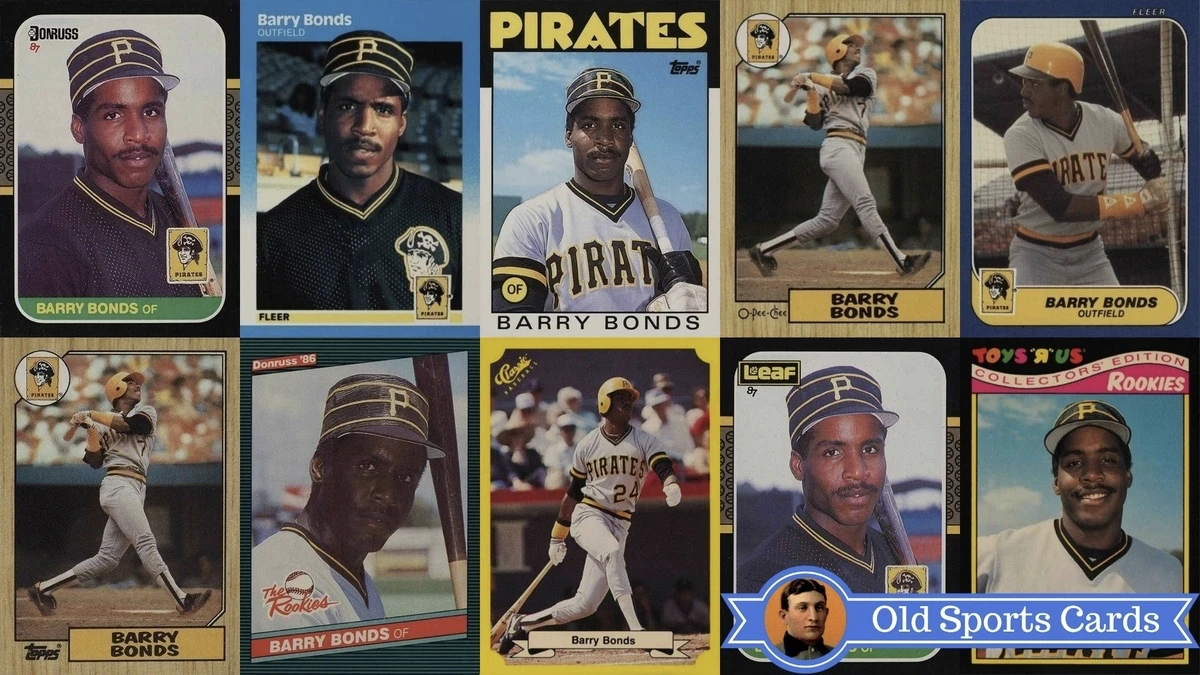
Barry Bonds is one of the most collected players to come out of the 1980s, and his rookie cards are where a lot of collectors start.
He doesn’t have one single rookie card though.
He has a whole group of them spread across 1986 and 1987, from affordable base cards to scarce parallels and a famous error card that runs well into five figures.
This guide breaks down every Bonds rookie and key early card, what each one is actually worth right now by grade, and which one is the smartest buy whether your budget is $50, $500, or $5,000.
I’ll also flag some variations that get faked and misrepresented often enough that you should never buy them raw.
By the end you’ll know exactly which Bonds rookie is right for you and what a fair price looks like.
Let’s jump right in!
QUICK FACTS
Most Valuable Rookie
1987 O-Pee-Chee 320 Barry Bonds Rookie Card
$27,500
Most Graded Rookie
1986 Topps Traded #11T Barry Bonds Rookie Card
63,543
LEAST VALUABLE ROOKIE
1986 Donruss Rookies #11 Barry Bonds Rookie Card
$400
Need Help Selling Your Sports Cards?
Fill out the form below and I’ll get back to you within 24 hours. No obligation.

Ross Uitts – Owner
Rookie Cards
These are the cards collectors mean when they say “Barry Bonds rookie.” His recognized true rookie is the 1986 Topps Traded, the first widely available card of his career, and the following year he landed in every major flagship base set: Topps, Fleer, Donruss, Leaf, and the Canadian O-Pee-Chee.
Together they make up the mainstream rookie tier, the cards you will see graded most often and the ones that anchor any Bonds collection.
The range here is wide.
You can own a recognizable PSA 9 for well under a hundred dollars, or chase a high-grade O-Pee-Chee that climbs into five figures because of how scarce it is in top condition.
Whatever your budget, this is where most collectors start, and there is a Bonds rookie at almost every price point.
-
1986 Donruss Rookies #11 Barry Bonds Rookie Card
PSA 10 Value $400Total PSA PopulationPSA 10 PopulationPSA 10 Grade Rate 0.0% (Set Avg: 0.0%)I’ll be honeSt. I never really warmed up to the design of the 1986 Donruss “The Rookies” set.
The endless thin stripes and the color scheme give this Bonds card a pretty odd look compared to his other rookies.
That said, it’s a legitimate 1986 rookie and the Donruss counterpart to the Topps Traded issue, so there’s real value here in top condition, around $350 for a top-graded example.

-
1986 Fleer Update #U-14 Barry Bonds Rookie Card
PSA 10 Value $1,000Total PSA PopulationPSA 10 PopulationPSA 10 Grade Rate 0.0% (Set Avg: 0.0%)I’ve always liked the design of the 1986 Fleer Update set.
This Bonds card has a lot going for it, with its blue borders, a bright yellow nameplate along the bottom, and a shot of him in the batting cage.
It’s one of his three major 1986 update-set rookies, right alongside the Topps Traded, and in top condition it can be worth just under $500.
-
1986 Topps Traded #11T Barry Bonds Rookie Card
PSA 10 Value $850Total PSA Population 63,543PSA 10 Population 5,131PSA 10 Grade Rate 8.1% (Set Avg: 10.3%)PSA Population Distribution
1731491617031,3423,17324,72825,6125,13112345678910This is the one most collectors point to as Barry Bonds’ true rookie card.
That bright yellow “Pirates” lettering across the top and the striped pillbox cap make it instantly recognizable, and it’s the card that anchors any Bonds rookie collection.
Because Topps printed the standard Traded card in big quantities, it’s very obtainable in high grade.
A PSA 10 runs around $600, which is a lot of card for the money.
There’s also a scarcer Tiffany version printed on brighter, higher-quality stock.
The quickest way to tell the two apart is the two small stars in the lower-left corner of the reverse, which appear on the standard card but not the Tiffany.
-
1987 Donruss #361 Barry Bonds Rookie Card
PSA 10 Value $425Total PSA Population 31,472PSA 10 Population 2,017PSA 10 Grade Rate 6.4% (Set Avg: 13.5%)PSA Population Distribution
323422659452,91812,28612,4322,01712345678910The standard 1987 Donruss is about as accessible as a Bonds rookie gets, and there’s nothing wrong with that.
It’s the card a whole generation of us pulled out of wax, that black-and-gold border framing a young Bonds in his Pirates uniform.
It was produced in huge numbers, so even nice raw copies are cheap.
But that black border is unforgiving, chipping at the corners, so a true PSA 10 is tougher than the low price suggests.
Expect a top example to land around $235.
If you just want an affordable, recognizable Bonds rookie to own, this is the one to start with.
-
1987 Fleer #604 Barry Bonds Rookie Card
PSA 10 Value $515Total PSA Population 30,476PSA 10 Population 1,293PSA 10 Grade Rate 4.2% (Set Avg: 12.6%)PSA Population Distribution
157461836281,87512,88711,4791,29312345678910The 1987 Fleer is one of the cleaner-looking Bonds rookies, with that simple blue-and-white striped border framing a young Bonds at the plate.
It’s affordable and easy to find, but high grade still carries real value.
Figure around $365 for a top example.
Fleer also issued a scarcer Glossy version on higher-quality stock with a glossy finish, printed in much smaller numbers, so it commands a premium over this standard card.
-
1987 Leaf #219 Barry Bonds Rookie Card
PSA 10 Value $4,250Total PSA Population 2,718PSA 10 Population 108PSA 10 Grade Rate 4.0% (Set Avg: 0.0%)PSA Population Distribution
2417591804101,15669110812345678910The 1987 Leaf is the one a lot of collectors overlook, and that’s exactly why I like it.
Leaf was the Canadian counterpart to Donruss, so it shares that same black-bordered design, but it was printed in far smaller numbers, which makes it much tougher to find than its American cousin.
Those black borders are brutal in high grade.
The slightest chipping shows, so clean PSA 9s and 10s are genuinely scarce.
That scarcity is why a top example can run around $1,500 while the regular Donruss sits in the low hundreds.
If you want a Bonds rookie most people don’t have, the Leaf is the smart pull.
-
1987 O-Pee-Chee 320 Barry Bonds Rookie Card
PSA 10 Value $27,500Total PSA PopulationPSA 10 PopulationPSA 10 Grade Rate 0.0% (Set Avg: 0.0%)The Canadian counterpart to his regular 1987 Topps issue, this O-Pee-Chee version is one of his most expensive, and it didn’t take an error to get there.
The young slugger is shown hitting a towering shot high into the air in his Pittsburgh Pirates uniform.
It’s incredibly difficult to find in pristine condition, but if you land one, you’ll see them sell for around $12,000.
-
1987 Topps #320 Barry Bonds Rookie Card
PSA 10 Value $750Total PSA Population 31,218PSA 10 Population 1,773PSA 10 Grade Rate 5.7% (Set Avg: 18.4%)PSA Population Distribution
15461423548461,9004,13412,3808,9111,77312345678910For a lot of collectors, this is the Bonds rookie.
It’s his first card in Topps’ flagship base set, wrapped in that unmistakable 1987 wood-grain border.
It was produced in enormous numbers, so it stays affordable.
Even a PSA 10 sits around $350, and that accessibility is exactly why it’s the most widely owned Bonds rookie and a great entry point.
Topps also released a much scarcer Tiffany version on glossy, higher-quality stock that trades for far more, but the standard card is the one most people start with.
Other Early Key Career Cards
Beyond the mainstream rookies, Bonds has a deep group of early cards that serious collectors chase.
This is where the premium parallels live: the 1986 Topps Traded Tiffany along with the 1987 Fleer Glossy and Topps Tiffany, all printed on better stock in far smaller numbers, so they carry a real premium over their standard versions.
You will also find his other 1986 update-set rookies here, the Fleer Update and the Donruss “The Rookies,” plus the oddball 1987 Classic Travel Update and its scarce green-back variation.
The headliner, though, is the 1987 Donruss Opening Day error, the famous card that pictures Johnny Ray instead of Bonds.
It is one of the most recognizable error cards of the decade and one of the most valuable cards in this whole guide.
If you already own the mainstream rookies, this is where it gets fun.
-
1986 Topps Traded Tiffany #11T Barry Bonds
PSA 10 Value $14,500Total PSA PopulationPSA 10 PopulationPSA 10 Grade Rate 0.0% (Set Avg: 0.0%)The Tiffany version of the 1986 Topps Traded is the chase card of Bonds’ rookies.
It carries the same instantly recognizable design, that huge yellow “Pirates” lettering and striped cap, but Topps printed the Tiffany on higher-quality stock and in far smaller quantities.
That scarcity is everything.
In top condition a Tiffany can easily reach around $10,000, a massive premium over the standard card.
Aside from the brighter stock, the easiest tell is on the reverse.
The Tiffany lacks the two small stars in the lower-left corner that appear on the standard Topps Traded.
You can see the difference in the pictures below.
-
1987 Classic Travel Update #113 Barry Bonds Green Back
PSA 10 Value $6,500Total PSA PopulationPSA 10 PopulationPSA 10 Grade Rate 0.0% (Set Avg: 0.0%)Classic was never quite as popular as the mainstream brands like Topps, Fleer, and Donruss, but I remember their cards getting plenty of attention back in the day.
In 1987 they produced this sharp-looking Bonds card, a great action shot framed by bright yellow borders.
There are two different backs: a yellow one and a green one.
The green-back variation is far rarer and worth much more as a result, and it’s the version that climbs toward $1,000.
-
1987 Donruss Opening Day #163 Barry Bonds Johnny Ray Error
PSA 10 Value $20,000Total PSA PopulationPSA 10 PopulationPSA 10 Grade Rate 0.0% (Set Avg: 0.0%)I’ll never forget looking up prices in a Beckett guide as a kid and running across the 1987 Donruss Opening Day section… I was stunned when I saw the price next to the Barry Bonds error card.
My next move was to go diving through my own cards to see if I had one.
I did not… I didn’t know it at the time, but these errors only turned up in factory sets, and all of my Donruss Opening Day cards had been pulled from packs.
This card, with Johnny Ray pictured on the front instead of Bonds, goes down in hobby history as one of the most recognizable error cards ever produced.
Its value has held up extremely well over time, around $15,000, making it one of the top cards of the ’80s.
-
1987 Fleer Glossy #604 Barry Bonds
PSA 10 Value $800Total PSA PopulationPSA 10 PopulationPSA 10 Grade Rate 0.0% (Set Avg: 0.0%)Fleer’s Glossy version rewards collectors who pay attention.
It carries the same clean blue-and-white 1987 Fleer design as the standard issue, but with a high-gloss coating and a much smaller print run from Fleer’s glossy tin sets.
Better eye appeal plus real scarcity is what pushes a top example toward $750, well beyond the regular Fleer.
The gloss does make print defects and edge wear easier to spot, so condition matters even more here.
For a collector who already owns the mainstream rookies and wants something harder to track down, the Glossy is a satisfying next step.
-
1987 Topps Tiffany #320 Barry Bonds
PSA 10 Value $3,900Total PSA PopulationPSA 10 PopulationPSA 10 Grade Rate 0.0% (Set Avg: 0.0%)The 1987 Topps Tiffany takes that classic wood-grain Topps design and puts it on premium, glossy stock, and that’s what makes it one of Bonds’ priciest early cards.
While the standard 1987 Topps runs around $350 in top condition, the Tiffany trades much higher, toward $3,000, thanks to its higher quality and far smaller print run.
Two easy tells: the Tiffany’s reverse stock looks noticeably whiter and brighter, and it lacks the “PRTD.
IN U.S.A.” line next to the Topps copyright mark.
See the pictures below for a comparison.

Ross’s Take
So which Bonds rookie should you actually buy?
If you just want one and you’re done, get the 1986 Topps Traded.
It’s the recognized rookie, it’s easy to buy and sell, and a clean PSA 9 won’t cost much.
The 1986 Fleer Update is the smart second pickup, often cheaper than the Traded and arguably a better looking card.
Those two cover most collectors.
If you’ve got real money and patience, the Topps Traded Tiffany in PSA 10 is the one Bonds rookie with a true ceiling.
Buy it already graded and buy it for the eye appeal, not just the label.
And whatever you do, never buy a Tiffany raw, it’s the most faked card he has.
For collectors, PSA 9 across the board is the sweet spot.
For investors, it’s the Tiffany or nothing.
