
17 Most Valuable 1949 Bowman Baseball Cards

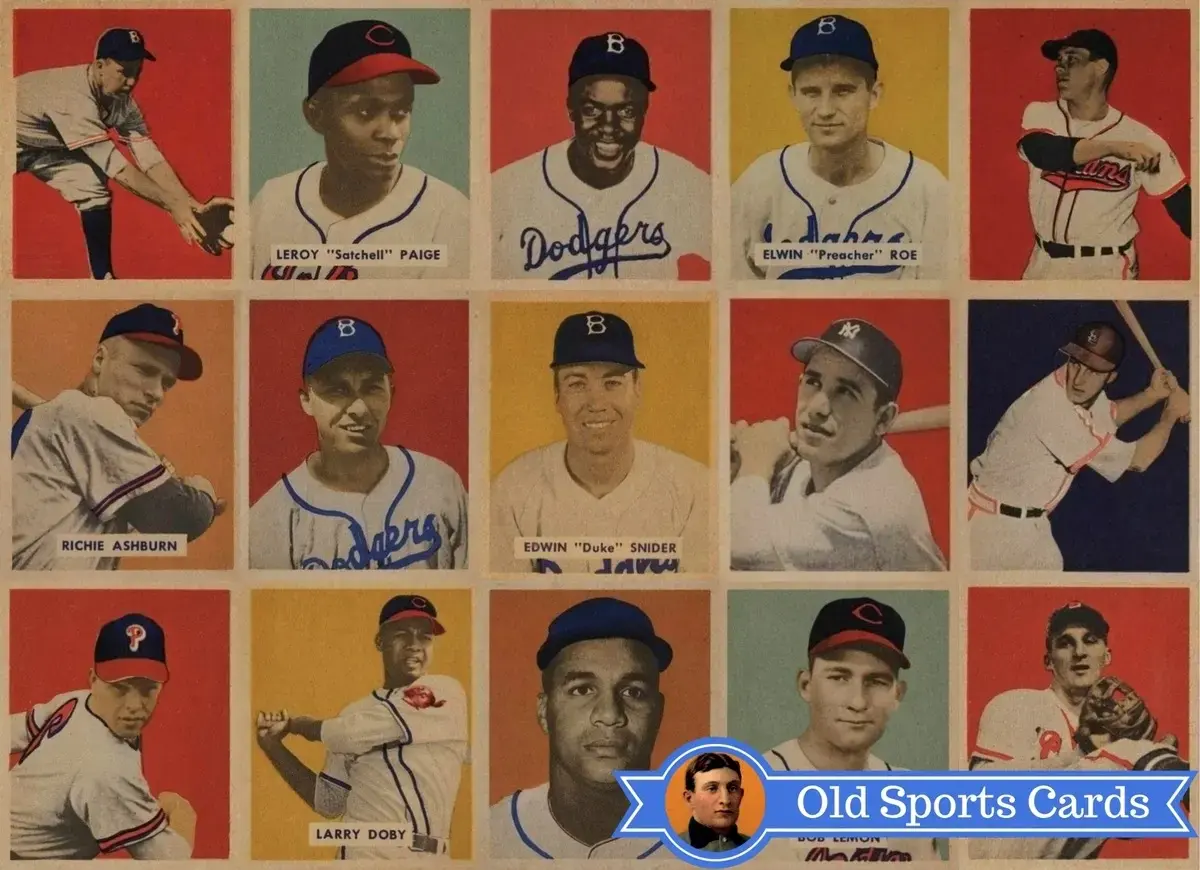
After launching the modern baseball card era in 1948, Bowman came back in 1949 with a bigger, bolder follow-up that has become one of the most historically important sets in the hobby.
Spanning 240 cards, the set featured colorized photos set against bright, hand-tinted backgrounds, a simple but charming look that defines the postwar era.
What truly sets 1949 Bowman apart is its rookie class, headlined by Jackie Robinson, Roy Campanella, Larry Doby, Satchel Paige, and Duke Snider.
Hall of Fame veterans like Yogi Berra, Stan Musial, and Bob Feller round out a deep and star-studded checkliSt. And as with most vintage sets, set builders chase the scarce high-number series, which climbs sharply in both difficulty and value.
No matter which card you’re after, the 1949 Bowman set stands as a landmark of the vintage era.
And in this guide, we’ll look at the 17 most valuable.
Let’s jump right in!
1949 Bowman Baseball Set Snapshot
SET DETAILS
240
Jackie Robinson, Larry Doby, Satchel Paige, Duke Snider, Roy Campanella
Yogi Berra, Stan Musial, Bob Feller, Pee Wee Reese
GRADING ANALYSIS
70,115
TOTAL GRADED BY PSA
4,448
PSA 3 Population
6.3%
PSA 3 Grade Rate
MOST GRADED CARDS
1
#50 Jackie Robinson
2.9%
2,010
2
#84 Roy Campanella
2.4%
1,676
3
#24 Stan Musial
2.0%
1,369
Need Help Selling Your Sports Cards?
Fill out the form below and I’ll get back to you within 24 hours. No obligation.

Ross Uitts – Owner
- #1
1949 Bowman #50 Jackie Robinson Rookie Card
Rookie CardPSA 3 Value $8,750 – $9,250Total PSA Population 2,010PSA 3 Population 194PSA 3 Grade Rate 9.7% (Set Avg: 6.3%)Jackie Robinson had one of, if not the, most important MVP seasons in baseball history.
In 1949, Robinson led a resurgent Brooklyn Dodgers through a frantic and furious NL pennant race to a one-game triumph over the St. Louis Cardinals.
The 30-year-old second baseman won his first and only batting title with a .342 average and topped the Majors in stolen bases (37).
Robinson also outdistanced a who’s who of Hall-of-Famers to lead everyone in WAR (9.3), sidestepping names like Stan Musial, Ted Williams, and Ralph Kiner.
A good portion of those wins came from Robinson’s glove work.
The first-time All-Star posted a sterling .981 fielding percentage at one of the game’s most taxing positions and turned an NL-best 119 double plays.
It was a legendary season, even when taken out of its social context.
The steely reserve it took for Robinson to become the first-ever African-American MVP in the game’s most intense market lifts Robinson’s exploits to the level of not just baseball history, but American history.

- #2
1949 Bowman #224 Satchel Paige Rookie Card
Rookie CardPSA 3 Value $5,750 – $6,000Total PSA Population 1,209PSA 3 Population 113PSA 3 Grade Rate 9.3% (Set Avg: 6.3%)It is cruel that Satchel Paige never faced MLB competition at the peak of his pitching powers.
The version of Paige that crossed the color barrier with the 1948 Cleveland Indians wasn’t on the same level.
That’s to be expected, considering Paige was 41 years old and 17 years into his professional baseball career.
What the Indians got was a wily veteran papering over depleted stuff with deception.
Paige was quite strong in his 1948 debut, pitching to a 2.48 ERA in 21 appearances (7 starts).
However, he didn’t have the stamina left to take on a true starter’s workload.
It was more of the same in 1949 with lower effectiveness.
Paige pitched ten more innings than ’48 (83) with a 4-7 record and 3.04 ERA.
Once among the most feared strikeout artists in the Negro Leagues, Paige struck out only 54 for a pedestrian 5.9 K/9.
It was a productive year, nonetheless.
It was also the last Paige played in Cleveland.
The Hall-of-Famer was released in the offseason after a change in team ownership.
- #3
1949 Bowman #233 Larry Doby
PSA 3 Value $1,500 – $1,550Total PSA Population 732PSA 3 Population 65PSA 3 Grade Rate 8.9% (Set Avg: 6.3%)In 1948, Larry Doby and Satchel Paige became the first African American teammates to win a World Series, just one year after Jackie Robinson brought the Majors to its point of integration.
It was a watershed moment for baseball and society as a whole.
It was also just the start of Larry Doby’s brilliant Hall-of-Fame career.
Nearly two years after he became the first black player in American League history, Doby was named to his first of seven consecutive MLB All-Star Games.
The 25-year-old Cleveland Indians outfielder hit the power switch, improving from 14 homers in ’48 to 24.
He would not dip below 20 bombs again until his injury-shortened 1957 campaign with the Chicago White Sox.
Doby ended the year slashing .280/.389/.468 for the third-place Indians with 25 doubles, ten stolen bases, 91 walks, 106 runs, and 85 RBIs in 147 games played.
His 650 plate appearances were the second-most of his 17-year professional career.
- #4
1949 Bowman #226 Duke Snider Rookie Card
Rookie CardPSA 3 Value $1,150 – $1,200Total PSA Population 982PSA 3 Population 78PSA 3 Grade Rate 7.9% (Set Avg: 6.3%)On October 2nd, 1949, Duke Snider unofficially became the man for the Brooklyn Dodgers and their rabid fan base.
Snider was already in place as the franchise’s future.
A half-decade after his first invite to Dodgers spring training, the 22-year-old center fielder was handed the keys to the middle of the Brooklyn batting order by manager Burt Shotton.
Sitting 3rd in the lineup amid a two-team pennant race with the St. Louis Cardinals, Snider slashed .292/.361/.493 with 23 home runs, 28 doubles, seven triples, 12 stolen bases, 100 runs, and 92 RBIs in 146 games.
His MLB-worst 92 strikeouts left room for improvement.
But, not a single one mattered on the final day of the ’49 regular season.
Nursing a one-game lead over the St. Louis Cardinals for the league title, the Dodgers entered the top of the 10th of Game #154 in a 7-7 tie with the third-place Phillies.
Snider did the deciding damage in front of 36,765 hostile Philly fans, plating Pee Wee Reese with the eventual game-winning and pennant-winning single.
- #5
1949 Bowman #84 Roy Campanella Rookie Card
Rookie CardPSA 3 Value $850 – $875Total PSA Population 1,676PSA 3 Population 195PSA 3 Grade Rate 11.6% (Set Avg: 6.3%)Integration moved full speed ahead in 1949, through the MLB All-Star Game and into the World Series.
It was a year of firsts.
Now locked in as the starting catcher of the Brooklyn Dodgers, Roy Campanella emerged as one of the most respected hitters in the Majors, as evidenced by his MLB-leading 17 intentional walks.
When the Dodgers called up Don Newcombe from the Minors, Campanella and Newcombe joined forces to become the first African-American battery in MLB history.
Already with a preexisting relationship from their time in the New England League, the duo joined teammate Jackie Robinson and Cleveland’s Larry Doby as the first black All-Stars.
Campanella caught the last five innings of the Midsummer Classic and caught every All-Star frame from there for the NL until the eighth inning in 1954.
He ended the year as a down-ballot MVP mention with a .287/.385/.498 slash with 22 home runs and 82 RBIs.
Campanella, Newcombe, and Robinson carried the Dodgers to the 1949 pennant, ultimately losing the trophy to the rival Yankees in five games.
- #6
1949 Bowman #24 Stan Musial
PSA 3 Value $800 – $825Total PSA Population 1,369PSA 3 Population 152PSA 3 Grade Rate 11.1% (Set Avg: 6.3%)There’s no Stan Musial season from his first 18 years in the Big Leagues that doesn’t scream Hall-of-Fame.
Take Musial’s 1949 season.
A year after winning his third NL batting title and leading all of baseball with a wow-inducing 11.3 WAR, the St. Louis Cardinals first baseman picked patience over everything.
Musial drew a career-high 107 walks for the second-place Cards, passing triple digits for the first time.
The 28-year-old used his keen eye to zero in on pitchers’ mistakes, parlaying it all into MLB bests in hits (207), doubles (41), and total bases (382).
Musial also sat atop the AL leaderboards for triples (13) and on-base percentage (.438) while placing second to MVP Jackie Robinson in WAR (9.2).
“The Man” finished runner-up to Robinson in that MVP race, the third of four consecutive years (and four of five) that Musial placed in the top two.
And to underline his importance to St. Louis in a fierce pennant race, he played in all 157 games (including three ties).
- #7
1949 Bowman #214 Richie Ashburn Rookie Card
Rookie CardPSA 3 Value $625 – $650Total PSA Population 693PSA 3 Population 81PSA 3 Grade Rate 11.7% (Set Avg: 6.3%)Richie Ashburn couldn’t build on the offensive promise of his 1948 debut in his sophomore season.
However, he made up for it with a historic defensive performance in center field.
The reigning Sporting News NL Rookie-of-the-Year was coming off a second-place finish in the league batting race (.333).
Expectations were sky-high for Ashburn and the Philadelphia Phillies in a top-heavy National League.
Frustratingly for Phillies fans, it never came together.
Philadelphia fell out of the pennant race after a 13-19 start to the second half.
Ashburn’s average dropped to .282, and his .342 on-base percentage is the worst of his 15-year Hall-of-Fame career.
Considering his pronounced lack of power, the sudden drops were troubling.
Ashburn’s defense was nowhere near as worrisome.
At just 22 years old, the Nebraska native became the most sure-handed center fielder baseball had to offer.
His 514 putouts set a new MLB record for the position, and his 3.42 range factor (putouts + assists divided by innings played) was also a baseball beSt.
- #8
1949 Bowman #60 Yogi Berra
PSA 3 Value $575 – $600Total PSA Population 1,188PSA 3 Population 120PSA 3 Grade Rate 10.1% (Set Avg: 6.3%)The New York Yankees front office had every intention of replacing Yogi Berra at catcher before the 1949 season.
Then, new manager Casey Stengel stepped in.
Berra was a below-average defensive catcher in his first full-time year with the 1948 squad.
New York’s pitching staff was inconsistent with Yogi behind the dish, and the reigning World Series champs fell to third in the AL standings (despite winning 94 games).
Stengal put a stop to THE replacement nonsense before the ’49 campaign.
Dubbing Berra his “assistant manager,” Stengal asked legendary backstop Bill Dickey to mentor the 24-year-old in plate mechanics.
Even though Berra struggled at times to call effective games and toss out baserunners, the effects of Dickey’s tutelage and Stengal’s trust did wonders.
Berra’s hitting slipped to a .277/.323/.480 slash as he worked on his defense.
On the other hand, he upped his power with 20 home runs in 54 fewer at-bats.
Most importantly, Berra was the on-field extension of Stengal during the team’s run to a second World Series title in three years.
- #9
1949 Bowman #100 Gil Hodges Rookie Card
Rookie CardPSA 3 Value $410 – $420Total PSA Population 1,034PSA 3 Population 102PSA 3 Grade Rate 9.9% (Set Avg: 6.3%)Gil Hodges was the anchor of the great Brooklyn Dodgers teams of the late 1940s and 1950s.
Often overshadowed by teammates Jackie Robinson and Duke Snider, Hodges was just as essential to Brooklyn’s run of six pennants and two World Series titles from 1949 through 1959.
Hodges’ breakout came in 1949 during a Dodgers youth movement.
Brooklyn remained patient with the second-year first baseman after a less-than-stellar rookie campaign.
Hodges posted negative WAR (-0.1) in that ill-fated ’48 debut.
One year later, Hodges was among baseball’s most productive first basemen.
His 23 home runs tied Snider for the Dodgers’ lead, and his 115 RBIs placed him second to Robinson.
Hodges played his first All-Star Game in front of his home fans in Brooklyn, joining six teammates on the squad.
Hodges was also among the lone hitting highlights for the Dodgers in their five-game World Series loss to the hated Yankees.
Despite a .235 average, the Hall-of-Famer drove in four of the team’s 14 runs.
- #10
1949 Bowman #238 Bob Lemon Rookie Card
Rookie CardPSA 3 Value $360 – $370Total PSA Population 538PSA 3 Population 69PSA 3 Grade Rate 12.8% (Set Avg: 6.3%)As Bob Feller transitioned out of his position as the Cleveland Indians’ ace, another Bob quickly came in to take over the role.
Bob Lemon burst into the national spotlight in 1948, earning his first All-Star nod and a top-five MVP finish.
He won both of his starts during the team’s World Series showdown against the Boston Braves, including the decisive Game 6.
Even though the Indians fell out of the championship conversation in 1949, Lemon continued to roll.
Named to another All-Star squad and placing in the top ten for MVP, the 28-year-old righty went 22-10 with a 2.99 ERA in 37 appearances (33 starts).
Lemon completed 2/3 of his starts, and his 279.2 innings ranked fifth in the Majors.
Feller’s up-and-down season forced the entire pitching staff to step up.
And, it was Lemon who answered the call loudeSt. He’d go on to make five more All-Star teams in a row, paving a smooth road for himself to Cooperstown.
- #11
1949 Bowman #46 Robin Roberts Rookie Card
Rookie CardPSA 3 Value $330 – $340Total PSA Population 998PSA 3 Population 108PSA 3 Grade Rate 10.8% (Set Avg: 6.3%)Robin Roberts wasn’t yet an All-Star-caliber starter in 1949.
He was still one heck of an innings eater for a Philadelphia Phillies team on the fringes of the NL pennant race.
Roberts was essentially manager Eddie Sawyer’s guy.
He led all starters on the team with 43 appearances, with 12 of those appearances coming in relief.
Only closer Jim Konstanty appeared more (53 games), and he went on to win the NL MVP award one year later.
As for Roberts, his results were essentially just above league-average.
He finished 15-15 for the year with a 3.69 ERA in 226.2 innings pitched.
Only rotation mate Ken Heintzelman and his league-leading five shutouts logged more.
It was a very demanding spot for a 22-year-old to be in, and Roberts did well in it.
His 106 ERA+ was strong considering his workload, and his ’49 experience proved pivotal in setting up his Hall-of-Fame run.
- #12
1949 Bowman #33 Warren Spahn
PSA 3 Value $310 – $320Total PSA Population 1,004PSA 3 Population 110PSA 3 Grade Rate 11.0% (Set Avg: 6.3%)As Warren Spahn stepped forward, the Boston Braves stepped back.
Neither would be long for the town.
A year after making the franchise’s second-ever playoff appearance, the reality of the Braves’ situation settled in.
The team’s ballpark, Braves Field, was falling apart.
The Boston Red Sox had the market locked down, and the Braves were treated mainly as an afterthought.
From there, it was a mess of bad contracts, bad vibes, and mutiny amongst the shipmates.
The 1949 Braves fell back to fourth place in the National League, and the clock began to tick until the team’s eventual move to Milwaukee (1953).
In the middle of all this chaos, Warren Spahn seemed undeterred.
The 28-year-old lefty was named to his second All-Star team and finished seventh for MVP despite the team’s struggles.
Spahn led the NL in wins (21), complete games (25), and strikeouts (151).
He added MLB bests in starts (38) and innings (302.1).
- #13
1949 Bowman #36 Pee Wee Reese
PSA 3 Value $200 – $205Total PSA Population 846PSA 3 Population 75PSA 3 Grade Rate 8.9% (Set Avg: 6.3%)What Pee Wee Reese brought to the great Brooklyn Dodgers teams of the late 1940s and 1950s can’t be overstated.
The veteran shortstop was the team’s captain, its nerve center.
Reese pushed all players with equal force and respect.
He didn’t waver or mince words when the team’s success was on the line.
“When Pee Wee told us where to play or gave some of us the devil, somehow it was easy to take,” Jackie Robinson said later.
“He just has a way about him of saying the right thing.” In 1949, Reese united the team in their march to the World Series.
He never took a day off, as evidenced by his MLB-leading 743 plate appearances.
The 30-year-old topped both 100 runs (an NL-best 132) and 100 walks (a career-best 116), and his .279 average was premium among MLB shortstops.
It was a near-perfect year for Reese.
A top-five MVP finish.
An All-Star appearance.
A pennant.
Only a title could have made it better.
(A lot better, but still.)
- #14
1949 Bowman #27 Bob Feller
PSA 3 Value $180 – $185Total PSA Population 821PSA 3 Population 77PSA 3 Grade Rate 9.4% (Set Avg: 6.3%)Cleveland Indians legend Bob Feller was little more than an average pitcher during the 1949 MLB season.
The signs were there that Feller’s stuff was starting to fade.
He had a good ’48 campaign for the World Series champs, but performed more like a mid-rotation veteran than the top-three MVP finisher of years paSt. His fastball lost some of its jump, and so did much of his strikeout power.
1949 was worse.
The bad feelings started on Opening Day when Feller strained his pitching shoulder.
He was removed from the game after two innings, yet the effects of the injury lingered on.
Feller was a .500 pitcher at the break and failed to make the All-Star team for the first time since 1937 (military service excluded).
Feller logged 211 innings in 35 appearances (34 starts).
It was his lightest workload since 1937.
By season’s end, Feller was 15-14 with a 3.75 ERA and 106 OPS+.
He struck out just 108, falling well short of his eighth consecutive strikeout crown.
- #15
1949 Bowman #162 Preacher Roe Rookie Card
Rookie CardPSA 3 Value $145 – $155Total PSA Population 297PSA 3 Population 34PSA 3 Grade Rate 11.4% (Set Avg: 6.3%)The 1949 Brooklyn Dodgers only took one game of that year’s World Series, but it was at least a memorable one.
Starting pitcher Preacher Roe was fantastic in his second year at Ebbets, finishing 15-6 with a team-best 2.79 ERA.
The 33-year-old lefty was maligned for his obvious use of the illegal “spitball,” and there was no year that the ball ducked and dived more than in 1949.
Cheating or not, Roe was among the best hurlers in the National League.
He was one of seven Dodgers players to appear in the All-Star Game at home in Brooklyn, and he finished with down-ballot MVP consideration.
Roe’s most significant moment came in Game 2 of the World Series.
Down a game to the Yankees after a 1-0 loss the night before, the Dodgers leaned on Preacher to give them a prayer.
He responded with a six-hit complete game shutout in front of a feverish Yankee Stadium crowd, silencing the Bombers in a 1-0 win.
It was Roe’s only appearance of the Series and the only game that Brooklyn was able to salvage.
- #16
1949 Bowman #85 Johnny Mize
PSA 3 Value $85 – $95Total PSA Population 406PSA 3 Population 32PSA 3 Grade Rate 7.9% (Set Avg: 6.3%)One team’s good riddance was another team’s fortune in August 1949.
The first four months of the season were torture for Johnny Mize.
His five years with the New York Giants (excluding his military service) were marked by numerous losses, and 1949 was no exception.
The Giants were now an NYC as the Dodgers and Yankees battled for championships.
It was excruciating for Mize, and the addition of new manager Leo Durocher wasn’t helping.
Durocher and Mize never saw eye to eye, and the losing didn’t help.
Sometimes, though, these things turn into fairytale endings.
Mize got his in an August trade to the Yankees.
Thrust into the role of pinch-hitter, the 36-year-old thrived with clutch hits galore.
Mize gutted through a bum shoulder to help New York clip the Red Sox for the AL pennant.
He followed that up with one of the biggest hits of the Yankees’ five-game Series triumph: a two-out, bases-loaded single in the ninth inning of Game 3 that plated the deciding runs.

- #17
1949 Bowman #98 Phil Rizzuto
PSA 3 Value $79 – $81Total PSA Population 763PSA 3 Population 68PSA 3 Grade Rate 8.9% (Set Avg: 6.3%)The New York Yankees kicked off an unprecedented streak of five consecutive World Series titles in 1949.
It’s not a coincidence that the team’s five-peat coincided exactly in time and length with the peak of Phil Rizzuto’s Hall of Fame career.
Rizzuto’s star skyrocketed in ’49.
The 31-year-old shortstop slashed .275/.352/.358 with five homers, 22 doubles, seven triples, 72 walks, 18 stolen bases, and 110 runs in 153 games played.
He was the catalyst, the starting point for the team’s historic offensive barrage.
Rizzuto’s most valuable asset, though, was his glove.
He was virtually impenetrable at perhaps the game’s most challenging position.
His .971 fielding percentage led the league, and his steady contributions prompted a New York Times writer to dub him the most “indispensable man” on the star-studded Yankees.
Rizzuto ended the year as the runner-up for AL MVP (Ted Williams) and a championship.
He’d go on to win the award the following year.
Rizzuto is one of several players in this set whose cards can be found in two variations: one with his name on the front and one without.
The variation without Rizzuto’s is much more common than the “No Name” variation.

Ross’s Take
This set ranks among the true cornerstones of the early post-war era.
Where some Bowman issues lean on their design, the 1949 set makes its mark with history and sheer star power.
This is the set that delivered the first cards of barrier-breaking legends Jackie Robinson, Roy Campanella, Larry Doby, and Satchel Paige, along with a young Duke Snider.
And the rest of the checklist is loaded with Hall of Famers.
Thanks to that historic significance, demand has only grown over the years, with the Jackie Robinson rookie leading the charge.
However, I think it still flies under the radar.
If you’re a vintage collector, this checklist is packed with must-haves.
