
12 Most Valuable 1992 Studio Baseball Cards

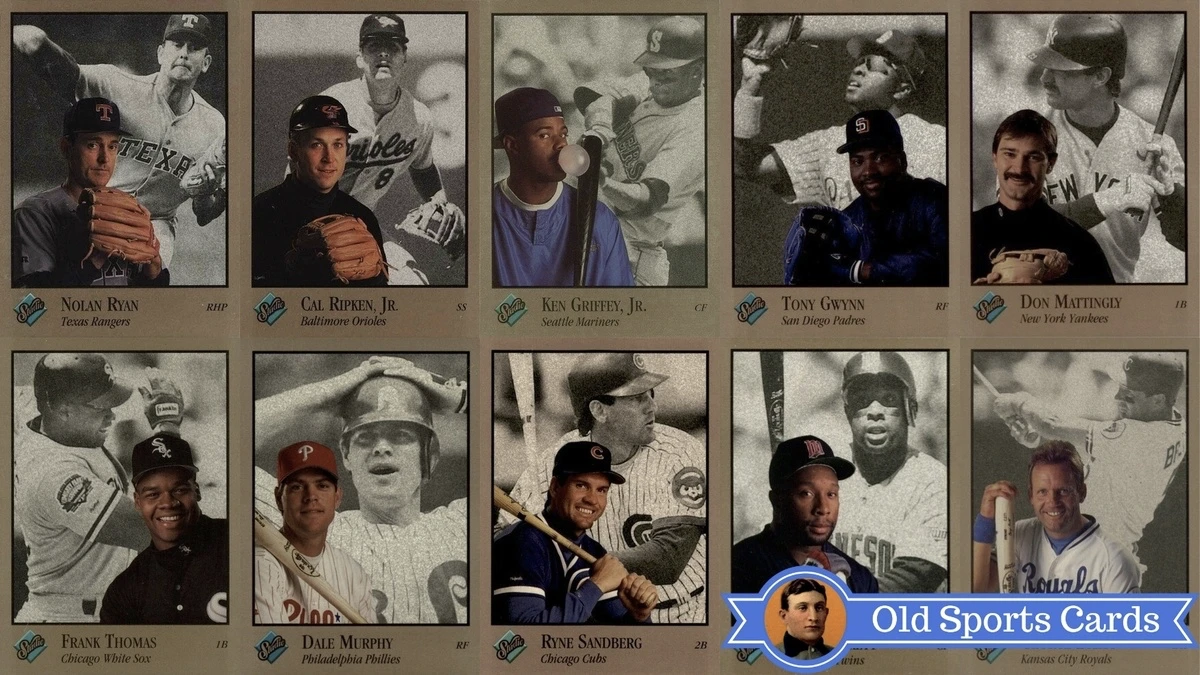
After mixed reviews to its 1991 Studio release, Leaf made a couple of glaring changes to its 1992 Studio baseball set to appeal to a wider audience.
The black and white studio shots were out and a mix of color and action photography was in…
Remember, studio photography was all the rage in the early 90s.
In an era before everyone had a cell phone with a high-quality camera, photo studios in places like Sears were often the only option for professional photography.
And ’91 Studio represented the style perfectly, showcasing popular MLB players in front of marble-toned studio backgrounds.
However, many collectors were turned off by the black and white photos.
Leaf responded with shaded black and white action shots in the background and offsetting color portraits in the foreground for ’92 Studio.
It was a welcome change.
And collectors were delighted that ’92 Studio kept the spirit of its predecessor by offering glimpses into players’ personal lives on the backs and, at times, goofy shots on the fronts.
Overall, the brand’s sophomore release was a success.
And in this guide, we’ll take a look at the 12 most valuable.
Let’s jump right in!
Stay On Top Of The Card Market
Weekly pricing updates, grading insights, and new card guides — straight to your inbox. For free.
Join thousands of collectors. Unsubscribe anytime.

Ross Uitts – Owner
- #1
1992 Studio #232 Ken Griffey Jr.
PSA 10 Value $300Total PSA Population 482PSA 10 Population 109PSA 10 Grade Rate 22.6% (Set Avg: 41.1%)The 1992 MLB All-Star Game was a second-generation showcase.
The Junior Circuit won their fifth straight Midsummer Classic, 13-6, on the backs of a trio of Major League sons: Cal Ripken Jr., Sandy Alomar Jr., and Ken Griffey Jr., the most impressive of all that day.
Undoubtedly the game’s most popular player in his fourth Big-League season, Junior took home MVP honors in San Diego with a 3-for-3 outing featuring a mammoth home run, a double, and two RBIs.
It was yet another scrapbook-worthy All-Star memory for the Griffey family.
Griffey Sr. and Jr. became the first father-son combo to hit back-to-back home runs on the All-Star stage two years before.
On this day, Griffey strung together back-to-back-to-back hits with Ripken and Alomar in what felt like an ultimate passing-of-the-torch moment.
The 22-year-old center fielder ended his third consecutive All-Star season with a .308 average, 27 home runs, 83 runs, 103 RBIs, and a third straight Gold Glove.

- #1
1992 Studio #248 Nolan Ryan
PSA 10 Value $225Total PSA Population 268PSA 10 Population 84PSA 10 Grade Rate 31.3% (Set Avg: 41.1%)Nolan Ryan delighted in proving everyone wrong, including his own body.
In April, the 45-year-old Texas Rangers ace hit the IL for the fourth time since 1990, nursing acute tendinitis and an inflamed bursa sac in his right Achilles tendon.
Also, his left calf was strained.
If he hadn’t been Nolan Ryan, that would have been enough signs for a mid-40s pitcher to call it quits.
However, the Ryan Express wasn’t ready to return to the trainyard.
“Because of my age, any time something happens I think look for that to be the injury that finishes me off,” Ryan said.
When he returned, Ryan wasn’t quite the same as his first three seasons with the Rangers.
However, he gutted it out for a strong enough showing, going 5-9 with a 3.72 ERA and 2.0 WAR in just 27 starts.
The 26-year vet narrowly missed a seventh consecutive campaign with more strikeouts (157) than innings pitched (157.1).
- #2
1992 Studio #216 Don Mattingly
PSA 10 Value $60Total PSA Population 71PSA 10 Population 40PSA 10 Grade Rate 56.3% (Set Avg: 41.1%)The weight of constant losing takes a toll on any baseball veteran.
It’s downright unbearable when you’re the captain of the Yankees.
Don Mattingly concluded the 1992 season, his tenth in the Majors and tenth with the Bombers, outside of the playoff conversation yet again.
New York had zero playoff appearances during his decade with the club, and the ’92 campaign marked the club’s fourth consecutive losing effort.
They hadn’t even touched second place in the AL East since 1986.
“I want to get to a point where the last two weeks mean something,” Mattingly said.
“I’m not going to be choosy and ask for a World Series.
I just want to be in a pennant race.” Mattingly wasn’t the hitter of his mid-1980s peak, but he at least showed signs of life in ’92, posting his first above-average OPS+ (106) of the Nineties.
The individual come-up didn’t mean much, though, as the grumbles in the Yankee Stadium stands (and clubhouse) got louder.
- #4
1992 Studio #104 Tony Gwynn
PSA 10 Value $50Total PSA Population 50PSA 10 Population 26PSA 10 Grade Rate 52.0% (Set Avg: 41.1%)Tony Gwynn heard all the criticisms about his weight.
He didn’t give it much time, even as repeated injuries fueled the fire.
“They can analyze me all they want.
I don’t give a damn,” Gwynn said.
“I’m not going to worry about what other people think.” It’s not like Gwynn’s way didn’t work.
Heading into his age-32 season in 1992, the 32-year-old right fielder had seven All-Star appearances and four National League batting titles.
By the end of the 1990s, he doubled those batting crowns to eight.
Still, Gwynn had to fight off speculation about the effect of his body type on his durability.
The future Hall-of-Famer missed the 1992 All-Star Game with a calf injury and played the fewest games (128) of his full-time career thus far.
Regardless, Gwynn’s generational hitting remained in place.
He finished fifth in the NL with a .317 average, his eighth top-five placement in nine years.
- #5
1992 Studio #129 Cal Ripken Jr.
PSA 10 Value $50Total PSA Population 80PSA 10 Population 49PSA 10 Grade Rate 61.3% (Set Avg: 41.1%)Cal Ripken Jr.’s 1991 MVP campaign seemed a million miles away just one season later.
The Baltimore Orioles closed the doors on old Memorial Stadium at the end of ’91, moving to the designer digs of Camden Yards.
Camden was partially thought out with Ripken in mind, with spacious gaps that perfectly suited his left-center to right-center power.
It all appeared to be set up for another go at league honors.
However, behind-the-scenes troubles submerged Ripken’s repeat bid before it got started.
The 31-year-old shortstop was distracted by intense contract negotiations from Spring Training on.
Baseball’s Ironman also dealt with elbow and back issues from hit-by-pitches.
He got his contract sorted in August, but it was too late to get things rolling in the other direction.
Ripken posted his first below-average OPS+ (92), slashing .251/.323/.366 with 14 home runs and 72 RBIs.
He got his Gold Glove and another All-Star nod, but it wasn’t enough to shake off the bad vibes of a frustrating year.
- #6
1992 Studio #209 Kirby Puckett
PSA 10 Value $40Total PSA Population 60PSA 10 Population 28PSA 10 Grade Rate 46.7% (Set Avg: 41.1%)The Minnesota Twins could not hold off the resurgent Oakland A’s in 1992, falling to second in the AL West after a lengthy pennant race.
So went the Twins’ chances at a World Series repeat and a third championship in six years.
It was a disappointment, to be sure.
Yet, plenty remained to smile about for a talented 90-win Twins club.
The most heartening aspect of the Twins’ 1992 campaign was the MVP-level play of beloved Minnesota son Kirby Puckett.
After singlehandedly saving the team with a magical Game 6 of the ’91 World Series, Puckett’s Q-factor had never been higher.
There was only more goodwill to come.
The 32-year-old center fielder went off all year long, leading the Majors in hits (210) and pacing the AL in WAR (7.1) and total bases (313).
He finished runner-up to Oakland’s Dennis Eckersley for MVP, notching an All-Star appearance, Gold Glove, and Silver Slugger as ample consolation.
- #7
1992 Studio #181 George Brett
PSA 10 Value $35Total PSA Population 67PSA 10 Population 35PSA 10 Grade Rate 52.2% (Set Avg: 41.1%)George Brett was going to get 3,000 hits one way or the other.
It appeared increasingly unlikely that would come in 1992, though, with a late-season shoulder injury bogging him down.
Brett had little protection in a light-hitting Kansas City lineup and didn’t even reach league-average in terms of OPS+ (98).
He kept plugging away despite it all.
Heading into a road series with the Angels in late September, the first-ballot Hall-of-Famer had 165 hits on the year and stood four knocks away from becoming the 18th member of the 3,000 Club.
Ever pugnacious, Brett lit a fire under himself after missing the first two games against California.
Despite a limited range of movement in his right shoulder, the Royals legend inserted himself into the lineup for a September 30th date with Destiny.
Brett collected all four needed hits that day with a showman’s flourish, capping things off with a bouncing single in the seventh off a Tim Fortugno fastball.
- #8
1992 Studio #159 Frank Thomas
PSA 10 Value $30Total PSA Population 49PSA 10 Population 24PSA 10 Grade Rate 49.0% (Set Avg: 41.1%)From 1991 to 1997, the towering “Big Hurt” Frank Thomas stood head and shoulders above the American League.
The Chicago White Sox first baseman led the American League in walks four times over that stretch and topped 100 free passes each year.
In ’91, Thomas joined Babe Ruth and Ted Williams to post at least a .300 average with 32 home runs, 109 RBIs, and 138 walks in a single season.
He didn’t slow down much in 1992, pacing the American League in free passes yet again (122) to go along with league-bests in on-base percentage (.439) and OPS (.975).
The 24-year-old also proved a lethal gap hitter with an MLB-leading 46 doubles, the highest total of his 19-year Hall-of-Fame career.
The Steroid Era had more than its fair share of hitting juggernauts.
Yet no one else possessed the mixture of patience, power, and pure hitting prowess that Thomas did.
- #9
1992 Studio #82 Barry Bonds
PSA 10 Value $30Total PSA Population 54PSA 10 Population 19PSA 10 Grade Rate 35.2% (Set Avg: 41.1%)The final moment of Barry Bonds’ Pittsburgh Pirates career was a microcosm of his time with the team.
Bonds was a cut above during the regular season, winning NL MVP honors for the second time in three seasons.
He led the Majors in WAR (9.0), walks (127), on-base percentage (.456), slugging percentage (.624), and OPS+ (204).
The 27-year-old left fielder also topped the National League in runs (109) for the only time in his career.
Bonds was more selective and more deadly than ever.
However, the Pirates yet again failed to get over the hump, losing in a seven-game NLCS to the Braves for a second consecutive year.
Bonds hit .261 with a .433 OPS in defeat, narrowly missing out on extending the series with a throw to nab Sid Bream in Game 7.
It came up just late, ending Bonds’ days in Pittsburgh with a futile, last gasp.
- #10
1992 Studio #9 Deion Sanders
PSA 10 Value $25Total PSA Population 9PSA 10 Population 2PSA 10 Grade Rate 22.2% (Set Avg: 41.1%)1992 was the pinnacle of Deion Sanders’ two-sport stardom.
It started on the baseball diamond.
After three years of unfulfilled expectations in New York and Atlanta, Sanders finally hit his stride in his fourth Big League season.
The 24-year-old played a new career-high 97 games for the ’92 Braves and set a career-best with 3.2 Wins Above Replacement.
He hit over .300 for the only time in his career (.304) with eight home runs, 26 stolen bases, 28 RBIs, and an MLB-best 14 triples.
He also took a shot at professional sports history on October 11th, playing with the NFL’s Atlanta Falcons before flying to Pittsburgh for the Braves’ NLCS game with the Pirates.
Sanders never played in Atlanta’s Game 5 loss.
However, he did shine in the eight October games he played for the NL champs, going 8-for-20 with two doubles, four runs scored, and five stolen bases.
- #11
1992 Studio #18 Ryne Sandberg
PSA 10 Value $25Total PSA Population 40PSA 10 Population 21PSA 10 Grade Rate 52.5% (Set Avg: 41.1%)Ryne Sandberg was a soft-spoken superstar.
That didn’t mean he wasn’t a savvy businessman.
Heading into the 1992 season, the eight-time All-Star and former MVP knew what he was worth and what his hometown Cubs needed to pay to keep him around.
Sandberg’s $2.1 million salary was a massive bargain at the end of a three-year deal, especially considering he trailed only Barry Bonds and Cal Ripken Jr. in WAR to start the decade.
Sandberg set a hard March 2nd deadline for contract negotiations in ’92, with free agency looming.
The Cubs played ball, handing Ryno the then-largest contract in baseball: a four-year, $28.4 million extension.
“Somebody will pass him up, but we don’t care,” agent Jim Turner said.
“He belongs with the Chicago Cubs.
Sandberg more than earned his salary for ’92, posting the second-best WAR of his career (7.8) with a .304 average, 26 home runs, and 87 RBIs in 158 games.
- #12
1992 Studio #79 Dale Murphy
PSA 10 Value $25Total PSA Population 55PSA 10 Population 35PSA 10 Grade Rate 63.6% (Set Avg: 41.1%)It looked like Dale Murphy was finally getting back to being Dale Murphy in 1991.
Although knee problems had zapped his effectiveness as a defensive right fielder, the 35-year-old had a serviceable year at the plate, posting a .252 average, 103 OPS+, 18 home runs, and 81 RBIs in his second go-around with the Philadelphia Phillies.
It was good timing for a revival.
Murphy’s old team, the Atlanta Braves, went from worst to first and won an NL pennant.
Murphy only got one chance at October in Georgia, a three-and-done to the NLCS in 1982.
A few good years in a Phillies uniform could ease the sting of Atlanta’s sudden revival.
Sadly, it never came to pass.
The former back-to-back MVP was forced to undergo left knee surgery in ’92 and developed major complications with a staph infection.
He was only able to appear in 18 games for Philly.
Murphy was ultimately released two days before Opening Day in 1993.

Ross’s Take
It’s not so much that collectors didn’t like the 1991 Studio baseball set.
Many did.
But most collectors would agree that Leaf made the right call by including color photography in the brand’s sophomore release.
The market at the time was incredibly competitive and collectors were clearly demanding higher quality products after Upper Deck changed the game in 1989.
Regardless, the main draw of the Studio brand was that it offered collectors a closer look at the personal side of MLB players.
Within the 264-card checklist there are plenty examples of players showing their lighter side.
Ken Griffey Jr. blowing a huge bubble.
Randy Johnson holding three broken bats.
The way Dave Winfield hoisted the ball on his fingertips.
And bizarre things like Jose Lind wielding a sword and Jose Rijo lifting weights gave the Studio brand its unique place in the hobby.
Let’s not forget, the card reverses were often many collectors’ only chances to learn how Jeff Bagwell used to operate a forklift, Robin Yount worked at a bakery or that Will Clark was a huge fan of Clint Eastwood.
Looking back at how competitive the market was in the late 80s and early 90s, it’s easy to see why Leaf came up with the idea of the Studio brand.
Collectors were looking for anything with a unique design or that offered a different way to connect with their MLB heroes.
And, love it or hate it, the Studio brand did both.
Love old cards? Get weekly updates from a fellow collector.
Pricing updates, grading insights, and new guides on the cards you actually care about — the junk wax era, vintage, and everything in between. One email a week. No fluff.
Free. No spam. Unsubscribe anytime.
Ross Uitts – Owner
