
25 Most Valuable 1992 Topps Baseball Cards

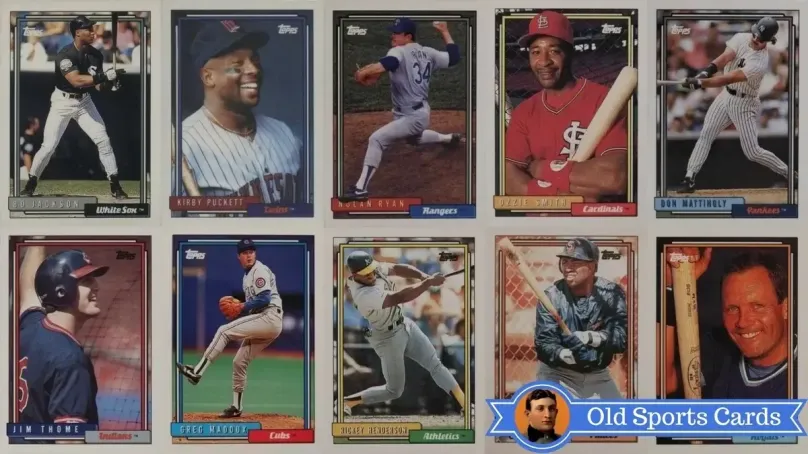
One of the things that I’ll always remember about 1992 Topps baseball cards is that they did the unthinkable that year: they left out the gum.
But they did offer up some parallels for the first time in company history with their Gold and Gold Winner cards.
And the set packed plenty of star power and even a couple of decent rookie cards in Manny Ramirez and Shawn Green.
Sadly, these days, most of the cards in the set aren’t worth the cardboard on which they’re printed but there are some here and there which can have value in top condition.
And in this guide, I’ll run through the 25 most valuable.
Let’s jump right in!
Stay On Top Of The Card Market
Weekly pricing updates, grading insights, and new card guides — straight to your inbox. For free.
Join thousands of collectors. Unsubscribe anytime.

Ross Uitts – Owner
- #1
1992 Topps #1 Nolan Ryan
PSA 10 Value $90Total PSA PopulationPSA 10 PopulationPSA 10 Grade Rate 0.0% (Set Avg: 0.0%)I’ve always loved the way Topps showcased Nolan Ryan in their 1992 set: the overhead angle perfectly captures the fireballer in the middle of his delivery.
Ryan would first appear in the 1968 Topps set and would continue to do so all the way to the release of the 1994 Topps set…a true testament to his longevity.
With such a long career that spanned across four decades, there is no shortage of Ryan cards to collect.
In top grade, this one can be worth around $30 or so because there are so many Ryan collectors out there chasing even his “junk era” cards in high grade.

- #2
1992 Topps #90 Robin Yount
PSA 10 Value $60Total PSA PopulationPSA 10 PopulationPSA 10 Grade Rate 0.0% (Set Avg: 0.0%) - #3
1992 Topps #50 Ken Griffey Jr.
PSA 10 Value $55Total PSA PopulationPSA 10 PopulationPSA 10 Grade Rate 0.0% (Set Avg: 0.0%)Usually I enjoy it when companies would feature Griffey showcasing his incredibly smooth swing.
But, this card with its horizontal layout also does a fantastic job of capturing him on the base path sliding into third.
From his rookie debut in 1989, Griffey was always one of the key cards to collect in any set in which he appeared.

- #4
1992 Topps #4 Nolan Ryan Record Breaker
PSA 10 Value $55Total PSA PopulationPSA 10 PopulationPSA 10 Grade Rate 0.0% (Set Avg: 0.0%)Nolan Ryan finished the 1991 season with 203 strikeouts bringing his career total at the time to 5,511.
That was also his 22nd season in a row with at least 100 strikeouts which surpassed Don Sutton’s previous record of 21 seasons in a row from 1966-1986.
It was yet another strikeout record tacked onto Ryan’s amazing resume and the 1992 Topps set commemorated his achievement with this card.
And the company did so by photographing him at an angle that perfectly captured how intimidating it must have been for opposing hitters to see one of his blazing fastballs coming at them.
- #5
1992 Topps #300 Don Mattingly
PSA 10 Value $50Total PSA PopulationPSA 10 PopulationPSA 10 Grade Rate 0.0% (Set Avg: 0.0%)Don Mattingly wasn’t a power hitter in 1992, not like he was during his mid-1980s peak.
However, he did find a little bit of dynamite as his New York Yankees began to take on a new shape.
Now just one of two 30-plus players in New York’s everyday starting lineup, Mattingly spanked 14 home runs in ’92, equal to his combined number for the previous two seasons.
The 31-year-old concluded the campaign slashing .288/.327/.416 with 40 doubles, 89 runs, and 86 RBIs in 157 games.
It wasn’t enough for an All-Star nomination, but Mattingly did secure his seventh Gold Glove in eight years.
Mattingly also flourished in his new captaincy role, tutoring young players like Bernie Williams and Pat Kelly as the season progressed.
New York’s youth movement didn’t carry Donnie Baseball to his first postseason appearance, but it did bring home the franchise’s most wins (76) since the ’88 campaign.
- #6
1992 Topps #290 Bo Jackson
PSA 10 Value $45Total PSA PopulationPSA 10 PopulationPSA 10 Grade Rate 0.0% (Set Avg: 0.0%)There was no 1992 season for Bo Jackson.
There was just a ton of pain and rehab.
Retired from the NFL after sustaining a devastating hip injury in January 1991, Jackson was still intent on keeping his baseball dreams alive.
He signed a three-year flier with the Chicago White Sox before the ’91 campaign, playing 23 games in September.
Rather than going into the ’92 season at what he felt was half-speed, Bo underwent a full hip replacement on April 4th, killing off his campaign before it even started.
Considering the millions of dollars Jackson had raked in through salaries and the ubiquitous “Bo Knows” advertising campaign, you’d think he’d call it a day and listen to his body.
After all, his hip had contracted necrosis and struggled to respond to rehabilitation.
Instead, Jackson put in crazy work and finished his White Sox stint with 85 games in ’93.
- #7
1992 Topps #555 Frank Thomas
PSA 10 Value $45Total PSA PopulationPSA 10 PopulationPSA 10 Grade Rate 0.0% (Set Avg: 0.0%)From first-round pick to legit MVP candidate in two years, Frank Thomas exploded onto the baseball scene unlike any slugger in MLB history.
The herculean Chicago White Sox first baseman posted at least a .975 OPS in each of his first eight seasons.
In 1992, his first full campaign, Thomas posted an MLB-best 1.006 OPS, the first of seven 1.000+ OPS seasons during his Hall of Fame career.
’93 was the nadir of this stretch (.975) and Thomas still led the American League to go with his MLB-best 46 home runs and AL-best 122 walks.
The 24-year-old placed eighth for AL MVP and led the 86-win White Sox to their third consecutive winning season.
“The coolest thing about Frank is he wasn’t afraid to be great,” Chicago hitting coach Walt Hriniak said.
“He wasn’t afraid to put the club on his shoulders (as a young player) and go for it.”
- #8
1992 Topps #156 Manny Ramirez Rookie Card
Rookie CardPSA 10 Value $40Total PSA PopulationPSA 10 PopulationPSA 10 Grade Rate 0.0% (Set Avg: 0.0%)Ramirez began playing in Brooklyn’s Youth Service League at the age of 14 and did so for five years until around the time this photo for his 1992 Topps rookie card was likely taken.
Even at a young age, it was clear that Ramirez had an incredible work ethic and was destined to be an incredible hitter.
While his legacy would end up tarnished by his use of banned substances, Ramirez finished his career with a .312/.411/.585 slash line and belted 555 home runs.
His career slugging percentage and OPS (.996) rank eighth all-time and his successful clutch hitting in the postseason only added to his reputation of being a big-time hitter.
He definitely had a Hall of Fame-caliber career but the controversy around the usage of banned substances has prevented him from induction so far.
- #9
1992 Topps #110 Ryne Sandberg
PSA 10 Value $40Total PSA PopulationPSA 10 PopulationPSA 10 Grade Rate 0.0% (Set Avg: 0.0%)Ryne Sandberg cashed in before the 1992 season, and he did so at the exact right time.
Slated to make $2.1 million in his walk year, Sandberg was well underpaid for his contributions compared to salaries at the time.
If the Chicago Cubs wanted to keep the face of their franchise under lock and key, a deal needed to get done.
On March 2nd, Sandberg signed a four-year, $28.2 million contract extension, making him the highest-paid player in MLB history.
(He’d be eclipsed one year later by Barry Bonds, ushering in a new era of big-money deals).
Considering how Sandberg performed in ’92, the extension initially looked like a steal.
Sandberg finished second to Bonds in the NL for total WAR (7.8) among position players, slashing .304/.371/.510 with 26 home runs and 87 RBIs in 158 games.
Unlucky for Chicago’s pocketbooks, it was the last great season of Sandberg’s Hall-of-Fame career.
- #10
1992 Topps #575 Kirby Puckett
PSA 10 Value $40Total PSA PopulationPSA 10 PopulationPSA 10 Grade Rate 0.0% (Set Avg: 0.0%)Kirby Puckett was both a fantastic hitter and fielder as he would compile one batting title, 6 Silver Slugger awards and 6 Gold Gloves over his storied career.
And he was also just a fun-loving guy who you could tell truly enjoyed the game.
Just look at the huge smile on his face on his 1992 Topps card, arguably one of his most recognizable cards of the 1990s.
His Topps rookie card will always be his most-demanded, obviously, but I would argue that this one is one of his most easily recognizable.
The imagery sticks in your mind.
Plus, his card was also showcased on the fronts of many wax boxes, as seen at the top of this article, which also boosted its recognition.
- #11
1992 Topps #380 Barry Bonds
PSA 10 Value $40Total PSA PopulationPSA 10 PopulationPSA 10 Grade Rate 0.0% (Set Avg: 0.0%)Barry Bonds wasn’t exactly humble heading into his 1992 contract year.
Already a one-time NL MVP and the reigning runner-up, Bonds demanded a contract worth at least $3 million per year and half-jokingly claimed he wouldn’t sign for “$100 million” unless he received a long-term pact.
Bonds had the Pirates cornered.
And he knew it.
“If I do leave, I’ll haunt the Pittsburgh Pirates,” Bonds said.
You may hate how he said it.
But he was right.
The 27-year-old left fielder put up the walk year to end all walk years, securing his second MVP while driving the Pirates to a third consecutive NL East title.
Bonds hit .311 with 34 home runs, swiped 39 bags and led the Majors in WAR (9.0), walks (127), OPS (1.080), and OPS+ (204) among other categories.
Bonds eventually spurned the Pirates for an MLB record six-year, $43.75 million deal with the San Francisco Giants.
His departure sent Pittsburgh into a tailspin: a 20-year playoff drought, to be exact.
- #12
1992 Topps #78 Ivan Rodriguez
PSA 10 Value $35Total PSA PopulationPSA 10 PopulationPSA 10 Grade Rate 0.0% (Set Avg: 0.0%)Ivan Rodriguez was unquestionably one of the greatest catchers who ever played the game.
The former MVP and 14-time All-Star could do it all as he accumulated 13 Gold Glove and 7 Silver Slugger awards over his impressive career.
And he made it incredibly difficult for opposing teams to steal bases against him as he routinely caught more than 50% of would-be base stealers.
Rodriguez appeared in the 1991 Topps Traded set but later received the iconic “Topps All-Star” trophy logo for his 1992 Topps issue.
- #13
1992 Topps #2 Rickey Henderson Record Breaker
PSA 10 Value $35Total PSA PopulationPSA 10 PopulationPSA 10 Grade Rate 0.0% (Set Avg: 0.0%) - #14
1992 Topps #560 Rickey Henderson
PSA 10 Value $35Total PSA PopulationPSA 10 PopulationPSA 10 Grade Rate 0.0% (Set Avg: 0.0%)While everyone certainly remembers that Henderson was a monster on the base paths (he is the all-time leader in stolen bases and runs scored after all), he was also an incredible leadoff hitter.
Many will argue he was the greatest leadoff hitter to ever play and I doubt they’ll meet much resistance in that argument.
Henderson had a compact swing and terrific bat speed, both showcased exceptionally well by this image that Topps captured.
It’s just a great-looking baseball card with massive eye appeal.
- #15
1992 Topps #620 George Brett
PSA 10 Value $35Total PSA PopulationPSA 10 PopulationPSA 10 Grade Rate 0.0% (Set Avg: 0.0%)George Brett may have gotten his 3,000th hit off of California Angels pitcher Tim Fortugno, but it was Fortugno who got the last laugh.
Brett entered Kansas City’s September 30th, 1992, contest four hits shy of the magical 3,000 mark.
In and out of the lineup with injuries, there was real doubt that the 39-year-old would be able to play that day.
Inserted into the game just a short time before first pitch, Brett opened the game with a double before lacing two sharp singles to move to 2,999.
In the seventh, facing Fortugno, the Hall-of-Famer received a sustained ovation from a lighter-than-usual crowd of 17,336.
3,000 ended as a dribbler to second, followed by an errant throw.
Brett was so caught up in the moment that he was quickly picked off by Fortugno at firSt. “I was the most surprised person in the ballpark,” Brett said.
“I was right in the middle of a sentence to (Gary) Gaetti and they picked me off.”
- #16
1992 Topps #40 Cal Ripken Jr.
PSA 10 Value $35Total PSA PopulationPSA 10 PopulationPSA 10 Grade Rate 0.0% (Set Avg: 0.0%)Ripken was one of my favorite players as a kid and I always loved snagging his cards from wax packs.
However, I always thought this card was especially intriguing when I first saw it.
I remember thinking at the time that, although it made for a great card picturing Ripken alongside the plaque of Lou Gehrig, it could have jinxed his entire streak.
After all, baseball players are some of the most supersticious athletes aren’t they?
Why tempt the baseball gods in this way?
It turns out that it didn’t matter and he’d go on to break Gehrig’s continuous games streak on September 6, 1995 after playing in his 2,131st consecutive game.
- #17
1992 Topps #580 Greg Maddux
PSA 10 Value $35Total PSA PopulationPSA 10 PopulationPSA 10 Grade Rate 0.0% (Set Avg: 0.0%)The 1992 NL Cy Young award was contested in a two-horse race.
After that race was done, both horses would be in the same stable.
At the end of the first half, it was clear that the final two would likely be Atlanta’s Tom Glavine and Chicago Cubs ace Greg Maddux.
Glavine took the early lead with 13 wins before the break, but Maddux zeroed in late to take his first of four consecutive Cy Youngs.
The numbers supported the decision.
Maddux led all of MLB in WAR (9.2) and innings pitched (268.0).
He also paced the National League in wins (20), starts (35), and ERA+ (166) while posting a tidy 2.18 ERA.
Maddux went big in his contract year, and he reaped big rewards after.
Spurning offers from the Cubs and the Yankees, “The Professor” moved to Atlanta, joining Glavine on a five-year, $28 million deal.
Soon, the Big Three of Glavine, Maddux, and John Smoltz would take over the world.
- #18
1992 Topps #242 Mike Mussina Rookie Card
Rookie CardPSA 10 Value $30Total PSA PopulationPSA 10 PopulationPSA 10 Grade Rate 0.0% (Set Avg: 0.0%)Mike Mussina retired from baseball with a reputation as a top-notch pitcher but his career numbers didn’t quite appear Hall of Fame-worthy on the surface.
His 3.68 ERA, 2,813 strikeouts, 270 wins, 5 All-Star appearances, and 7 Gold Gloves were nothing to slouch at but not enough to put him over the Hall of Fame hump.
Until sabermetrics came around.
It turns out that when you adjusted Mussina’s numbers for the fact that he pitched his entire career in the A.L.
East in hitter-friendly ballparks during the steroid era, he was actually very much a Hall of Fame-caliber pitcher.
Once he was finally elected in 2019 during his sixth year of eligibility, his rookie cards received a bump in value.
He would appear in the Bowman, Score and Upper Deck sets in 1991 but his Topps rookie card did not surface until 1992.
- #19
1992 Topps #69 Kenny Lofton Rookie Card
Rookie CardPSA 10 Value $30Total PSA PopulationPSA 10 PopulationPSA 10 Grade Rate 0.0% (Set Avg: 0.0%)Even as a 25-year-old rookie, Kenny Lofton knew exactly what his role was.
“The guys called me the igniter,” Lofton said.
“Once I ignited the flames, everything took off.” A former 17th-round pick, Lofton stole 168 bases over parts of four minor-league seasons.
As his hitting tool slowly developed, it was clear that the Cleveland Indians had a special talent on their hands.
And he didn’t take any time to prove it at the MLB level.
Lofton went full speed through his rookie campaign in 1992, outdistancing everyone for his first of five consecutive AL stolen base crowns.
The future six-time All-Star swiped 66 bags, 12 more than runner-up Pat Listach and 18 more than the future stolen-base king, Rickey Henderson.
Lofton was also a Gold Glove-caliber defender in center, using his top-tier straight line speed to turn doubles and triples into outs.
Throw in a .285 average and nearly 100 runs scored (96), and you see why he was named the runner-up for AL Rookie-of-the-Year.
- #20
1992 Topps #450 Mark McGwire
PSA 10 Value $30Total PSA PopulationPSA 10 PopulationPSA 10 Grade Rate 0.0% (Set Avg: 0.0%)This was the Mark McGwire that the Oakland A’s were looking for.
As his fellow Bash Brother, Jose Canseco, crashed out in real time, McGwire reemerged as the centerpiece of Oakland’s high-octane hitting attack.
An easy choice for AL Comeback Player of the Year, McGwire hit .268 with an AL-best .585 slugging percentage and 176 OPS+ in 139 games.
With his 42 home runs, 90 walks, and 104 RBIs, Big Mac completely silenced the doubters who saw his 1991 struggles as a death knell.
“My only expectations are to play every day and be consistent,” McGwire said when asked about the expectations placed on him.
“I wasn’t consistent last year.” McGwire was more than consistent.
He was a wrecking ball, earning his first top-five MVP finish (fourth) to go along with an All-Star nod and a Silver Slugger.
It all ended on a sour note, though, as McGwire went just 3-for-20 (.150) in Oakland’s six-game ALCS loss to Toronto.
- #21
1992 Topps #551 Chipper Jones Top Prospects
PSA 10 Value $30Total PSA PopulationPSA 10 PopulationPSA 10 Grade Rate 0.0% (Set Avg: 0.0%)Even as a 25-year-old rookie, Kenny Lofton knew exactly what his role was.
“The guys called me the igniter,” Lofton said.
“Once I ignited the flames, everything took off.” A former 17th-round pick, Lofton stole 168 bases over parts of four minor-league seasons.
As his hitting tool slowly developed, it was clear that the Cleveland Indians had a special talent on their hands.
And he didn’t take any time to prove it at the MLB level.
Lofton went full speed through his rookie campaign in 1992, outdistancing everyone for his first of five consecutive AL stolen base crowns.
The future six-time All-Star swiped 66 bags, 12 more than runner-up Pat Listach and 18 more than the future stolen-base king, Rickey Henderson.
Lofton was also a Gold Glove-caliber defender in center, using his top-tier straight line speed to turn doubles and triples into outs.
Throw in a .285 average and nearly 100 runs scored (96), and you see why he was named the runner-up for AL Rookie-of-the-Year.
- #22
1992 Topps #760 Ozzie Smith
PSA 10 Value $30Total PSA PopulationPSA 10 PopulationPSA 10 Grade Rate 0.0% (Set Avg: 0.0%)If you’re not familiar with Baseball Reference’s Rtot advanced stat, it is an extremely accurate barometer of how a player affects the game (and his team’s chances of winning) in the field.
As defined by the folks over at BR, Rtot is “the number of runs above or below average the player was worth based on the number of plays made.” It combines four advanced defensive metrics into a single catch-all score.
Now that you know what Rtot is all about, are you even remotely surprised that Ozzie Smith grades out as one of the greatest defensive players of all time?
Neither am I.
In 1992, “The Wizard” topped all MLB shortstops with an Rtot of 13, also known as total zone runs.
This marked the tenth time that the St. Louis Cardinals legend had paced the NL in the metric.
Overall, Smith was worth 239 Rtot in nineteen MLB seasons, good for second all-time among shortstops (Mark Belanger) and fourth overall.
- #23
1992 Topps #768 Jim Thome Rookie Card
Rookie CardPSA 10 Value $30Total PSA PopulationPSA 10 PopulationPSA 10 Grade Rate 0.0% (Set Avg: 0.0%)Next up we have Hall of Fame slugger Jim Thome making his Topps debut enjoying some batting practice.
I used to love watching the way Thome would absolutely obliterate the ball on his way to crushing 612 career home runs.
He had such a distinct batting stance and swing.
And not only could he hit for power, he was very successful at drawing walks and by the time his career was finished he would end up with a career 0.402 OBP.
In 2018, Thome’s legacy was cemented forever as a much-deserving first ballot Hall of Famer.
- #24
1992 Topps #270 Tony Gwynn
PSA 10 Value $25Total PSA PopulationPSA 10 PopulationPSA 10 Grade Rate 0.0% (Set Avg: 0.0%)The deeper that Tony Gwynn got into video studies, the more patient his approach became.
Even though it seems to make little sense, Gwynn actually began to level up as a hitter midway through his career.
The San Diego Padres icon already had four batting titles in ten seasons before his 1992 campaign, a once-in-a-generation stretch that all but etched his Cooperstown plaque.
But then, remarkably, Gwynn went into “Matrix” mode, seemingly slowing down pitches on the corners to ensure he only targeted strikes.
Suddenly, after two years in the .350s for on-base percentage, Gwynn was up to .371 in 1992.
He finished just outside the NL top ten in OBP and fifth overall in batting average.
It all turned out to be one giant step forward.
Gwynn doubled down on his video study and jumped into a streak of four consecutive .400 OBP campaigns and four straight batting titles.
- #25
1992 Topps #100 Jose Canseco
PSA 10 Value $25Total PSA PopulationPSA 10 PopulationPSA 10 Grade Rate 0.0% (Set Avg: 0.0%)The Oakland A’s were tired of Jose Canseco going into the 1992 season, and for good reason.
Never one to shy away from the tabloids and police blotters, Canseco was charged with “aggravated battery” in February for hammering his wife’s BMW with his Porsche.
The legal ramifications were the last straw for the Oakland brass, regardless of Canseco’s All-Star status.
Canseco had his fifth All-Star nod in seven years in ’92, slashing .246/.335/.456 with 22 home runs and 72 RBIs in 97 games.
The production was there, but Canseco’s off-field problems remained a black mark on what was otherwise a successful regular season for the soon-to-be AL West champs.
That’s why GM Sandy Alderson wasted no time sealing a trade pact with the Texas Rangers during a game, removing Canseco from the field right before he took an at-bat.
As you might expect, Canseco wasn’t a fan of how the move was pulled off.
“I was down, and the A’s kicked me like a dog,” Canseco said later.

Ross’s Take
While the values of 1992 Topps baseball cards have not held up well over time, I think the design was terrific.
And while most are not worth anything these days, there are some exceptions that can still be worth money in high grade as you can see.
Overall, it’s a decent set and cards were of relatively higher quality than others back then as they were printed on white, crisp stock.
Like many Topps sets of the era, there were 792 cards in total to collect.
Within it, there were also several different subsets, including: Draft Picks Managers All-Stars Record Breakers Prospects And don’t forget those Gold and Gold Winner parallels.
For the nostalgic collector, this can be a fun set to try and put together but just don’t expect to find any gum inserted into packs to keep you company as Topps did not include any that year.
Love old cards? Get weekly updates from a fellow collector.
Pricing updates, grading insights, and new guides on the cards you actually care about — the junk wax era, vintage, and everything in between. One email a week. No fluff.
Free. No spam. Unsubscribe anytime.
Ross Uitts – Owner
