
15 Most Valuable 1997 Upper Deck Baseball Cards

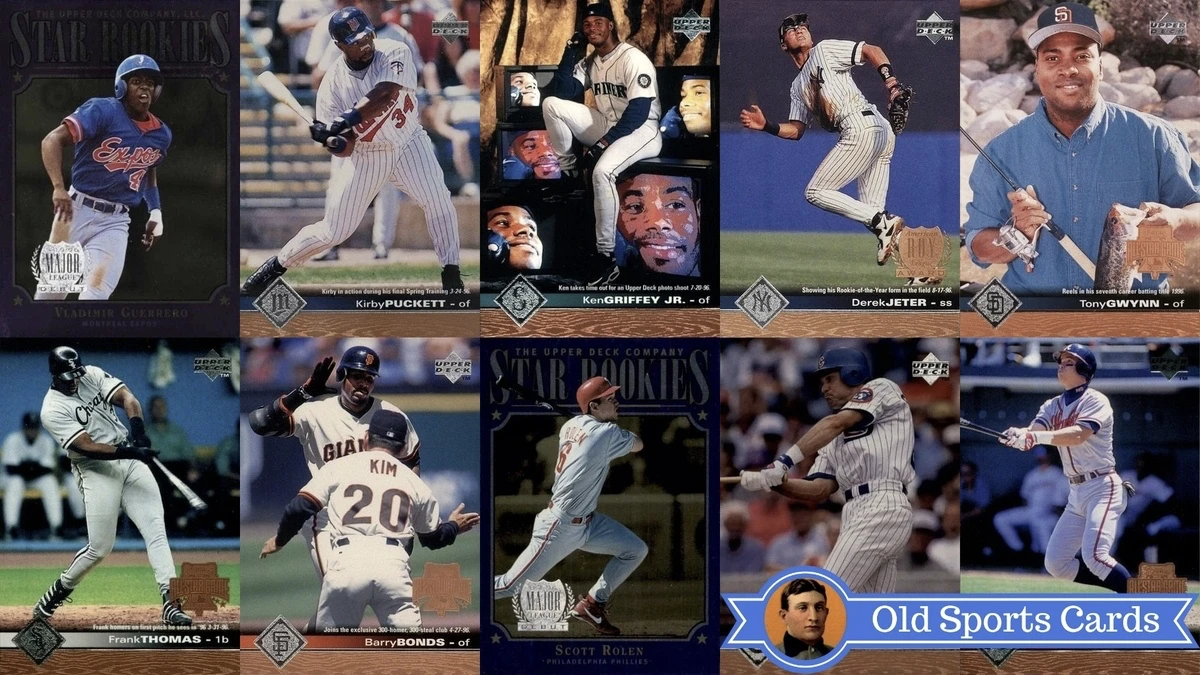
At first glance, the 1997 Upper Deck baseball set might look like just another ordinary set.
It has all of the hallmarks of a mid-90s Upper Deck product: borderless design, beautiful photography, and creative subsets.
But make no mistake, this set is full of innovation…
Perhaps most significant, ’97 Upper Deck is credited as the first set in the hobby to introduce game-used material into its cards.
If you look closely at the card fronts, Upper Deck also time-stamped each card with the date of when the image was captured along with a brief mention of that moment’s significance.
I wish more cards had that feature, as understanding the context behind the image is incredibly fun and helpful.
Finally, the “Ken Griffey Jr.’s Hot List” subset was one of the first examples of a card company intentionally shortprinting cards to manufacture relative scarcity into them.
While the set may fly under most collectors’ radars, the hobby owes a lot to 1997 Upper Deck for pushing the industry to new heights.
And in this guide, we’ll take a look at the 15 most valuable.
Let’s jump right in!
1997 Upper Deck Baseball Set Snapshot
SET DETAILS
550
Vladimir Guerrero, Adrian Beltre, Andruw Jones, Lance Berkman
Ken Griffey Jr., Barry Bonds, Chipper Jones, Derek Jeter, Tony Gwynn, Rickey Henderson
GRADING ANALYSIS
1,834
TOTAL GRADED BY PSA
643
PSA 10 Population
35.1%
PSA 10 Grade Rate
MOST GRADED CARDS
1
#440 Derek Jeter
7.7%
142
2
#175 Ken Griffey Jr.
6.3%
115
3
#424 Ken Griffey Jr.
5.1%
93
Stay On Top Of The Card Market
Weekly pricing updates, grading insights, and new card guides — straight to your inbox. For free.
Join thousands of collectors. Unsubscribe anytime.

Ross Uitts – Owner
- #1
1997 Upper Deck #175 Ken Griffey Jr.
PSA 10 Value $725 – $750Total PSA Population 115PSA 10 Population 16PSA 10 Grade Rate 13.9% (Set Avg: 35.1%)Seattle Mariners megastar Ken Griffey Jr. was already a perennial MVP candidate heading into 1997, with three top-five finishes in the previous four campaigns.
However, one or two standout seasons always seemed to block the path to his destiny.
In ’97, he wouldn’t be denied.
Griffey put together a clean season for the ages in an era defined by steroid-enhanced offensive production.
The 27-year-old center fielder carried the Mariners to their second division title in three years, becoming just the sixth player with 55 home runs (56), 125 runs, and 125 RBIs (an MLB-best 147) in a single season.
Junior led all AL hitters in slugging percentage (.646) and WAR (9.1) en route to just the ninth unanimous MVP award in Junior Circuit history.
“I just really don’t know what to say or how to say or react,” a bewildered Griffey said.
“This award means a lot.” Griffey had several interesting and amusing cards during the 1990s and this is certainly one of them.

- #2
1997 Upper Deck #450 Mark McGwire
PSA 10 Value $110 – $115Total PSA Population 26PSA 10 Population 11PSA 10 Grade Rate 42.3% (Set Avg: 35.1%)The St. Louis Cardinals weren’t doing much of anything heading into the 1997 MLB trade deadline.
And then, they altered the course of their franchise with one blockbuster trade.
Sitting multiple games under .500 and off the fringes of the playoff chase, the Cardinals pulled off a shocker, acquiring Oakland A’s slugger Mark McGwire in a four-player deal.
It was a strange trade, considering that the Cardinals were out of the postseason hunt and appeared destined to lose the upcoming free agent after the season.
It appears the Cardinals front office knew something we didn’t.
After hitting 34 home runs for the bottom-feeding A’s in the year’s first half, McGwire hit 24 with St. Louis to finish three shy of Roger Maris’ single-season record.
He ended the year slashing .274/.393/.646 with 58 total bombs, 101 walks, and 123 RBIs in 156 games.
Contrary to what many assumed, McGwire re-signed with St. Louis in mid-September, inking an extension through 2000 worth nearly $30 million.

- #3
1997 Upper Deck #385 Ken Griffey Jr.
PSA 10 Value $105 – $115Total PSA Population 55PSA 10 Population 13PSA 10 Grade Rate 23.6% (Set Avg: 35.1%)Cards #370 – 387 comprised the “Capture the Flag” subset.
Featuring unique designs, these cards showcased players from several teams who were in contention for a given pennant chase during the 1996 season.
The reverse of the cards have short blurbs that mention each player’s accomplishment and contribution towards his team’s performance.
And division standings are also shown to put into perspective where each team was during that race to firSt. Subsets are generally a great way to build collector interest by showcasing star players and their unique abilities.
However, the “Capture the Flag” subset took things a bit further by providing additional context for important moments from the 1996 race to the playoffs.

- #4
1997 Upper Deck #20 Cal Ripken Jr.
PSA 10 Value $95 – $100Total PSA Population 47PSA 10 Population 23PSA 10 Grade Rate 48.9% (Set Avg: 35.1%)For the fifteenth and final time in 1997, Cal Ripken Jr. played every game of the Baltimore Orioles’ regular season slate.
(And some postseason games, too.) It was far from the 36-year-old’s best individual effort.
Permanently moved over to third base to make room for free-agent shortstop Mike Bordick, Ripken slashed .270/.331/.402 with 17 home runs, 30 doubles, 79 runs, and 84 RBIs in 686 plate appearances (611 at-bats).
His 1.8 WAR was the worst of his career thus far, and his 93 OPS+ made him a below-average MLB hitter.
Regardless of Ripken’s season-long swoon, a stacked O’s roster outlasted the field to win the AL East and earn home-field advantage on the AL side of the bracket.
Baltimore finished two wins shy of a Series appearance, falling in six to the Cleveland Indians in the ALCS.
Ripken was stellar in 10 playoff contests, leading the team in batting average (.385) and on-base percentage (.467).
- #5
1997 Upper Deck #492 Tony Gwynn
PSA 10 Value $85 – $90Total PSA Population 20PSA 10 Population 12PSA 10 Grade Rate 60.0% (Set Avg: 35.1%)The 1997 season was when the true greatness of Tony Gwynn came into statistical focus.
While the San Diego Padres took a step back from playoff participants to National League also-rans, Gwynn was as sharp a hitter as ever.
The 37-year-old right fielder was healthier than he’d been since the 1980s, appearing in more games (149) than any other season during the decade.
Gwynn’s sudden durability padded his shat sheet nicely.
The future Hall-of-Famer led the Majors in hits for the third time in four seasons with a career-best 220 base knocks.
The Padres were a mediocre bunch otherwise (76-86), yet Gwynn was a veteran master of his craft, dinking and dunking singles and doubles anywhere there was a spot of green grass to be found.
All of those hits added up.
Gwynn won his eighth batting title with a .372 average, tying Honus Wagner’s National League record.
He also became the first NL player since Rogers Hornsby (1920-25) to win at least four consecutive batting titles.
- #6
1997 Upper Deck #170 Barry Bonds
PSA 10 Value $59 – $60Total PSA Population 19PSA 10 Population 7PSA 10 Grade Rate 36.8% (Set Avg: 35.1%)Upon his arrival in San Francisco in 1993, Barry Bonds was a two-time MVP with a wealth of playoff experience from his time as the centerpiece of the Pittsburgh Pirates.
Bonds won his third MVP award in his first year with the Giants.
However, it took him a half-decade to return to October.
The future home run king’s long-awaited playoff return was delayed by top-heavy rosters unsuited for contention.
In 1997, the Giants finally got the equation right, piecing together the team’s first division title since winning the pennant in 1989.
Bonds excelled for the resurgent San Francisco club, placing fifth for NL MVP with a .291/.446/.585 slash line, 40 home runs, 123 runs, 101 RBIs, and an MLB-best 145 walks in 159 games.
It didn’t amount to much in the postseason, however, as Bonds hit just .250 with no home runs and a .647 OPS in a surprising three-and-out NLDS loss to the expansion Florida Marlins.
- #7
1997 Upper Deck #424 Ken Griffey Jr.
PSA 10 Value $50 – $52Total PSA Population 93PSA 10 Population 18PSA 10 Grade Rate 19.4% (Set Avg: 35.1%)The “Ken Griffey Jr.’s Hot List” subset featured ten of the most popular stars of the day with a special foil marking on the surface.
These special cards with names like Derek Jeter, Alex Rodriguez, Frank Thomas and the man himself offered collectors an even higher-quality way to experience their favorite players.
That is, if you were lucky enough to find them.
Upper Deck printed fewer examples to manufacture scarcity into the cards and build collector intereSt. By doing so, this marked one of the first times in hobby history that a company intentionally short-printed cards as a chase mechanism.
They may not be “rare” by any means, but the intent was clear.
And this subset was yet another example of how the 1997 Upper Deck set overall sought to change the game.
- #8
1997 Upper Deck #494 Rickey Henderson
PSA 10 Value $44 – $46Total PSA Population 21PSA 10 Population 14PSA 10 Grade Rate 66.7% (Set Avg: 35.1%)The first two times Rickey Henderson was traded during the middle of the season, he won a World Series with his new team.
The Yankees traded him to the eventual World Series champion Oakland A’s midway through the 1989 season, and Oakland later traded him to Toronto, where he helped the Blue Jays beat Philly in the 1993 World Series.
In 1997, the Anaheim Angels tried their luck with the rent-a-Rickey strategy.
The Anaheim Angels were in contention in the AL West but down a leadoff hitter after Tony Phillips faced charges of felony cocaine possession.
And a year after winning the NL West, San Diego was 9.5 games behind the San Francisco Giants.
So, on August 13, 1997, Anaheim sent three prospects to San Diego for a much-needed spark at the top of the order.
However, things didn’t work out as well for Anaheim as they had for Oakland and Toronto.
Henderson hit just .183 with a .343 OBP, some of the worst numbers of his career.
Anaheim finished six games behind the AL West champion Seattle Mariners.
And Rickey would be back in Oakland for a fourth stint with the A’s in 1998.
- #9
1997 Upper Deck #229 Scott Rolen
PSA 10 Value $39 – $41Total PSA Population 5PSA 10 Population 0PSA 10 Grade Rate 0.0% (Set Avg: 35.1%)The seeds of the Philadelphia Phillies’ return to relevance were sown over a decade before they won the 2008 World Series.
In 1997, former second-round pick Scott Rolen made his full-time debut as the Phillies’ everyday third baseman.
Nobody knew then that he’d go on to be the pillar of Philadelphia’s first championship team in nearly 30 years.
However, that’s not to say he wasn’t a standout immediately.
On a Phillies team full of underperformers and veterans at the end of their rope, Rolen shined, pushing past pitchers Matt Morris and Livan Hernandez for a unanimous NL Rookie-of-the-Year selection.
Rolen led National League rookies in nearly every relevant offensive category, slashing .283/.377/.469 for the 68-win Phils with 21 home runs, 35 doubles, 16 stolen bases, 93 runs, and 92 RBIs in 156 games played.
His 4.5 WAR placed just outside the top ten of NL position players.
- #10
1997 Upper Deck #271 Vladimir Guerrero
PSA 10 Value $39 – $41Total PSA Population 92PSA 10 Population 4PSA 10 Grade Rate 4.3% (Set Avg: 35.1%)Vladimir Guerrero’s rookie year was a family affair.
Tabbed as a middle-of-the-order centerpiece in Montreal, Guerrero took some time to adjust to the MLB and Canadian life.
The prized Dominican Republic prospect battled homesickness throughout his minor-league journey, and it was the same story when he took over Montreal’s full-time right fielder role in 1997.
Suffering through two DL stints and being stuck behind a language barrier, Guerrero did his best to stay engaged and put his best foot forward.
The 22-year-old performed admirably under the circumstances.
Guerrero finished sixth in NL Rookie-of-the-Year voting for the fourth-place Expos, slashing .302/.350/.483 with 11 home runs, 22 doubles, and 40 RBIs in 90 games.
His natural hitting prowess was easy to spot.
However, he still looked adrift for long portions of the season.
That’s where his mom came in.
Guerrero flew her over to Montreal during the season, and her cooking and guidance became central to his eventual All-Star breakout at the end of the decade.
- #11
1997 Upper Deck #325 Ryne Sandberg
PSA 10 Value $39 – $40Total PSA Population 18PSA 10 Population 9PSA 10 Grade Rate 50.0% (Set Avg: 35.1%)Ryne Sandberg didn’t let declining production force him out of the game.
Instead, he read the tea leaves and called it a day before anyone could pull the trigger for him.
Sandberg retired initially before the 1995 season, weighed down by a disintegrating marriage and other personal issues.
He returned in 1996, putting together a productive yet lacking year for a mediocre Cubs team needing a PR jolt.
The eventual Hall-of-Famer gave it one more go in 1997, but the numbers never came around.
Sandberg hit .264 in 135 games with a career-low 0.8 WAR.
It was apparent that the 37-year-old second baseman was on his way out, and he didn’t waste time accepting it.
On August 2nd, 1997, Sandberg announced his retirement, culminating in Ryne Sandberg Day on September 20th of that same year.
“I truly lived my field of dreams right here at Wrigley Field,” Sandberg said during his emotional retirement speech.
- #12
1997 Upper Deck #40 Frank Thomas
PSA 10 Value $37 – $38Total PSA Population 15PSA 10 Population 9PSA 10 Grade Rate 60.0% (Set Avg: 35.1%)“The Big Hurt” wasn’t a prototypical Steroid Era slugger.
He was legitimately one of the most skilled and deft hitters of the 1990s and 2000s.
In the 1997 campaign, Thomas already had an MLB home run title (1992) and two AL MVPs (1993, 1994).
The 29-year-old Chicago White Sox first baseman also posted two 30-home-run years and three 40-bomb campaigns in the previous six seasons, emerging as one of the most dangerous longball threats of an era chock full of them.
Thomas wasn’t a one-trick pony, though.
He was an intelligent hitter who exhibited A-level patience and used the whole field to his advantage.
Entering ’97, the future Hall-of-Famer had already led the American League three times in on-base percentage and four in walks.
Then, Thomas one-upped himself, easily clearing his AL rivals to become the tallest and heaviest player to win a batting title (.347) in MLB history.
“I don’t especially care about the home run title,” Thomas said.
“I’d rather have the hitting title.
Guys my size aren’t supposed to win that.”
- #13
1997 Upper Deck #105 Kirby Puckett
PSA 10 Value $29 – $30Total PSA Population 17PSA 10 Population 11PSA 10 Grade Rate 64.7% (Set Avg: 35.1%)There’s a world where Minnesota Twins outfielder Kirby Puckett would have played the 1997 MLB season, and his march towards 3,000 hits would have been in overdrive.
Instead, we were robbed of the later years of Puckett’s career and left to wonder what could have been.
Puckett was the jovial focal point of the golden age of Minnesota Twins baseball.
The Twins won two World Series titles with the Hall-of-Famer in tow (1987, 1991, the only two championships of the franchise’s Minnesota era to this day.
Puckett led the league in hits four times during his twelve years as a Big Leaguer and won the 1989 AL batting title with an MLB-best .339 average.
That’s not to mention his six Gold Gloves.
Sadly, the sudden onset of glaucoma and interference of vision in his right eye cut Puckett’s career short before the 1996 season.
If that hadn’t happened, Puckett may have finished his age-37 campaign in ’97 just a few hundred hits shy of the hallowed 3,000 Hit Club.
- #14
1997 Upper Deck #10 Chipper Jones
PSA 10 Value $24 – $25Total PSA Population 19PSA 10 Population 8PSA 10 Grade Rate 42.1% (Set Avg: 35.1%)With his “big brother,” David Justice, off to Cleveland in a massive offseason trade, Chipper Jones got his first taste of being the indisputable face of the Atlanta Braves in 1997.
The Chipper Era of Braves baseball started off well enough.
Although Jones didn’t hit at an MVP level, he was still the engine for an Atlanta team that chugged its way to a third of eleven consecutive division titles.
Jones slashed .295/.371/.479 for the 101-win Braves with 21 home runs, 41 doubles, 100 runs, and 111 RBIs in 157 games.
The 25-year-old also swiped 20 bases to compile the first of two 20/20 seasons in three years.
Even without former team leaders Justice and Marquis Grissom in tow, Atlanta rode a balanced offense and an elite pitching staff to another October showcase.
It was the perfect way to cut the rope on the franchise’s new stadium, Turner Field, although it ended with a six-game NLCS loss to an upstart Florida Marlins squad.
- #15
1997 Upper Deck #440 Derek Jeter
PSA 10 Value $21 – $22Total PSA Population 142PSA 10 Population 35PSA 10 Grade Rate 24.6% (Set Avg: 35.1%)From 1996 to 2000, the New York Yankees built yet another dynasty in a franchise history full of them.
The Bronx Bombers won four titles over those five years.
The only year they didn’t bring home the Commissioner’s Trophy during that half-decade was 1997.
It was a maddening year for everyone, including new-and-future franchise icon Derek Jeter.
The Yankees shortstop’s sophomore year was a letdown.
Jeter hit .291 with a .775 OPS in an MLB-high 748 at-bats, adding up to a just-above-league-average 103 OPS+.
The 23-year-old was dependable yet not exemplary, hitting for his worst average until 2010.
The most disappointing part of it all was the final result.
After knocking out the Atlanta Braves in ’96 for the franchise’s first championship in eighteen years, the Yankees bowed out to the division rival Orioles in a tense, five-game ALDS.
Jeter was strong in defeat, going 7-for-21 with two home runs and six runs scored.

Ross’s Take
The hobby wasn’t in its greatest spot during the mid-90s as it was still dealing with the fallout of the 1994 MLB Strike and the hobby bubble burSt. So, Upper Deck and other manufacturers had to get creative to build collector interest and regain the excitement of the late 80s and early 90s.
And Upper Deck answered the call perhaps better than any company during that time by introducing game-used material and other innovative techniques.
Sure, none of the cards in the 550-card checklist stand out as hobby icons.
But the hobby owes a lot to the set as a whole.
The distribution of the set also featured some quirks.
While Series One (#1 – 240) and Series Two (#271 – 520) could be found in standard packs, collectors had to send in wrappers to redeem the “Updates” to Series One (#241 – 270) and Series Two (#521 – 550).
As usual, there were several different subsets, including: Strike Force (#64 – 72) Defensive Gems (#136 – 153) Global Impact (#181 – 207) Star Rookies (#223 – 243; #268 – 288) Postseason/World Series Highlights (#244 – 267) Season Highlights/Team Checklists (#214 – 222; #316 – 324) Capture the Flag (#370 – 387) Ken Griffey Jr.’s Hot List (#415 – 424) Diamond Debuts (#469 – 483) Major League Debut (throughout checklist) Final Tribute (throughout checklist) On the surface, it may be easy to overlook this set.
As I mentioned in the opener, the look and feel of the cards would make you think they were just a regular Upper Deck set.
But the hobby milestones that it brought were far more than normal achievements.
For that reason, this set has its own place in hobby history.
Love old cards? Get weekly updates from a fellow collector.
Pricing updates, grading insights, and new guides on the cards you actually care about — the junk wax era, vintage, and everything in between. One email a week. No fluff.
Free. No spam. Unsubscribe anytime.
Ross Uitts – Owner
