
20 Most Valuable 1994 Topps Baseball Cards

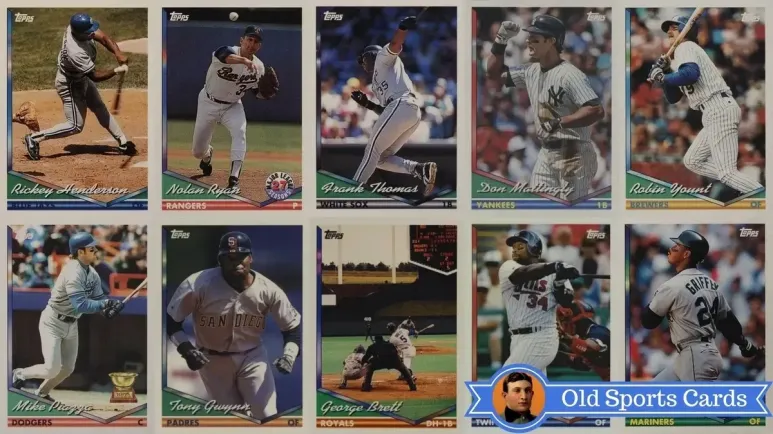
Had the 1994 MLB season not ended early in a strike, 1994 Topps baseball cards might receive a little more love than they do in this hobby.
The set design is pretty good and the checklist includes some fantastic players and Hall of Famers.
But, because of the strike, baseball fans and collectors turned sour on the sport, and this set suffered in popularity as a result.
However, with the recent boom in the sports card market, you might be surprised that some of these cards can still be worth something in high grade.
And in this guide, I’ll run through the 15 most valuable.
Let’s jump right in!
1994 Topps Baseball Set Snapshot
Stay On Top Of The Card Market
Weekly pricing updates, grading insights, and new card guides — straight to your inbox. For free.
Join thousands of collectors. Unsubscribe anytime.

Ross Uitts – Owner
- #1
1994 Topps #34 Nolan Ryan
PSA 10 Value $650 – $675Total PSA Population 1,592PSA 10 Population 215PSA 10 Grade Rate 13.5% (Set Avg: 38.1%)On September 22, 1993, Nolan Ryan’s arm finally gave out when he tore a ligament during a game against the Seattle Mariners.
It was a disappointing way to end his legendary career that spanned across four decades.
Topps paid tribute to Ryan by including him in their 1994 set and placing a small logo in the bottom-right corner that states “27 Major League Seasons”.
His 27 seasons in Major League Baseball is the most by any player in modern baseball and one of the dozens of records he still holds to this day.
I have always appreciated how Topps chose to feature Ryan throwing a heater front and center on his final regular issue Topps card, just the way he should be.

- #2
1994 Topps #700 Barry Bonds
PSA 10 Value $200 – $225Total PSA Population 195PSA 10 Population 68PSA 10 Grade Rate 34.9% (Set Avg: 38.1%)Barry Bonds may not have won NL MVP in 1994.
But there was no question who the most dangerous slugger in the Major Leagues was.
Bonds won two MVP awards with the 1990 and 1992 Pittsburgh Pirates and added a third to his shelf in his 1993 San Francisco Giants debut.
In ’94, things got trickier.
For one, voters wanted a fresher story than the guy who’d dominated the awards race so far in the decade.
In addition, Bonds was standoffish with the media, projected a diva attitude, and was often downright rude to many inside and outside the Giants organization.
These combined hurdles are probably why Bonds finished fourth in the NL MVP voting in ’94 rather than higher up the ladder.
The 29-year-old ended the year with a .312/.426/.647 slash, 37 home runs, 81 RBIs, and an NL-leading 74 walks in 112 games.
We’re not saying that Jeff Bagwell didn’t earn the award (he did), but a runner-up finish would have made more sense for the future home run king.
- #3
1994 Topps #400 Ken Griffey Jr.
PSA 10 Value $200 – $225Total PSA Population 488PSA 10 Population 157PSA 10 Grade Rate 32.2% (Set Avg: 38.1%)Ken Griffey Jr. got off to a blistering start to the 1994 season as he belted 30 home runs in the Mariners’ first 65 games.
He hit just ten more during the remaining 47 games of the shortened season but still finished with the league lead at 40.
Griffey would lead the league in home runs three more times over his twenty-two years in the Majors.
He also finished with a career-best 1.076 OPS, picked up a Gold Glove and Silver Slugger, but finished a distant second in MVP voting to Frank Thomas.
This card has fantastic eye appeal, all driven by Griffey showing off his notoriously smooth swing and likely watching another blast head for the fence.
- #4
1994 Topps #209 Billy Wagner Rookie Card
Rookie CardPSA 10 Value $175 – $200Total PSA Population 518PSA 10 Population 67PSA 10 Grade Rate 12.9% (Set Avg: 38.1%) - #5
1994 Topps #158 Shortstop Prospects
PSA 10 Value $125 – $135Total PSA Population 3,306PSA 10 Population 391PSA 10 Grade Rate 11.8% (Set Avg: 38.1%)While Derek Jeter made his official rookie card debut in the 1993 Topps set, he appeared on this card alongside other short stop prospects Orlando Miller, Brandon Wilson, and Mike Neal.
Miller spent four years in the Big Leagues, but neither Wilson nor Neal ever made it past AAA.
And we all know how Jeter’s career turned out: he’s one of the all-time great New York Yankees.
In 1992, Jeter began working his way up from Class A Greensboro and a few years later made his Major League debut on May 29, 1995, after teammates Tony Fernandez and Pat Kelly were injured.
He was later demoted back to the Minors that year but returned as the Yankees starting shortstop on Opening Day of the 1996 season, a position he held until the end of his career in 2014.
- #6
1994 Topps #1 Mike Piazza
PSA 10 Value $85 – $95Total PSA Population 296PSA 10 Population 69PSA 10 Grade Rate 23.3% (Set Avg: 38.1%)The 1993 Rookie of the Year, Mike Piazza burst onto the scene during his rookie campaign as he batted .318, hit 35 homers and drove in 112 runs to pick up a Silver Slugger.
He was an easy choice for the Topps All-Star Rookie Team in this set, noted by the golden cup in the lower right-hand side of the card.
Piazza was on pace to put up similar numbers in his sophomore campaign as he finished with a .319 batting average, 24 home runs, and 92 RBI in 107 games before the season ended prematurely.
Elected to Hall of Fame in 2016 as a New York Met, Piazza was one of the most exciting and popular players of his era.
- #7
1994 Topps #300 Ryne Sandberg
PSA 10 Value $80 – $85Total PSA Population 184PSA 10 Population 103PSA 10 Grade Rate 56.0% (Set Avg: 38.1%)Ryne Sandberg was fed up in 1994.
It seemed like every time his Chicago Cubs built some momentum, ownership tore the team down and traded away their best players for pennies on the dollar.
Sandberg gritted his teeth for a decade after the team’s electric 1984 division championship, watching his front office drop the ball over and over.
As the spring turned to summer and the ’94 Cubs showed few signs of life in the new NL Central, Sandberg threw up his hands and called it quits.
“I lost the edge that it takes to play,” Sandberg said at a hastily arranged press conference.
“The drive, the motivation, the killer instinct.” While it was true that Sandberg was burnt out, he left $15 million on the table because he didn’t see a point to what the Cubs were doing.
The preventable departures of Andre Dawson and Greg Maddux in free agency, coupled with clubhouse problems, provided the final (albeit temporary) nails in the coffin.
- #8
1994 Topps #499 Greg Maddux
PSA 10 Value $80 – $85Total PSA Population 121PSA 10 Population 70PSA 10 Grade Rate 57.9% (Set Avg: 38.1%) - #9
1994 Topps #248 Rickey Henderson
PSA 10 Value $80 – $85Total PSA Population 270PSA 10 Population 116PSA 10 Grade Rate 43.0% (Set Avg: 38.1%)Late in the 1993 season, the Blue Jays traded Steve Karsay and José Herrera to the Athletics in exchange for Henderson as they were making a charge at a deep playoff run.
Due to a hand injury, Henderson could not perform up to his usual standards as he batted just .215, well off his career .279 average.
However, he did pick up his second World Series ring during his time with the Blue Jays as he and Paul Molitor scored on Joe Carter’s legendary three-run walk-off home run versus the Phillies in Game 6.
During the offseason, Henderson re-signed with the Athletics and was back in the leadoff spot for the 1994 season.
He appeared in both the regular 1994 Topps set and the Topps Traded as a result of the trade.
- #10
1994 Topps #600 Don Mattingly
PSA 10 Value $75 – $80Total PSA Population 308PSA 10 Population 157PSA 10 Grade Rate 51.0% (Set Avg: 38.1%)By the time the 1994 season rolled around, Don Mattingly was a shell of his former dominant self of the 1980s as injuries continued to nag him.
However, even though his power at the plate had greatly diminished, that didn’t prevent him from being a staunch defender as he was able to pick up his 9th and final Gold Glove.
Mattingly would play one more year in 1995, helping the Yankees to the only playoff appearance of his career.
I remember vividly how huge his name was in the hobby during the late 80s and early 90s as he was always one of the big names you wanted to pull out of a pack of cards.
That hobby legacy helps keep his cards in decent demand from other collectors who grew up during that period.
- #11
1994 Topps #500 Bo Jackson
PSA 10 Value $65 – $70Total PSA Population 182PSA 10 Population 75PSA 10 Grade Rate 41.2% (Set Avg: 38.1%)The hype had long since settled by 1994, and Bo Jackson had the chance to simply play a game.
Years after the brutal hip injury that ended his NFL career, the former two-sport superstar was now in a part-time role with the California Angels.
His wheels had long since been compromised, so the Angels kept his load manageable and shuffled him between corner outfield and designated hitter.
He proved to be a valuable addition.
Jackson slashed .279/.344/.507 with 13 home runs and 43 RBIs in 75 games, helping keep the mostly woeful Angels within striking distance in an awful AL WeSt. But Jackson also had to defend.
In his 46 games played in the outfield, the 31-year-old made three errors and posted some of the worst advanced stats among all MLB regulars.
It was hard to watch sometimes, considering what an athletic marvel he had been less than a half-decade before.

- #12
1994 Topps #180 George Brett
PSA 10 Value $65 – $70Total PSA Population 374PSA 10 Population 221PSA 10 Grade Rate 59.1% (Set Avg: 38.1%) - #13
1994 Topps #200 Cal Ripken Jr.
PSA 10 Value $50Total PSA Population 309PSA 10 Population 171PSA 10 Grade Rate 55.3% (Set Avg: 38.2%)Cal Ripken Jr. has been one of my favorite players ever since I was a kid.
It’s hard not to like a guy who was not only extraordinarily gifted but who gave his best effort every time he stepped on the field for 2,632 games in a row.
A 2-time MVP, 19-time All-Star, 2-time Gold Glover, and 8-time Silver Slugger, the Iron Man is arguably the greatest shortstop of all-time.
Ripken would pick up his eighth and final Silver Slugger award for his efforts during the 1994 season, and this card perfectly showcases his tremendous hitting ability.
- #13
1994 Topps #606 Ken Griffey Jr.
PSA 10 Value $55 – $60Total PSA Population 211PSA 10 Population 83PSA 10 Grade Rate 39.3% (Set Avg: 38.1%) - #14
1994 Topps #777 Chipper Jones Coming Attractions
PSA 10 Value $50Total PSA Population 158PSA 10 Population 51PSA 10 Grade Rate 32.3% (Set Avg: 38.2%) - #14
1994 Topps #270 Frank Thomas
PSA 10 Value $55 – $60Total PSA Population 186PSA 10 Population 85PSA 10 Grade Rate 45.7% (Set Avg: 38.1%)Chicago White Sox first baseman Frank Thomas dominated the American League from 1990 to 1997 despite playing half his games in one of the most pitcher-friendly parks in the Majors.
In its fourth year as the new Comiskey Park, the stadium now known as Rate Field was where fly balls went to die.
It wasn’t quite as treacherous for hitters as the original Comiskey Park (a field half-designed by a top-level pitcher), but it still ranked low in total runs and batting average per game.
Things got especially rough in September as cold fronts deadened batted balls.
None of this seemed to affect “The Big Hurt”.
In 1994, Thomas ran away with his second consecutive AL MVP award, capturing 24 of 28 first-place votes.
The 26-year-old hit a career-best .353 with 38 home runs and 101 RBIs in just 113 games.
He led the Majors in multiple offensive categories, including on-base percentage (.487), OPS (1.217), runs (106), and walks (109).
- #15
1994 Topps #520 Wade Boggs
PSA 10 Value $45 – $50Total PSA Population 105PSA 10 Population 66PSA 10 Grade Rate 62.9% (Set Avg: 38.1%)After a down 1993 debut with the New York Yankees, compared to his standards anyway, Wade Boggs reentered the conversation in 1994 as the best pure hitter in the American League.
This was the Boggs that the Yankees shelled out $11 million for.
Despite some nagging injuries that limited him to 97 games, the 36-year-old third baseman hit .342 for his best batting average since his 1988 AL batting championship.
Boggs placed fifth in this batting race, picking up his tenth consecutive All-Star appearance along the way.
The Hall-of-Famer also placed fourth in the AL in on-base percentage (.433) and sixth in Wins Above Replacement (4.5).
And while his actual defensive metrics graded out just above average for an MLB third baseman, Boggs’ flair for the dramatic and veteran status earned him his first of two career Gold Gloves.
1994 turned out to be Boggs’ best year in a Yankees uniform.
He played two more in pinstripes before finishing his career with the expansion Tampa Bay Devil Rays.
- #15
1994 Topps #620 Tony Gwynn
PSA 10 Value $40Total PSA Population 172PSA 10 Population 122PSA 10 Grade Rate 70.9% (Set Avg: 38.2%) - #16
1994 Topps #310 Robin Yount
PSA 10 Value $45 – $50Total PSA Population 176PSA 10 Population 85PSA 10 Grade Rate 48.3% (Set Avg: 38.1%) - #17
1994 Topps #100 Kirby Puckett
PSA 10 Value $45 – $50Total PSA Population 166PSA 10 Population 81PSA 10 Grade Rate 48.8% (Set Avg: 38.1%)On June 26th, 1994, Kirby Puckett became the most prolific hitter in Minnesota Twins history.
And just like he always seemed to do, he did it with a bang.
Over two-and-a-half years after his Game 6 walk-off turned the ’91 World Series in favor of the Twins, Puckett stepped into the box with history in sight.
The 34-year-old right fielder came into the game with 2,085 hits in a Minnesota uniform, tied with Rod Carew for the all-time Twins record.
Opening a showdown with the Kansas City Royals, Puckett crushed a homer off of starting pitcher Scott Erickson to move into first place alone.
He added two more hits that day to reach #2,088.
While Puckett’s final tally of 2,304 hits remains a Twins record, it is not the franchise record.
That honor goes to Sam Rice, who compiled 2,889 base knocks from 1915 through 1933 with the formerly named Washington Senators.

Ross’s Take
Distributed in two series of 396 cards each, the 1994 Topps set contained 792 cards in total with lots of stars and Hall of Famers but not many truly iconic cards.
As they had done in their previous two sets, Topps brought back the Gold parallel cards while also including Black Gold and Finest inserts to boost collector intereSt. Within the set were also several subsets to enjoy, including: Coming Attractions Draft Picks Future Stars Measures of Greatness Prospects However, combine the lack of key cards with the strike that ended the 1994 season and you are left with a set that is often overlooked by hobbyists.
Looking back now, though, it still brings back some great memories and nostalgia of the stars of that era.
Love old cards? Get weekly updates from a fellow collector.
Pricing updates, grading insights, and new guides on the cards you actually care about — the junk wax era, vintage, and everything in between. One email a week. No fluff.
Free. No spam. Unsubscribe anytime.
Ross Uitts – Owner
