
30 Most Valuable 1993 Topps Baseball Cards

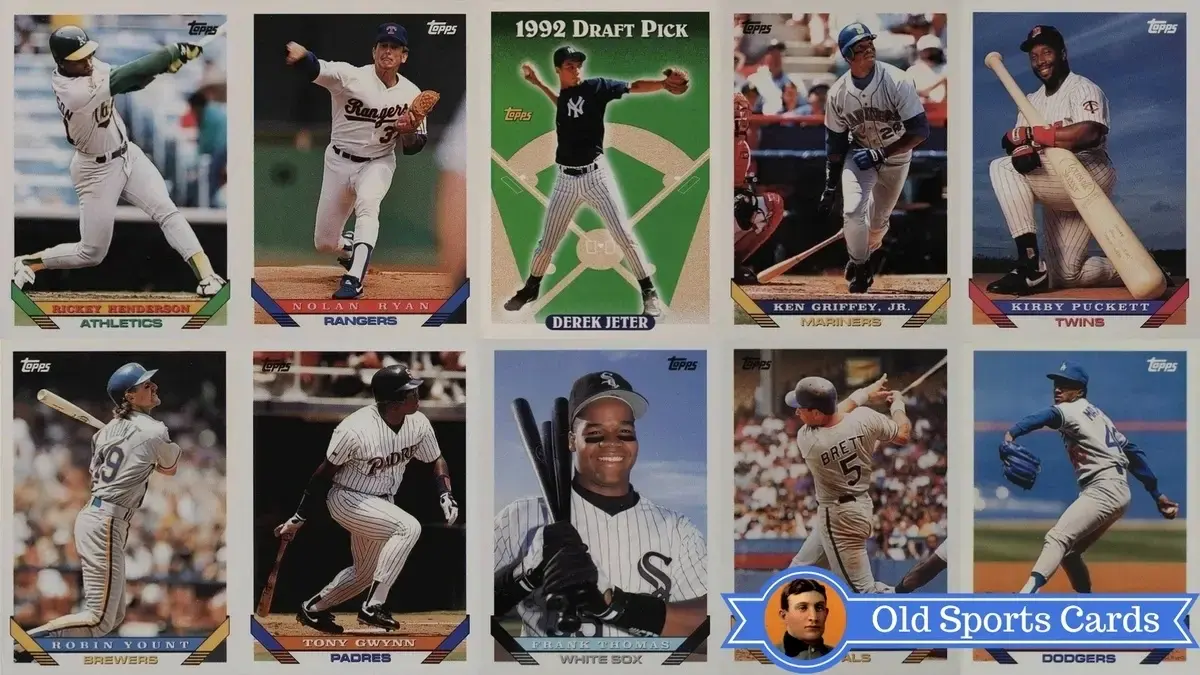
Like many sets of the era, 1993 Topps baseball cards are often overlooked and all but forgotten.
But, the one key thing that keeps this set relevant is the Derek Jeter rookie card.
In fact, there are four different ones but we’ll get into that later…
Also of note was that Topps issued this set in different series, the first time it had done so since 1973.
Additionally, it was the company’s largest set to date with a checklist that consisted of a whopping 825 cards.
Sadly, these days, most of the cards in the set aren’t worth the cardboard on which they’re printed but there are some here and there which can have value in top condition.
And in this guide, I’ll run through the 30 most valuable.
Let’s jump right in!
1993 Topps Baseball Set Snapshot
SET DETAILS
825
Derek Jeter, Jim Edmonds
Ken Griffey Jr., Nolan Ryan, Frank Thomas, Tony Gwynn, Cal Ripken Jr., Rickey Henderson
GRADING ANALYSIS
88,993
TOTAL GRADED BY PSA
17,341
PSA 10 Population
19.5%
PSA 10 Grade Rate
MOST GRADED CARDS
1
#98 Derek Jeter
67.6%
60,192
2
#799 Jim Edmonds
2.8%
2,483
3
#700 Nolan Ryan
1.8%
1,638
Love old cards? Get weekly updates from a fellow collector!
Weekly pricing updates, grading insights, and new card guides — straight to your inbox. For free.
Join thousands of collectors. Unsubscribe anytime.

Ross Uitts – Owner
- #1
1993 Topps #98 Derek Jeter Rookie Card
Rookie CardPSA 10 Value $490 – $500Total PSA Population 60,192PSA 10 Population 3,978PSA 10 Grade Rate 6.6% (Set Avg: 19.5%)The Derek Jeter Rookie card is by far and away the key to this set.
To make things interesting, there are actually four different types: base, Gold, Colorado Rockies Inaugural and Florida Marlins Inaugural.
The base card features a fantastic image of the legendary Yankee superimposed over a baseball field graphic.
The gold parallel is easily distinguished from the base by the “Topps Gold” logo in gold foil underneath Jeter’s glove as well as the gold foil nameplate along the bottom.
And because MLB welcomed two expansion teams in the Florida Marlins (now Miami Marlins) and Colorado Rockies for the 1993 season, Topps celebrated by producing special factory sets that were to be distributed exclusively in each team’s city.
Those cards are also distinguished by special foil stamps in the lower corners.
None of Jeter’s 1993 Topps rookies are cheap in high grade but the Gold, Colorado Rockies Inaugural and Florida Marlins Inaugural versions can all go for over $1,000 in PSA 10 grade.

- #2
1993 Topps #179 Ken Griffey Jr.
PSA 10 Value $95 – $100Total PSA Population 1,540PSA 10 Population 466PSA 10 Grade Rate 30.3% (Set Avg: 19.5%)Topps did a pretty decent job of capturing players in great action shots in this set and Griffey Jr.’s card is a prime example.
I’d like to think that ball he is watching was one of the 630 home runs he sent over the fence during his career.
The 1993 season saw him set personal bests at that point in his career in runs scored (113), home runs (45), and RBI (109) as he’d go on to pick up a Gold Glove, Silver Slugger and All-Star selection.
His cards were popular back then and still popular enough now for this one to be worth around $20 in top condition.
- #3
1993 Topps #700 Nolan Ryan
PSA 10 Value $80 – $85Total PSA Population 1,638PSA 10 Population 885PSA 10 Grade Rate 54.0% (Set Avg: 19.5%)Ryan had nearly completed his 27th full season in the Majors when a ligament in his elbow popped as he was pitching against the Mariners on September 22, 1993.
Amazingly, he still tried to keep pitching but ultimately he was finished and the career of one of baseball’s greatest pitchers finally came to an end.
Some records in baseball will likely never be broken and Ryan’s all-time strikeout total of 5,714 is likely one of them.
This card perfectly captures a view of Ryan burning one towards the plate and even though it may not be his most valuable card, it’s certainly one of his best-looking.
- #4
1993 Topps #799 Jim Edmonds Rookie Card
Rookie CardPSA 10 Value $55 – $65Total PSA Population 2,483PSA 10 Population 605PSA 10 Grade Rate 24.4% (Set Avg: 19.5%)During his era, Jim Edmonds was one of the greatest center fielders in the game.
The guy racked up 8 Gold Gloves while being able to hit for power as well as he’d finish his career just shy of 400 homers with 393.
He’s a borderline Hall of Famer but was unfortunately removed from the ballot after receiving only 2.5% of the vote during his first year of eligibility.
His rookie card pictures him in a batting stance with the words “Coming Attraction” overhead with strobe lights shining behind him.
Edmonds would appear in 12 games with the Angels in 1993 and finished 8th in Rookie of the Year voting in 1994.
But he really broke out in the 1995 season when he tallied 33 home runs, 107 RBI and 120 runs scored on his way to being an All-Star that year.
- #5
1993 Topps #397 George Brett
PSA 10 Value $45 – $50Total PSA Population 343PSA 10 Population 229PSA 10 Grade Rate 66.8% (Set Avg: 19.5%)George Brett didn’t mince words when he announced his retirement late in the 1993 MLB season.
The Kansas City Royals legend had run the gamut for 20 years, and the passion for playing had faded.
“If you ride a roller coaster 162 times, you are ready for something different,” Brett said.
“Do you want to go on another roller coaster?” Rather than going through the motions and collecting a check from the only Big-League team he’d ever known, Brett called it quits.
There was no farewell tour.
No big explosion of presents and video tributes.
Brett was simply tired.
And two decades of Hall-of-Fame baseball were plenty to leave behind.
The 40-year-old ended his 21st and final campaign slashing .266/.312/.434 with 19 home runs, 31 doubles, seven stolen bases, and 75 RBIs in 145 games.
Brett finished his career with a .305 lifetime average, and his 3,154 hits ranked 12th all-time when he left.
- #6
1993 Topps #400 Bo Jackson
PSA 10 Value $45 – $50Total PSA Population 332PSA 10 Population 158PSA 10 Grade Rate 47.6% (Set Avg: 19.5%)How did Bo Jackson play in 1993, given where he was just a few months earlier?
The answer was personal.
Before his mother’s passing, she asked the former two-sport star whether he was ready for another comeback.
She wanted to see Bo end his playing career on his terms, rather than at the whims of his injured body.
Jackson told her yes, promising that his first hit would be hers.
He somehow made it all happen, even with the odds stacked against him.
Just eight months before breaking camp with the Chicago White Sox, Jackson had a pronounced limp.
He couldn’t even run until the turn of the year.
Still, Jackson got himself ready and picked up his first hit, a home run, on April 9th, 18 days before his mother died.
He played 85 games with the Sox at DH and in the outfield, hitting .232 with 16 home runs in 308 plate appearances (284 at-bats).
- #7
1993 Topps #750 Rickey Henderson
PSA 10 Value $45 – $50Total PSA Population 348PSA 10 Population 240PSA 10 Grade Rate 69.0% (Set Avg: 19.5%)I always loved this card as it gave a great look at Henderson’s compact and powerful swing.
Everyone remembers how amazing he was on the base paths as he’d go on to become the career leader in runs scored (2,295) and stolen bases (1,406).
The former MVP and 10-time All-Star could flat out run.
But, he could also hit, too, and is widely regarded as the greatest lead-off hitter in the history of the game.
- #8
1993 Topps #150 Frank Thomas
PSA 10 Value $45 – $50Total PSA Population 426PSA 10 Population 233PSA 10 Grade Rate 54.7% (Set Avg: 19.5%)As big as Thomas was and considering how great he was with the bat, I was always surprised that his career home run total (521) wasn’t higher.
Sure, he had a few seasons cut short due to injury that likely prevented him from at least eclipsing the 600 mark.
Nevertheless, there’s no questioning Thomas was one of the greatest power hitters of all-time and currently sits in a three-way tie for 20th with Willie McCovey and Ted Williams on the career home runs liSt. His 1993 Topps card bursts with eye appeal as he hoists three bats over his shoulder with a beaming smile.
- #9
1993 Topps #200 Kirby Puckett
PSA 10 Value $40 – $45Total PSA Population 472PSA 10 Population 234PSA 10 Grade Rate 49.6% (Set Avg: 19.5%)Kirby Puckett’s inclusion in the 1993 MLB All-Star Game drew pushback.
Admittedly, it was one of his worst overall seasons in a Minnesota Twins uniform, but Puckett wasn’t about to give up his spot to make his detractors happy.
“A lot of people say I should not be here because my numbers are down, but I went out and played hard every day,” Puckett said at the time.
If the critics had gotten their way, we wouldn’t have been able to watch history unfold at Camden Yards.
Puckett went 0-for-16 on extra-base hits over his first seven All-Star appearances.
He righted that wrong quickly, becoming the first Twin to homer in a Midsummer Classic since Harmon Killebrew in 1971.
The 33-year-old outfielder tacked on a double in the fifth to secure the first All-Star MVP in Twins franchise history.
It was a thrilling moment in an otherwise rough year in which Puckett posted a career-worst 1.4 WAR.
- #10
1993 Topps #701 Top Prospects Catchers
PSA 10 Value $40 – $45Total PSA Population 1,415PSA 10 Population 482PSA 10 Grade Rate 34.1% (Set Avg: 19.5%) - #11
1993 Topps #557 Pedro Martinez
PSA 10 Value $35 – $40Total PSA Population 793PSA 10 Population 191PSA 10 Grade Rate 24.1% (Set Avg: 19.5%)Pedro Martinez didn’t have the physical stature of his brother, Ramon.
However, that didn’t stop the younger Martinez brother from chasing down his MLB dream.
“What he lacked in size, he made up for in mental composure,” former Los Angeles Dodgers scout Rafael Avila said.
“Pedro was more aggressive, intelligent, and determined than all the other boys of his age.” Ramon was five inches taller and had the look of a Cy Young winner.
Pedro, on the other hand, was a shade under six feet and looked more wide-eyed than anything.
In short, the Dodgers didn’t quite know what to do with him.
Rather than plugging him into the rotation with his brother, Los Angeles converted the 21-year-old to a bullpen specialist for his ’93 debut.
Martinez finished sixth in NL Rookie-of-the-Year voting, posting a 10-5 record with a 2.61 ERA and just 76 hits allowed in 107.0 innings.
He struck out 119 in what would become a one-and-done in Southern California.
- #12
1993 Topps #32 Don Mattingly
PSA 10 Value $35 – $40Total PSA Population 496PSA 10 Population 293PSA 10 Grade Rate 59.1% (Set Avg: 19.5%)Next on our list is Don Mattingly’s card that was printed horizontally to capture him in the middle of a pick-off play at firSt. From the looks of it, the opposing player was able to get back safely before Mattingly could apply the tag.
Mattingly’s cards during the 1980s were always in high demand as he looked like the next surefire Yankee Hall of Famer.
Injuries caught up to him and sadly his production fell off during the 1990s and he wasn’t quite able to finish off that Hall of Fame resume.
However, as one of the most highly-collected and beloved players of his era, his cards are still popular enough in PSA 10 holders for those wanting a bit of nostalgia from their childhood collecting days.

- #13
1993 Topps #405 Griffey Jr. and Van Slyke All-Stars
PSA 10 Value $35 – $40Total PSA Population 190PSA 10 Population 105PSA 10 Grade Rate 55.3% (Set Avg: 19.5%) - #14
1993 Topps #100 Mark McGwire
PSA 10 Value $35 – $40Total PSA Population 238PSA 10 Population 104PSA 10 Grade Rate 43.7% (Set Avg: 19.5%)Mark McGwire was the AL MVP for the first 27 games of the 1993 season.
And then, his campaign just ended.
After bashing his way back into the awards conversation with 42 homers in 1992, the Oakland A’s first baseman picked up right where he left off.
McGwire hit .333 in a month’s worth of action, smashing nine homers and driving in 24 in just 84 at-bats.
McGwire’s 225 OPS+ would have been a career high.
Instead, an injury basically zeroed out his season.
McGwire suffered a torn plantar fascia in his left heel, a nagging, slow-healing injury that knocked him out in mid-May.
He returned for just two games in September, but by then, there was no postseason in sight worth risking further injury.
Big Mac’s foot problems would be a recurring theme for the rest of his career, and he’d miss over half of the 1994 schedule because of an unpredictable, stop-and-start rehab.
- #15
1993 Topps #572 Trevor Hoffman
PSA 10 Value $35 – $40Total PSA Population 371PSA 10 Population 131PSA 10 Grade Rate 35.3% (Set Avg: 19.5%)The San Diego Padres fans did a complete 180 on Trevor Hoffman.
You can’t blame them for their early unreSt. The Padres acquired Hoffman in the middle of the 1993 season from the Florida Marlins as a key part of the Gary Sheffield mega-trade.
Padres fans were understandably upset at the obvious fire sale and the loss of Sheffield.
They turned their ire on the rookie.
Hoffman was booed mercilessly for a couple of weeks, especially after getting roughed up in a three-run meltdown two days into his San Diego career.
Gradually, though, the fans got behind him as he collected strikeouts and slowly worked his way towards the closer’s role.
The 25-year-old righty made 67 appearances on the year, 39 with the Padres.
His ERA ballooned to 4.31 with San Diego (compared to 3.28 with Florida), yet he still struck out 53 batters in 54.1 innings and recorded three saves.
- #16
1993 Topps #5 Tony Gwynn
PSA 10 Value $30 – $35Total PSA Population 264PSA 10 Population 147PSA 10 Grade Rate 55.7% (Set Avg: 19.5%)It’s amazing to think what Tony Gwynn could have done if his knees hadn’t given out.
The San Diego Padres’ immortal already holds a bevy of National League records, including most batting titles (eight) and a 19-year streak of .300 seasons, second only to Ty Cobb (23) in MLB history.
However, it’s still plausible to argue that Gwynn left even more on the field.
From about 1991 on, Gwynn’s struggles with maintaining a healthy weight put major stress on his knees.
This led to several absences with knee problems and considerable time under the surgeon’s knife.
In 1993, Gwynn had a puncher’s chance of chasing down Colorado’s Andres Galarraga for yet another batting crown.
However, his left knee wasn’t cooperating, and the 33-year-old right fielder underwent season-ending surgery in mid-September.
Gwynn finished second to Galarraga in the batting race, 12 points back at .358.
- #17
1993 Topps #2 Barry Bonds
PSA 10 Value $30 – $35Total PSA Population 431PSA 10 Population 258PSA 10 Grade Rate 59.9% (Set Avg: 19.5%)Barry Bonds’ 1993 home debut with the San Francisco Giants was picture-perfect.
The day started in a classic Giants fashion.
Tony Bennett lit up the capacity Candlestick Park crowd with a stirring rendition of the Star-Spangled Banner.
Bonds unleashed the fireworks shortly thereafter.
In his first at-bat, the reigning NL MVP crushed a two-run home run off of Florida Marlins starter Chris Hammond, the first of 586 he’d hit in a Giants uniform.
No matter how hated Bonds was elsewhere around baseball or in the media, the San Francisco fans always had his back.
And he rewarded their faithfulness with multiple records, a 2002 NL pennant, and five spectacular MVP campaigns, the first coming in his ’93 introduction.
Bonds won the award, his third in four tries, with 24 of 28 first-place votes.
The 28-year-old right fielder also picked up a Gold Glove and Silver Slugger, while pacing the Majors in home runs (46), WAR (9.9), OPS (1.136), and OPS+ (206).
- #18
1993 Topps #3 Ryne Sandberg
PSA 10 Value $30 – $35Total PSA Population 223PSA 10 Population 131PSA 10 Grade Rate 58.7% (Set Avg: 19.5%)Speaking of strong defenders in the infield, Ryne Sandberg ended up with 9 Gold Glove awards to his name.
Like Ripken, though, Sandberg was also noted for the unusual amount of bat power he had for someone at his position.
To that point, Sandberg ranks 5th on the all-time list for home runs (282) hit by a second baseman.
The beloved Cubbie and one of the brightest stars of the 90s rightfully earns a spot on this list and his card can be worth $30 in top condition.
- #19
1993 Topps #40 Ozzie Smith
PSA 10 Value $30 – $35Total PSA Population 245PSA 10 Population 173PSA 10 Grade Rate 70.6% (Set Avg: 19.5%)A “Wizard” was missing from the 1993 MLB All-Star Game.
For the first time since his third year with the Padres (1980), iconic St. Louis Cardinals shortstop Ozzie Smith was left off the Midsummer Classic roster.
Barry Larkin was well worth the starting SS spot, and both Jay Bell and Jeff Blauser were worthy alternates.
But it just didn’t feel right that the game’s biggest summer stage wouldn’t include the greatest defensive player of his generation.
Smith’s slight offensive production hadn’t been a problem before.
The 38-year-old slashed .288/.337/.356 in 141 games and slapped his first home run since 1991.
Those are far from MVP numbers, but still…it’s Ozzie Smith.
Even without the Gold Glove, no one was more clutch at shortstop.
Fans understood that and acted accordingly, voting him back in ’94 for the first of three All-Star nods of his career.
- #20
1993 Topps #183 Greg Maddux
PSA 10 Value $30 – $35Total PSA Population 262PSA 10 Population 172PSA 10 Grade Rate 65.6% (Set Avg: 19.5%)Greg Maddux’s 1993 campaign was the worst of his back-to-back-to-back-to-back Cy Young performances.
That’s not really saying much, considering just how transcendent Maddux was at that point.
Maddux had unique leverage going into the 1992-93 offseason.
The former Chicago Cubs ace was the reigning Cy Young winner, and nearly every team in the league at least kicked the tires on signing him.
Ultimately, the 27-year-old righty chose the Atlanta Braves over a more lucrative offer from the New York Yankees, citing concerns about quality of life and raising a family.
It remains the best and most impactful free-agent signing in Braves history.
While Maddux wasn’t quite as polished as ’92, nor on the level of what he’d become in ’94 and ’95, he was absolutely brilliant for the NL West champs, topping the Majors in ERA (2.36), innings (267.0), and WHIP (1.049).
He also paced the league with 8 shutouts and a 170 ERA+.
- #21
1993 Topps #331 Kenny Lofton
PSA 10 Value $30 – $35Total PSA Population 229PSA 10 Population 120PSA 10 Grade Rate 52.4% (Set Avg: 19.5%)The Cleveland Indians needed only one full year to go all-in on Kenny Lofton.
That’s to say, it was a fantastic year.
In 1992, Lofton finished as a runner-up in the AL Rookie-of-the-Year balloting with a .285 average and a league-best 66 stolen bases.
If anyone could remotely touch Rickey Henderson at this point, it was Lofton.
So, Cleveland opened the checkbooks and inked the 26-year-old center fielder to a four-year, $6.3 million contract, big money in the early 1990s.
Lofton returned the investment right away with a 70-steal season in 1993.
He also evolved continuously as a hitter, adding pop and spreading his focus to the gaps to finish with 28 doubles, nearly double his output from his debut year.
It was just the start of a beautiful friendship between Lofton and the City of Cleveland.
Lofton extended his stolen-base championship streak to five with the Indians, and he catalyzed the franchise’s 1995 AL pennant run.
- #22
1993 Topps #300 Cal Ripken Jr.
PSA 10 Value $25 – $30Total PSA Population 514PSA 10 Population 287PSA 10 Grade Rate 55.8% (Set Avg: 19.5%)The “Iron Horse” will forever be remembered for his record for most consecutive games played (2,632) and the power he had at the plate which was unusual for a shortstop.
A somewhat overlooked part of Ripken’s legacy is that he was also fantastic with the glove.
In fact, he was a 2-time Gold Glover…
For that reason, I’ve always liked this card as it gave collectors a look at Ripken on the defensive side of the ball.
- #23
1993 Topps #1 Robin Yount
PSA 10 Value $25 – $30Total PSA Population 262PSA 10 Population 182PSA 10 Grade Rate 69.5% (Set Avg: 19.5%)Robin Yount wasn’t happy heading into his final season.
The Milwaukee Brewers let his Hall-of-Fame teammate and buddy, Paul Molitor, jump ship, declining to match a contract offer from the reigning World Series champion Toronto Blue Jays.
Yount openly questioned the “small-market” business vibe surrounding the club, with penny-pinching becoming the Brewers’ main focus.
That isn’t to say he retired after the ’93 campaign because of the fire sale, but it helped cement his decision.
The 37-year-old center fielder played 127 games for an aimless, 69-win Milwaukee squad, slashing .258/.326/.379 with eight home runs, nine stolen bases, and 51 RBIs in 514 plate appearances (454 at-bats).
That was it.
Yount posted nearly identical averages left versus right and home versus away, a testament to his pure hitting tool.
Named a first-ballot Hall-of-Famer by a slim margin, the 20-year vet closed things out with 3,142 hits, a total that now sits just outside the top-20 all time.
- #24
1993 Topps #460 Randy Johnson
PSA 10 Value $25 – $30Total PSA Population 97PSA 10 Population 43PSA 10 Grade Rate 44.3% (Set Avg: 19.5%)Seven of the ten highest strikeout-rate seasons in MLB history through the 2002 season belong to one man.
One very big man.
Randy Johnson started his career with one of the most intimidating fastballs we’ve ever seen.
However, he relied too much on brute force and struggled to find the strike zone regularly.
Before the 1993 season, Johnson took some simple advice from one of his flamethrowing forebearers.
“I told Randy he could be the most dominating pitcher in baseball if he would just work on his game,” fellow Hall-of-Famer Nolan Ryan said later.
Johnson worked.
And, Johnson thrived.
It started in 1993, Johnson’s first of six 300-strikeout campaigns (308).
The towering 29-year-old Seattle Mariners lefty placed runner-up for AL Cy Young, finishing 19-8 with a 3.24 ERA in 255.1 innings.
His 10.9 strikeouts/9 topped baseball by a significant margin, as did 6.5 hits/9.
He did plunk an MLB-worst 16 batters, but it was worse for them than for him.
- #25
1993 Topps #445 Dale Murphy
PSA 10 Value $25 – $30Total PSA Population 175PSA 10 Population 134PSA 10 Grade Rate 76.6% (Set Avg: 19.5%)What was once a sure Hall-of-Fame career ended with a thud in 1993.
Dale Murphy had it all in the 1980s.
He was the face of the Atlanta Braves, a two-time MVP and a two-time home run champ.
His 308 home runs during the decade trail only the great Mike Schmidt (313) and place him ahead of Cooperstown inductees like Eddie Murray and Andre Dawson.
That’s legendary stuff.
So why isn’t he enshrined?
Well, the rest of Murphy’s career happened.
Ripped apart by chronic knee problems, including degenerative arthritis and structural damage to his left knee, Murphy gradually lost his pop, his defensive acumen, and his overall hitting acumen.
By 1993, Murphy was on his last comeback with no Hall-of-Fame path in sight.
He played 26 games for the expansion Colorado Rockies, hitting just .143 with no home runs.
That was enough for Murphy to call it a day on May 27th officially.
- #26
1993 Topps #529 Top Prospects Shortstops
PSA 10 Value $25 – $30Total PSA Population 603PSA 10 Population 183PSA 10 Grade Rate 30.3% (Set Avg: 19.5%)Chipper Jones may have made his rookie card debut in the 1991 Topps set, but he also appeared on a couple of “Top Prospects” cards in both the company’s 1992 and 1993 sets.
Pictured as a member of the AA Greenville Braves, Jones appears alongside Dave Silvestri, Benji Gil, and Jeff Patzke.
While none of those guys panned out as well as Jones did, the card still packs some great eye appeal with clear player headshots atop an image of a base and ball.
- #27
1993 Topps #156 Sammy Sosa
PSA 10 Value $25 – $30Total PSA Population 129PSA 10 Population 45PSA 10 Grade Rate 34.9% (Set Avg: 19.5%)Sammy Sosa’s power suddenly switched on in 1993.
After hitting 37 home runs over parts of four seasons, the Chicago Cubs outfielder busted out for 33 in 1993.
Sosa looked extremely comfortable, and that was by design.
With Andre Dawson out of town, Sosa moved back to his customary right-field slot.
In addition, the Chicago Cubs coaching staff pulled back on instruction, allowing Sosa to spread out and find his own timing in the box.
It worked better than anyone could have hoped.
Sosa added 36 steals to his bushel of bombs, becoming the first Cub to join the 30/30 Club.
In early July, he put together nine consecutive hits, finishing one shy of tying the National League record.
The strikeouts were rough (135), but Sosa’s raw production and charisma made him a Wrigley favorite.
It was a big year with a big return.
Sosa signed a deal worth nearly $3 million in the offseason.
- #28
1993 Topps #207 Paul Molitor
PSA 10 Value $25 – $30Total PSA Population 147PSA 10 Population 125PSA 10 Grade Rate 85.0% (Set Avg: 19.5%)The Milwaukee Brewers found the magic move with Paul Molitor in 1992.
In the end, it turned into a huge wasted opportunity.
After batting leadoff for most of his 15-year run with the Crew, Molitor moved down to third in the order.
The Brewers soared to second in the AL East with their best record (92-70) since their ’82 pennant win.
You’d think the Brewers would run it back.
Instead, the front office balked at re-signing their Hall-of-Fame face on a multi-year, multimillion-dollar deal.
Instead, Molitor left for Toronto at three years and $13 million.
This left many Brewers fans and players miffed heading into the ’93 season, including fellow Cooperstown inductee Robin Yount.
“I think it stinks,” Yount said.
“I think it’s a sad day when one of the best players in the American League wants to stay in a city with a team he’s been a part of for a long time, and the organization can’t afford to keep him.”
- #29
1993 Topps #390 Wade Boggs
PSA 10 Value $20 – $25Total PSA Population 200PSA 10 Population 138PSA 10 Grade Rate 69.0% (Set Avg: 19.5%)Talk about jumping out of the frying pan and into the fire.
Tired of the Boston sports scene and looking to leave a trail of personal issues behind him, Wade Boggs committed the ultimate sin during the 1992-93 season, jumping ship to the hated New York Yankees on a three-year, $11 million pact.
Boggs saw the writing on the wall in Beantown and felt the Yankees’ ongoing youth movement was close to delivering postseason glory.
He was right, but that didn’t make Red Sox fans feel so great.
In fact, they showered their former idol with screams and boos any time he appeared in plain sight at Fenway.
It didn’t bother Boggs too much, at least in terms of production.
The 35-year-old bounced back from the worst hitting season of his career, topping .300 (.302) for the 11th time in 12 years.
It was enough to earn Boggs a seventh Silver Slugger and yet another All-Star appearance.
- #30
1993 Topps #227 Jeff Bagwell
PSA 10 Value $20 – $25Total PSA Population 112PSA 10 Population 78PSA 10 Grade Rate 69.6% (Set Avg: 19.5%)Jeff Bagwell’s unique stance was a winner.
No matter how weird his seated crouch looked, it still accounted for 449 career home runs, a Rookie of the Year award, an MVP, and a Hall of Fame induction.
That’s not to say Bagwell’s swing didn’t have glitches.
In fact, he had one painful weak spot in his mechanics that he eventually had to correct.
In 1993, the 25-year-old Houston Astros first baseman leveled up for the third consecutive year.
From a promising rookie to a soaring sophomore to one of the game’s top hitters, Bagwell finished sixth in the NL with a .320 average and seventh in OPS (.903).
It was a huge step forward.
Then came a freak step back.
In mid-September, Bagwell broke his hand on a hit-by-pitch.
He suffered similar injuries in ’94 and ’95, both because his hands dropped dangerously low in the strike zone.
By ’96, he’d pad it up.

Ross’s Take
While most of the cards in this set are not worth anything these days, there are some exceptions that can still be worth money in high grade as you can see.
And in the case of Jeter, quite a bit of money…
Overall, it’s a decent set that boasts some fantastic photography and action shots.
Within it, there were also several different subsets, including: Checklists First Draft Picks Future Stars League Leaders Managers Record Breakers Team Leaders Turn Back The Clock And don’t forget those Gold parallels and Colorado Rockies / Florida Marlins inaugural sets.
If nothing else, this set packs a whole lot of nostalgia.
Love old cards? Get weekly updates from a fellow collector.
Pricing updates, grading insights, and new guides on the cards you actually care about — the junk wax era, vintage, and everything in between. One email a week. No fluff.
Free. No spam. Unsubscribe anytime.
Ross Uitts – Owner
