
25 Most Valuable 1978 Topps Baseball Cards

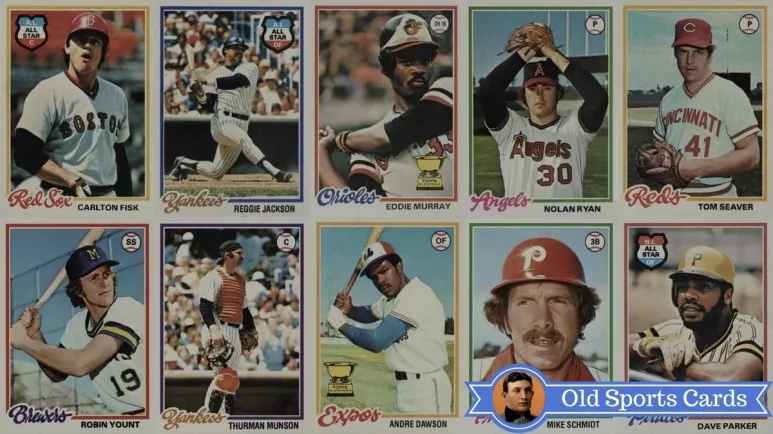
One thing that sticks out in my mind about the 1978 Topps baseball card set is how much Hall of Fame controversy there is within its checkliSt. Some guys are clearly Hall of Famers.
But, there is a crop of other guys who are borderline…
Some have been fortunate enough to have received the Cooperstown nod from the Veterans Committee.
And then there are others, seemingly just as deserving, who still haven’t received the call.
Fortunately, I don’t have to make those close calls of who gets into the Hall of Fame and who doesn’t, and instead, I can focus on their baseball cards.
And in this guide, I’ll run through the 25 most valuable in the set.
Let’s jump right in!
1978 Topps Baseball Set Snapshot
SET DETAILS
726
Eddie Murray, Alan Trammell, Paul Molitor, Jack Morris
Nolan Ryan
GRADING ANALYSIS
234,851
TOTAL GRADED BY PSA
62,762
PSA 8 Population
26.7%
PSA 8 Grade Rate
MOST GRADED CARDS
1
#36 Eddie Murray
7.1%
16,718
2
#707 Rookie Shortstops
4.6%
10,841
3
#20 Pete Rose
3.2%
7,455
Need Help Selling Your Sports Cards?
Fill out the form below and I’ll get back to you within 24 hours. No obligation.

Ross Uitts – Owner
- #1
1978 Topps #400 Nolan Ryan
PSA 9 Value $5,000 – $5,500Total PSA Population 6,903PSA 9 Population 149PSA 9 Grade Rate 2.2% (Set Avg: 26.7%)Nolan Ryan is one of the biggest names in the hobby as baseball card collectors simply love the guy.
How could they not?
“The Ryan Express” is the model for power pitching longevity.
Over an incredible 27-year career, he roasted opposing hitters with his astonishing velocity to the tune of a record 5,714 strikeouts and seven no-hitters.
Although he led the league in strikeouts (260) for the sixth time in seven years, the 1978 season wasn’t one of his best as he went 10-13 with a 3.72 ERA.
Since he pitched from the 1960s to the 1990s, Nolan Ryan cards will remain among the most desirable from both the vintage and modern eras.

- #2
1978 Topps #36 Eddie Murray Rookie Card
Rookie CardPSA 9 Value $1,600 – $1,700Total PSA Population 16,718PSA 9 Population 719PSA 9 Grade Rate 4.3% (Set Avg: 26.7%)One of the most desirable rookie cards of the 1970s, the 1978 Topps Eddie Murray shows the legendary slugger taking a practice swing and looking right at the camera.
The 1977 MLB Rookie of the Year, Topps recognized Murray as one of their “All-Star Rookies” in the set, as noted by the golden trophy in the lower-right corner.
Over his brilliant 21-year career, Murray became an 8-time All-Star, 3-time Silver Slugger, 3-time Gold Glover, and 1983 World Series champion.
Perhaps the most telling thing about Murray’s greatness is that he is on the shortlist of players with 3,000+ hits and 500+ home runs along with Hank Aaron, Willie Mays, Alex Rodriguez, Albert Pujols, and Rafael Palmeiro.
- #3
1978 Topps #707 Paul Molitor and Alan Trammell
Rookie CardPSA 9 Value $1,400 – $1,500Total PSA Population 10,841PSA 9 Population 461PSA 9 Grade Rate 4.3% (Set Avg: 26.7%)Arguably the best multi-player rookie card in the hobby, the 1978 “Rookie Shortstops” card features two Hall of Famers in Paul Molitor and Alan Trammell.
Although shown here as a shortstop, Molitor spent relatively little time there since fellow Brewer Hall of Famer, Robin Yount, was already locked in at the position.
Instead, he transitioned between second and third for most of his career.
Known for his exceptional bat and speed on the base paths, Molitor was a 7-time All-Star, 4-time Silver Slugger, 1993 World Series Champ/MVP, and collected 3,319 hits on his way to being a first-ballot Hall of Famer in 2004.
On the other hand, Trammell did not earn enough votes to be elected into the Hall during his fifteen years of eligibility.
Despite being a 6-time All-Star, 3-time Silver Slugger, 4-time Gold Glover, the 1984 World Series MVP, and forming one of the most solid double-play combos in baseball history alongside Lou Whitaker, his resumé lacked the type of stats to make him an obvious choice.
Looking a bit deeper into some of the more advanced sabermetrics to see just how great he was, the Modern Baseball Committee inducted Trammell in 2018.
- #4
1978 Topps #560 Dave Parker
PSA 9 Value $400 – $425Total PSA Population 655PSA 9 Population 97PSA 9 Grade Rate 14.8% (Set Avg: 26.7%)Dave Parker was one of the best players of his era and 1978 happened to be the best season of his impressive career.
Along with belting 30 home runs and driving in 117 runs, Parker picked up the batting title, a Gold Glove, and the MVP award for his incredible year.
He was a 7-time All-Star, 3-time Gold Glover, 3-time Silver Slugger, 2-time batting champion, 2-time World Series champion, the 1978 MVP, and finished in the top-five of the MVP vote on four other occasions.
One of the most feared hitters of his day, “The Cobra” also had a cannon for an arm.
His overall resumé has frequently put him in the conversation of whether or not he should be in the Hall of Fame but only time will tell if he finally gets his day in Cooperstown.
- #5
1978 Topps #100 George Brett
PSA 9 Value $375 – $400Total PSA Population 3,306PSA 9 Population 249PSA 9 Grade Rate 7.5% (Set Avg: 26.7%)George Brett made his rookie card debut in the 1975 Topps set, but that isn’t his only desirable card from the 1970s.
His 1978 Topps issue pictures Brett working on a massive wad of chewing tobacco with an All-Star badge in the lower-right corner to commemorate his efforts from the previous season.
The reverse of this card mentions Brett’s 215 hits that he collected during the 1976 season, making him the only Royals hitter in team history with a 200+ hits season at the time.
Those 215 hits remain the second-most in team history to this day behind Willie Wilson’s incredible 230 hits during the 1980 season.
Brett played in just 128 games in 1978 but still managed to lead the league in doubles (45) while making his third straight All-Star appearance.
- #6
1978 Topps #200 Reggie Jackson
PSA 9 Value $350 – $375Total PSA Population 3,078PSA 9 Population 381PSA 9 Grade Rate 12.4% (Set Avg: 26.7%)Heading into the 1978 season, Reggie Jackson had just turned in one of the most memorable World Series performances in history.
In his last at-bat versus the Dodgers’ Don Sutton in Gave Five of the 1977 World Series, Jackson sent one deep over the right field wall, but it wasn’t enough as the Yankees would lose 10-4.
However, that home run was just the beginning of something remarkable.
After Dodgers righty Burt Hooton walked Jackson in his first plate appearance in front of the hometown New York crowd, Jackson blasted the first pitches of his next three at-bats off of Hooton, Elias Sosa and Charlie Hough over the outfield fence.
That gave Jackson four home runs on four consecutive swings (going back to Game Five) off four different Dodgers pitchers.
It was this performance that cemented his legacy as “Mr. October.”
- #7
1978 Topps #580 Rod Carew
PSA 9 Value $270 – $285Total PSA Population 1,388PSA 9 Population 167PSA 9 Grade Rate 12.0% (Set Avg: 26.7%)Rod Carew started his Hall of Fame career at second base, but by the time the 1978 season rolled around, he was the Twins’ full-time first baseman.
The 1977 season was Carew’s finest as he would be named MVP after winning the batting title with an extraordinary .388 batting average, a personal best and Twins record, while also leading the league in runs scored (128), hits (239) and OPS (1.019).
His 1978 Topps card shows him transitioning from cap to helmet, getting back to work doing what he did best for 19 years in the Majors: hit.
Carew capped off his final season with the Twins in 1978 with his seventh batting title before being traded to California to finish his career with the Angels.
- #8
1978 Topps #704 Lou Whitaker Rookie Card
Rookie CardPSA 9 Value $240 – $260Total PSA Population 3,734PSA 9 Population 594PSA 9 Grade Rate 15.9% (Set Avg: 26.7%)At the Cooperstown induction ceremony for Jack Morris and Alan Trammell during the summer of 2018, one very noticeable thing seemed to be missing: their Tigers teammate, Lou Whitaker.
Whitaker was named the MLB Rookie of the Year in 1978 and went on to a fantastic 19-year career with Detroit, picking up 3 Gold Gloves, 4 Silver Sluggers, and 5 All-Star selections along the way.
I don’t know the ins and outs of Hall of Fame voting, but Whitaker has Trammell beaten in each major stat category except for batting average.
Maybe it’s not a good comparison since they played different positions but it just doesn’t seem right for one to be in the Hall of Fame without the other.
They were the Batman and Robin of double plays, playing in 1,918 games together, the most of any shortstop/second baseman combo in history.
And if advanced metrics helped Trammell into Cooperstown, they should help Whitaker, too, in my opinion.
His career WAR of 75.1 ranks seventh amongst second basemen and is well ahead of many other Hall of Famers at the position, including guys like Ryne Sandberg and Roberto Alomar.
If Whitaker is eventually inducted, his rookie card should jump in price.
- #9
1978 Topps #708 Dale Murphy
PSA 9 Value $175 – $185Total PSA Population 4,436PSA 9 Population 787PSA 9 Grade Rate 17.7% (Set Avg: 26.7%)New Atlanta Braves manager Bobby Cox had a very high opinion of rookie Dale Murphy before the 1978 campaign got underway.
“Give Murphy 500 at-bats this season and he’ll hit 25 homers minimum in the National League,” Cox said before the campaign.
Well, Murphy got 530 at-bats and smacked 23 dingers, not too far off from Cox’s generous prediction.
However, Murphy may have had over 30 home runs if he had been able to lay off pitches out of the zone.
The 22-year-old hit just .226 on the year with an NL-worst 145 strikeouts.
He walked just 42 times and posted a below league-average 80 OPS+.
The extra-base hits were plenty (40), but a .284 on-base percentage wasn’t going to cut it for long.
Things got much better.
Murphy would always be a strikeout-prone hitter, but his hitting evolved to make up for it on his way to back-to-back MVPs in the early 1980s.
- #10
1978 Topps #60 Thurman Munson
PSA 9 Value $170 – $175Total PSA Population 3,244PSA 9 Population 675PSA 9 Grade Rate 20.8% (Set Avg: 26.7%)Reggie Jackson was “Mr. October” for the New York Yankees.
However, honorable mention should go to Thurman Munson for his heroics in the clutch.
Coming off a franchise’s first world championship in fifteen years, Munson had a solid regular season, slashing .297/.332/.373 with six home runs, 27 doubles, 73 runs, and 71 RBIs in 154 games.
His durability was key and his veteran instinct played a picture-perfect role in Ron Guidry’s Cy Young run.
Where Munson really shone, though, was when the chips were down.
The 31-year-old plated a huge insurance run in the AL East tiebreaker against Boston, securing the team’s third straight division title.
He followed it up with one of the timeliest home runs in Yankees history, a two-run, go-ahead home run in the eighth inning that swung Game 3 and the entire ALCS against the Kansas City Royals.
He kept it on track in the World Series, too, hitting .320 with five runs and seven RBIs in a six-game triumph over the Dodgers.
- #11
1978 Topps #40 Carl Yastrzemski
PSA 9 Value $140 – $145Total PSA Population 1,896PSA 9 Population 308PSA 9 Grade Rate 16.2% (Set Avg: 26.7%)Carl Yastrzemski’s hitting was a model of superstar consistency in the 1960s and early 1970s.
Things were a little bit more hit-or-miss as the end of the Seventies approached.
In 1978, the Boston Red Sox left fielder/first baseman had a pretty down year by his lofty standards.
Yastrzemski slashed .277/.367/.423 with 17 home runs, 21 doubles, 76 walks, 70 runs in 144 games.
He was still an exceedingly patient hitter (76 walks against just 44 strikeouts).
However, it was hard to patch over the fact that his 40 extra-base hits were his fewest since his injury-shortened ’72 campaign.
If the Red Sox had gotten the MVP of years past, it’s possible they would have won the AL East by a comfortable margin.
Instead, 99-win Boston was clipped by the hated New York Yankees in a winner-takes-all tiebreaker, losing the division and a playoff berth by a single game.
That would be the closest Yaz would get to another October until he retired in 1983.
- #12
1978 Topps #703 Jack Morris Rookie Card
Rookie CardPSA 9 Value $125 – $135Total PSA Population 6,577PSA 9 Population 1,161PSA 9 Grade Rate 17.7% (Set Avg: 26.7%)No other pitcher gave up more hits, runs, and home runs in the 1980s as Jack Morris.
But, he also pitched the most innings and had the most wins during that decade.
He was wild at times with his split-finger fastball but a complete wizard in the postseason.
That was the kind of mixed career he had.
His five All-Star appearances, five top-five finishes in Cy Young voting, four World Series rings, 254 wins, and 3.90 ERA were impressive, but not enough to convince voters to send him to Cooperstown when he was eligible from 2000 to 2014.
Morris did finish with as high as 67.7% of the vote in 2013 but was still far short of the 75% he needed for election.
However, the Modern Era Committee finally inducted him in 2018 with his long-time Tigers teammate, Alan Trammell, as mentioned earlier.
Morris’s card was among one of the 66 double-print cards in the set.
- #13
1978 Topps #72 Andre Dawson
PSA 9 Value $110 – $120Total PSA Population 3,484PSA 9 Population 798PSA 9 Grade Rate 22.9% (Set Avg: 26.7%)Andre Dawson was an imposing figure at the plate, craning every bit of his 6-foot-3 frame over the strike zone.
“The Hawk” showed no fear crowding the dish and rarely let inside fastballs push him back.
Consequently, he took plenty of lumps.
In 1978, the second-year Montreal Expos center fielder was plunked an NL-leading twelve times in 660 plate appearances.
It was the first of four times he’d pace the Senior Circuit in hit-by-pitches in six seasons.
Dawson’s fearless approach helped boost his power game in ’78.
While he scuffled to a .253 average and on-base percentage under .300 (.299) in his sophomore season, the 23-year-old boosted his home run output to 25.
He also stole 28 bases to collect his first of five 20/20 campaigns in six years.
Dawson wasn’t yet the complete hitter he’d become, but his unflappable approach in the box was piecing everything together.
- #14
1978 Topps #282 New York Yankees Team
PSA 9 Value $110 – $120Total PSA Population 506PSA 9 Population 110PSA 9 Grade Rate 21.7% (Set Avg: 26.7%)The Red Sox and Yankees finished the 1978 regular season tied for first place in the American League East with identical records of 99-63.
After a coin toss to decide who would host the one-game playoff, the teams went to Boston to duke it out at Fenway Park.
The Yankees sent Ron Guidry to the mound to face off against Boston’s Mike Torrez and, after a hard-fought nail-biter, the Yankees ultimately prevailed, 5-4.
With a bit of momentum under their belts, the Yankees eventually became World Series champions after defeating the Dodgers in six, helped by Reggie Jackson’s home run spree mentioned earlier.

- #15
1978 Topps #6 Nolan Ryan Record Breaker
PSA 9 Value $110 – $115Total PSA Population 3,410PSA 9 Population 432PSA 9 Grade Rate 12.7% (Set Avg: 26.7%) - #16
1978 Topps #700 Johnny Bench
PSA 9 Value $100 – $110Total PSA Population 2,748PSA 9 Population 560PSA 9 Grade Rate 20.4% (Set Avg: 26.7%)The load of being the best catcher in the Major Leagues began to weigh heavily on Johnny Bench’s body in 1978.
Bench had already spent eleven years as the primary backstop for the Cincinnati Reds, incurring a laundry list of bumps, bruises, and injuries along the way.
By 1978, the future Hall-of-Famer’s back and throwing shoulder were both in constant agony.
He also had lingering issues with his thumb and feet, the latter suffering multiple fractures throughout his career.
The pain finally became too much in Bench’s age-30 campaign.
His 120 games played were the fewest of his career, and his prolonged absences were just enough to tip the NL West scales in favor of the rival Los Angeles Dodgers.
“Are there times I wish I hadn’t caught?
Sure,” Bench said.
“But then I wouldn’t have been Johnny Bench.” Bench still ended the ’77 season slashing .260/.340/.483 with 23 home runs, 73 RBIs, and a 129 OPS+ in 451 plate appearances (393 at-bats).
- #17
1978 Topps #360 Mike Schmidt
PSA 9 Value $100 – $110Total PSA Population 3,726PSA 9 Population 904PSA 9 Grade Rate 24.3% (Set Avg: 26.7%)The Philadelphia Phillies had all the talent in the world to be the team of the 1970s.
However, the playoffs proved to be their undoing.
Philadelphia posted back-to-back 101-win seasons in 1976 and 1977, yet fell to the Cincinnati Reds and Los Angeles Dodgers in consecutive NLCS disappointments.
1978 was pretty similar.
In fact, it was worse.
The Phillies scraped an NL East title together with 90 wins in what was a very poor division overall.
The face of the franchise, Mike Schmidt, had his worst year since his ’73 rookie campaign, slashing .251/.364/.435 and seeing his OPS drop nearly 170 points to .798.
A big contributor to that freefall was a season-long power outage.
After leading the league in homers three of the previous four years with no fewer than 36 in a season, Schmidt cranked just 21 in 145 games.
And after hitting just .063 in the ’77 NLCS, Schmidt hit just .200 with no homers in yet another four-game loss to Los Angeles.
- #18
1978 Topps #530 Dave Winfield
PSA 9 Value $85 – $90Total PSA Population 1,708PSA 9 Population 338PSA 9 Grade Rate 19.8% (Set Avg: 26.7%)The San Diego Padres hosted their first All-Star Game in 1978.
It coincided with the breakout of their brightest young star.
A year after earning his first All-Star nod, 26-year-old Friars outfielder Dave Winfield leveled up.
Before Opening Day, he was named the first team captain in San Diego history.
From there, he led by example.
Named NL Player of the Month in June, Winfield cracked .300 for the first time, slashing .308/.367/.499, all career bests at the time.
He ended the ’78 campaign fifth in the National League in batting average, sixth in RBIs (97), seventh in hits (181), and 10th in homers (24) among other top-ten finishes.
Winfield’s big moment came during the Padres’ best year thus far.
San Diego hung around the periphery of the National League West race all season before finishing fourth at 84-78.
It was the Padres’ first winning season in a decade of operation and their last one until their ’84 World Series appearance.
- #19
1978 Topps #20 Pete Rose
PSA 9 Value $80 – $90Total PSA Population 7,455PSA 9 Population 1,759PSA 9 Grade Rate 23.6% (Set Avg: 26.7%)Pete Rose was never one to shy from the limelight.
So, when the 37-year-old Cincinnati Reds third baseman chased down hitting-streak history in 1978, he was far from humble.
“Fine with me,” Rose said as cameras descended on him.
“I like talking about my base hits.” Rose had plenty of base hits to talk about.
On May 5th, 1978, the controversial superstar slapped his 3,000th hit against the Montreal Expos, becoming the 13th player to reach that plateau.
Just over a month later, Rose collected two knocks in a June 14th game against the Chicago Cubs.
He’d tally a base hit in every game until August 1St. Rose eventually broke Tommy Holmes’ 33-year-old NL record in late September, stretching his streak to 38 games.
DiMaggio’s immortal 56-gamer was in sight.
On August 1st, though, Rose finally went hitless to stop the counter at 44.
He posted multiple hits in 18 of those games and struck out just five times in 182 at-bats.
- #20
1978 Topps #34 Willie McCovey
PSA 9 Value $75 – $80Total PSA Population 1,048PSA 9 Population 132PSA 9 Grade Rate 12.6% (Set Avg: 26.7%)Willie McCovey’s days as a perennial All-Star were long gone in 1978.
The San Francisco Giants legend was nine years removed from his landmark ’69 MVP season and seven from his last All-Star appearance.
McCovey played through arthritic pain in his knees for most of the 1970s, and the 40-year-old was now relegated to a platoon role at first base.
However, he was still Willie McCovey, and his chase of 500 home runs was still an enduring highlight of San Francisco’s 89-win campaign.
McCovey thought it would come much quicker than it did.
He came into the season seven short and felt like he had a good shot of getting there by the end of April.
As it was, he struggled to get much of anything going and was forced to wait until the last day of June to punch his 500th ticket off of Atlanta lefty Jamie Easterly.
“That was the first time that the guys saw me smile going around the bases,” McCovey joked.
- #21
1978 Topps #670 Jim Rice
PSA 9 Value $70 – $80Total PSA Population 981PSA 9 Population 231PSA 9 Grade Rate 23.5% (Set Avg: 26.7%)In 1978, Boston Red Sox slugger Jim Rice became the first American League player since Joe DiMaggio in 1937 to tally 400 total bases in a season (406).
No player since Hank Aaron (1959) had done it, and Rice remains one of just nineteen players to get there.
To put that into perspective, there have been five more perfect games than 400-base campaigns.
Here’s a list of iconic, once-in-a-generation hitters who never touched 400: Ted Williams, Mickey Mantle, Willie Mays, Ken Griffey Jr., Albert Pujols, and Mike Trout.
Rice also led the Majors in home runs (46), RBIs (139), hits (213), and slugging percentage (.600).
He wouldn’t have reached 400 bases, either, if he hadn’t topped the game with 15 triples.
With Carlton Fisk compromised by a late-season injury, Rice took the baton and sprinted the Sox to within a one-game tiebreaker of an AL East title.
After Boston’s bitter loss to New York, he took home league MVP honors, besting Yankees rival Ron Guidry for the award.
- #22
1978 Topps #5 Pete Rose Record Breaker
PSA 9 Value $70 – $75Total PSA Population 1,683PSA 9 Population 307PSA 9 Grade Rate 18.2% (Set Avg: 26.7%) - #23
1978 Topps #270 Carlton Fisk
PSA 9 Value $60 – $65Total PSA Population 1,644PSA 9 Population 516PSA 9 Grade Rate 31.4% (Set Avg: 26.7%)Carlton Fisk strapped the Boston Red Sox to his back for most of his career.
By September 1978, the load got too heavy.
The 30-year-old catcher scorched through the summer months in ’78, posting an average over .350 and an on-base percentage north of .400 in June and July.
As the Red Sox fought to keep their head above water, Fisk solidified a formidable trio with soon-to-be MVP Jim Rice and Fred Lynn.
Seemingly out of the East race in mid-September, the Sox stormed to the finish with a 12-2 burSt. It forced a one-off East showdown with the Yanks.
One reason for their eventual downfall in that game was Fisk’s health.
The Hall-of-Famer suffered a broken rib late in the year, compromising both his hitting and throwing.
Boston couldn’t overcome it in the end, falling to New York, 5-4, and missing the playoffs for a third consecutive season.
- #24
1978 Topps #715 Jim Kaat
PSA 9 Value $50 – $55Total PSA Population 259PSA 9 Population 108PSA 9 Grade Rate 41.7% (Set Avg: 26.7%)1978 was the second year of a prolonged slump for veteran starting pitcher Jim Kaat.
After struggling in the Game 3 loss that killed the Philadelphia Phillies in the 1976 NLCS, Kaat dropped to back-end starter territory.
His ERA+ of 75 in 1977 was his worst in 17 years, and his improvement to an 88 ERA+ in ’78 was still well below average.
By the time the ’78 campaign started, manager Danny Ozark made the decision to lighten the 39-year-old’s workload.
Three years earlier, Kaat topped 300 innings pitched for the Chicago White Sox.
He received less than half that rope for the 1978 NL East champions.
The future Hall-of-Famer finished 8-5 on the year in just 140.1 innings, pitching to a 4.10 ERA with just 48 strikeouts against 32 walks.
Kaat’s role was to eat innings in the regular season and provide rest to the remainder of the rotation.
He wasn’t rostered for either of the Phillies’ playoff runs in ’77 and ’78.
- #25
1978 Topps #173 Robin Yount
PSA 9 Value $50 – $55Total PSA Population 3,110PSA 9 Population 874PSA 9 Grade Rate 28.1% (Set Avg: 26.7%)Robin Yount’s career reached a pivotal crossroads at a very young age.
Selected third overall by the Milwaukee Brewers in the 1973 MLB Draft, the shortstop phenom played one season in Single-A ball before making the team at 18 years old.
Yount handled things admirably despite some early-career struggles at the plate.
His arm and range at short were impactful, and his bat came along nicely as he entered his twenties.
However, that’s where things took a turn.
Yount labored through tendonitis in his foot and began to pressure the team in contract negotiations.
He was openly defiant and embittered as the team kept losing.
In 1978, Yount was forced to sit out at the beginning of the year because of his foot issue and sequestered himself away from the team.
He toyed with the idea of retirement before rejoining in mid-May.
It proved fortuitous.
Yount has his best offensive year thus far (.293 average, 110 OPS+) and the 93-win Brewers posted their first winning record in ten years of existence.

Ross’s Take
When it comes to sets from the 70s, I personally prefer those from the first half of the decade but this one still has plenty going for it.
Plagued by mis-cuts, printing defects, and ink smudges there are still some great rookie cards and plenty of Hall of Famers to collect.
The Hall of Fame inductions of Alan Trammell and Jack Morris have certainly boosted the set’s overall desirability in recent years.
Within the 726-card checklist were also several different subsets, including: Record Breakers (#1 – 7) League Leaders (#201 – 208) Playoff and World Series Highlights (#276 – 277) Rookie Stars (#701 – 711) Checklists While some of the cards can be quite expensive in high grade, the 1978 Topps set is one of the more affordable vintage sets that you can put together.
