
25 Most Valuable 1968 Topps Baseball Cards

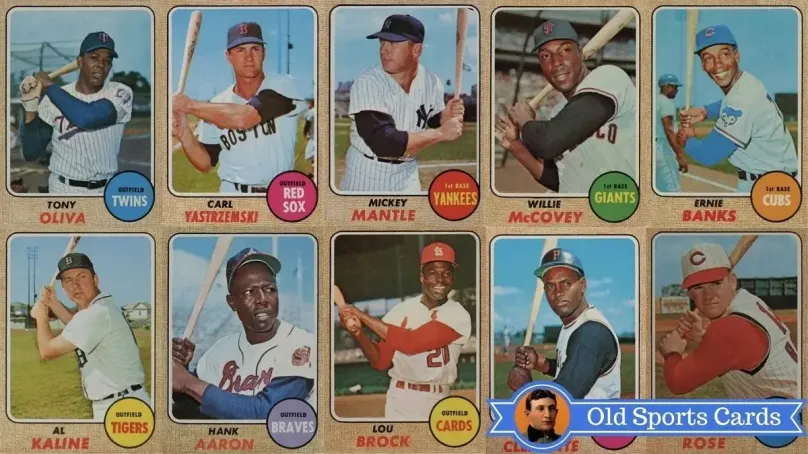
Instantly recognizable due to their burlap-colored borders, the 1968 Topps baseball card set is packed with Hall of Famers and anchored by two key rookie cards.
One of those rookie cards actually sold for well into the six figure range during an auction in 2016…
Many collectors feel that the design of this set is one of Topps’ least favorable of the 1960’s but personally, I love them.
True, the burlap borders do easily show wear and tear but I think it’s always nice to mix things up once in a while and Topps easily accomplished that in this case.
Love them or hate them, this set definitely has its place in the vintage card collecting circle.
And in this guide, I’ll run through the 25 most valuable to look for.
Let’s jump right in!
1968 Topps Baseball Set Snapshot
SET DETAILS
598
Nolan Ryan, Johnny Bench
Mickey Mantle, Hank Aaron, Roberto Clemente, Willie Mays, Pete Rose
GRADING ANALYSIS
394,627
TOTAL GRADED BY PSA
116,707
PSA 8 Population
29.6%
PSA 8 Grade Rate
MOST GRADED CARDS
1
#177 Mets Rookies Jerry Koosman/Nolan Ryan
4.9%
19,261
2
#280 Mickey Mantle
4.6%
18,300
3
#247 Reds Rookies Johnny Bench/Ron Tompkins
3.7%
14,763
Need Help Selling Your Sports Cards?
Fill out the form below and I’ll get back to you within 24 hours. No obligation.

Ross Uitts – Owner
- #1
1968 Topps #177 Nolan Ryan Rookie Card
Rookie CardPSA 8 Value $18,000Total PSA Population 19,261PSA 8 Population 755PSA 8 Grade Rate 3.9% (Set Avg: 29.6%)The Nolan Ryan rookie card is by far and away the most valuable in the 1968 Topps set.
Collectors often joke that their Jerry Koosman rookie card is the most valuable in the set since Ryan actually shares this card with him.
Koosman may not have had the career Ryan did but he would go on to be named to two All-Star teams and even once finished second in voting for the Cy Young award.
Clearly, Nolan Ryan is the star of this card, which is one of the most valuable and important vintage baseball cards in the hobby.
In fact, a Nolan Ryan rookie graded in PSA 10 Gem Mint condition sold for an incredible $612,360 at auction in 2016.

- #2
1968 Topps #400 Mike McCormick White Team Letters
PSA 8 Value $2,700Total PSA Population 182PSA 8 Population 23PSA 8 Grade Rate 12.6% (Set Avg: 29.6%)This is a prime example of how the value of a baseball card can be heavily impacted because of a simple variation.
The regular version of this card will show the Giants team name in yellow letters.
However, some examples made it off the printing press with the team name in white letters.
Far fewer white letter variations exist so collectors are willing to pay huge premiums for the card to complete an entire master set.
Though he was not a Hall of Famer, McCormick actually won the Cy Young award for his work in the 1967 season.

- #3
1968 Topps #280 Mickey Mantle
PSA 8 Value $2,500Total PSA Population 18,300PSA 8 Population 1,238PSA 8 Grade Rate 6.8% (Set Avg: 29.6%)Mickey Mantle cards will always be at or near the top of any list of most desirable cards in any set in which he appeared.
The Mick was larger than life and fans adored the Yankees slugger.
Of all his regular Topps issues, this is his least valuable.
That just shows you how valuable his cards can be when his “cheapest” card is almost at the top of this liSt. I’ve always loved this card as it gives a great shot of Mantle batting lefty with intense concentration in his legendary Yankee pinstripes.
The 1968 season would be Mantle’s last as a professional baseball player.
- #4
1968 Topps #247 Johnny Bench Rookie Card
Rookie CardPSA 8 Value $2,000Total PSA Population 14,763PSA 8 Population 1,130PSA 8 Grade Rate 7.7% (Set Avg: 29.6%)The other key rookie card in this set would belong to Johnny Bench.
Bench easily goes down in history as one of the game’s all-time greatest catchers but because his popularity didn’t quite reach the heights of Nolan Ryan, his rookie card can be had for much less.
The young Bench stares off into the distance wearing a backwards Reds cap on a bright blue day, giving this card a huge amount of character and eye appeal.
Centering can often be a challenge with this card as you’ll often find it favoring one or more borders.
- #5
1968 Topps #50 Willie Mays
PSA 8 Value $975Total PSA Population 5,956PSA 8 Population 540PSA 8 Grade Rate 9.1% (Set Avg: 29.6%)Willie Mays baseball cards are always among the keys to any set in which he was included since he was arguably one of the top five best baseball players who ever played.
Mays could do it all…
He could hit, field, and run at incredible levels that are rarely seen by themselves, let alone all in one package of a single player.
Mays is shown hoisting a pair of bats over one should and staring off to the left.
I wish Topps would’ve chose a more exciting shot for such a high profile legend, but it’s tough to complain too much about any Mays card…
Mays’ offensive production had started to dip during the season before but he was still playing at a high enough level in 1968 to earn his 15th All-Star appearance…in a row.
- #6
1968 Topps #150 Roberto Clemente
PSA 8 Value $950Total PSA Population 6,305PSA 8 Population 579PSA 8 Grade Rate 9.2% (Set Avg: 29.6%)Along with Mantle, Mays and Aaron, Roberto Clemente cards are some of the most sought after of the 1950’s and 1960’s.
This one is no exception.
Donning his Pittsburgh Pirates gear, Clemente stands at bat staring intently off into the distance.
Not enough good things can be said about Clemente.
Not only was he an amazing ball player, his dedication to humanitarian efforts truly place him in another class.
Major League Baseball did well in creating the Roberto Clemente Award which is given annually to the player who “best exemplifies the game of baseball, sportsmanship, community involvement and the individual’s contribution to his team.”
- #7
1968 Topps #490 Super Stars
PSA 8 Value $850Total PSA Population 5,419PSA 8 Population 610PSA 8 Grade Rate 11.3% (Set Avg: 29.6%)This is a fantastic card depicting three of the game’s all-time greats in Harmon Killebrew, Willie Mays and Mickey Mantle.
Between this trio of bombers, they hit a jaw-dropping 1,769 home runs with Mays topping the list: Willie Mays: 660 Harmon Killebrew: 573 Mickey Mantle: 536 Had Killebrew played on a larger market team, we would likely hear a lot more about him.
Regardless, he was an amazing baseball player.
That goes for all three of these guys and thankfully, Topps created this wonderful card as a nice tribute to them.
- #8
1968 Topps #110 Hank Aaron
PSA 8 Value $775Total PSA Population 6,760PSA 8 Population 758PSA 8 Grade Rate 11.2% (Set Avg: 29.6%)Next up is legendary slugger Hank Aaron.
The 1968 season was kind of a down year for Aaron as he failed to do what he so often did season after season: hit above .300, hit 30+ home runs and drive in 90+ RBI.
Regardless, his performance on the field was still good enough to land him his 14th All-Star appearance in a row.
Aaron was one of the game’s greatest hitters of all-time and he routinely struck fear into the hearts and minds of opposing pitchers.
- #9
1968 Topps #45 Tom Seaver
PSA 8 Value $650Total PSA Population 9,034PSA 8 Population 834PSA 8 Grade Rate 9.2% (Set Avg: 29.6%)It’s easy to discount the 1968 New York Mets when you look at the miracles of the following year.
Yet, it was perhaps equally important to bringing a title to Queens.
“We pass over 1968 too quickly,” Mets broadcaster Howie Rose once said.
“That was the season the executives were getting the pieces together.” After six seasons of 66 wins or fewer, New York improved to 73-89 on the strength of a revamped pitching staff.
The Mets gave up no fewer than 672 runs from the team’s 1962 inception through 1967.
In ’68, they gave up just 499.
New York’s front office finally put the pieces in play to keep runs off the board, including a brand-new ace in second-year righty Tom Seaver.
The reigning Rookie-of-the-Year put together an even better performance in ’68, finishing 16-12 with a tiny 2.20 ERA in 278 innings.
Seaver spun 14 complete games and five shutouts in 36 outings, along with notching a 200-strikeout campaign (205) for the first of nine consecutive seasons.
- #10
1968 Topps #230 Pete Rose
PSA 8 Value $650Total PSA Population 5,880PSA 8 Population 603PSA 8 Grade Rate 10.3% (Set Avg: 29.6%)What a great look at Pete Rose standing in a batting pose doing what he did best: getting ready to hit the baseball.
During the 1968 season, Rose would bat .335 which earned him his first of three batting titles throughout his career.
Rose will always be surrounded by controversy due to his involvement in gambling on baseball but you can’t argue how good of a hitter he was.
His playing ability keeps his popularity extremely high with players and he’s always among the keys to the set.
I love those old cutoff uniforms of that era and Rose’s red undershirt mixed with his Reds uniform give this card strong eye appeal.
- #11
1968 Topps #80 Rod Carew
PSA 8 Value $525Total PSA Population 4,214PSA 8 Population 485PSA 8 Grade Rate 11.5% (Set Avg: 29.6%)After finishing on the brink of an AL pennant in 1967, the Minnesota Twins took a stumbling misstep in ’68.
Most of the blame fell on manager Cal Ermer.
“Cal Ermer was a weak man,” Twins catcher John Roseboro once wrote.
“He was quiet like (legendary Dodgers manager) Walter Alston, but he didn’t have Walt’s firmness or the respect Walter had.” One player who regressed temporarily under Ermer’s guidance was second-year second baseman Rod Carew.
Ermer and Carew never got along, and Cal even benched the kid for two games after showing up late to the stadium for a game, a move that incensed Twins owner Calvin Griffith.
Carew hit .273 with a .312 on-base percentage, both career worsts.
The 22-year-old also hit just one home run in 127 games.
By season’s end, Griffith pulled the plug and fired Ermer in favor of former New York Yankees middle infielder Billy Martin.
- #12
1968 Topps #374 Roberto Clemente All-Star
PSA 8 Value $275Total PSA Population 2,413PSA 8 Population 344PSA 8 Grade Rate 14.3% (Set Avg: 29.6%) - #13
1968 Topps #100 Bob Gibson
PSA 8 Value $265Total PSA Population 3,710PSA 8 Population 699PSA 8 Grade Rate 18.8% (Set Avg: 29.6%)A total of twenty-five pitchers have won an MVP award, most of which have come with a degree of controversy.
After all, most starters appear in less than 20% of their team’s games, and relievers rarely touch above 40%.
One MVP hurler who received absolutely no pushback, though, was the great Bob Gibson.
The St. Louis Cardinals’ super-ace orchestrated a 1968 campaign that remains the standard of pitching dominance.
His 1.12 ERA remains an MLB Live Ball era record, as does his 13 shutouts in 28 starts.
Gibson posted an ERA under one against four of the nine NL clubs he faced.
The 32-year-old’s worst work was against the Los Angeles Dodgers, and even that came with a sterling 2.12 ERA.
Perhaps the most important note from Gibson’s MVP year was what he did to close things out.
The Hall-of-Famer tossed 23 complete games in his final 25 outings, basically carrying the defending champion Cards to their second consecutive pennant and third in five years.
- #14
1968 Topps #3 National League RBI Leaders
PSA 8 Value $250Total PSA Population 2,855PSA 8 Population 292PSA 8 Grade Rate 10.2% (Set Avg: 29.6%) - #15
1968 Topps #165 Tony Oliva
PSA 8 Value $250Total PSA Population 651PSA 8 Population 168PSA 8 Grade Rate 25.8% (Set Avg: 29.6%)Tony Oliva’s Hall of Fame career was often a race against his own body.
The 15-year Minnesota Twins outfielder/DH was born with a genetic deformity in both of his knees.
Twins staff spotted the issue before his 1964 AL Rookie of the Year season, but couldn’t do much except recommend exercises and mitigate his pain.
It would take several surgeries and rehabs for Oliva to keep playing baseball, let alone play it at the level he did.
Yet somehow, for most of his career, the Cuban-born star showed up and maximized his playing time.
Even when his knees were giving him major trouble, as they did in 1968 following surgeries the previous two years, Oliva did the dirty work to get on the field as much as possible.
Oliva played 128 games in ’68, the low of his five-year career thus far.
However, he probably should have played fewer.
And he probably shouldn’t have put up another All-Star campaign, complete with a .289/.357/.477 with 18 home runs and 68 RBIs.
But, he did.
- #16
1968 Topps #355 Ernie Banks
PSA 8 Value $250Total PSA Population 3,826PSA 8 Population 723PSA 8 Grade Rate 18.9% (Set Avg: 29.6%)Ernie Banks did what he could in 1968 to make the best out of a bad situation.
It was no shock to anyone involved or around the Chicago Cubs that Banks and manager Leo Durocher weren’t exactly the best of friends.
Durocher openly mocked Banks and repeatedly forced “Mr. Cub” to fight for his starting first-base job.
Durocher often treated the two-time MVP and first-ballot Hall-of-Famer like a rookie, rather than a franchise cornerstone.
Still, Banks pushed through.
He even took a “player-coach” role from Durocher in 1967, half-offered in jest and half in hopes of phasing him out of the starting lineup.
Rather than taking offense, Banks tutored the team’s young players and put up the power numbers necessary to force Durocher’s hand.
In 1968, Banks hit 32 home runs, his most in six years.
For all of Durocher’s posturing, Banks still got into 150 games for the third-place Cubs.
He earned every one of them.
- #17
1968 Topps #250 Carl Yastrzemski
PSA 8 Value $250Total PSA Population 3,947PSA 8 Population 766PSA 8 Grade Rate 19.4% (Set Avg: 29.6%)1968 was the “Year of the Pitcher.” Boston Red Sox left fielder Carl Yastrzemski didn’t get the memo.
Many things conspired against hitters in ’68.
Everything from an extended strike zone to cavernous ballparks to a 15″ mound to the birth of the slider hit all at once.
Batting averages dipped, power numbers cratered, and overall run scoring took a dive to Deadball Era levels.
(They even lowered the mound five inches after the season because things were so rough.) It was all very anti-hitter.
And yet, Yaz still hit like the Hall-of-Famer he was.
The reigning AL MVP hit .301 in 1968 to win his second consecutive batting crown and third overall.
He was the only player in the AL to crack .300, and his title remains historic as the lowest winning batting average in MLB history.
Yastrzemski also paced the Majors in WAR (10.5), on-base percentage (.426), and walks (119) on his way to another top-ten MVP placement.
- #18
1968 Topps #5 National League Home Run Leaders
PSA 8 Value $225Total PSA Population 1,291PSA 8 Population 134PSA 8 Grade Rate 10.4% (Set Avg: 29.6%) - #19
1968 Topps #500 Frank Robinson
PSA 8 Value $200Total PSA Population 1,869PSA 8 Population 385PSA 8 Grade Rate 20.6% (Set Avg: 29.6%)Frank Robinson played the 1968 season through a literal daze.
The Baltimore Orioles outfielder suffered a brutal concussion on June 27th, 1967, after colliding head-first with Chicago White Sox infielder Al Weis’ knee in hopes of busting up a double play.
The resulting head injury caused persistent headaches and spells of double vision.
It was a traumatic experience and one that Robinson felt cost him dearly.
“I don’t know how much I left at second base,” Robinson said later.
“I haven’t been the same hitter since.” Robinson missed about a month, but it took much longer to get tracked.
His entire ’68 campaign was under a blurry cloud, an issue that became even more glaring in the run-stifling Year of the Pitcher.
For what he was going through, though, Robinson had a pretty dang good year.
The 32-year-old slashed .268/.390/.444 with the worst home run (15) and RBI totals (52) of his career thus far.
Yet, his 153 OPS+ still placed fifth in the American League.
- #20
1968 Topps #480 Managers Dream
PSA 8 Value $185Total PSA Population 3,077PSA 8 Population 584PSA 8 Grade Rate 19.0% (Set Avg: 29.6%) - #21
1968 Topps #240 Al Kaline
PSA 8 Value $175Total PSA Population 2,670PSA 8 Population 472PSA 8 Grade Rate 17.7% (Set Avg: 29.6%)Al Kaline tried to talk his manager out of playing him in his first (and only) World Series.
It didn’t work.
Kaline’s 1968 season started quite strongly.
The 33-year-old outfielder/first baseman crossed 2,000 games played in mid-April and set a new Detroit Tigers career record with his 307th home run in mid-May.
Detroit was also playing great baseball, well on its way to a 103-win, pennant-clinching campaign.
That’s when things got painful.
On May 25th, the Hall-of-Famer suffered a broken arm after he was nailed with a Lew Krausse fastball.
Kaline missed over a month and was held to pinch-hitting duties and spot first-base work for the remainder of the regular season.
Because of his diminished role and injury problems, Kaline lobbied manager Mayo Smith to leave him off the Fall Classic roster.
Smith smartly declined, instead shuffling the lineup deck to place Kaline in right.
He responded with a blistering .379 average and two clutch homers that helped vault the Tigers to their first World Series win in 23 years.
- #22
1968 Topps #520 Lou Brock
PSA 8 Value $160Total PSA Population 2,361PSA 8 Population 751PSA 8 Grade Rate 31.8% (Set Avg: 29.6%)You can argue for several players when looking for the most clutch postseason performer of all time.
No matter who you end up choosing as your #1, Lou Brock has to be somewhere on the shortliSt. In 1968, the legendary St. Louis Cardinals left fielder appeared in his third and final World Series.
The sixth-place MVP finisher was coming off a banner regular season in which he led the Majors in doubles (46), triples (14), and stolen bases (62).
It was the perfect lead-in to Brock’s chance at a third World Championship in three tries.
In the two previous World Series, the Cooperstown legend hit a combined .356.
In ’67, Brock stole seven bases in seven games.
He was even better in 1968.
Brock hit .464 with a wild .516 on-base percentage for the defending champs, matching his stolen base total from the year before while also hitting two big home runs.
The end result, however, was different.
Detroit rolled back from a 3-1 Series deficit, outscoring the Cards 22-5 in the final three games to wrest away the title.
- #23
1968 Topps #370 Hank Aaron All-Star
PSA 8 Value $150Total PSA Population 2,930PSA 8 Population 546PSA 8 Grade Rate 18.6% (Set Avg: 29.6%) - #24
1968 Topps #330 Roger Maris
PSA 8 Value $150Total PSA Population 3,983PSA 8 Population 796PSA 8 Grade Rate 20.0% (Set Avg: 29.6%)Roger Maris was the winningest MLB player of the 1960s.
From 1960 to 1968, the former home run champion of the world played for seven different pennant winners across both leagues and three World Series victors.
Maris served a critical role for those five New York Yankees teams and two St. Louis Cardinals squads, providing historic pop, underrated baserunning, and even back-to-back MVP awards in 1961 and 1962.
Maris also got out before his body completely shut down.
Roughed up by injuries and the mental strain of being Public Enemy #1 in the Bronx, the seven-time All-Star announced his intention to retire at the conclusion of the 1968 season.
At that point, Maris’ power had diminished to the tune of just five home runs in 100 games.
However, he still posted an above-average OPS+ in the Year of the Pitcher (105) with a solid 2.3 WAR.
It ended tough, though, with a seven-game Series loss to Detroit, in which the 33-year-old hit just .158.
- #25
1968 Topps #290 Willie McCovey
PSA 8 Value $135Total PSA Population 2,235PSA 8 Population 578PSA 8 Grade Rate 25.9% (Set Avg: 29.6%)Everyone had a right to fear pitchers in the Year of the Pitcher.
But who did the pitchers freak out about?
If you took a poll of NL hurlers in 1968, the answer would likely be San Francisco Giants slugger Willie McCovey.
“(He’s) the most feared left-handed hitter in the National League,” Cincinnati Reds ace Jim Maloney said at the time.
They had good reason for anxiety.
McCovey absolutely crushed righties in ’68 and didn’t show much give against lefties, either.
The 30-year-old first baseman cracked 7.0 WAR for the first time and topped the Senior Circuit in home runs (36), slugging percentage (.545), and RBIs (105).
McCovey also topped the Majors in OPS (.923) and OPS+ (174).
McCovey wasn’t just a home run merchant, either.
He also placed eighth in the NL in batting average (.293), scored 81 runs, and walked 72 times.
McCovey’s MLB-worst 21 errors were unsightly, but the third-place NL MVP finisher still graded out above average overall per current-day advanced stats.

Ross’s Take
So there you have it, the ten most valuable 1968 Topps baseball cards.
As you can see, this set is loaded with Hall of Famers and stars as well as some great rookie cards and variations.
This set was quite large as it contained a total of 598 cards.
High number cards, those numbered #498 to 598, were printed in smaller quantities and do carry price premiums versus other cards in the set.
Within the set were also several different subsets, including: All-Stars (#361 – 380) Leaders (#1 – 12) Star Rookies World Series Game 1-7 and Summary (#151 – 158) Checklists While the hobby may have mixed opinions on the aesthetic appeal of this set, there’s no doubting that it contains huge star power and great value overall.
