
15 Most Valuable 1995 Donruss Baseball Cards

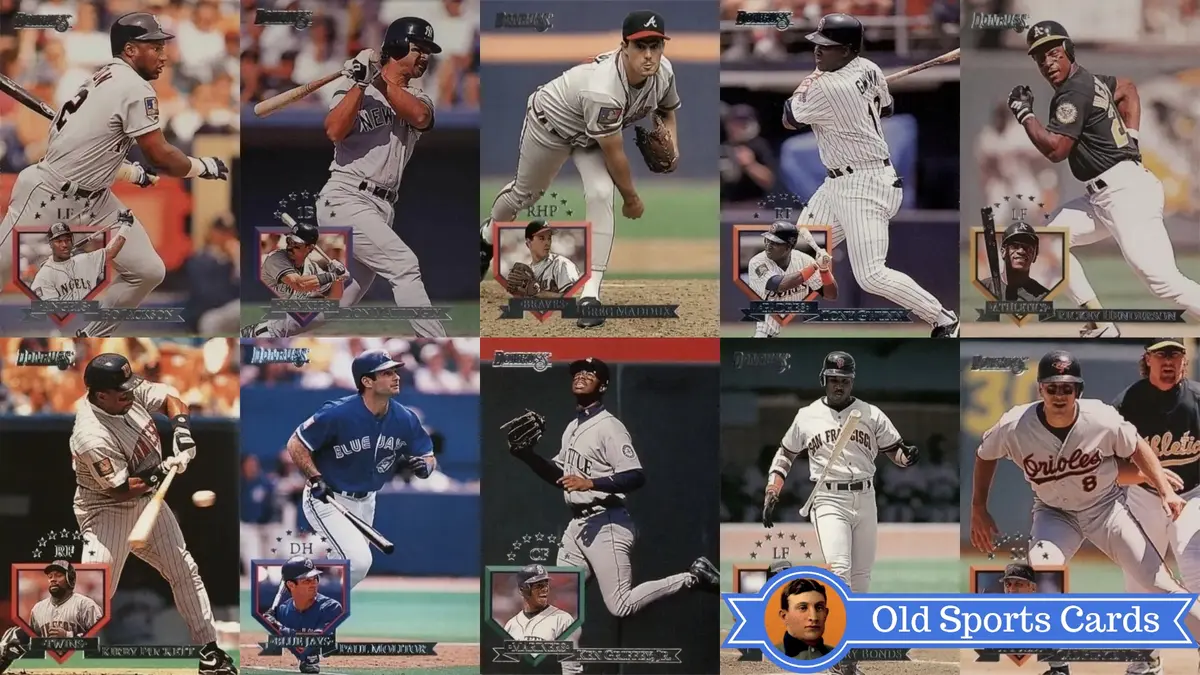
By 1995, the hobby was deep into its “experimental phase,” and Donruss was leaning hard into the high-gloss, premium aesthetic to keep pace with collector preferences.
The 1995 Donruss set is a perfect snapshot of that transition—gone were the simple paper stocks of the 80s, replaced by a sleek, UV-coated design.
Unfortunately, the timing wasn’t great… It was a strange year for baseball, with the strike-shortened season leaving a bitter taste in many fans’ mouths.
Collectors were turned away and the set never really held up all that great over time.
Still, ‘95 Donruss is a fun, affordable rip that perfectly captures the era when the hobby was trying to figure out exactly how “premium” it wanted to be.
And in this guide, we’ll take a look at the 15 most valuable.
Let’s jump right in!
1995 Donruss Baseball Set Snapshot
SET DETAILS
550
Armando Benitez
Key Griffey Jr., Rickey Henderson, Don Mattingly, Tony Gwynn, Cal Ripken Jr.
GRADING ANALYSIS
802
TOTAL GRADED BY PSA
306
PSA 10 Population
38.2%
PSA 10 Grade Rate
MOST GRADED CARDS
1
#114 Alex Rodriguez
21.9%
176
2
#83 Cal Ripken Jr.
7.2%
58
3
#55 Don Mattingly
7.0%
56
Stay On Top Of The Card Market
Weekly pricing updates, grading insights, and new card guides — straight to your inbox. For free.
Join thousands of collectors. Unsubscribe anytime.

Ross Uitts – Owner
- #1
1995 Donruss #340 Ken Griffey Jr.
PSA 10 Value $70Total PSA Population 52PSA 10 Population 0PSA 10 Grade Rate 0.0% (Set Avg: 38.2%)The Seattle Mariners won just one playoff series with the great Ken Griffey Jr. in uniform.
That came in the strike-interrupted 1995 campaign.
In 1994, the season took a turn toward cancellation, with the Mariners in a tightly contested AL West race.
The team was not particularly good (49-63), and neither was the division, but Griffey was, placing second for AL MVP behind Chicago’s Frank Thomas.
The strike cut the World Series and delayed the start of the ’95 schedule by a month.
By the time Opening Day finally came on April 27th, Griffey had the look of the league’s true Most Valuable Player.
However, one month later, “The Kid” shattered his left wrist in the middle of his iconic “Spiderman” catch at the Kingdome.
He missed nearly half of the season, but came back just in time to join the M’s for their first-ever AL West championship celebration.
The M’s went on to oust the Yankees in the ALDS behind Griffey’s .391 series, but ultimately fell to the Cleveland Indians in a six-game ALCS loss.

- #2
1995 Donruss #507 Bo jackson
PSA 10 Value $70Total PSA Population 37PSA 10 Population 12PSA 10 Grade Rate 32.4% (Set Avg: 38.2%)The 1994 MLB players’ strike made up Bo Jackson’s mind for him.
The original plan was for Jackson to focus on baseball 100% after a brutal injury in the 1990 AFC Divisional Round ended his football career.
He played a handful of games for the ’91 Chicago White Sox, sat out the ’92 season to focus on injury rehab, and returned for two productive part-time seasons for the Sox (’93) and California Angels (’94).
When the labor stoppage wiped out the last two months of the ’94 campaign (and playoffs), Jackson turned to Plan B.
His name value remained, and he used that to dabble in acting and other pursuits.
By the time the ’95 got underway, he had at least 1/6 of the Majors calling him.
Jackson declined those overtures, announcing his retirement and his excitement to spend more time at home.
“I got to know my family,” Jackson said.
“That looks better to me than any $10 million contract.”
- #3
1995 Donruss #83 Cal Ripken Jr.
PSA 10 Value $50Total PSA Population 58PSA 10 Population 26PSA 10 Grade Rate 44.8% (Set Avg: 38.2%)Cal Ripken Jr. approached Lou Gehrig’s consecutive games record with determination and quiet focus, putting his head down and doing the work day after day.
When it came time to celebrate milestone #2,131, the Baltimore Orioles icon initially hesitated.
“Rafael Palmeiro and Bobby Bonilla said we’re not getting this thing going again until you take a lap.
They physically grabbed me, threw me out there,” Ripken said.
It wasn’t just a moment for Ripken.
September 6th, 1995, was a celebration of baseball at a tenuous time.
Less than 12 months before, the game went without a World Series in a mess of labor disputes.
Now, one of the game’s good guys was getting his due for breaking the record of another one of baseball’s good ones.
Ripken relaxed as the celebration unfolded and began to feel the gravity of the moment.
“We like baseball,” Ripken said later.
“We like the history of baseball.
And I guess I became a symbol of that.”
- #4
1995 Donruss #305 Rickey Henderson
PSA 10 Value $50Total PSA Population 37PSA 10 Population 27PSA 10 Grade Rate 73.0% (Set Avg: 38.2%)The end of Rickey Henderson’s third stay with the Oakland A’s boiled down to a business decision.
Henderson had a very good 1995 campaign, his best by OPS+ (132) from 1994 to his retirement after the 2003 season.
The 37-year-old left fielder hit .300 for the sixth time in his Hall-of-Fame career while posting an on-base percentage over 40% (.407) for the fourteenth time.
Henderson also cracked nine home runs and finished eighth in the AL in stolen bases (32) despite missing over a month’s worth of games due to injury and reSt. Rickey was still a top-tier leadoff hitter and plenty valuable.
However, he played for the A’s, a franchise known for slicing costs dramatically and engaging in full-scale rebuilds.
So, when the A’s offered him a dramatic pay cut of less than half his ’95 salary ($3.6 million), Rickey packed his bags and moved south, joining the San Diego Padres on a lucrative two-year, $6.2 million pact.
- #5
1995 Donruss #380 Kirby Puckett
PSA 10 Value $45Total PSA Population 21PSA 10 Population 17PSA 10 Grade Rate 81.0% (Set Avg: 38.2%)Kirby Puckett’s final season ended with one of the most gruesome hit-by-pitches the game has seen.
It was a horrific curtain call for yet another Hall-of-Fame hitting exhibition.
The Twins were terrible (55-86), but it was to little fault of Puckett, who finished fractions of a point outside the top ten of the AL batting race.
The 35-year-old right fielder concluded the year slashing .314/.379/.515 with 23 home runs, 39 doubles, and 99 RBIs in 137 games.
These strong numbers earned Puckett a tenth All-Star appearance and some down-ballot MVP consideration.
However, it all ended with a sickening thud.
Puckett was blasted in the face by a Dennis Martinez fastball on the final day of the regular season, shattering his jaw on impact.
The resulting scene was not for the faint of heart.
“I’ve never seen that much blood on a baseball field, ever,” teammate Frankie Rodriguez said.
“It was scary.”
- #6
1995 Donruss #224 Tony Gwynn
PSA 10 Value $45Total PSA Population 9PSA 10 Population 5PSA 10 Grade Rate 55.6% (Set Avg: 38.2%)Tony Gwynn was denied a legitimate shot at a .400 season by the ’94 labor dispute.
It only served to inspire him.
The San Diego Padres right fielder ended the strike-shortened 1994 campaign with an MLB-leading .394 average.
If anyone could become the first since Ted Williams (1994) to hit the magical .400 mark, Gwynn was the guy.
Instead, Gwynn had to settle for the game’s best batting average in over five decades.
Once play finally resumed in 1995, the 35-year-old got back at it.
An uncharacteristic May (.282) was soon forgotten as Gwynn blistered his way through the final four months.
The Hall-of-Famer ended the year with a .368 average and his sixth batting title.
Gwynn also led the Majors in hits (197), stole 17 bases, and cracked .400 in on-base percentage (.404) for the second consecutive season.
It wasn’t the .400 everyone was looking for, but it was plenty enough for an 11th All-Star nod and sixth top-ten MVP placement.
- #7
1995 Donruss #55 Don Mattingly
PSA 10 Value $45Total PSA Population 56PSA 10 Population 23PSA 10 Grade Rate 41.1% (Set Avg: 38.2%)Just over 30 years before Don Mattingly made his first World Series as a coach with the Toronto Blue Jays, the beloved New York Yankees captain clinched his one and only playoff appearance as a player.
Sadly, it came with Mattingly at the end of his playing rope.
What was once a slam-dunk Hall of Fame candidacy had since been sent sideways by a congenital back condition.
In the late 1980s, Donnie Baseball was among the greatest hitters of his generation: a six-time All-Star, five-time Gold Glover, and MVP (1985).
Five years after the turn of the decade, Mattingly was no longer elite.
He was a fantastic leader, a great resource, and a just-above-league-average hitter.
A young, Yankees dynasty-in-waiting lifted their captain to an elusive playoff berth, capturing the first-ever AL Wild Card.
Mattingly hit .417 in his only playoff series, a gut-wrenching, five-game ALDS loss to the AL West champion Seattle Mariners.
- #8
1995 Donruss #8 Barry Bonds
PSA 10 Value $40Total PSA Population 14PSA 10 Population 1PSA 10 Grade Rate 7.1% (Set Avg: 38.2%) - #9
1995 Donruss #50 Ozzie Smith
PSA 10 Value $35Total PSA Population 15PSA 10 Population 3PSA 10 Grade Rate 20.0% (Set Avg: 38.2%)Ozzie Smith’s 1995 season set his retirement in motion.
The 40-year-old “Wizard” became the oldest shortstop in MLB history to start on Opening Day.
The St. Louis Cardinals and Smith were forever linked, and it would seem sacrilegious for anyone else to take the spot.
The problem was that Smith didn’t quite have the juice anymore.
Once the most breathtaking and efficient shortstop in the league, the Cardinals legend was now a league-average defender with decreased side-to-side mobility.
His bat, which had never been his calling card, was also fading.
Add in a long, midseason absence due to rotator cuff surgery, and it was clear that the era of Ozzie Smith was coming to an end.
Overall, Smith slashed a rough .199/.282/.244 with no homers, 11 RBIs, and four stolen bases in 44 games.
His -0.7 WAR was the worst of his career, ultimately leading to a 1996 platoon under new manager Tony LaRussa.
82 regular-season games later, Smith called it quits.
- #10
1995 Donruss #415 Deion Sanders
PSA 10 Value $35Total PSA Population 3PSA 10 Population 1PSA 10 Grade Rate 33.3% (Set Avg: 38.2%) - #11
1995 Donruss #162 Paul Molitor
PSA 10 Value $30Total PSA Population 14PSA 10 Population 12PSA 10 Grade Rate 85.7% (Set Avg: 38.2%) - #12
1995 Donruss #275 Frank Thomas
PSA 10 Value $30Total PSA Population 25PSA 10 Population 9PSA 10 Grade Rate 36.0% (Set Avg: 38.2%)Frank Thomas’ seven-year tear from 1991-97 ranks among the most dominant multi-year peaks in MLB history.
The hulking Chicago White Sox first baseman got his call-up in August 1990 and proceeded to slug a hefty .529 in just 60 games.
It kept getting heftier.
Thomas slugged at least .536 each year from ’91 to ’97 and crossed .600 five consecutive times from ’93 to ’97.
The two-time MVP’s .729 output during the 1994 strike-shortened season ranks 21st all-time.
Thomas wasn’t just a power hitter, either.
He was also patient while hitting for average.
The Big Hurt hit .300 in all seven years, with his lowest coming in 1995 (.308).
The Hall-of-Fame also topped the AL in walks four times during this run, including an MLB-best 136 free passes in ’95.
OPS and OPS+ may not be catch-alls, but they sum up the story quite well.
Thomas finished at least top-two in both categories for six of these seven campaigns, only going as low as third in 1995.
- #13
1995 Donruss #331 Greg Maddux
PSA 10 Value $30Total PSA Population 8PSA 10 Population 4PSA 10 Grade Rate 50.0% (Set Avg: 38.2%) - #14
1995 Donruss #355 Wade Boggs
PSA 10 Value $30Total PSA Population 6PSA 10 Population 1PSA 10 Grade Rate 16.7% (Set Avg: 38.2%)The 1995 season was the last time we saw Wade Boggs in Hall-of-Fame form.
The 37-year-old New York Yankees third baseman joined captain Don Mattingly as the veteran heart of a Bronx renaissance.
In 1994, New York seemed destined to make their first postseason in over a decade before the strike stopped everything.
Boggs and the Bombers picked up where they left off in ’95, scratching and clawing their way through the first-ever AL Wild Card race to a playoff berth.
The Hall-of-Famer was a vital contributor to the team’s rise, winning his second Gold Glove and hitting .324 with a hefty 4.2 WAR in 126 games.
Boggs also got on base over 40% of the time for an 11th season (.412), giving the rest of the lineup plenty of runs to knock in.
It would be the final time.
New York bowed out in a five-game ALDS nail-biter with Seattle, and Boggs would go on to regress into a league-average hitter in his final four MLB seasons.
- #15
1995 Donruss #460 Mark McGwire
PSA 10 Value $30Total PSA Population 21PSA 10 Population 10PSA 10 Grade Rate 47.6% (Set Avg: 38.2%)1995 marked the second of two big-time comebacks by Oakland A’s slugger Mark McGwire.
After his otherworldly 1987 AL Rookie-of-the-Year season, McGwire went up and down, ultimately falling into a deep slump that spanned the entire ’91 campaign.
Big Mac shook it off in 1992 for comeback #1, but then it was injuries’ turn to take their toll.
McGwire played just 74 combined games in ’93 and ’94 due to a chronic, painful left heel injury.
It looked to many that this was going to be the story of McGwire’s career.
And then, all of a sudden, the heel got better.
Then came some of the best power-hitting seasons ever.
In 1995, McGwire was named AL Comeback Player of the Year for the second time by several media outlets, slashing .274/.441/.685 with 39 home runs in just 104 games.
Spread that pace over a 162-game schedule, and McGwire would have challenged Roger Maris’ single-season HR record three years before the Great Home Run Chase of ’98.

Ross’s Take
While the 550-card checklist might feel like a bit of a downer—especially without a “monster” rookie to chase—1995 Donruss still has its place as a flagship set of the mid-90s era.
It’s one of those sets where the lack of a marquee freshman debut is actually offset by the sheer star power of the veterans.
Cal Ripken Jr. was in the thick of his streak and would eventually surpass Lou Gehrig for the all-time consecutive games record later in the season.
Ken Griffey Jr. was at his peak and playing perhaps his greatest baseball.
Tony Gwynn was still a near-impossible out, scattering the ball around the field at a .368 clip.
And guys like Frank Thomas, Barry Bonds, and Mark McGwire were sending the ball into the stratosphere.
Yes, this set is overlooked in the hobby.
And maybe rightfully so.
But for the diehard collector, as always, there is plenty to enjoy in ‘95 Donruss if you’re willing to dig.
Love old cards? Get weekly updates from a fellow collector.
Pricing updates, grading insights, and new guides on the cards you actually care about — the junk wax era, vintage, and everything in between. One email a week. No fluff.
Free. No spam. Unsubscribe anytime.
Ross Uitts – Owner
