
Ryne Sandberg Rookie Cards: Values, Grading and What’s Worth Buying

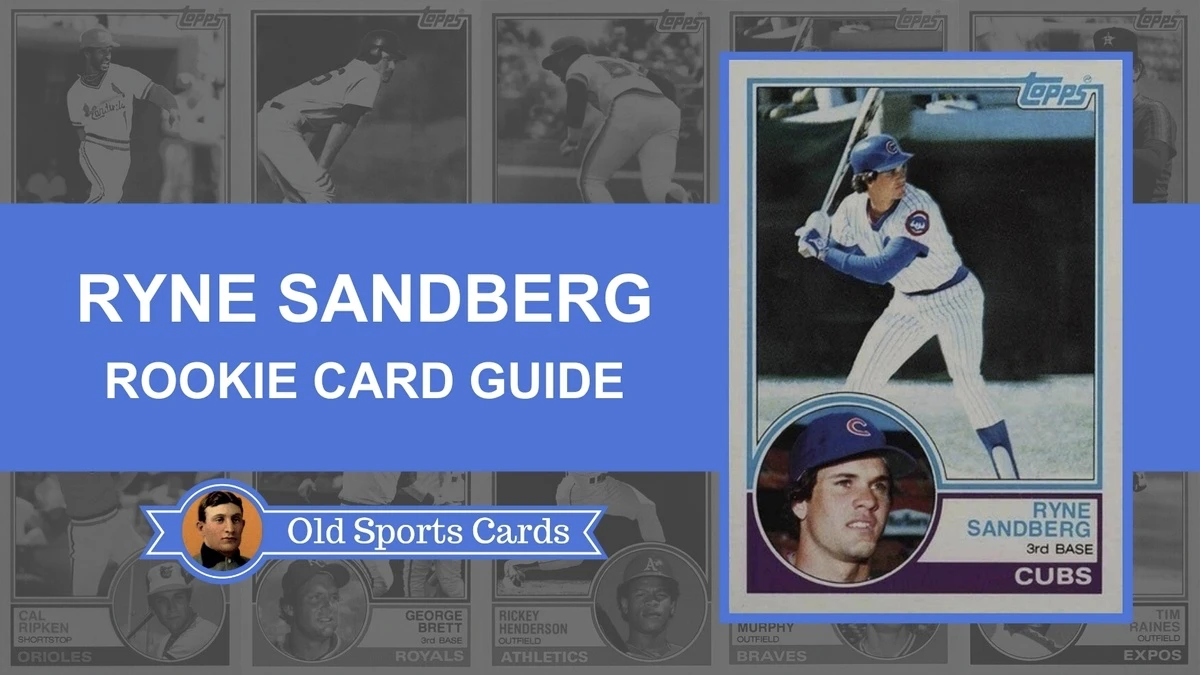
The only difficult choice collectors may have when adding a Ryne Sandberg rookie card to their collection is…
which one?
By the time Sandberg made his MLB debut, competition in the hobby was heating up and multiple companies were fighting for a piece of the pie.
Gone were the days when Topps was the only game in town and most guys had only one rookie card.
For example, some of the guys Sandberg competed against, like George Brett and Rickey Henderson, started in that era and had only one rookie card.
But Sandberg has four mainstream rookies.
The hobby was expanding, and so were collector options.
And in this guide, we’ll take a detailed look at all of them (as well as some other key early cards.) Let’s jump right in!
QUICK FACTS
Most Valuable Rookie
1983 O-Pee-Chee #83 Ryne Sandberg Rookie Card
$7,300
Most Graded Rookie
1983 Topps #83 Ryne Sandberg Rookie Card
24,276
LEAST VALUABLE ROOKIE
1983 Fleer #507 Ryne Sandberg Rookie Card
$425
Need Help Selling Your Sports Cards?
Fill out the form below and I’ll get back to you within 24 hours. No obligation.

Ross Uitts – Owner
Rookie Cards
Ryne Sandberg’s rookie cards all date to 1983, and they capture him right as he was becoming the cornerstone of the Cubs.
He has four mainstream rookies: Topps, Fleer, Donruss, and the Canadian O-Pee-Chee.
The Topps is the one most collectors gravitate toward thanks to the brand’s reach, while the Donruss and Fleer offer the same young Sandberg at approachable prices.
As with several of his 1983 classmates, the O-Pee-Chee is the scarce, premium version of the group, printed in Canada in much smaller numbers and tougher to track down.
Centering and the usual early-1980s condition quirks make high grades the real challenge across all four.
Whatever your budget, there is a Sandberg rookie that fits, from an everyday Donruss or Fleer to the harder O-Pee-Chee, and 1983 is where any Sandberg collection takes root.
-
1983 Donruss #277 Ryne Sandberg Rookie Card
PSA 10 Value $900 – $925Total PSA Population 7,951PSA 10 Population 405PSA 10 Grade Rate 5.1% (Set Avg: 28.7%)PSA Population Distribution
5816703064596932,9762,77840512345678910In 1981, Topps’ stranglehold on the baseball card market finally ended.
Thanks to a legal ruling, Donruss and Fleer could now compete in the lucrative and growing hobby.
Donruss’s first couple of sets in 1981 and 1982 are decent.
However, their third installation was arguably their best yet because it contained rookie cards from Tony Gwynn, Wade Boggs, and Ryne Sandberg.
The designs of the Donruss sets of the early 1980s are all fairly simple, but their 1983 set design is one of my favorites.
The nameplate at the bottom, in the form of a baseball bat, complemented by the team name cradled inside a mitt, adds a nice creative touch overall.
From 1983 until he retired, Sandberg served as the Chicago Cubs’ full-time second basemen.
However, he spent the majority of his rookie 1982 campaign at the hot corner.
Hence, you’ll note the “3B” position listed along the bottom of his Donruss and other rookies on this liSt. This isn’t Sandberg’s most expensive rookie, but it isn’t his cheapest either.

-
1983 Fleer #507 Ryne Sandberg Rookie Card
PSA 10 Value $460 – $470Total PSA Population 7,960PSA 10 Population 958PSA 10 Grade Rate 12.0% (Set Avg: 27.6%)PSA Population Distribution
6717531122927502,3963,14395812345678910Some may find this surprising, but there are more PSA 10 examples of Sandberg’s Fleer rookie than the other mainstream card manufacturers.
I always thought that Topps’ quality control was a bit better than that of Donruss and Fleer at the time.
But Fleer’s wasn’t that bad after all.
PSA has graded just over 7,000 copies of this card, awarding just over 900 with a PSA 10 grade.
That means around 13% of them have found themselves in a PSA 10 holder.
By comparison, around 5% of his Donruss rookies have earned a PSA 10 grade, while his Topps and O-Pee-Chee rookies grade a PSA 10 roughly 3.5% and 2% of the time, respectively.
Therefore, since his Fleer rookie is relatively easier to find in PSA 10 condition, it makes sense that it is his “cheapeSt.” $300 for a PSA 10 example isn’t peanuts, but it’s far less than his others.
Pricing aside, I would have to say this is his least attractive rookie card, too.
Maybe other hobbyists agree and that could also play into the lower value.
-
1983 O-Pee-Chee #83 Ryne Sandberg Rookie Card
PSA 10 Value $7,300Total PSA PopulationPSA 10 PopulationPSA 10 Grade Rate 0.0% (Set Avg: 0.0%)Most manufacturers in 1983 featured rookie cards of future Hall-of-Famers Tony Gwynn, Wade Boggs, and Ryne Sandberg.
O-Pee-Chee was an exception.
Since they were produced for the Canadian market, O-Pee-Chee checklists typically contained smaller checklists than their Topps counterpart.
So that meant a given player who appeared in the Topps set didn’t always appear in the O-Pee-Chee set.
Fortunately for the hobby, Gwynn and Sandberg made the ’83 O-Pee-Chee checkliSt. Boggs didn’t.
In Gwynn and Sandberg’s cases, their O-Pee-Chee rookies are easily their most expensive.
Not only are they more scarce to begin with compared to their Donruss, Fleer and Topps counterparts, they’re relatively more difficult to find in PSA 10 condition.
O-Pee-Chee cardstock was notorious for being lower quality and plagued with print issues.
That makes PSA 10 grades nearly impossible.
That’s why this card can cost thousands of dollars.
Aesthetically, the card features nearly the same design as his Topps rookie.
However, the O-Pee-Chee logo is clearly marked on the front, while the reverse side features the O-Pee-Chee branding and French text.
-
1983 Topps #83 Ryne Sandberg Rookie Card
PSA 10 Value $2,250 – $2,400Total PSA Population 24,812PSA 10 Population 797PSA 10 Grade Rate 3.2% (Set Avg: 18.6%)PSA Population Distribution
1929802475621,2632,95610,3997,66379712345678910Ryne Sandberg’s most widely recognized rookie card is his 1983 Topps #83.
The design is iconic, with a bit of a nod to Topps’ 1963 set, where smaller, encircled player headshots accompany larger main images.
And the action shot of Sandberg in his stance wearing the Chicago Cubs pinstriped home jerseys is arguably the best of his quartet of mainstream rookies.
I remember when you could pick up a PSA 10 example of this card for under $400 several years ago.
But, those days are long gone.
Now, you’ll easily pay over $1,000.
PSA has graded around 22,000 examples of this card and awarded just under 800 of them with a PSA 10 grade.
That’s about a 3.5% rate.
Though Donruss and Fleer were in the mix and competing with Topps throughout the 1980s, a given player’s Topps rookie is usually his most favorable.
And that’s certainly the case for Sandberg.
That should help his Topps rookie hold up well for years to come.
Other Early Key Career Cards
Here is where Sandberg’s card story gets a twist: his earliest cards show him as a Phillie, not a Cub.
Philadelphia drafted and developed him, so his first issue, the 1980 TCMA Reading Phillies, and his 1981 TCMA Oklahoma City card both picture him climbing through the Phillies’ system before the January 1982 trade that sent him to Chicago.
There is also an offbeat 1981 Venezuela Winter League sticker from his time in winter ball, and a 1982 Red Lobster Cubs oddball that catches him as a brand-new Cub.
None of these are his recognized rookie, but together they trace a fun path from Phillies prospect to Chicago icon.
They are regional and oddball issues with small print runs, so they are scarce and tough in high grade.
For the collector who already owns the 1983 rookies, these early cards are the rewarding deep cuts, especially the Reading card as his true firSt.
-
1980 TCMA Reading Phillies #22 Ryne Sandberg
PSA 10 Value $1,300Total PSA PopulationPSA 10 PopulationPSA 10 Grade Rate 0.0% (Set Avg: 0.0%)This is widely considered Ryne Sandberg’s first card, and it comes with a fun wrinkle: he is pictured as a Phillie, not a Cub.
Philadelphia drafted and developed Sandberg, and this 1980 TCMA card from the Double-A Reading Phillies captures him early in that climb, before the trade that would change his career.
TCMA minor league sets were produced in modest numbers and sold regionally, so this one is genuinely tough to find, especially in top condition.
For Cubs fans it is a bit of a curiosity to see Sandberg in Phillies gear, and for serious collectors it is the earliest piece of cardboard you can own of a future Hall of Famer.
Scarcity and that pre-Cubs backstory make it one of the most interesting cards in his run.
-
1981 TCMA Oklahoma City 89ers #17 Ryne Sandberg
PSA 10 Value $15,000Total PSA PopulationPSA 10 PopulationPSA 10 Grade Rate 0.0% (Set Avg: 0.0%)By 1981 Sandberg had climbed to Triple-A with the Oklahoma City 89ers, the Phillies’ top affiliate, and this TCMA card captures him one step from the majors, still in the Philadelphia system.
It is another scarce minor league issue from the era, produced in limited numbers and distributed regionally rather than in packs.
What makes it notable is the timing, since this is one of the last cards to show Sandberg as a Phillies prospect before the January 1982 trade sent him to the Cubs, where he became a star.
For collectors chasing his pre-rookie path, the Oklahoma City card is a key piece, and clean copies are hard to come by given how few were saved.
-
1981 Venezuelan Winter League Stickers #233 Ryne Sandberg
PSA 5 Value $5,000Total PSA PopulationPSA 5 PopulationPSA 5 Grade Rate 0.0% (Set Avg: 0.0%)This is one of the more offbeat early Sandberg items, a sticker from the 1981 Venezuela Winter League.
Like many young prospects of the era, Sandberg sharpened his game in winter ball, and the Venezuelan league produced sticker sets featuring the players who came down to compete.
These are true oddballs, printed cheaply and never meant to last, so they are scarce and often found with the usual sticker problems like peeling or surface wear.
For the collector who already owns his rookies and minor league cards, this is a quirky, hard-to-find piece that captures Sandberg in an unusual setting.
It is not a card most people chase first, but it is a rewarding deep cut for a Sandberg completiSt.

-
1982 Red Lobster Cubs #23 Ryne Sandberg
PSA 10 Value $1,400Total PSA PopulationPSA 10 PopulationPSA 10 Grade Rate 0.0% (Set Avg: 0.0%)By 1982 Sandberg had landed in Chicago, and this oddball comes from a Red Lobster-sponsored Cubs set issued that year.
Regional, sponsor-tied promotions like this were common in the era, handed out or sold locally rather than packaged nationally, which keeps surviving copies relatively scarce.
It is a fun one because it shows Sandberg as a brand-new Cub, right at the start of the run that would make him a Chicago icon and eventual Hall of Famer.
As with most regional issues, condition is the catch, since these were not produced or stored with collectors in mind.
For a Sandberg fan, it is an affordable and characterful addition to the early part of his card story.


Ross’s Take
Now that we’ve gone through the list, here are some of my thoughts on Ryne Sandberg’s rookie cards: My Favorite: I would have to say it’s a tie between the O-Pee-Chee and Topps rookies.
The design is basically the same, minus the logos and French text.
Obviously, they’re the most expensive, too, making them more desirable from a monetary standpoint.
As collectors, I think we’re just lucky that Sandberg (and Gwynn) made the ’83 O-Pee-Chee checklist to begin with.
My Least Favorite: I like all of Sandberg’s rookies because he was one of my favorite players to watch growing up.
But if I had to choose a least favorite, I guess I would go with his Fleer rookie.
I just don’t like the design as much as the others.
That’s the only reason.
