
15 Most Valuable 1941 Play Ball Baseball Cards

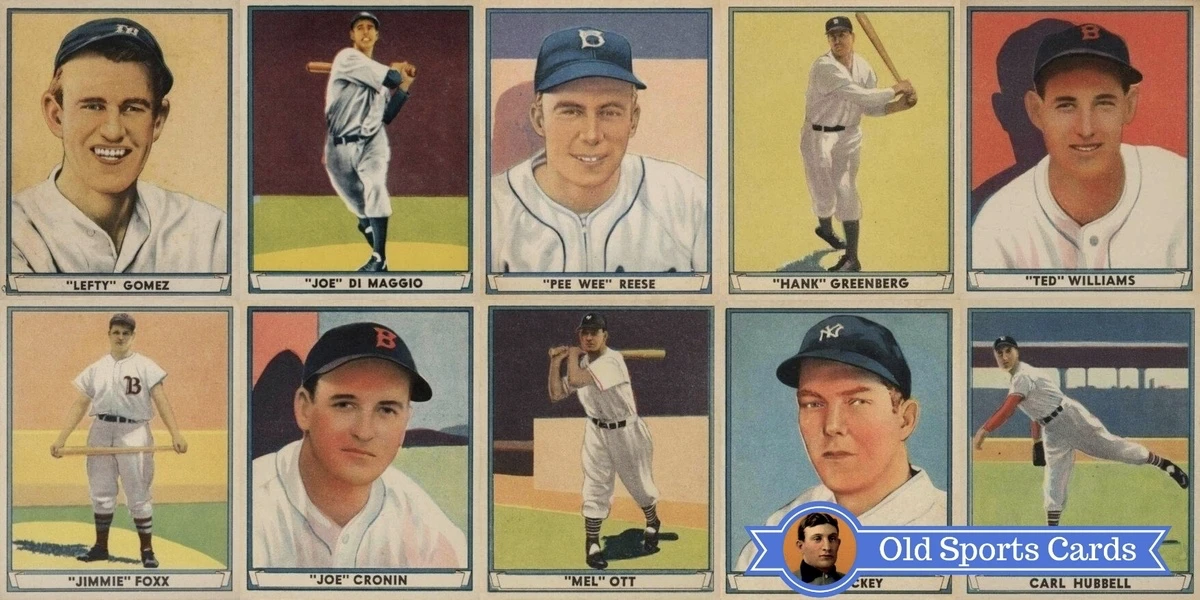
For the third installment of their trilogy of baseball card sets, Gum, Inc.
made one obvious upgrade to the 1941 Play Ball set: full-color artwork.
Unlike the black and white designs of the ’39 and ’40 Play Ball sets, the card fronts in ’41 Play Ball feature beautifully designed poses, portraits, and action shots with a touch of Art Deco styling.
Other subtle changes included adjustments to the text on the reverse side and a smaller 72-card checkliSt. However, the colorized fronts will always be the easiest way to distinguish the ’41 Play Ball set from the others.
For that reason alone, most collectors point to this one as their favorite Play Ball set.
And in this guide, we’ll take a look at the 15 most valuable.
Let’s jump right in!
Need Help Selling Your Sports Cards?
Fill out the form below and I’ll get back to you within 24 hours. No obligation.

Ross Uitts – Owner
- #1
1941 Play Ball #71 Joe DiMaggio
PSA 5 Value $6,500Total PSA Population 1,050PSA 5 Population 120PSA 5 Grade Rate 11.4% (Set Avg: 6.8%)Any time a hitter gets a whiff of a 25-game or 30-game hit streak, Joe DiMaggio’s name is inevitably on everyone’s mind.
And inevitably, the player’s streak ends, and DiMaggio’s holy number remains unchallenged.
The “Yankee Clipper” captured everyone’s attention and imagination in 1941, with 56 consecutive games of hitting nirvana.
As the New York Yankees center fielder rocketed past George Sisler’s modern-day record (41) and Wee Willie Keeler’s all-time mark (44), it never felt like it would end.
It eventually did, but the streak lives on forever, in highlight packages, on elementary baseball diamonds, everywhere.
DiMaggio hitched the Yankees to his bat for over two glorious months, pushing them from the middle of the AL pack to a pennant and a fifth World Series title in six years.
He took home league MVP for a second time with a .357 average, 30 home runs, and MLB bests in RBIs (125) and total bases (348).

- #2
1941 Play Ball #14 Ted Williams
PSA 5 Value $3,000Total PSA Population 1,384PSA 5 Population 155PSA 5 Grade Rate 11.2% (Set Avg: 6.8%)“56” isn’t the only number that defined the 1941 MLB season.
In 1940, Ted Williams was a pariah.
Boston fans either loved him or hated him, and a writer targeted the sophomore outfielder for a perceived “holier-than-thou” attitude.
Fast-forward to 1941, and all was forgotten.
The 22-year-old natural hit .406 for the campaign, becoming the first American League hitter in 19 years to crack the .400 mark.
He also reached base 55.3% of the time, a peerless performance in the 20th Century.
The haters still found ways to take potshots at Williams.
But they rang hollow when you saw just how good the kid really was.
Finishing second in the MVP race to Joe Dimaggio and his hit streak, Williams was arguably the better hitter.
In addition to his batting title and on-base prowess, the Hall-of-Famer topped the Majors in home runs (37), runs (135), walks (147), and OPS (1.287), among other categories.
- #3
1941 Play Ball #54 Pee Wee Reese Rookie Card
Rookie CardPSA 5 Value $1,500Total PSA Population 788PSA 5 Population 118PSA 5 Grade Rate 15.0% (Set Avg: 6.8%)An injury cut Pee Wee Reese’s remarkable rookie campaign short.
It also cast a pall on his sophomore showing.
On August 15th, 1940, the young Brooklyn Dodgers shortstop broke a bone in his left heel on an out-of-control slide into second base.
His teammates carried him off the field in a bitter end to a fantastic debut year.
Reese’s heel injury was a devil to rehab.
At the start of the 1941 campaign, he remained saddled with an ankle brace to keep his foot from bending or planting awkwardly.
Even when he took off the brace, Reese didn’t look comfortable.
His batting average dropped sharply from .272 to .229, and his slugging percentage dipped under .300 (.294) for the only time until his final year in Brooklyn.
Reese had no power and no confidence in his shaky left foot.
Even the franchise’s first NL pennant in 21 years couldn’t alleviate the frustration of a lost sophomore season.
- #4
1941 Play Ball #13 Jimmie Foxx
PSA 5 Value $700Total PSA Population 918PSA 5 Population 120PSA 5 Grade Rate 13.1% (Set Avg: 6.8%)1941 was the end of Jimmie Foxx’s best days on the diamond.
It was also one of the worst years of his life.
With his marriage failing and headed for divorce, the 33-year-old first baseman doubled down on his drinking habits.
He remained a kind face between the lines, yet his off-field struggles weighed heavily.
Foxx’s relationship with player/manager Joe Cronin was also a source of stress.
The two never really got along in the clubhouse, and things only got worse as the campaign progressed.
At least Double X could still hit.
The 17-year-old veteran made his ninth consecutive All-Star team with a .300/.412/.505 slash line, 19 home runs, 27 doubles, eight triples, 93 walks, 87 runs, and 105 RBIs in 135 games.
That was the end of Foxx’s best days.
The Hall-of-Famer was sold to the Cubs early in the 1942 season and faded into retirement by the end of 1945.
- #5
1941 Play Ball #18 Hank Greenberg
PSA 5 Value $575Total PSA Population 804PSA 5 Population 97PSA 5 Grade Rate 12.1% (Set Avg: 6.8%)Hank Greenberg had bigger things on his mind than baseball in 1941.
With World War II amping up into its most deadly stages, the reigning MVP was drafted into the Army in early May.
Greenberg went out in style, hammering two homers in his May 6th farewell.
After just 19 games, the 30-year-old Detroit Tigers left fielder headed to Fort Custer, Michigan, to train for service.
As for thousands of others, the reality of war began to settle in.
Three months later, it seemed he’d be back in a Tigers uniform much sooner than expected.
The US passed a law that exempted men 28 or older from the draft.
Greenberg readied for a 1942 MLB return.
And then Pearl Harbor happened.
Horrified by the events of that December day, the Hall-of-Famer enlisted and dutifully prepared for deployment.
“We are in trouble, and there’s only one thing to do,” Greenberg said.
“Return to service.”
- #6
1941 Play Ball #8 Mel Ott
PSA 5 Value $450Total PSA Population 711PSA 5 Population 72PSA 5 Grade Rate 10.1% (Set Avg: 6.8%)Mel Ott had a predictably potent year at the plate in 1941.
It’s what happened after the season that was unexpected.
While the 32-year-old New York Giants right fielder slipped slightly from his athletic peak, he was still one of the game’s top hitters, slashing .286/.403/.495 with 27 home runs, 100 walks, 89 runs, and 90 RBIs.
As it went for years, Ott shined brightest on an otherwise dull Giants squad.
In the winter of 1941, Ott’s role with the team shifted dramatically.
At the Winter Meetings, friend and manager Bill Terry called it quits.
Readying for a new life at his Florida home, Terry spent no time picking his successor.
Already the Giants’ field captain, Ott was quickly given the reins as player/manager.
“Hiya, Manager,” Giants president Horace Stoneham said when presenting Ott with the offer.
“I have a new job for you at more money.” Ott took the gig and remained in the role for seven seasons.
- #7
1941 Play Ball #72 Lefty Gomez
PSA 5 Value $300Total PSA Population 488PSA 5 Population 60PSA 5 Grade Rate 12.3% (Set Avg: 6.8%)Lefty Gomez took a figurative slap to the face in 1941.
It hurt so bad that he never talked about it again.
Gomez was the All-Star heart of the New York Yankees rotation in the 1930s, helping pitch the Pinstripes to five Series wins (six altogether).
He was a seven-time All-Star, a two-time ERA champ, and a two-time Triple Crown winner.
Lefty was the Yankees.
That is, until the Forties.
Gomez appeared in just nine games in 1940 due to injury and looked nothing like his former self.
Yankees management shopped him to the Brooklyn Dodgers in the offseason, only to reconsider at Gomez’s beheSt. Lefty rewarded them with a strong effort in ’41, finishing 15-5 with a 3.74 ERA in 23 starts.
Expecting to take the ball in the Yankees’ five-game Series win, Gomez was left out of the Fall Classic altogether.
It was a gut-wrenching moment for the 32-year-old and a sign of things to come.
- #8
1941 Play Ball #6 Carl Hubbell
PSA 5 Value $275Total PSA Population 585PSA 5 Population 83PSA 5 Grade Rate 14.2% (Set Avg: 6.8%)King Carl Hubbell wasn’t quite royal in 1941.
He was still effective, nonetheless.
A winner of two NL MVP awards, three ERA titles, and a World Series championship in the 1930s, Hubbell was the wily veteran for the 1941 Giants.
He still had plenty of zip to catch hitters flat-footed, but he was also much easier to square up than ever before.
Hubbell finished 11-9 for the year with a 3.57 ERA.
He made 26 appearances (22 starts) with 11 complete games and a shutout.
Those are fine numbers without context, yet a further look shows how far Hubbell had fallen.
The 38-year-old gave up 169 hits and 53 walks in 164.0 innings, calculating out to a new career-worst 1.354 WHIP.
His 104 ERA+ stands barely above league average, unlike his league-best 193 eight years before.
After a decade of ruling the game, The King had finally surrendered his throne.
- #9
1941 Play Ball #64 Bobby Doerr
PSA 5 Value $275Total PSA Population 420PSA 5 Population 76PSA 5 Grade Rate 18.1% (Set Avg: 6.8%)1941 was the moment that Bobby Doerr became a perennial All-Star.
It also catalyzed his evolution into the game’s best defensive second baseman.
Already known as one of the Majors’ slicker fielders, Doerr struggled a bit on routine grounders in 1941.
He committed 20 errors in 699 chances, as opposed to 21 in 902 chances the year before.
The 23-year-old was still dazzled with his athleticism and range in the hole, but the numbers remained the numbers.
Regardless, Doerr was named to the All-Star Game for the first of nine times.
He hit .282 on the year with 16 home runs, 28 doubles, 74 runs, and 93 RBIs in 132 games.
Even if his numbers weren’t the greatest per se, Doerr was still extremely gifted.
Despite never playing winter ball and rarely practicing during the offseason, the future Hall-of-Famer identified his defensive deficiencies and dropped his errors into the single digits by 1943.
- #10
1941 Play Ball #19 Charlie Gehringer
PSA 5 Value $250Total PSA PopulationPSA 5 PopulationPSA 5 Grade Rate 0.0% (Set Avg: 6.8%)1941 was the last time we saw Charlie Gehringer as an on-field regular.
A year after the Detroit Tigers took the AL pennant, the 38-year-old Gehringer showed the effects of over a half-decade of professional ball.
After thirteen .300 seasons in fourteen years, an MVP, and a batting title, Gehringer saw his average dip to .220 in 127 games, his worst, by far, as a full-time player.
He also set career worsts in on-base percentage (.363), slugging (.303), and OPS+ (71).
The power wasn’t there anymore, and neither were the quick hands.
Oddly enough, they weren’t gone for good.
After retiring as a player/coach in 1942, Gehringer enlisted in the US Navy and became a baseball coach in service.
He was discharged three years later and briefly considered another run.
“I came out of the service in such good shape, I felt I could’ve played a few years,” Gehringer said.
“I decided to stick with what I got, so I retired.”
- #11
1941 Play Ball #70 Bill Dickey
PSA 5 Value $250Total PSA Population 550PSA 5 Population 69PSA 5 Grade Rate 12.5% (Set Avg: 6.8%)Bill Dickey towered over the American League for years.
Dickey, a six-foot-one catcher with sneaky pop, manned the plate for seven of the New York Yankees’ 27 World Series championships.
In 1941, Dickey was a much different player.
Nearing the end of his Hall-of-Fame career, the 34-year-old had to rest regularly to keep his body in order.
That’s not to say that Dickey wasn’t in great form.
He once again led the AL in fielding (.994) and orchestrated an early-season 21-game hitting streak.
Dickey wasn’t swinging for the fences like he used to (7 homers in 397 at-bats), but his .284 average and 71 RBIs proved his worth to the Yankee order.
Dickey picked up his eighth All-Star selection and some down-ballot MVP consideration for his ’41 efforts.
He also picked up another ring as the Yankees disposed of the rival Dodgers in a five-game Fall Classic triumph.
- #12
1941 Play Ball #63 Dom DiMaggio
PSA 5 Value $225Total PSA Population 408PSA 5 Population 66PSA 5 Grade Rate 16.2% (Set Avg: 6.8%)It was all DiMaggio all the time in 1941.
The three DiMaggio brothers were peas in a baseball pod.
All three were starting center fielders in 1941: Joe in the Bronx, Vince in Pittsburgh, and Dom in Boston.
The eldest, Vince, had a fine breakout year for the Pirates, garnering a smattering of down-ballot MVP votes.
The middle child, Joe, wove “56” into the fabric of the game on his way to AL’s Most Valuable Player.
The youngest, Dom, was also quite good.
Now locked into center at Fenway, the 24-year-old Red Sox sophomore reached All-Star status for the first time, slashing .283/.385/.408 with eight homers, 37 doubles, six triples, 90 walks, and 117 runs scored in 144 games.
Dom also worked up some Midsummer Classic magic, singling home Joe to the delight of the Detroit crowd.
His brother may have commanded the limelight, but Dom was no slouch either.
- #13
1941 Play Ball #60 Chuck Klein
PSA 5 Value $175Total PSA Population 398PSA 5 Population 60PSA 5 Grade Rate 15.1% (Set Avg: 6.8%)In the early 1930s, Chuck Klein stood shoulder-to-shoulder with the best hitters alive.
He finished top two for NL MVP in three consecutive seasons from 1931 to 1933, winning the award in 1932.
Klein’s ascent to the pinnacle of baseball was a quick one.
His fall down the ladder was a lot slower.
The slugging outfielder made just two trips to the Midsummer Classic, with 1934 being the laSt. He was still a very productive hitter for the rest of the decade, albeit one left under the radar.
As soon as the 1940s came around, Klein was at a much less impactful point in his career.
And by 1941, he was a pinch-hitter with a loose interpretation of the term “hitter.” Klein hit the bottom of the barrel in 84 plate appearances for the ’41, hitting just .123.
He’d make just 41 more PAs in the next three years, and things would only worsen.
- #14
1941 Play Ball #15 Joe Cronin
PSA 5 Value $150Total PSA Population 515PSA 5 Population 81PSA 5 Grade Rate 15.7% (Set Avg: 6.8%)Joe Cronin was a beloved member of the Boston community, a stand-up guy liked by nearly everyone he met.
Cronin was named player/manager of the Red Sox upon arriving on the team in 1935 and remained in the chair for 13 years.
He spent eleven of them as an active player, with six of those campaigns yielding All-Star results.
The 1941 campaign served as Cronin’s last season in the Midsummer spotlight.
Finishing 11th in the AL MVP race, the 34-year-old shortstop/third baseman slashed .311/.406/.508, the second .300/.400/.500 season of his Hall-of-Fame career.
He also added 16 home runs, 38 doubles, eight triples, 82 walks, 98 runs, 95 RBIs, and a league-best 14 sacrifice bunts in 143 games.
Under Cronin’s leadership, the Red Sox finished second in the American League at 84-70-1.
Yes, they landed 17 games behind the pennant and Series-winning Yankees.
However, they also joined the Bombers as the only two teams in the Junior Circuit with a winning record.
- #15
1941 Play Ball #20 Red Ruffing
PSA 5 Value $150Total PSA Population 517PSA 5 Population 86PSA 5 Grade Rate 16.6% (Set Avg: 6.8%)You could always count on Red Ruffing in the clutch.
After mucking about with the Boston Red Sox to end the 1920s, Ruffing landed with the New York Yankees early in the 1930 campaign and never looked back.
The Hall-of-Famer immediately emerged as a rotation stalwart for the Pinstripe dynasty before becoming an All-Star and MVP candidate in 1938.
Ruffing’s elite reputation had much to do with his performance under the brightest lights.
The veteran righty entered the 1941 World Series with a 5-1 October record, with all but one of his seven starts going the distance.
Start #8 was yet another Classic gem.
Given the ball for Game 1 against the Dodgers, Ruffing gave up just two runs (one earned) in a complete-game win.
It was yet another tone-setting Series win for the Yankees ace and one that got the ball rolling toward a fifth title in six years.

Ross’s Take
As you can see, the eye appeal of this set alone makes it one of the most interesting designs of the later pre-War era.
Gum, Inc.
also simplified the nameplate design compared to the 1940 Play Ball set by abandoning the glove, bat, ball and other design elements.
However, one “quirk” I’ve always found interesting is how the company went out of its way to put many of the players’ shortened names into quotes.
For example, “Pee Wee” Reese, “Lefty” Gomez and “Red” Ruffing don’t stand out all that much, given those were their nicknames.
However, using quotations for “Joe” DiMaggio since his full name was Joseph DiMaggio or “Ted” Williams as his full name was “Theodore” Williams always struck me as amusing.
Only when a player’s actual full name was used, like Carl Hubbell, were there no quotations.
Not a big deal.
But it is noticeable, nonetheless.
As for the checklist itself, the run of 72 cards didn’t leave much room to make a huge impact.
But there are tons of big-name stars and Hall of Famers within.
The Pee Wee Reese rookie card is a huge draw for collectors, though it still plays third wheel to the Joe DiMaggio and Ted Williams cards.
Jimmie Foxx, Hank Greenberg, Mel Ott, and several other icons help round out the compact yet potent checkliSt. As the United States turned its attention to the efforts in World War II, the production of baseball cards became understandably de-prioritized.
For that reason, this set will always stand out as one of the last great pre-War sets in hobby history.
