
30 Most Valuable 1990 Topps Baseball Cards

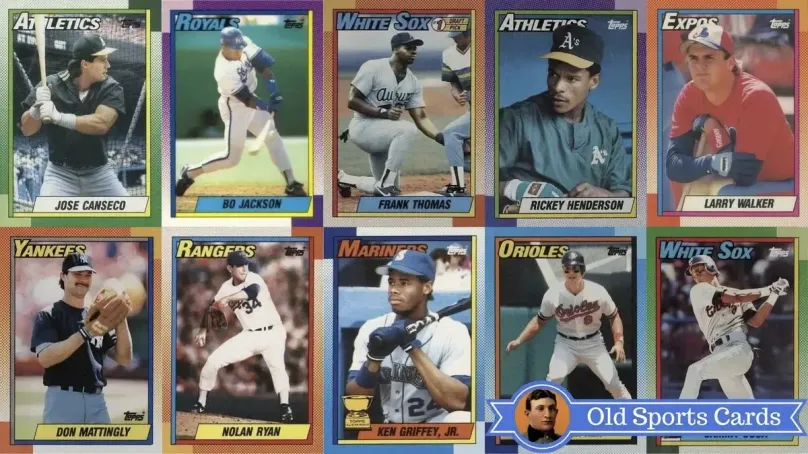
Usually, collectors will have a strong opinion one way or the other about 1990 Topps baseball cards: Either they love them or they hate them…
And it has everything to do with the multi-colored design.
I’ve always liked the look of these cards, and as a kid, I loved ripping packs in search of rookies and star players.
In this guide, we take a look at the 30 most valuable 1990 Topps baseball cards.
Let’s jump right in!
1990 Topps Baseball Set Snapshot
Stay On Top Of The Card Market
Weekly pricing updates, grading insights, and new card guides — straight to your inbox. For free.
Join thousands of collectors. Unsubscribe anytime.

Ross Uitts – Owner
- #1
1990 Topps #414 Frank Thomas No Name On Front Rookie Card
Rookie CardPSA 10 Value $183,000Total PSA Population 300PSA 10 Population 1PSA 10 Grade Rate 0.3% (Set Avg: 17.1%)You did not read that price incorrectly.
The regular Frank Thomas rookie card (which we’ll get to later) is the key rookie card in this set.
But somehow, a small quantity printed without Thomas’s name on the bottom nameplate made it into circulation.
Many collectors believe the printing dies used for the sheet of orange-bordered cards were somehow blocked at some point, preventing Thomas’s name from being inked.
And because it’s such an incredibly rare error, collectors are willing to pay up big time for it.
Examples of this variation that have achieved a PSA 9 Mint grade can sell between $15,000 and $20,000.
And the one PSA 10 Gem Mint example that exists sold for an eye-popping $183,000 in February 2026.
Even if it’s not in pristine shape, it can still be worth thousands of dollars as it remains one of the most infamous error cards in hobby history.

- #2
1990 Topps #USA1 George Bush
PSA 9 Value $10,000Total PSA PopulationPSA 9 PopulationPSA 9 Grade Rate 0.0% (Set Avg: 17.1%)To honor President Bush, Topps printed 100 or so of these with a picture of him during his college days in his Yale uniform.
The company’s chairman, Arthur Shorin, even presented some of them in a binder to the former president in 1989.
It’s said that those that made it to the White House were coated with a glossy finish.
Like the “No Name On Front” Thomas rookie card, this one is exceptionally rare and card collectors go crazy for this card.
Added to that, there are presidential artifact collectors who also drive up the price for it.
- #3
1990 Topps #414 Frank Thomas Error-Partial Blackless Rookie Card
Rookie CardPSA 9 Value $1,100Total PSA Population 89PSA 9 Population 16PSA 9 Grade Rate 18.0% (Set Avg: 17.1%)Many hobbyists are aware of the “No Name On Front” Frank Thomas rookie card but not as many may know of the “Partial Blackless Error” version of this card.
If you look closely at the name plate at the bottom of the card, you’ll notice that the black trim around Thomas’s name isn’t complete and breaks near his right foot.
It’s so subtle that many may easily look past it but this error can make a huge difference when it comes to price.
Interestingly, it’s more rare than the “No Name On Front” error but doesn’t command nearly the same price premium compared to the regular base card.
As of this righting, there are twelve examples of this card that exist in PSA 9 holders versus nineteen of the “No Name On Front” version.
And there are no PSA 10 examples.
- #4
1990 Topps #336 Ken Griffey Jr.
PSA 10 Value $1,100Total PSA Population 18,564PSA 10 Population 631PSA 10 Grade Rate 3.4% (Set Avg: 17.1%)After finishing third in the 1989 AL Rookie Of The Year race, Junior began a steady climb towards superstardom.
The dynamic center fielder broke into the mainstream with a highlight package of Gold Glove grabs and loping homers.
He was the face of a new generation of ballplayers: all swagger, speed, and strength.
Yet, it wasn’t until his father left the Cincinnati Reds and joined him in Seattle in 1990 that Griffey truly found his footing.
The first father-son combo to play in the Big Leagues at the same time became the first father-son duo to play for the same team in the same game on August 31St. “I wanted to cry or something,” Junior said.
“It just seemed like a father-son game, like we were out playing catch in the backyard.
But we were actually playing a real game.” With Senior behind him, Junior calmed down and caught fire.
His trademark smile began to widen, especially after the duo’s emotion-fueled back-to-back bombs in a September 14th game against the Angels.
The first-time All-Star slashed .300/.366/.481 for the 77-win Mariners with 22 home runs, 28 doubles, seven triples, 16 stolen bases, 91 runs scored, and 80 RBIs.
I remember searching for this card left and right as a kid.
With a fantastic image of “The Kid” flanked by the “Topps All-Star Rookie” trophy symbol, many would argue this is the best-looking card in the set.
- #5
1990 Topps #414 Frank Thomas Name On Front Rookie Card
Rookie CardPSA 10 Value $90Total PSA Population 25,461PSA 10 Population 3,916PSA 10 Grade Rate 15.4% (Set Avg: 17.1%)Now, this is what Thomas’s rookie card is supposed to look like when his full name appears at the bottom of the card.
Though he may not have been MLB’s hottest rookie in 1990, he certainly turned into one of the biggest superstars of his era.
In fact, while fellow White Sox rookies Robin Ventura and Scott Radinsky picked up some votes for Rookie of the Year honors in 1990, Thomas didn’t receive any at all.
The following season, though, Thomas broke out in a big way as he finished third in MVP voting and picked up his first of four career Silver Sluggers.
While batting .318 with 32 home runs, 104 runs scored, and 109 RBI, Thomas also led the league in walks (138), OBP (.453), and OPS (1.006), helping to launch his reputation as a disciplined and well-rounded hitter.
His rookie care is a must-have in this set and one of the most iconic cards of the 1990s.
- #6
1990 Topps #701 Bernie Williams Rookie Card
Rookie CardPSA 10 Value $80Total PSA Population 1,715PSA 10 Population 386PSA 10 Grade Rate 22.5% (Set Avg: 17.1%)Bernie Williams was an extremely productive player during the mid to late 1990’s.
And he was an integral part of the Yankees dominance of that era.
I used to love watching him play–he was a class act.
You could argue he was a better center fielder than others (like Lloyd Waner, for example) who made it to the Hall of Fame, too.
His 1990 Topps rookie card has held up over the years with decent value.
Williams remains popular with Yankees fans, obviously, but he was also one of the most well-liked players of his era.
- #6
1990 Topps #1 Nolan Ryan
PSA 10 Value $90Total PSA Population 3,091PSA 10 Population 1,133PSA 10 Grade Rate 36.7% (Set Avg: 17.1%)There’s no other way to put it: Nolan Ryan was built differently.
At 43, the Texas Rangers ace remained the class of MLB power pitchers.
Finishing with a 13-9 record, Ryan won the AL strikeout title for the fourth consecutive season in 1990, spinning 232 strikeouts in 204 innings pitched.
His 3.44 ERA and five complete games were bonkers, considering it was his 24th big-league season.
And his ability to keep hitters half his age off-balance without a side-to-side slider or curve was even wilder.
The year included Ryan’s 300th win (a July 31st dub over the Milwaukee Brewers) and a mind-boggling no-hitter of the defending champion and eventual 1990 AL pennant-winning Oakland Athletics.
Ryan dazzled against the game’s most fearsome lineup, tallying 14 strikeouts (all swinging) and two walks over 130 grueling pitches.
It was a testament to his conditioning and one-of-a-kind commitment to the game.
“Determination, all the years and years of work, it was all right there,” his battery mate John Russell said.
“It was the greatest thing I’ve ever seen.” Topps also created a subset for him to commemorate his legendary career, which spanned his time with the Mets, Angels, Astros, and Rangers.
We’ll get to that a bit later on this liSt.
- #8
1990 Topps #200 Don Mattingly
PSA 10 Value $70Total PSA Population 674PSA 10 Population 205PSA 10 Grade Rate 30.4% (Set Avg: 17.1%)Don Mattingly’s career was almost a tale of two decades.
With six straight All-Star appearances and one MVP during the 1980s, Mattingly seemed on a clear path to the Hall of Fame.
He could hit for power and average while possessing a rock-solid glove at first base.
But by 1990, the future Yankee Captain was seemingly constantly playing through pain.
Injuries were always the tale of Mattingly’s career, casting a cloud over what looked to be a slam-dunk Hall-of-Fame career in the mid-to-late 1980s.
The impressive home run and RBI totals faded, and Mattingly was overlooked for any All-Star selections in the 1990s.
Even though he still had a top-notch glove on defense and could still hit for average, his power wasn’t nearly what it used to be.
After retiring as a player in 1995, the Indiana native returned to the Majors in 2004 as a coach for the Yankees before slowly working his way up to managing the Dodgers, Marlins, and Blue Jays.
Despite seeing Mattingly’s career begin to decline at the height of his prime, he was one of the hottest names in the hobby of that era, and collectors still love his cards today.
- #9
1990 Topps #730 Tony Gwynn
PSA 10 Value $70Total PSA Population 427PSA 10 Population 159PSA 10 Grade Rate 37.2% (Set Avg: 17.1%)There’s bad injury luck.
And then there’s catastrophic injury luck.
The career of the immortal Tony Gwynn falls in the latter category.
In 20 Major League seasons, the generation’s best bell-to-bell hitter lost around 500 games due to various issues.
The list of bumps and bruises that Gwynn endured includes ten different knee surgeries and other dings to his wrist, knees, Achilles tendons, and fingers.
In 1990, the San Diego Padres right fielder lost a few weeks after fracturing his right index finger crashing into the outfield wall in Atlanta.
The training staff had to get creative to get Gwynn back onto the field, attaching a plastic cup to his glove to ease the pain and protect him from future injury.
The digit fracture likely cost him a chance at his fourth consecutive batting title.
Somehow, he still hit .309 for the 75-win Padres with 29 doubles, ten triples, four homers, 79 runs scored, and 72 RBIs in 141 games played.
He landed his sixth All-Star nod and made the most of his plastic cup predicament en route to a fourth career Gold Glove award.
- #10
1990 Topps #220 Barry Bonds
PSA 10 Value $70Total PSA Population 999PSA 10 Population 236PSA 10 Grade Rate 23.6% (Set Avg: 17.1%)After four promising seasons, Barry Bonds’ career began to skyrocket in 1990.
It was a season of firsts for the young Bonds.
He hit over .300 (.301), drove in more than 100 RBI (114), hit over 30 home runs (33), and scored more than 100 runs (104) for the first time in his career.
He also set a personal best for stolen bases (52) while leading the league in slugging percentage (.565) and OPS (.970).
The blistering campaign launched the young superstar’s career into the stratosphere.
As a testament to his exceptional performance, Bonds was selected for his first All-Star Game, earned his first MVP title, and was honored with his first Gold Glove and Silver Slugger awards.
Still, the superstar slugger’s attitude continued to rub some the wrong way.
Fans raged at Bonds’ perceived lack of effort, swagger, and me-first mentality.
None of this mattered in 1990, though, as he continued to produce fantastic numbers.
Bonds leaped from a five-tool slugger on the verge to the most complete player in baseball.
- #11
1990 Topps #2 Nolan Ryan Mets
PSA 10 Value $70Total PSA Population 1,390PSA 10 Population 483PSA 10 Grade Rate 34.7% (Set Avg: 17.1%)Cards number 2-5 tell the story of Nolan Ryan’s career with the Mets, Angels, Astros and Rangers up to that point in time.
I think it was a great way to salute Ryan and these cards remain one of my favorite subsets of all-time from any set.
The reverse reads: “The pitcher destined to do for strikeouts what Babe Ruth did for home runs was signed by the Mets out of high school in his native Alvin, Texas, in June, 1965 .
.
.
Ryan, although owning ‘a major league fastball’ from the outset, had his expected advance hindered by wildness, bothersome finger blisters and a continuing military obligation…After fanning 445 batters in 291 minor league innings while pitching for five Mets’ farm clubs in three seasons, he reached She Stadium in 1968…But Army Reserve duties and blisters, which trainer Gus Mauch finally alleviated by the application of pickle brine, prevented Ryan from achieving the stability his employers desired…Despite frequent flashes of mound brilliance, Ryan’s lack of consistency finally prompted his inclusion in the December, 1971 trade with the Angels that put him on the path to pitching immortality.” I think it was a great way to salute Ryan and these cards remain one of my favorite subsets of all-time from any set.
- #11
1990 Topps #61 Deion Sanders Rookie Card
Rookie CardPSA 10 Value $65Total PSA Population 1,397PSA 10 Population 224PSA 10 Grade Rate 16.0% (Set Avg: 17.1%)1990 was the year that Deion Sanders’ traveling two-sport showcase really got going.
“Prime Time” was selected fifth overall by the NFL’s Atlanta Falcons in 1989.
It was the third time he had been drafted by a professional sports team, following his sixth and 30th-round selections in the 1985 and 1988 MLB drafts.
Most players would choose one and go from there.
Sanders had the bravado and the guts to go for both, consequences be damned.
From the beginning, his decision ruffled the feathers of baseball traditionalists.
There was no way that Sanders could give the game his entire focus, and purists criticized that as a slight.
Sanders didn’t care.
He played 57 games for the 1990 New York Yankees as a left and right fielder, hitting just .158 with a .507 OPS.
The poor showing did little to kill his confidence.
After the 1990 MLB season, Sanders returned to his job as the Atlanta Falcons’ starting cornerback.
He’d continue to dart back and forth between the two sporting worlds for the next five years (and seven years altogether.)
- #12
1990 Topps #3 Nolan Ryan Angels
PSA 10 Value $70Total PSA Population 1,524PSA 10 Population 511PSA 10 Grade Rate 33.5% (Set Avg: 17.1%)Ryan’s next stop was in Los Angeles where he pitched for the Angels from 1972 to 1979.
The reverse reads: “Ryan’s eight seasons with the Angels (1972-1979) not only sustained Horace Greeley’s ‘Go West’ advice, but projected him among the all-time pitching greats .
.
.
Along with authoring four of his record five no-hitters, Ryan won fame and fortune by striking out 2,416 batters in the 2,182 innings he pitched for the California club .
.
.
Working for six managers on a team that was a composite 50 games below .500 during his stay, Ryan was the American League’s strikeout leader seven times, missing only in 1975 when elbow problems, corrected by post-season surgery, idled him much of the second half of that year .
.
.
In five of his Angels’ seasons Ryan had more than 300 K’s, with the 383 he fanned in 1973 the one-season major league standard.”
- #12
1990 Topps #97 Curt Schilling
PSA 10 Value $60Total PSA Population 709PSA 10 Population 57PSA 10 Grade Rate 8.0% (Set Avg: 17.1%)After a pair of September call-ups in 1988 and 1989, Curt Schilling got his first extended look at the big-league level in 1990.
With the Baltimore Orioles mucking around the .500 mark, manager Frank Robinson wanted to see what he had in the former second-round pick.
Schilling was called up at the end of July and thrust into a pivotal relief role.
To the kid’s credit, he answered the bell.
By most advanced metrics, the 23-year-old righty was one of the game’s most valuable relievers over the season’s final two months.
Schilling pitched to a 2.54 ERA in 35 appearances, scattering 38 hits and surrendering just one homer in 46 innings pitched.
Schilling’s 151 ERA+ and 2.94 FIP were sterling compared to all relief pitchers, let alone rookies.
And while advanced metrics weren’t really a thing in 1990, it was clear that Schilling was one heck of an asset.
Come January, the Orioles parlayed that asset into All-Star third baseman Glenn Davis, shipping Schilling to Houston alongside Pete Harnisch and Steve Finley.
- #13
1990 Topps #300 Bo Jackson
PSA 10 Value $60Total PSA Population 1,056PSA 10 Population 262PSA 10 Grade Rate 24.8% (Set Avg: 17.1%)Bo Jackson was an incredibly popular athlete during the late 80s and early 90s.
His reputation as a two-sport superstar earned him a place in commercials, video games, and even cartoons.
He was everywhere.
On the football field, Jackson was one of the game’s best backs with a devastating combination of speed and power.
On the baseball field, Jackson had a cannon for an arm and a compact, powerful swing, which is on full display on this card.
Unfortunately, the 1990 season would be Jackson’s last full season in baseball as a devastating hip injury during a football game in 1991 prevented him from ever playing at his All-Star level again.
Despite the disappointing turn of events in his career, collectors of that era still love Jackson and have built quite the following for his cards these days.
- #13
1990 Topps #4 Nolan Ryan Astros
PSA 10 Value $70Total PSA Population 1,534PSA 10 Population 599PSA 10 Grade Rate 39.0% (Set Avg: 17.1%)Ryan may not have been as dominant as many would have expected during his time with the Houston Astros from 1980 to 1988, but “dominant” is a relative term.
After putting up ridiculous numbers in New York and L.A., Ryan never eclipsed the 300-K mark in a single season.
Houston was the only team that never saw Ryan achieve that mark.
The reverse reads: “The decade of the 80’s became a golden era for Ryan in more ways than one.
Free agency earned him a rich contract with Houston and during his eight seasons with the Astros he achieved pitching milestones attained by no others .
.
.
On September 26, 1981 he fashioned his record fifth no-hitter, vs.
Los Angeles and on April 27, 1983 eclipsed Walter Johnson’s 3,508 strikeout total when he fanned Montreal’s Brad Mills .
.
.
On July 11, 1985 Ryan became the first ever to reach the 4,000 strikeout plateau, victimizing New York’s Danny Heep .
.
.
Ryan’s 270 strikeouts led the NL in 1987 and, at age 40, made him the oldest ever to pace the league in K’s .
.
.
His 106-94 won-lost record in his nine Houston seasons enabled him to equal the fabled Cy Young as the only pitchers to win 100 or more for a club in both leagues, Ryan doing so when he defeated the Mets, July 9, 1988.”
- #14
1990 Topps #570 Cal Ripken Jr.
PSA 10 Value $60Total PSA Population 635PSA 10 Population 172PSA 10 Grade Rate 27.1% (Set Avg: 17.1%)Under manager Frank Robinson, the 1990 Baltimore Orioles finished fifth in the AL East with a 76-85 record.
It was an underwhelming season for the team overall and Ripken’s numbers weren’t the greatest either as he batted just .250 with 21 home runs, 84 RBI, and 78 runs scored.
Still, “The Iron Man” played well enough to earn his eighth straight trip to the All-Star game.
Ripken would regroup during the offseason to turn in the finest season of his career, setting multiple personal bests during the 1991 campaign while taking home his second MVP to go along with a Gold Glove and Silver Slugger.
- #14
1990 Topps #5 Nolan Ryan Rangers
PSA 10 Value $70Total PSA Population 1,385PSA 10 Population 395PSA 10 Grade Rate 28.5% (Set Avg: 17.1%)For his fourth and final stint in the Majors, Ryan packed his bags in Houston and headed northwest to Dallas.
Most Major Leaguers are finished before they reach their 40s.
But Ryan wasn’t most Major Leaguers.
The legendary fireballer continued to pitch at a high level between the ages of 42 and 46 while in Dallas.
The reverse reads: “The same free agency route that linked him with Houston in 1980 earned Ryan a cash-laden contract with the Rangers last year .
.
.
His return to the American League, to say the least, was successful as Ryan drew to within 11 victories of 300 wins and his 301 strikeouts led the majors, the sixth time he has reached that plateau .
.
.
On June 14, at Texas Stadium, Ryan downed his onetime Angels’ teammates and thus joined the select group of pitchers with wins over all 26 clubs .
.
.
On July 11, at Anaheim, Ryan appeared in his fifth All-Star game and his two inning stint earned him the victory .
.
.
However, his greatest single feat of the season occurred August 22 at Texas when Ryan, with appropriate fanfare, chalked career strikeout No.
5,000, buzzing a 96 mph fastball past Oakland’s Rickey Henderson in the fifth inning.”
- #15
1990 Topps #692 Sammy Sosa Rookie Card
Rookie CardPSA 10 Value $60Total PSA Population 15,052PSA 10 Population 1,104PSA 10 Grade Rate 7.3% (Set Avg: 17.1%)It would take a few years for Sammy Sosa’s career to heat up so I don’t recall this card being too hyped at the time.
But as his career progressed and the home runs kept piling up, he turned into one of the most popular players in the league.
We all know of his association with the PED controversy.
Despite that tarnished reputation, his 1990 Topps rookie still has some value to it in high grade.
- #20
1990 Topps #450 Rickey Henderson
PSA 10 Value $50Total PSA Population 605PSA 10 Population 221PSA 10 Grade Rate 36.5% (Set Avg: 17.1%)In his first full season back in Oakland after a four-and-a-half-year stint with the Yankees, Rickey Henderson played lights out in 1990, to put it mildly.
Rickey led the AL in four major statistical categories beginning with runs scored (119), stolen bases (65), OPS (1.016), and OBP (.439).
Leading the league in runs scored and stolen bases was nothing new for Henderson, but it was the first time in his career that he outpaced everyone in OBP and OPS.
Within that OBP stat was the remarkable fact that Henderson either walked or hit safely in 125 of the 136 games he played that season.
And he nearly won the batting title with his .325 average, narrowly losing out to George Brett (.329) on the final day of the season.
Not surprisingly, Henderson picked up the AL MVP award that year.
While most of the team struggled at the plate in the World Series that year, Henderson was one of the lone bright spots as he batted .333 (5-15) with an OBP of .444, an OPS of 1.111, two runs scored, and three stolen bases.
- #21
1990 Topps #700 Kirby Puckett
PSA 10 Value $50Total PSA Population 399PSA 10 Population 165PSA 10 Grade Rate 41.4% (Set Avg: 17.1%)From 1986 to 1989, Kirby Puckett was the best defensive center fielder in the game.
The Minnesota Twins superstar was a game-breaking combination of expert instincts, leaping ability, arm strength, and sneaky closing speed.
He showed no signs of dropping off in 1990.
However, manager Tom Kelly was still worried that Puckett needed a break.
If not, Kelly worried that Puckett would burn out before his time.
In August, Kelly penciled Puckett into right field for the first time in his seven-year MLB career.
And while he still featured in center field through the end of 1993, Kelly continued to move the future Hall-of-Famer to right at his discretion.
1990 was, as you might expect, a weird year for Puckett.
It showed at the plate.
The reigning AL batting champion failed to crack .300 (.298) for the first time since 1985.
He registered just 164 hits on the year after leading the league with over 200 hits each of the previous three years.
As Puckett scrambled to find his groove, the Twins slid to 74 wins and last place in the AL WeSt. All would be forgotten in 1991, but 1990 remained frustrating for everyone in the Twin Cities, Puckett included.
- #22
1990 Topps #331 Juan Gonzalez Rookie Card
Rookie CardPSA 10 Value $40Total PSA Population 2,106PSA 10 Population 191PSA 10 Grade Rate 9.1% (Set Avg: 17.1%)At 16 years old, Juan Gonzalez was a scout’s dream.
The Puerto Rican native was a raw athletic marvel, a perpetual motion machine of cannon throws, explosive hitting, and pure hustle.
Coveted by a long list of MLB teams, the 6-foot-3 center fielder ultimately signed with the Texas Rangers in late May 1986 for $140,000.
By the turn of the decade, Gonzalez was taking his final developmental steps.
On the cusp of a full-time big-league job, Gonzalez opened the 1990 season in the Triple-A Pacific Coast League.
It was there, with Oklahoma City, where he proved he’d outgrown the Minor League system.
Gonzalez hit .258 in 128 games for OKC, posting 29 homers and 29 doubles in 537 plate appearances (496 at-bats).
The right-handed power hitter was recalled to Texas for the final month of the ‘90 season.
With the eventual third-place Rangers well out of the AL West race, Gonzalez had time and space to prove his mettle.
And prove it he did, slashing .289/.316/.522 with four homers and 12 RBIs in 95 plate appearances (90 at-bats).
There would be no return trip to the Minors.
Gonzalez remained a Ranger until the end of the 2003 campaign, snagging two AL MVP awards and three All-Star selections along the way.
- #23
1990 Topps #590 Ozzie Smith
PSA 10 Value $40Total PSA Population 338PSA 10 Population 196PSA 10 Grade Rate 58.0% (Set Avg: 17.1%)Did you know that Ozzie Smith totaled 2,460 hits over his 19-year MLB career?
Many point to the St. Louis Cardinals legend as the epitome of a light-hitting middle infielder.
The predominant narrative paints him as the greatest defensive shortstop of his era despite his perceived shortcomings at the plate.
The truth is different.
While there was little power to speak of, Smith topped .270 nine times in his final twelve seasons.
He hit .262 in 2,573 career games.
That’s a very respectable mark for a defense-first specialiSt. In fact, Smith’s 1990 season was one of his worst offensive campaigns post-1983, and it wasn’t all that terrible.
Yes, only 23 of his 130 hits went for extra bases.
Smith was undoubtedly prone to pop-ups and soft grounders, making weak contact more often than not.
However, he still hit at a decent .254 clip with 60 runs scored, 51 RBIs, and 32 stolen bases.
And his efforts were strong enough to land him his tenth consecutive All-Star appearance and eleventh straight Gold Glove.
It was a down year for Smith in a terrible year for the last-place Cards.
It wasn’t a defining moment, more an outlier.
- #24
1990 Topps #675 Jim Abbott
PSA 10 Value $40Total PSA Population 208PSA 10 Population 28PSA 10 Grade Rate 13.5% (Set Avg: 17.1%) - #25
1990 Topps #750 Dale Murphy
PSA 10 Value $40Total PSA Population 192PSA 10 Population 87PSA 10 Grade Rate 45.3% (Set Avg: 17.1%)The face of the Braves became the subject of intense trade talks at the turn of the decade.
After back-to-back MVPs and an explosive six-year stretch over which he averaged over 36 homers and a shade under 105 RBIs per year, Murphy fell off in 1988.
It got worse in 1989, and the trade rumors started to swirl.
The 34-year-old right fielder could veto any trade proposal.
Yet, he seemed understanding of Atlanta’s position as they played the market.
“We really didn’t play that well, and probably because of the way I played.
I really didn’t do that well,” Murphy said.
Atlanta didn’t pull the trigger on a deal until early August, giving Murphy four more months to say goodbye to the Braves faithful.
He continued to scuffle as the ink on the wall began to dry.
When he was dealt to the Phillies on August 3rd, the heartbreak was inevitable.
The Braves were moving towards becoming the Team of the 90s, and Murphy’s exit was a sad step in that direction.
Overall, Murphy slashed .245/.318/.417 in 154 games split between Philly and Atlanta.
He slugged 24 homers and added 23 doubles, a triple, 60 runs scored, and 83 RBIs in 629 plate appearances (563 at-bats).
- #26
1990 Topps #757 Larry Walker Rookie Card
Rookie CardPSA 10 Value $40Total PSA Population 4,409PSA 10 Population 771PSA 10 Grade Rate 17.5% (Set Avg: 17.1%)Larry Walker could flat-out rake with a bat in his hands.
He could also field, as shown by his seven Gold Glove awards.
As a versatile player who could do it all, Larry Walker was a joy to watch.
Walker’s journey to “The Show” started in 1985 when the future Hall of Famer signed with the Montreal Expos for a pittance.
After slogging through the Minors and battling through injury, Walker caught his break in 1989.
He did just enough in 114 games of Triple-A ball to earn a call-up but hit just .170 in his first 20 MLB games.
With Hubie Brooks lost to free agency in the offseason, Expos manager Buck Rodgers named the 23-year-old his starting right fielder in 1990.
His 19 home runs tied Andre Dawson’s rookie franchise record, and his steady play in right field was a critical contribution to the 85-win Expos’ first winning season since 1987.
In a career filled with multiple great seasons, his 1997 season sticks out more than moSt. Walker went ballistic that year, smacking 49 home runs, driving in 130 runs, scoring another 143 himself and hitting to the tune of a .363 batting average.
Remarkably, that stat line wasn’t good enough to take home the Triple Crown but he did win MVP honors that season.
- #27
1990 Topps #250 Jose Canseco
PSA 10 Value $35Total PSA Population 361PSA 10 Population 101PSA 10 Grade Rate 28.0% (Set Avg: 17.1%)Although back problems hampered him during the 1990 season, Jose Canseco still managed to blast home runs at one of the highest rates of his career as he would belt 37 in just 481 at-bats.
For his efforts, Canseco earned a trip to his fourth All-Star game and picked up the second Silver Slugger of his career at that point.
Unfortunately, the back issues kicked in at the wrong time as he struggled with back spasms throughout the entire postseason.
Although Canseco batted just .182 (2-11) with one RBI in the AL Championship versus the Red Sox, the Athletics collectively played well enough to sweep Boston.
Unfortunately for Oakland, Canseco was even worse in the World Series, batting 0.083 (1-12) with one home run and two RBI.
This time, the team couldn’t overcome the dip in production and fell quickly to the Reds, 4-0.
- #28
1990 Topps #690 Mark McGwire
PSA 10 Value $35Total PSA Population 437PSA 10 Population 51PSA 10 Grade Rate 11.7% (Set Avg: 17.1%)The Oakland Athletics were the hottest team in baseball in 1990 as they’d go on to finish 103-59 in the regular season and swept the Red Sox 4-0 in the AL Championship Series.
With a well-rounded offense led by the heavy-hitting “Bash Brothers” Mark McGwire and Jose Canseco, the A’s had no problem putting runs on the board all season long.
However, things changed in the World Series as they couldn’t seem to figure out the Cincinnati Reds pitching and shockingly found themselves on the other end of a sweep.
After belting 38 home runs and driving in 108 RBI during the regular season, McGwire’s power stroke was silent when it mattered moSt. “Big Mac” batted just .214 with zero home runs and zero RBI, while fellow “Bash Brother” Jose Canseco didn’t fare much better.
The dynamic duo had been shut down, something that was unheard of heading into the World Series.
- #29
1990 Topps #760 Wade Boggs
PSA 10 Value $35Total PSA Population 195PSA 10 Population 74PSA 10 Grade Rate 37.9% (Set Avg: 17.1%)Another playoff appearance, another crash and burn for the snake-bitten Red Sox.
It all started so well.
Boston went 76-57 through the first five-plus months of the season, staking an inside track for their third AL East title in five years.
And then, the demons came screaming back.
The Sox lost 17 of their last 29 games, backing their way into a division title thanks to Tom Brunansky’s iconic diving catch in the season’s final game.
Sadly, Brunansky’s heroics weren’t enough to reignite the Sox.
Boston was outscored 20-4 in the ALCS, losing four straight to Oakland without scoring more than one run in a single game.
For the great Wade Boggs, it was another October nightmare.
The other six months weren’t so hot either.
The 32-year-old third baseman put together the worst season of his nine-year career thus far, posting new lows in batting average (.302) and on-base percentage (.386).
His 44 doubles and 187 hits were worth plenty to the AL East champs, but his .804 OPS was well off the torrid pace of his previous seven campaigns.
Boggs worked to make up for lost time in the ALCS with a blistering 7-for-16 performance.
Sadly, the rest of the Red Sox lineup did nothing to help him, and Boston’s postseason losing streak stretched to ten games.
- #30
1990 Topps #715 Greg Maddux
PSA 10 Value $35Total PSA Population 272PSA 10 Population 105PSA 10 Grade Rate 38.6% (Set Avg: 17.1%)

Ross’s Take
So there you have it, the ten most valuable 1990 Topps cards.
As you can see, it will take them being professionally graded in gem mint condition to be worth much.
This set was a monster and contained a 792 card checklist in total.

And for those of us who grew up collecting these as kids, they’ll always have a huge nostalgic factor to them despite not having the most monetary value.
Love old cards? Get weekly updates from a fellow collector.
Pricing updates, grading insights, and new guides on the cards you actually care about — the junk wax era, vintage, and everything in between. One email a week. No fluff.
Free. No spam. Unsubscribe anytime.
Ross Uitts – Owner
