12 Most Valuable 1968 Topps Football Cards

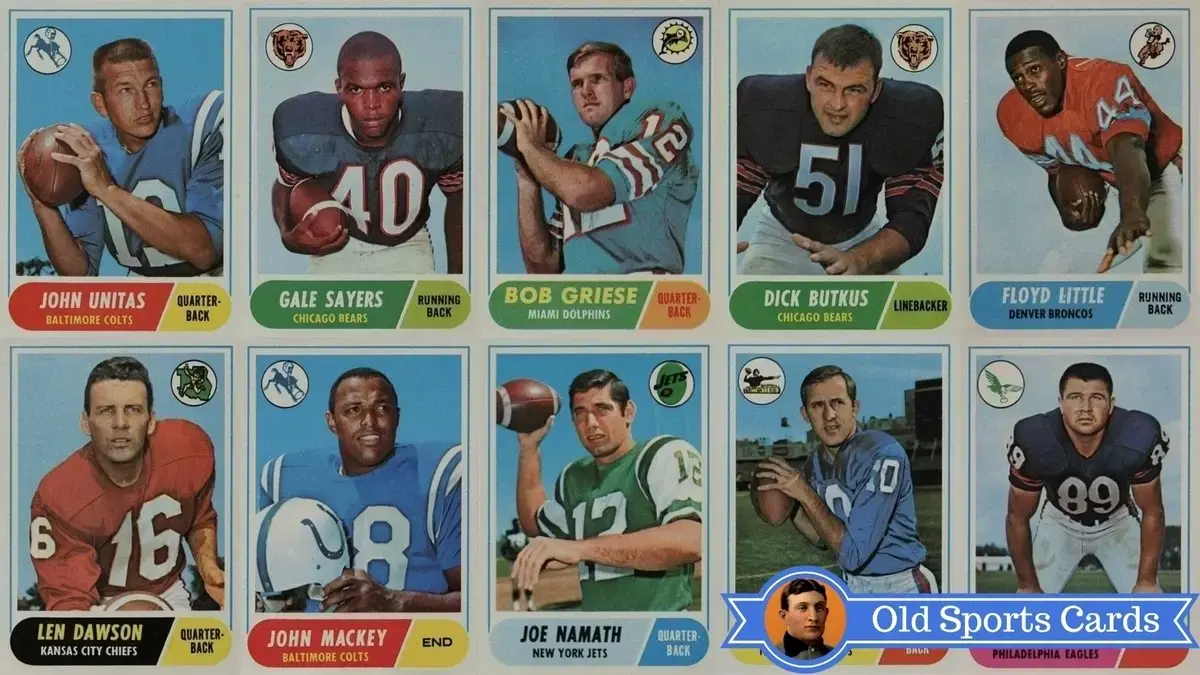
1968 Topps Football Set Snapshot
SET DETAILS
219
Bob Griese
Johnny Unitas, Joe Namath, Gale Sayers, Dick Butkus, Bart Starr
GRADING ANALYSIS
90,371
TOTAL GRADED BY PSA
32,865
36.4%
MOST GRADED CARDS
1
#196 Bob Griese
2.5%
2,245
2
#196 Bob Griese
2.5%
2,232
3
#65 Joe Namath
2.4%
2,175
Need Help Selling Your Sports Cards?
Fill out the form below and I’ll get back to you within 24 hours. No obligation.

Ross Uitts – Owner
- #1
1968 Topps #196 Bob Griese Rookie Card
Rookie CardPSA 8 Value $500Total PSA Population 2,232PSA 8 Population 316PSA 8 Grade Rate 14.2% (Set Avg: 36.4%)The dangers of being Bob Griese became readily apparent in his second AFL season.
It was two professional years, two Pro Bowls for the 23-year-old Miami Dolphins quarterback, and the plaudits were well deserved.
Griese’s name was plastered all over the league leaderboards, including in passing yards (2,473, 4th), passing touchdowns (21, 3rd), and completion percentage (52.4%, 2nd).
Griese even posted a better passer rating (75.7) than AFL MVP Joe Namath (72.1).
There was, however, one caveat.
Griese was getting hit harder and more regularly than any other QB in the league.
Standing just 6-foot-1 and legally blind in his right eye, the Purdue product was often a sitting duck for enterprising pass rushers.
Factor in a porous offensive line, and you get dozens of cringe-worthy sacks, 43, to be exact, an AFL high.
Griese was able to punch out of it in 1968, yet the hits would soon pile up and start costing him games because of injuries.

- #2
1968 Topps #65 Joe Namath
PSA 8 Value $485Total PSA Population 2,166PSA 8 Population 274PSA 8 Grade Rate 12.7% (Set Avg: 36.4%)What is it with New York City athletes and calling their shot?
Just over 36 years after the great Babe Ruth pointed to the ivy at Wrigley Field and blasted a tall-tale World Series bomb, New York Jets QB Joe Namath delivered his own guarantee.
Three days before a Super Bowl III showdown with the NFL’s Baltimore Colts, all the smart money was against Namath and the Jets.
NFL MVP Earl Morrall and the Colts were favored by 18 points in Vegas, with some sportsbooks releasing bets with a spread closer to 20.
The Jets were the ultimate “no one believes in us” team, and Namath wasn’t having it.
“I got news for you, buddy,” he quipped to a heckler at a Miami Touchdown Club banquet.
“We’re going to win the game.
I guarantee it.” It was easy to laugh it off then, but not after the game.
“Broadway Joe” controlled the game masterfully from whistle to whistle, passing for 206 yards and winning game MVP honors in a seemingly miraculous 16-7 upset.
- #3
1968 Topps #1 Bart Starr
PSA 8 Value $400Total PSA Population 1,363PSA 8 Population 140PSA 8 Grade Rate 10.3% (Set Avg: 36.4%)In 1968, the Green Bay Packers dynasty finally reached its expiration date.
The first eight years of the Sixties had been a blast for starting quarterback Bart Starr and the boys.
Under the guidance of the great Vince Lombardi, Green Bay created a juggernaut that no other franchise has matched, winning four NFL championships and two Super Bowls with just two playoff misses.
However, all good things must come to an end, and they did in ’68.
With Lombardi off the sidelines and in the front office, the Packers turned to defensive coordinator Phil Bengtson to lead an aging and injury-prone core.
All of a sudden, the athletes who dominated the NFL for nearly a decade were behind the curve.
It didn’t help that Starr missed a portion or all of eight regular-season games, cutting into the value of his league-best 63.7% completion rate.
Injuries followed him and much of the Packers roster all season long, leading to the team’s first losing finish (6-7-1) in a decade.

- #4
1968 Topps #75 Gale Sayers
PSA 8 Value $345Total PSA Population 1,328PSA 8 Population 192PSA 8 Grade Rate 14.5% (Set Avg: 36.4%)It wasn’t just an injury that cut Gale Sayers’ career cruelly short.
It was the time that he lived in.
When the Chicago Bears’ halfback suffered his first big knee injury nine weeks into the 1968 season, he was an MVP favorite and an All-Pro First Team lock.
What makes the season-ending incident even more frustrating in retrospect is that it wouldn’t have been such a big deal in the current medical landscape.
“The injury was only serious because they had to saw through muscles and nerves,” Sayers said later.
“If they had arthroscopic techniques in those days, I’d have been back in a couple of weeks.” It was such a bummer of an injury, even more so because Sayers was having arguably the most explosive rushing season the league had ever seen.
The 25-year-old rushed 138 times for 856 yards, good for a league-best 6.2 yards per carry.
That’s over a full yard better than the runner-up, Cleveland’s Leroy Kelly (5.0).
- #5
1968 Topps #100 Johnny Unitas
PSA 8 Value $325Total PSA PopulationPSA 8 PopulationPSA 8 Grade Rate 0.0% (Set Avg: 36.4%)“The Baltimore Colts had a prime opportunity to end Johnny Unitas’ nightmare 1968 season on a rewarding note, but it wasn’t to be.
It all started badly.
During the final game of the preseason against Dallas, Unitas was hit just wrong, tearing multiple ligaments in his throwing arm and shoulder.
Just like that, the Hall-of-Famer was sidelined in favor of backup Earl Morrall.
The beautiful thing for Colts fans was that Morrall was up to the task, putting up the season of his life for an out-of-nowhere NFL MVP win.
However, it was painful to watch the 36-year-old Unitas on the sidelines, considering he was the one who first put the franchise on the championship map.
Head coach Don Shula played it safe with the compromised Unitas, essentially saving him until a late-game relief appearance in Super Bowl III.
A rejuvenated Johnny U led Baltimore on its only scoring drive of the game, but the heavily-favored Colts still fell to the upstart Jets, 16-7.”
- #6
1968 Topps #173 Floyd Little
PSA 8 Value $270Total PSA Population 743PSA 8 Population 169PSA 8 Grade Rate 22.7% (Set Avg: 36.4%)Floyd Little was the most versatile player in the AFL in 1968, a virtual Swiss Army knife who made an otherwise drab Denver Broncos season interesting.
After an uneven rookie year in which he still led the league in all-purpose yardage (1,626), Little turned in a much more polished performance.
The former first-round pick out of Syracuse picked better holes and showed more patience as a running back, improving from 2.9 to 3.7 yards per attempt on a similar workload.
Little tallied 584 yards on the ground with three touchdowns.
But that was just one of three skill-position areas in which the 26-year-old provided value.
He was also the best big-play receiver the five-win Broncos had, amassing 331 yards, a touchdown, and the highest yards-per-catch (17.4) among Denver regulars.
And, oh yeah, Little also racked up 910 yards on returns (261 punt, 649 kick) for a total of 1,825 all-purpose yards, another AFL high.
- #7
1968 Topps #157 Ray Nitschke
PSA 8 Value $250Total PSA Population 378PSA 8 Population 56PSA 8 Grade Rate 14.8% (Set Avg: 36.4%)There wasn’t much to celebrate about the 1968 Green Bay Packers season, except perhaps the consistent play of the team’s veteran defense.
Anchored by multi-time All-Pro and five-time world champion Ray Nitschke, the Packers’ defense was the last thing to go for the game’s most enduring dynasty.
As the offense suffered through multiple injuries, underperformance, and the perils of advancing age, Nitschke and the D held stout, finishing fourth out of 16 teams in scoring defense (16.2 per game) and third in total defense.
It was a heroic performance, considering the unit was on the field much more than in previous years.
Nitschke’s All-Pro streak may have been snapped at four consecutive seasons, but the Hall-of-Fame middle linebacker was still one of the fiercest hitters and most intelligent defensive quarterbacks out there, as evidenced by his two interceptions and three fumble recoveries.
The defense would remain the team’s calling card through the end of the decade before eventually suffering the same fate as the offense.
- #8
1968 Topps #127 Dick Butkus
PSA 8 Value $210Total PSA Population 1,038PSA 8 Population 186PSA 8 Grade Rate 17.9% (Set Avg: 36.4%)Drafted third overall by the Chicago Bears in the 1965 NFL Draft, Dick Butkus immediately ascended to All-Pro status thanks to a unique tackling style that left legitimate marks on his opponents.
“Dick hit you with his head and shoulder, and that gave you enough of a jolt,” teammate Gale Sayers said.
“But then he’d rake you over with his whole body, elbows, knees.” This was all by design.
Butkus sacrificed picture-perfect tackling mechanics in favor of dishing out the most pain he could in the most efficient ways possible.
While he would straddle the line between clean and dirty play, he rarely crossed over.
Butkus wasn’t trying to injure people.
He was trying to dislodge the ball and cause chaos.
That’s why he received multiple MVP votes in 1968 despite the Bears’ mediocre 7-7 record.
His nose for the ball and the turnovers that followed were obviously valuable and were among the only reasons Chicago hung around the playoff race for most of the year.
- #9
1968 Topps #74 John Mackey Rookie Card
Rookie CardPSA 8 Value $180Total PSA Population 160PSA 8 Population 42PSA 8 Grade Rate 26.3% (Set Avg: 36.4%) - #10
1968 Topps #171 Len Dawson
PSA 8 Value $170Total PSA Population 348PSA 8 Population 99PSA 8 Grade Rate 28.4% (Set Avg: 36.4%) - #11
1968 Topps #161 Fran Tarkenton
PSA 8 Value $125Total PSA Population 717PSA 8 Population 193PSA 8 Grade Rate 26.9% (Set Avg: 36.4%)When the New York Giants traded a deep bag of draft picks for Fran Tarkenton, it was with the hopes that he’d carry them back to championship glory.
It didn’t happen, but at least they got to watch some of the best football of the Hall of Famer’s 18-year career.
After hitting rock bottom with a 1-12-1 finish in ‘66, the Giants mortgaged their future for the innovative Tarkenton, a breakneck, scrambling signal-caller with the craftiness and athleticism to make big plays appear out of thin air.
The former Minnesota star already had two Pro Bowls to his name, and he felt like a perfect match for the NYC limelight.
He was, but the rest of the team wasn’t ready.
For example, Tarkenton shone in 1968, earning his second straight Pro Bowl nod to start his Giants tenure with 2,555 passing yards, 301 rushing yards, and 24 total touchdowns (21 passing, 3 rushing).
However, the team was held back by a porous rushing defense and finished a disappointing 7-7.
- #12
1968 Topps #162 Mike Ditka
PSA 8 Value $100Total PSA Population 736PSA 8 Population 186PSA 8 Grade Rate 25.3% (Set Avg: 36.4%)1968 was the nadir of Mike Ditka’s playing career.
Unexpectedly traded to Philadelphia from Chicago after the 1966 NFL season, Ditka never assimilated into the Eagles the same way as he did with the Bears.
Head coach Joe Kuharich took an old-school approach to the tight end position, declining to feature Ditka as a lead receiver as he had become accustomed to during his time at Soldier Field.
This led to a rift between Ditka and Kuharich, a divide that only widened in ‘68 as the 29-year-old struggled through multiple aches, pains, and injuries.
By the time the campaign was in full swing, Ditka was on the outs, reduced to a reserve role behind the younger Fred Hill.
Overall, Ditka caught just 13 passes (compared to Hill’s 30) for 111 yards and two scores.
Just two years removed from his fifth consecutive All-Pro selection, Ditka was now the seventh-best receiver on one of the worst teams in the league.