
25 Most Valuable 1955 Topps Baseball Cards

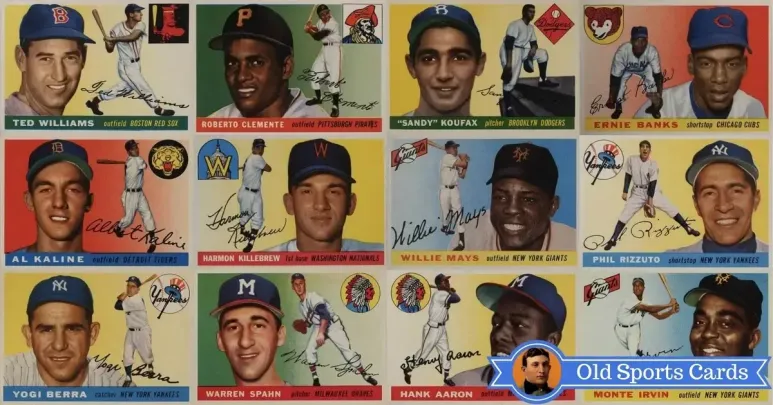
While the 1955 Topps baseball card set may not be the biggest in terms of its checkliSt…
…few sets pack the star power that this set did.
Key rookie cards of Roberto Clemente, Sandy Koufax, and Harmon Killebrew help headline a set packed with legends like Hank Aaron, Willie Mays, Jackie Robinson and Ted Williams to name a few.
Because of the checklist, the innovative horizontal design and the incredible artwork, this set ranks high atop the list of favorites for many collectors, including myself.
But, within such an iconic set, which are the most valuable?
In this guide, I run through the 25 most valuable cards in this iconic set.
Let’s jump right in!
1955 Topps Baseball Set Snapshot
SET DETAILS
206
Roberto Clemente, Sandy Koufax, Harmon Killebrew
Hank Aaron, Willie Mays, Jackie Robinson
GRADING ANALYSIS
217,952
TOTAL GRADED BY PSA
22,241
PSA 8 Population
10.2%
PSA 8 Grade Rate
MOST GRADED CARDS
1
#123 Sandy Koufax
5.7%
12,431
2
#47 Hank Aaron
3.8%
8,318
3
#50 Jackie Robinson
3.8%
8,217
Need Help Selling Your Sports Cards?
Fill out the form below and I’ll get back to you within 24 hours. No obligation.

Ross Uitts – Owner
- #1
1955 Topps #164 Roberto Clemente Rookie Card
Rookie CardPSA 8 Value $120,000 – $125,000Total PSA Population 7,877PSA 8 Population 123PSA 8 Grade Rate 1.6% (Set Avg: 10.2%)Roberto Clemente’s importance to the sport of baseball cannot be understated.
Fittingly, his 1955 Topps rookie card has become a hobby icon making it one of the most valuable baseball cards there are.
And although the Sandy Koufax and Harmon Killebrew cards are also key rookie cards in this set, Clemente’s is far and away the most expensive of the trio.
Mint condition examples of Clemente’s rookie card will easily set you back into the six figure range.
I really cannot say enough about this card as it will forever be one of the most important post-War cards you can collect.

- #2
1955 Topps #123 Sandy Koufax Rookie Card
Rookie CardPSA 8 Value $39,000 – $40,000Total PSA Population 12,431PSA 8 Population 245PSA 8 Grade Rate 2.0% (Set Avg: 10.2%)As a Dodger fan and collector of Sandy Koufax baseball cards, I must say I am a bit partial to this card.
While not as expensive as the Clemente rookie, Koufax’s rookie can also approach the six figure range in mint condition.
I don’t know if I can pick one Koufax card as a favorite but this one is definitely up there.
The bright yellow background and images of the young Koufax in his Brooklyn Dodger gear produce exception eye appeal.
Centering can be a challenge as can print marks in the yellow background.
- #3
1955 Topps #194 Willie Mays
PSA 8 Value $17,000 – $17,500Total PSA Population 4,145PSA 8 Population 139PSA 8 Grade Rate 3.4% (Set Avg: 10.2%)Like the Aaron card from this set, Topps used the same head shot on Mays’ 1955 Topps issue as they did the year before.
At least they changed up the action shot so not everything was duplicated.
The blue background and terrific imagery make this one of Mays’ best-looking cards overall.
The 1955 season saw Mays score 123 runs while racking up 51 home runs and 127 RBI.
Incredibly, those monster statistics were not enough to help him win his second consecutive MVP award as he would finished in fourth place in the vote that year.
- #4
1955 Topps #47 Hank Aaron
PSA 8 Value $13,000 – $13,500Total PSA Population 8,318PSA 8 Population 285PSA 8 Grade Rate 3.4% (Set Avg: 10.2%)Even though Topps used the same head shot as was on his 1954 rookie card, they made up for it with a great overall design.
The full color image of Aaron swinging the bat and facsimile signature are nice complements.
This is one of my favorite Hank Aaron baseball cards and you could argue it’s one of the best-looking cards in this set.
It’s incredible to think that Aaron would eventually be selected to 25 straight All-Star games, with the 1955 season marking the first year he’d receive that honor.
- #5
1955 Topps #2 Ted Williams
PSA 8 Value $11,500 – $12,000Total PSA Population 7,137PSA 8 Population 122PSA 8 Grade Rate 1.7% (Set Avg: 10.2%)Could you ask for a better action shot of the “Splendid Splinter” than the one Topps chose for his 1995 card?
What a great look at Williams’ beautiful and legendary swing.
Because he was arguably the game’s greatest hitter of all-time, his cards will always rank among the most valuable in any set in which he appeared.
This one is no exception as mint condition examples will cost you into the five figure range.
Centering and print defects in the yellow background are common challenges that keep many from reaching those lofty heights, however.
- #6
1955 Topps #50 Jackie Robinson
PSA 8 Value $8,500 – $8,750Total PSA Population 8,217PSA 8 Population 211PSA 8 Grade Rate 2.6% (Set Avg: 10.2%)1955 has gone down in baseball history as the year that Jackie Robinson helped lead the Brooklyn Dodgers to their only World Series title before the team moved to Los Angeles.
It was a momentous year for the team, and especially for Robinson himself.
Known primarily for his time at second base, Topps listed him as a third baseman and outfielder as he was spending more time there at the end of his career.
The headshot and action shot that Topps chose for this card really make it stand out from a design standpoint.
I don’t know if I have a favorite Jackie Robinson card (I love them all) but this one is definitely up there.
- #7
1955 Topps #8 Hal Smith
PSA 8 Value $8,000 – $8,250Total PSA Population 535PSA 8 Population 41PSA 8 Grade Rate 7.7% (Set Avg: 10.2%)The New York Yankees had no room for catching prospect Hal Smith in 1954, not with the great Yogi Berra ahead of him on the depth chart.
Manager Casey Stengel was open to giving Smith sporadic playing time.
Still, he ultimately sent him back to the Minors after Smith contracted infectious mononucleosis and spent over a week in the hospital.
Smith took the demotion in stride, winning the Triple-A American Association batting title with a .350 average.
The Columbus native’s huge year made him a prime trade target.
By the offseason, he was off to Baltimore as part of a staggering 17-player deal.
No longer behind Berra, Smith got the reins as the Orioles’ starting catcher for 1955.
The 24-year-old hit .271 in 135 games, but his lack of power (four homers in 466 plate appearances) concerned the O’s.
By the middle of the next season, he’d be traded again, this time to Kansas City.
- #8
1955 Topps #210 Duke Snider
PSA 8 Value $5,250 – $5,500Total PSA Population 2,716PSA 8 Population 74PSA 8 Grade Rate 2.7% (Set Avg: 10.2%)It might be a surprise that Duke Snider would be this high on the liSt. However, you must remember that baseball card values can depend on several quirks and factors.
In this case, Snider’s card was the last one printed in the set.
And usually, the first and last cards of any vintage set get a boost in value because they’re tougher to find in top condition.
Remember, kids used to stack these cards and secure them with rubber bands.
And usually, they did so sequentially.
So Snider’s card often found its place at the bottom of the stack and would be much more susceptible to wear and tear from the rubber band.
Add to this fact that Snider himself is a legendary Hall of Famer and that 1955 was a monumental year for the Dodgers.
Since they’d go on to win the World Series that year, many Dodger fans love Dodger cards from this set based on that association alone.
So, you can see that there are multiple factors at play here that contribute to the high value of this card.
- #9
1955 Topps #198 Yogi Berra
PSA 8 Value $4,400 – $4,500Total PSA Population 2,930PSA 8 Population 96PSA 8 Grade Rate 3.3% (Set Avg: 10.2%)Yogi Berra’s reputation may have been what earned him a third MVP award.
It’s not that Berra had a bad year in 1955.
Far from it.
The reigning AL MVP was an irreplaceable part of another New York Yankees pennant winner, slashing .272/.349/.470 with 27 home runs and 108 RBIs in 147 games.
With the 30-year-old behind the dish, Yankees pitchers posted the league’s best ERA (3.23) and allowed the second-fewest runs (569).
Berra was the star of a star-studded show in the Bronx.
However, his offensive output and overall WAR (4.5) paled in comparison to teammate Mickey Mantle (9.5) and eventual award runner-up Al Kaline (8.3).
WAR meant nothing in 1955, of course; it didn’t even exiSt. Still, the eye test also placed Mantle and Kaline ahead of Berra, if not others.
Still, Yogi won a close one to make it back-to-back MVPs, if not others.
- #10
1955 Topps #100 Monte Irvin
PSA 8 Value $4,200 – $4,300Total PSA Population 1,467PSA 8 Population 50PSA 8 Grade Rate 3.4% (Set Avg: 10.2%)Monte Irvin’s final year with the New York Giants was mostly uneventful.
Irvin had burst into the public consciousness in the early 1950s, patrolling the Polo Grounds outfield with grace while developing into an All-Star hitter.
He was a key piece of the Giants’ 1951 pennant-winning squad and a veteran leader for their 1954 World Series champions.
By 1955, though, Irvin was a few steps slower and no longer the hitter he once was.
As the Giants shifted toward youth ahead of their move west, the 36-year-old saw his playing time cut dramatically.
He appeared in just 51 games, slashing .253/.337/.333 with a single homer in 173 plate appearances.
His bat didn’t have much pop, and his fading athleticism didn’t help.
New York was ready to move on, leaving Irvin unprotected in the Rule 5 Draft.
The Chicago Cubs swooped in, setting the stage for his one-year swan song.
- #11
1955 Topps #124 Harmon Killebrew Rookie Card
Rookie CardPSA 8 Value $4,000 – $4,100Total PSA Population 7,979PSA 8 Population 264PSA 8 Grade Rate 3.3% (Set Avg: 10.2%)The third key rookie card in this set, Harmon Killebrew comes in just behind Snider for fourth place on the liSt. Like any of the 1955 Topps cards with yellow backgrounds, Killebrew’s card really pops with strong coloration and eye appeal.
I think Killebrew is often overlooked compared to some of the players who played during his era.
For example, did you know it wasn’t Aaron, Mantle, Maris, or Mays who produced the most home runs during the 1960’s?
It was Killebrew–he belted an astounding 393 home runs that decade.
Don’t get me wrong, his rookie card is still extremely popular and incredibly valuable.
I just think it has always been a bit undervalued.
- #12
1955 Topps #205 Gene Freese
PSA 8 Value $3,700 – $3,800Total PSA Population 668PSA 8 Population 43PSA 8 Grade Rate 6.4% (Set Avg: 10.2%)The 1955 Pittsburgh Pirates lost their first eight games and 25 of their first 36, dooming themselves right from the start.
They finished 60–94, their fourth straight year in the National League cellar.
If there was one positive, it was that manager Fred Haney got extended looks at young farm-system talent.
Only one player in Pittsburgh’s regular lineup was over 26.
With sparse crowds at Forbes Field, the kids had space to fail, learn, and fail again.
Some worked out, some didn’t.
One who did was utility man Gene Freese.
After just two years in the Minors, the 21-year-old earned a roster spot covering both second and third base.
He performed admirably, hitting .253 in 134 games with 14 home runs, 44 RBIs, and 2.1 WAR.
Freese played below-average defense at third and above-average at second.
He added left fielder and shortstop to his resume before the end of his 12-year career.
- #13
1955 Topps #31 Warren Spahn
PSA 8 Value $3,700 – $3,800Total PSA Population 3,161PSA 8 Population 89PSA 8 Grade Rate 2.8% (Set Avg: 10.2%)Warren Spahn remained patient in 1955 as his young Milwaukee Braves teammates figured themselves out.
Milwaukee’s core of Hank Aaron, Eddie Mathews, and Del Crandall powered another winning season and a second-place finish.
However, the team was still too inconsistent to seriously challenge the Brooklyn Dodgers.
That inconsistency bit the Braves in many of Spahn’s starts.
The 34-year-old lefty often pitched well but received little run support, finishing with 14 losses despite a 3.26 ERA and 115 ERA+.
Spahn wasn’t much of a strikeout artist anymore (just 110 Ks in 245.2 innings), but his improved control and 16 complete games should have translated into more wins and a tighter pennant race.
The growing pains paid off, though: the Braves won it all in 1957 and took another pennant in 1958.
Spahn reasserted himself as the game’s most dominant hurler, finishing in the top three of the AL Cy Young race in four of the next five campaigns.
- #14
1955 Topps #201 Sherm Lollar
PSA 8 Value $3,500 – $3,600Total PSA Population 538PSA 8 Population 40PSA 8 Grade Rate 7.4% (Set Avg: 10.2%)Multi-time All-Star catcher Sherm Lollar became a trivia answer in the Chicago White Sox’s historic April 23, 1955, beatdown of the Kansas City Athletics.
That day, the White Sox turned 29 hits (one shy of the AL single-game record) into a record-tying 29 runs.
Chicago put up crooked numbers in seven of nine innings, including 11 runs in the first two.
Lollar went 5-for-6 with two home runs and five RBIs, but it was those hits that made history.
The 30-year-old collected two hits in both the second and sixth innings, becoming the first White Sox player to record multiple hits in two separate innings of a game.
It was a defining highlight of a great year for Lollar, who finished 11th in AL MVP voting after hitting .261 with 16 home runs and 61 RBIs for the 91-win Sox.
- #15
1955 Topps #28 Ernie Banks
PSA 8 Value $3,100 – $3,200Total PSA Population 5,102PSA 8 Population 176PSA 8 Grade Rate 3.4% (Set Avg: 10.2%)Ernie Banks is another one of those Hall of Famers whose card is among the most desirable of any set in which he appeared.
Ernie’s card shows a nice, large head shot of him along the right with a nice action shot of him crouched and ready at the shortstop position.
The red background really gives this card some great eye appeal as it complements his Cubs uniform nicely.
Banks was a legend, to say the least, but because he didn’t quite have the star power as Aaron, Mays or Wiliams you can expect to pay relatively much less for this card compared to those.
But, that doesn’t mean it’s cheap…
- #16
1955 Topps #207 Bill Consolo
PSA 8 Value $3,100 – $3,200Total PSA Population 518PSA 8 Population 44PSA 8 Grade Rate 8.5% (Set Avg: 10.2%)The Boston Red Sox never saw Bill Consolo as a regular starter.
The Red Sox locked Consolo onto the roster in 1953 as a “bonus baby,” a now-defunct clause that forced teams to keep a rookie on the big-league roster for at least two years after paying a signing bonus.
Consolo hit lightly over those two years but showed strong potential at three different infield positions.
He felt like a worthwhile project — if only the Red Sox were willing to invest in him.
They weren’t.
And they never were.
With the bonus restrictions lifted in 1955, Boston moved Consolo to Oakland of the Pacific Coast League.
He hit .276 with 14 home runs in 159 games before returning to Beantown for an abbreviated eight-game stint.
Consolo would never return to the Minors, but he remained stuck in neutral on the Sox bench until he was dealt to the Washington Senators in 1959.
- #17
1955 Topps #25 Johnny Podres
PSA 8 Value $2,050 – $2,100Total PSA Population 1,037PSA 8 Population 55PSA 8 Grade Rate 5.3% (Set Avg: 10.2%)Podres was a four-time All-Star and three-time World Series champ.
It just so happens, though, that one of those championships he won was in 1955 with the Brooklyn Dodgers.
Not only did he help the team win, he was named MVP of the series.
In two starts versus the powerhouse that was the New York Yankees, Podres absolutely dominated them.
Amazingly, he allowed only two runs across two complete games, one of which was a shutout.
That kind of performance for a legendary team during an iconic World Series helps skyrocket the value of Podres’ 1955 Topps card.
- #18
1955 Topps #189 Phil Rizzuto
PSA 8 Value $1,950 – $2,000Total PSA Population 2,267PSA 8 Population 120PSA 8 Grade Rate 5.3% (Set Avg: 10.2%)The New York Yankees finally let one slip away to the Brooklyn Dodgers in 1955, losing the World Series 2–0 in Game 7.
New York would get revenge in 1956, but it still felt like the end of an era.
Part of that came from the decline of star shortstop Phil Rizzuto.
The 5-foot-6 firecracker had once been the most beloved player on a team full of giants.
Kids idolized him, pointing to his size and saying, “Why not me?” By ’55, though, age and injuries had caught up.
He played only 81 regular-season games, hitting .259 with a below-average 89 OPS+.
His once-reliable glove also began to falter.
Rizzuto stepped up in the Series, hitting .267 with a .450 on-base percentage.
It would be his last of nine Fall Classics, and one of only two that didn’t end with a trophy.
- #19
1955 Topps #176 Norm Zauchin
PSA 8 Value $1,750 – $1,800Total PSA Population 548PSA 8 Population 40PSA 8 Grade Rate 7.3% (Set Avg: 10.2%)An awful set of circumstances locked Norm Zauchin into Boston’s starting first base job in 1955.
Zauchin entered 1954 as a top prospect and was given the choice to join the Sox or take a year in the Minors.
Fresh off a military stint, Zauchin chose the latter, tearing up Triple-A Louisville with a .289 average, 18 homers, and 118 RBIs By spring training in ’55, there was no denying Zauchin a roster spot.
The tricky part was that the Sox had another celebrated first-base prospect on the roster, Boston University product Harry Agganis.
Zauchin and Agganis traded the starting role early before Agganis was hospitalized in May with a severe bout of pneumonia.
He mustered enough strength for two more games, but his body wouldn’t cooperate.
Tragically, Agganis died of a pulmonary embolism in mid-June.
Zauchin took over the starting role, heavy-hearted for the remainder of the season.
His top highlight was a record-tying 10-RBI day against the Nationals on May 27.
- #20
1955 Topps #4 Al Kaline
PSA 8 Value $1,750 – $1,800Total PSA Population 4,422PSA 8 Population 226PSA 8 Grade Rate 5.1% (Set Avg: 10.2%)A September swoon wasn’t enough to stop Al Kaline from rewriting history in 1955.
The 20-year-old Detroit Tigers right fielder came out blazing, finishing April on a 14-game hitting streak with a .453 batting average.
Kaline was an instant sensation and a slam-dunk pick for his first All-Star Game.
He continued to rake early in the second half before falling into a late-season slump.
Determined to rediscover his MVP form, Kaline tweaked his swing and mental approach daily.
What finally worked was the number 200.
Kaline knew that if he broke out of his funk, he could become the first Tigers player in twelve years to notch 200 hits.
He did just that, finishing the season with exactly 200.
In doing so, the league’s MVP runner-up raised his average to .340 and earned his first and only AL batting title.
He remains the youngest player ever to win a batting crown, a day younger than the immortal Ty Cobb.
- #21
1955 Topps #195 Ed Roebuck
PSA 8 Value $1,650 – $1,700Total PSA Population 656PSA 8 Population 52PSA 8 Grade Rate 7.9% (Set Avg: 10.2%)Ed Roebuck wasn’t impressed with the craftsmanship of his 1955 World Series ring, but he was still more than happy to receive it.
“It looks like a high school graduation ring.
I’m afraid to wear it because the blue part is crumbling,” Roebuck said years later.
“The value in my Dodger ring is that it’s the first and only Brooklyn championship ring.” The rookie right-hander played a crucial role for that breakthrough Brooklyn squad, serving as the team’s high-leverage bullpen arm for most of the year.
The 23-year-old posted a sub-2.00 ERA over the first three months, helping the Dodgers build an insurmountable lead in the NL.
Roebuck struggled in the second half, suffering multiple on-mound meltdowns, and was often passed up in favor of teammate Clem Labine.
He appeared in one World Series game, allowing a lone single over two innings in Brooklyn’s Game 6 loss.
- #22
1955 Topps #63 Joe Collins
PSA 8 Value $1,550 – $1,650Total PSA Population 669PSA 8 Population 44PSA 8 Grade Rate 6.6% (Set Avg: 10.2%)After three years as the New York Yankees’ starting first baseman, veteran Joe Collins was asked to make room for young Purdue product Bill “Moose” Skowron.
Collins was used to taking on any role he was given, so he stayed positive when manager Casey Stengel “demoted” him to a platoon role with Skowron.
The lefty-swinging Collins faced most righties, while Skowron handled southpaws.
The duo patched up the position well for the pennant-winning Yankees, combining for 25 home runs.
Skowron had the better offensive season, but Collins’ veteran savvy and defense kept him in the mix through the World Series.
Collins ended the regular season with a .234/.339/.414 line, 13 home runs, and 45 RBIs in 105 games.
The 32-year-old appeared in five of the team’s seven Fall Classic games, hitting .222 with two clutch homers in the loss to the Dodgers.
He remained in a part-time role until his retirement after the 1957 campaign.
- #23
1955 Topps #92 Don Zimmer Rookie Card
Rookie CardPSA 8 Value $1,500 – $1,600Total PSA Population 1,222PSA 8 Population 71PSA 8 Grade Rate 5.8% (Set Avg: 10.2%)Don Zimmer was always a character, both as a manager and a player.
In 1955, Zimmer was a rookie shortstop with the Brooklyn Dodgers and had something to prove.
After spending most of the previous year on the bench, the 23-year-old hustled into the backup shortstop role behind Pee Wee Reese.
Zimmer didn’t get much time at short, but fibbed his way into games at second base, telling manager Walt Alston he’d played the position “many times before.” His 15 home runs and strong defense kept him there.
Zimmer started at second in the first two World Series games before being benched in Game 3.
Furious about the perceived slight after a strong start to the Series, he publicly criticized Alston in the media and was promptly benched for two more games.
He returned for the final two, however, and played great as the Dodgers captured their long-awaited championship.
- #24
1955 Topps #187 Gil Hodges
PSA 8 Value $1,250 – $1,300Total PSA Population 1,948PSA 8 Population 150PSA 8 Grade Rate 7.7% (Set Avg: 10.2%)The 1955 Brooklyn Dodgers were the exception to decades of almosts and heartbreaks.
They were the team that finally got over the hump, the team that finally beat the Yankees on their sixth try.
It was the first and only Brooklyn team to win a World Championship.
The ’55 Dodgers remain sacred to old-school fans, and Gil Hodges endures as the man who helped push them over the top.
Hodges had another All-Star season (his seventh straight) slashing .289/.377/.500 and narrowly missing a sixth consecutive 30-homer, 100-RBI campaign (27 HR, 102 RBI).
And when it mattered most, Hodges delivered.
Hodges blew through August and September to lead the Dodgers to the pennant, hitting over .300 with eight homers in 161 at-bats.
The future Hall of Famer followed it up with a strong Series against New York, capping it off with the only two RBIs in the Dodgers’ historic Game 7 win.
- #25
1955 Topps #155 Ed Mathews
PSA 8 Value $1,200 – $1,250Total PSA Population 2,772PSA 8 Population 228PSA 8 Grade Rate 8.2% (Set Avg: 10.2%)Eddie Mathews holds the unique distinction of being the only Braves player to appear in the team’s Boston, Milwaukee, and Atlanta eras.
His stints in Boston and Atlanta were brief bookends to a 15-year Hall of Fame career defined by his time in Milwaukee, where he helped transform the Braves into champions and led them to two pennants and a 1957 World Series title.
In 1955, just three years into the team’s Wisconsin tenure, Mathews was already an established superstar.
The 23-year-old third baseman made his second All-Star team on the strength of his extraordinary plate discipline.
He led the NL with 106 walks, his second straight year topping 100.
He slashed .289/.413/.601, belted 41 home runs, and drove in 101 runs for the league’s runners-up.
Altogether, Mathews was worth 7.2 WAR, fourth among NL position players and sixth in the Majors.
He tallied at least 5.0 WAR in each of the next eight seasons, extending his overall streak to ten.

Ross’s Take
So, there you have it, the ten most valuable 1955 Topps baseball cards.
There may not be many cards in the set but there is a whole lot to love about them.
From the innovative 3-3/4″ by 2-5/8″ horizontal design to the incredible artwork and strong group of legendary Hall of Famers, this set has just about everything you could want.
Except for Mickey Mantle, Stan Musial, Roy Campanella, Whitey Ford, and Bob Feller for various reasons, mainly contract issues…
Other than that, this set has all of the legends of the day and three key vintage rookie cards in Clemente, Koufax and Killebrew.
Because of these features, this set will always be among the most desirable of any set in the hobby.
