

25 Most Valuable 1970 Topps Baseball Cards

If there is one thing I’ve learned over the years regarding 1970 Topps baseball cards, it’s this:
collectors either love or hate this set.
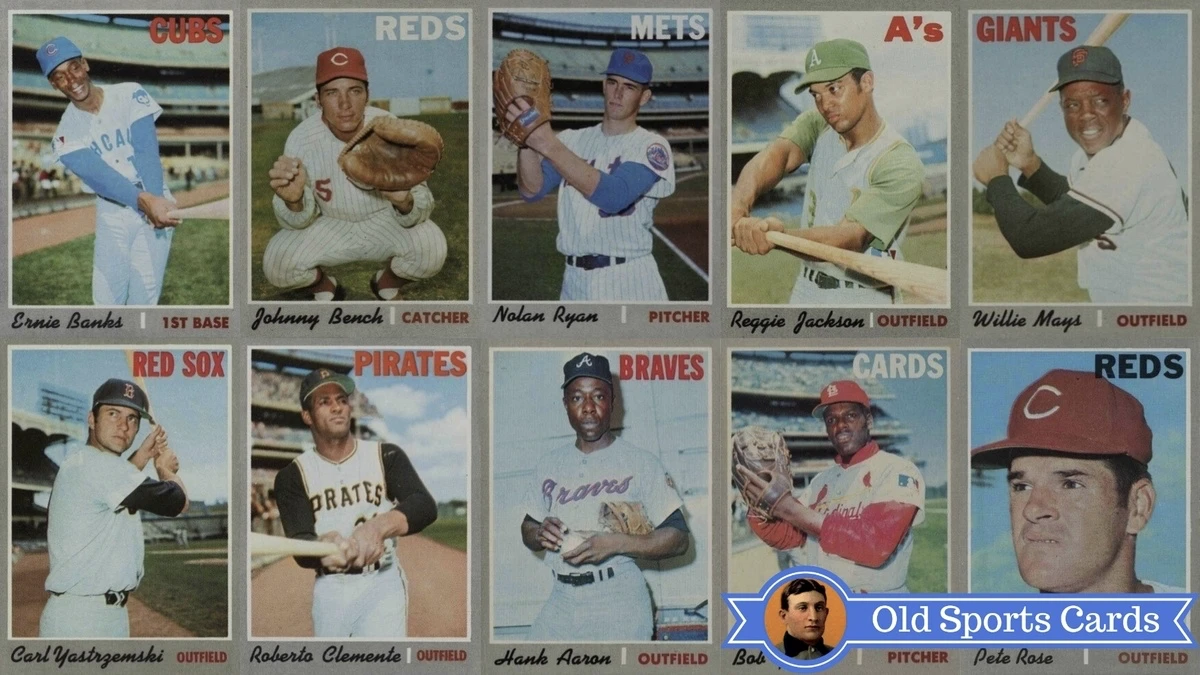
Most of it has to do with the gray border design as many feel that color makes for a rather drab-looking set.
Others will point to the centering issues that plague the set and/or the lack of any Hall of Fame rookie cards (although there are a couple of great rookie cards of former stars Thurman Munson and Vida Blue).
But whether you love or hate them, this set did pack a lot of star power in its 720-card checklist.
And in this guide, I’ll run through the 25 most valuable to look for.
Let’s jump right in!
1970 Topps Baseball: Market Analysis and Value Guide
1970 Topps Baseball Set Snapshot
1970 Topps Grading Analysis
-
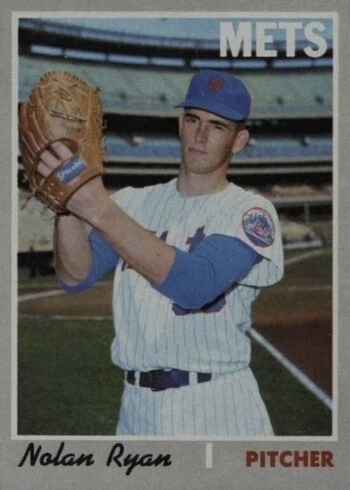
1970 Topps #712 Nolan Ryan
PSA 8 Value: $1,150
Total PSA Population: 7,450
PSA 8 Population: 937
PSA 8 Grade Rate: 12.6% (Set Avg.: PSA 8 Population: 106,255)
The New York Mets were counting on Nolan Ryan to come into the league, throw a bunch of high-octane fastballs, and push their already deep rotation to new heights.
It could have worked if the Mets had bothered to coach Ryan and weed out his more wild on-mound tendencies.
“We tell him to throw as hard as he can for as long as he can,” Mets pitching coach Rube Walker said.
Unsurprisingly, the Mets’ rudimentary approach to the 23-year-old right-hander pitcher yielded less-than-optimal results.
Ryan finished the 1970 season at 7-11 with a 3.42 ERA.
He improved year over year from 1969, posting a strong 118 ERA+ compared to 104.
However, the walks were a major concern.
Ryan’s 125 strikeouts in 131.2 innings were great.
His 97 walks?
Not so much.
Ryan was near unhittable at times, yet he, like the rest of the 83-win Mets, lacked direction.
It got so bad that the young fireballer considered quitting baseball if his situation didn’t improve.
-
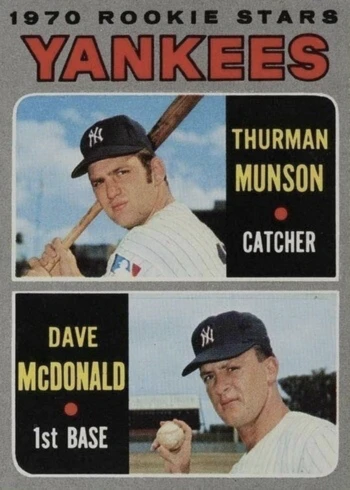
1970 Topps #189 Thurman Munson Rookie Card
PSA 8 Value: $600
Total PSA Population: 7,914
PSA 8 Population: 889
PSA 8 Grade Rate: 11.2% (Set Avg.: PSA 8 Population: 106,255)
Thurman Munson had the makings of a New York Yankees captain from day one.
In 1970, the 23-year-old Munson rode a strong Spring Training to become the Yankees’ starting catcher, a position he wouldn’t relinquish for a decade.
Munson had a rough go of it in April, hitting just .185.
That may not look good on paper, but it was the perfect opportunity for the kid to show what he was made of.
With his bat submerged in figurative ice, Munson sat back and took as many pitches as possible.
He took 18 free passes on the month, boosting his on-base percentage to over 40% (.405).
A near-unanimous choice for AL Rookie of the Year, Munson introduced himself as a Swiss Army Knife with the confidence and know-how to make the best of any situation.
“He did all of the things that a Yankee of old would have done to win games, run, hit, throw, and break up double plays,” teammate Fritz Peterson said.
From that point on, Munson was routinely considered the backbone of the Yankees, they named him captain at the start of the 1976 season.
In fact, he was the first Yankee captain since Lou Gehrig…that should tell you all you need to about the kind of player and teammate he was.
-
1970 Topps #350 Roberto Clemente
PSA 8 Value: $525
Total PSA Population: 6,713
PSA 8 Population: 712
PSA 8 Grade Rate: 10.6% (Set Avg.: PSA 8 Population: 106,255)
The 1970 season was both exhilarating and frustrating for Roberto Clemente and the Pittsburgh Pirates.
The good news was the Pirates were, well, good.
After a decade of mediocrity following their 1960 World Series win, Pittsburgh christened their brand-new Three Rivers Stadium with a summer of winning baseball.
On the backs of Roberto Clemente, Willie Stargell, and the best season of Bob Robertson’s career, the Pirates shocked the NL East field to win the division.
However, one of those backs gave out.
Clemente was out due to injury several times during the 1970 season, yet still finished 12th in the league’s MVP race with a .352 average, .407 on-base percentage, 14 home runs, and 60 RBIs in 108 games.
At season’s end, the 35-year-old right fielder again hit the injured list as his bad back required traction.
When he returned, he didn’t have his regular oomph, hitting just .214 as the Pirates managed just three runs in a three-and-out NLCS sweep at the hands of the Cincinnati Reds.

-
1970 Topps #500 Hank Aaron
PSA 8 Value: $525
Total PSA Population: 5,422
PSA 8 Population: 567
PSA 8 Grade Rate: 10.5% (Set Avg.: PSA 8 Population: 106,255)
There’s consistency, and then there’s Hank Aaron.
It takes a fantastic year to hit 30 home runs in any era.
In 1970, Aaron set a new National League record with his twelfth 30-homer season.
He’d go on to set a Major League record at 15.
Aaron slashed .298/.385/.574 in the 1970 campaign with 38 home runs, 103 runs, and 118 RBIs.
It marked the tenth time in the Hall-of-Famer’s career that he posted 100 runs and 100 RBIs in a single season.
The 36-year-old also collected his 3,000th hit with an infield single on May 17th against the Reds.
In doing so, Aaron became the only player in MLB history with 3,000 career hits and 500 home runs.
Aaron didn’t exactly beam over the accomplishment.
He was just happy to move on.
“I wanted to get it over so I could get on with my business,” Aaron said.

-
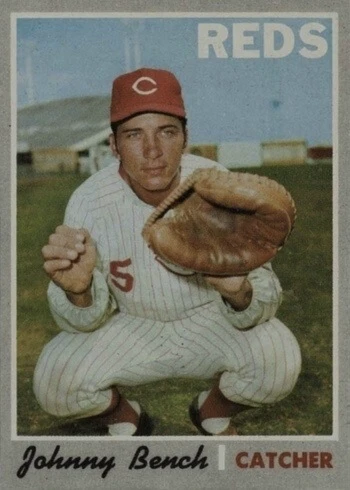
1970 Topps #660 Johnny Bench
PSA 8 Value: $525
Total PSA Population: 3,517
PSA 8 Population: 706
PSA 8 Grade Rate: 20.1% (Set Avg.: PSA 8 Population: 106,255)
1970 was the year of Johnny Bench.
A former Rookie-of-the-Year and two-time All-Star, the 22-year-old Cinncinati Reds catcher went supernova in his third MLB campaign.
Bench ran away with the 1970 NL MVP award, earning 22 of 24 first-place votes.
He led all of baseball with 45 home runs and 148 RBIs, adding 35 doubles, 97 runs, a 141 OPS+, and an MLB-best 11 sacrifice flies in 158 games.
Bench led all NL players with 7.4 WAR.
“I get a funny feeling when I remember that it was just a few years ago that I was just another wide-eyed youngster watching every move Mickey Mantle used to make,” Bench said.
Bench was a full-on celebrity, even after the Reds got bounced in a five-game World Series loss to the Baltimore Orioles.
The future Cooperstown inductee hit just .211 against Baltimore, yet it mattered little as the public and media fawned over him.
-
1970 Topps #140 Reggie Jackson
PSA 8 Value: $500
Total PSA Population: 4,780
PSA 8 Population: 600
PSA 8 Grade Rate: 12.6% (Set Avg.: PSA 8 Population: 106,255)
The 1970 MLB season was a horror show for Oakland A’s slugger Reggie Jackson.
It may also have been the best thing to happen to his professional career.
The personal side of things, however, was another thing entirely.
Two years after exchanging vows, Reggie divorced his wife, Jennie, and found himself stuck in a funk.
It carried onto the field.
After putting together one of the most impressive sophomore seasons in history in 1969, the 24-year-old outfielder regressed in a massive way.
Jackson’s OPS dropped over 200 points from an NL-best 1.018, and his power numbers dipped from 47 home runs to just 23.
He did steal a new career-best 26 bases, yet it came at the expense of a league-worst 17 failed attempts.
Unwilling to accept his .237 average and missed All-Star chance, Jackson played winter ball in Puerto Rico for the great Frank Robinson.
Robinson took the future Mr. October under his wing, and JJackson’scareer skyrocketed from there.

-
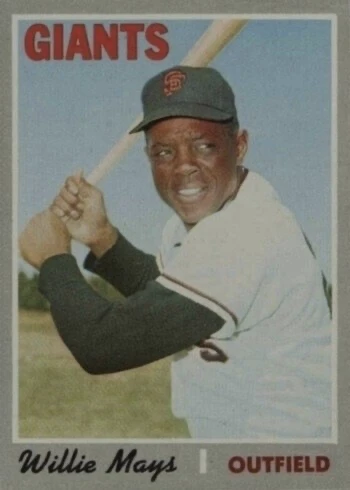
1970 Topps #600 Willie Mays
PSA 8 Value: $500
Total PSA Population: 4,497
PSA 8 Population: 756
PSA 8 Grade Rate: 16.8% (Set Avg.: PSA 8 Population: 106,255)
Willie Mays was nonchalant about his 3000th hit, even if no one else was.
The San Francisco Giants legend picked up his historic knock on July 18th, 1970, off Montreal Expos pitcher Mike Wegener.
The crowd serenaded Mays with a standing ovation as National League president Charles Feeney halted play.
Fellow 3000 Hit Club member Stan Musial greeted Mays on-field along with the Say Hey Kid’s former New York teammates, Monte Irvin and Carl Hubbell.
The chase for 3000 was all over the media, and Mays obviously heard the commotion.
However, he was much more proud about crushing his 600th homer a year before than joining the immortal hit parade.
“How can I help it,” Mays said of the journey to 3,000 hits.
“You guys are reminding me about it all the time.” The now 21-time All-Star ended his historic 1970 campaign, slashing .291/.390/.506 with 28 home runs and 83 RBIs in 139 games.
-
1970 Topps #462 Hank Aaron All-Star
PSA 8 Value: $400
Total PSA Population: 1,705
PSA 8 Population: 127
PSA 8 Grade Rate: 7.4% (Set Avg.: PSA 8 Population: 106,255)
Up next is the All-Star card of the legendary “Hammerin’ Hank” Aaron.
As of this writing, just under 3% of all examples of this card submitted to PSA have achieved PSA 9 Mint grade.
That’s a low percentage, but not quite as low as some as those of the other All-Star cards in this set.
From the 1955 season to the 1970 season, Aaron didn’t ever really have a bad year.
Sure, some of his stats were much higher in some years than others but he was elected as an All-Star in every season over that span.
The 1970 season would be more of the same as he’d smack 38 home runs and post 118 RBI while batting .298.

-
1970 Topps #580 Pete Rose
PSA 8 Value: $375
Total PSA Population: 4,392
PSA 8 Population: 816
PSA 8 Grade Rate: 18.6% (Set Avg.: PSA 8 Population: 106,255)
The switch flipped on the Big Red Machine when the 1970s got underway.
After three winning seasons with no playoffs to show for it, the Cincinnati Reds fired manager Dave Bristol to make way for Sparky Anderson, a 35-year-old San Diego Padres third-base coach who’d made his name as a four-time pennant winner in the Minors.
Anderson was the kick in the butt that the Reds needed.
Cincinnati soared from 89 wins and a third-place NL West finish in 1969 to 102 wins and the franchise’s first playoff appearance since 1961.
As it would be with plenty of Reds teams to come, it was Pete Rose who stirred everything up.
The defending two-time batting champion led the Majors with 205 hits, slashing .316/.385/.470 with 15 home runs, 52 RBIs, and 120 runs scored in 159 games.
With Charlie Hustle running roughshod over the NL, the Reds motored to their first of four NL pennants in seven years.

-
1970 Topps #464 Johnny Bench All-Star
PSA 8 Value: $350
Total PSA Population: 933
PSA 8 Population: 109
PSA 8 Grade Rate: 11.7% (Set Avg.: PSA 8 Population: 106,255)
The Sporting News All-Star cards in the 1970 Topps set were notoriously plagued with centering issues making examples of them in high grade all but impossible to find.
Bench wasted no time becoming an All-Star as he appeared in 13 straight All-Star games beginning with his rookie debut in 1968.
Interestingly, the rarity of Bench’s All-Star card in high grade isn’t too much greater than those of some of the other big name All-Stars on this liSt. What gives this card an extra boost in price, in my opinion, is that the 1970 season was the first of his two MVP campaigns in which he turned in single season bests in home runs (45) and RBI (148).

-
1970 Topps #21 Vida Blue Rookie Card
PSA 8 Value: $350
Total PSA Population: 1,218
PSA 8 Population: 194
PSA 8 Grade Rate: 15.9% (Set Avg.: PSA 8 Population: 106,255)
The emergence of Vida Blue in 1970 was the swing the A’s needed to become a dynasty.
Moved to Triple-A Iowa at the beginning of the 1970 season, Blue tweaked his delivery with the help of teammate Juan Pizarro to electric results.
The 20-year-old lefty vexed hitters all year long, finishing 12-3 with a 2.17 ERA and 165 strikeouts in 133 innings pitched.
In September, Blue was rewarded for his fantastic year with a call-up to Oakland.
After hitting a three-run home run in an otherwise rough first outing, Blue narrowly missed out on a no-hitter in start #2 after allowing a single to Kansas City’s Pat Kelly in the eighth, the only hit he’d surrender that day.
Two starts later, Blue got his no-no.
Outdueling soon-to-be AL Cy Young winner Jim Perry, the crafty lefty struck out nine and walked only one to make history against the division-leading Minnesota Twins.
During the 1971 season, Vida Blue turned in one of the greatest seasons any pitcher ever had as he won 24 games, struck out 301 batters, and notched a 1.82 ERA on his way to winning both the Cy Young and MVP awards.
He’d also be one of the keys in helping to lead the Oakland A’s to three straight World Series titles from 1972-1974.
Blue was no doubt one of the most effective pitchers during the 1970s but never quite cracked the Hall of Fame.
Regardless, his rookie card is still highly-desired by hobbyists who will pay big bucks for mint condition specimens.

-
1970 Topps #458 Pete Rose All-Star
PSA 8 Value: $325
Total PSA Population: 1,538
PSA 8 Population: 160
PSA 8 Grade Rate: 10.4% (Set Avg.: PSA 8 Population: 106,255)
Right behind Bench is Pete Rose, the all-time hits leader and fellow member of those “Big Red Machine” teams that dominated MLB during the 1970’s.
While Rose has been kept out of the Hall of Fame, there’s no question that he is still beloved by fans and baseball card hobbyists.
His name is consistently at the top of the list of most desired cards in any set in which he appeared right from his rookie card debut in 1963 through the 1980s.

-
1970 Topps #459 Reggie Jackson All-Star
PSA 8 Value: $325
Total PSA Population: 1,292
PSA 8 Population: 130
PSA 8 Grade Rate: 10.1% (Set Avg.: PSA 8 Population: 106,255)
The 1969 season was a career year for Reggie Jackson as he would post personal bests in home runs (47), RBI (118), runs (123), slugging percentage (.608) and OPS (1.018).
Fittingly, he was named to his first All-Star team that year and as such would have his own 1970 Topps All-Star card to celebrate.
However, Jackson’s offensive production took a huge dip in 1970 as nearly all of his major offensive stats were cut in half.
That slump in performance actually prompted Oakland A’s owner Charles Finley to send Jackson to Puerto Rico to play over the winter with the Santurce Crabbers.
It worked out perfectly as Jackson was back on track for the 1971 season and would go on to appear in 13 more All-Star games and win an MVP award over the remainder of his storied career.

-
1970 Topps #1 World Champions Mets Team
PSA 8 Value: $225
Total PSA Population: 1,001
PSA 8 Population: 205
PSA 8 Grade Rate: 20.5% (Set Avg.: PSA 8 Population: 106,255)
-
1970 Topps #1 World Champions New York Mets
PSA 8 Value: $225

-
1970 Topps #61 National League Batting Leaders
PSA 8 Value: $200
Total PSA Population: 1,282
PSA 8 Population: 179
PSA 8 Grade Rate: 14.0% (Set Avg.: PSA 8 Population: 106,255)

-
1970 Topps #300 Tom Seaver
PSA 8 Value: $200
Total PSA Population: 4,527
PSA 8 Population: 1,025
PSA 8 Grade Rate: 22.6% (Set Avg.: PSA 8 Population: 106,255)
A year after winning both the NL Cy Young Award and a World Series championship with the Miracle Mets, Tom Seaver found new ways to drop jaws and collect K’s.
Lots of K’s.
Lots and lots of K’s.
On the heels of back-to-back 200-strikeout seasons, Seaver tweaked his stuff and approach to dizzying effect.
The 25-year-old righty tallied two more K’s per nine than his 1969 award win, leading all NL pitchers in strikeouts (283) for the first time.
Over the next six years, Seaver would top the circuit in K’s four more times.
On April 22nd, Seaver set down nineteen San Diego Padres hitters, including ten in a row, to finish the appearance and set a record that stands to this day.
It was just one of many blistering outings for the All-Star in a year in which he topped the NL in ERA (2.82) and ERA+ (an MLB-best 143).

-
1970 Topps #630 Ernie Banks
PSA 8 Value: $175
Total PSA Population: 2,880
PSA 8 Population: 691
PSA 8 Grade Rate: 24.0% (Set Avg.: PSA 8 Population: 106,255)
It was never about Ernie Banks, even when it was all about Ernie Banks. Mr. Cub was the consummate teammate from day one.
Whether he was winning back-to-back MVP awards or inching towards retirement, the beloved Chicago Cubs first baseman/shortstop cooled his team off during the dog days of summer.
In 1970, manager Leo Durocher relegated the 39-year-old Banks to a part-time role.
Durocher treated the Cubs legend awfully during the campaign, disregarding the Hall-of-Famer and his unassailable legacy.
You wouldn’t have known it if you saw Banks play.
He kept smiling and putting on a show, including nailing his 500th career home run on May 12th.
It came on a rainy day before a sparse crowd, yet the joy remained.
“He is an inspiration,” teammate Phil Regan said.
“Sometimes we complain about the travel or the conditions or something, and then we see Ernie lifting everybody up.”

-
1970 Topps #470 Willie Stargell
PSA 8 Value: $160
Total PSA Population: 926
PSA 8 Population: 202
PSA 8 Grade Rate: 21.8% (Set Avg.: PSA 8 Population: 106,255)
Two events in 1970 paved the way for Willie Stargell to become the decade’s home run king.
The first was a managerial change.
After clashing with Pirates field bosses Harry Walker and Larry Shepard over the previous five seasons, Stargell was elated when former manager Danny Murtaugh returned before the campaign.
“I needed Danny’s presence to re-kindle my confidence,” Stargell said.
The second thing was a change in scenery.
Stargell spent his first eight years playing at the cavernous Forbes Field.
He still placed near the top of the NL home run leaderboards for most of the years, but it’s safe to say that dozens of dingers were left off the board due to the dimensions he had to work with.
The opening of Three Rivers Stadium cleared the way.
Stargell hit 31 bombs in just 136 games during the 1970 campaign.
He’d go on to hit 125 over the next three years, leading the Majors twice.

-
1970 Topps #530 Bob Gibson
PSA 8 Value: $160
Total PSA Population: 1,917
PSA 8 Population: 394
PSA 8 Grade Rate: 20.6% (Set Avg.: PSA 8 Population: 106,255)
If there is any such thing as a forgotten Cy Young season, Bob Gibson’s 1970 campaign is it.
Gibson’s second award win in three years is underwhelming by modern standards.
He led the National League in wins (23) and FIP (an MLB-best 2.29), yet finished just sixth in WHIP (1.190) and seventh in hits-per-nine (8.020).
All things considered, New York Mets ace Tom Seaver would have won the award easily if the vote had happened in 2024.
In an era where wins mattered more than anything, Gibson was the one that got the nod.
It was still a fantastic year.
And when you consider Gibson’s St. Louis Cardinals teammates’ poor defensive play and overall performance, the award makes more sense.
However, the win remains buried by today’s metrics, along with his first Cy Young win in 1968, perhaps (if not definitely) the greatest pitching season of the modern era, or any era, for that matter.

-
1970 Topps #10 Carl Yastrzemski
PSA 8 Value: $145
Total PSA Population: 2,862
PSA 8 Population: 627
PSA 8 Grade Rate: 21.9% (Set Avg.: PSA 8 Population: 106,255)
Carl Yastrzemski’s 1970 All-Star showcase remains an all-timer.
It also left a bitter taste in the mouth of the 30-year-old first baseman/left fielder.
Yastrzemski tallied four hits in his sixth consecutive All-Star appearance to win game MVP honors.
He joins Ted Williams as the only AL player with four hits in a Midsummer Classic.
The bummer was that the American League lost a 12-inning classic, 5-4, for its eighth consecutive loss to the Senior Circuit.
“I never knew that before,” Yaz said when told of his historic accomplishment.
“To tell you the truth, I was so sick of losing to the National League that I didn’t pay much attention to that stuff.” Yaz’s big day was the most noteworthy day of a monumental ’70 performance.
He missed out on a fourth batting title by a fraction of a percentage point (.329) and led all AL hitters in runs scored (125), on-base percentage (.452), slugging percentage (.592), total bases (335), and OPS+ (177).

-
1970 Topps #640 Al Kaline
PSA 8 Value: $140
Total PSA Population: 1,848
PSA 8 Population: 629
PSA 8 Grade Rate: 34.0% (Set Avg.: PSA 8 Population: 106,255)

-
1970 Topps #700 Frank Robinson
PSA 8 Value: $140
Total PSA Population: 1,750
PSA 8 Population: 440
PSA 8 Grade Rate: 25.1% (Set Avg.: PSA 8 Population: 106,255)
There are many reasons why Frank Robinson was just as much an inspiration as he was a great ballplayer.
By 1970, the Baltimore Orioles legend was knee-deep in his time coaching in the Puerto Rican Winter League.
Many players have gone on to laud Robinson for what he did for their careers in Puerto Rico, helping them find themselves both as athletes and people.
Robinson’s willingness to go the extra mile for others was never more evident than a June 25th showdown with the Red Sox in Boston.
The Orioles came back to tie the rival Sox with a seven-run ninth inning, setting off a crazy sequence of extra-inning events.
In the 13th inning, Robinson kept a Reggie Smith walk-off grand slam off the board with a violent, wall-crashing catch.
He cracked his rib in the collision.
Many other players would have begged off from there, but Robinson stayed in.
Unable to swing a bat effectively, the O’s right fielder laid down a perfect bunt to bring home the game-winning run.

-
1970 Topps #380 Tony Perez
PSA 8 Value: $135
Total PSA Population: 617
PSA 8 Population: 186
PSA 8 Grade Rate: 30.1% (Set Avg.: PSA 8 Population: 106,255)

-
1970 Topps #290 Rod Carew
PSA 8 Value: $120
Total PSA Population: 2,645
PSA 8 Population: 600
PSA 8 Grade Rate: 22.7% (Set Avg.: PSA 8 Population: 106,255)

-
1970 Topps #230 Brooks Robinson
PSA 8 Value: $115
Total PSA Population: 1,523
PSA 8 Population: 401
PSA 8 Grade Rate: 26.3% (Set Avg.: PSA 8 Population: 106,255)

1970 Topps Baseball Cards In Review
Overall, the one thing that should stand out more than anything with this set is how valuable the All-Star cards can be compared to the base cards.
It’s a rarity you just don’t see often in this hobby.
For a bit of trivia, this was the first time wax packs cost $0.10 and the last time the Seattle Pilots would appear in a set as they’d already packed up and left for Milwaukee to become the Brewers.

Within the set were also several different subsets, including:
- League Leaders (#61 – 72)
- Playoff Highlights (#195 – 202)
- World Series Highlights (#305 – 310)
- The Sporting News All-Stars (#450 – 469)
- Team Cards
- Rookie Cards
- Checklists
While the hobby may have mixed opinions on the aesthetic appeal of this set, there’s no doubting that it contains huge star power and great value overall.
