
25 Most Valuable 1969 Topps Baseball Cards

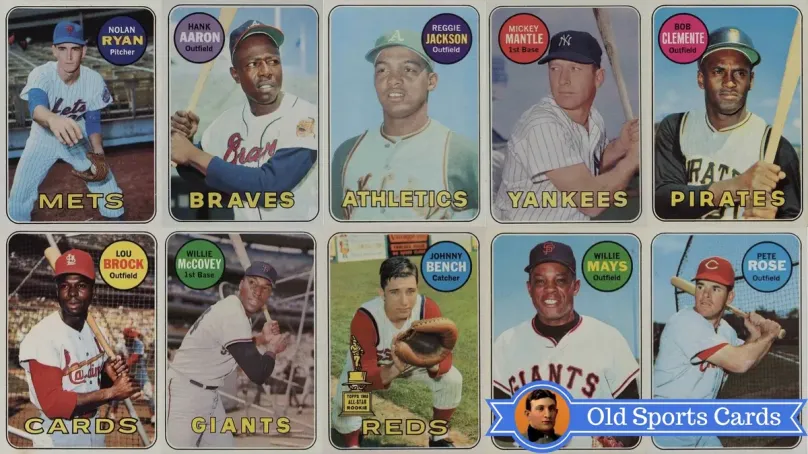
The 1969 Topps baseball card set is well-loved in this hobby by many collectors for several different reasons.
Between the Reggie and Rollie rookie cards, Bench and Ryan’s second-year cards, the variations, the variety of stars and Hall of Famers, and Mantle’s last card, there is just so much to appreciate.
Some will even say it’s the last great vintage set…
The design features large photography and a nice color scheme on the front, while the backs printed on pink backgrounds offered plenty of statistics, write-ups and cartoons to enjoy.
Overall, this set is just a solid vintage set that contains so many different things to have fun with as you try and build out a complete set or simply go for your favorite individual cards.
And in this guide, we’ll take a look at the 25 most valuable.
Let’s jump right in!
1969 Topps Baseball Set Snapshot
SET DETAILS
664
Reggie Jackson, Bobby Cox, Earl Weaver, Rollie Fingers
Mickey Mantle, Hank Aaron, Roberto Clemente, Willie Mays, Pete Rose
GRADING ANALYSIS
348,697
TOTAL GRADED BY PSA
111,431
PSA 8 Population
32.0%
PSA 8 Grade Rate
MOST GRADED CARDS
1
#500 Mickey Mantle Last Name in Yellow
4.1%
14,273
2
#260 Reggie Jackson
3.9%
13,443
3
#533 Nolan Ryan
3.1%
10,836
Need Help Selling Your Sports Cards?
Fill out the form below and I’ll get back to you within 24 hours. No obligation.

Ross Uitts – Owner
- #1
1969 Topps #500 Mickey Mantle Last Name In White
PSA 8 Value $100,000Total PSA Population 1,678PSA 8 Population 47PSA 8 Grade Rate 2.8% (Set Avg: 32.0%)After eighteen incredible seasons with the New York Yankees, Mickey Mantle announced his retirement from Major League Baseball on March 1, 1969.
But, that didn’t prevent Topps from including him in their flagship set that year.
And, interestingly, you can find two different Mickey Mantle cards in the checklist: one that displays his last name in white letters and another that shows his last name in yellow.
For some reason, an error in the printing process caused Mantle and several other players in the set whose first or last names were supposed to be in a given color to instead appear in white.
At some point, Topps caught the error, corrected it, and then began churning out the yellow letter versions again.
Since they corrected the error, any white letter variation that made it into circulation is considered more rare and valuable.
According to PSA’s population report, to give you an idea of the relative scarcity, they’ve graded between six and seven times as many white letter variations as the yellow letter cards.

- #2
1969 Topps #260 Reggie Jackson Rookie Card
Rookie CardPSA 8 Value $5,500Total PSA Population 13,443PSA 8 Population 588PSA 8 Grade Rate 4.4% (Set Avg: 32.0%)By the time you get into the PSA 9 and PSA 10 range, Reggie Jackson’s rookie card would exceed both the white and yellow letter versions of Mickey Mantle’s card at the top in this set.
In February 2022, a PSA 9 example sold for $99,000, and in February 2021, a PSA 10 example breached the million-dollar mark with a whopping $1,005,600 price tag.
Yet, with 562 examples of this card having received the PSA 8 grade at the time of this writing, there are just enough in circulation to water down the price enough to where the Mantles can outmatch it in the same grade.
Still, as one of the most iconic cards in the hobby, this one is a must-have for any vintage collector.
Jackson’s career was not without controversy, but there’s no debating that he was one of the greatest hitters this game has ever seen.
His incredible power and towering home runs earned him the 1973 MVP, fourteen All-Star selections, five World Series rings and two World Series MVPs.
And, don’t forget, Reggie had a reputation for coming up big when it mattered most: in the postseason.
For that reason, he will always carry the nickname of “Mr. October.”
- #3
1969 Topps #500 Mickey Mantle Last Name In Yellow
PSA 8 Value $4,200Total PSA Population 14,273PSA 8 Population 532PSA 8 Grade Rate 3.7% (Set Avg: 32.0%)Here is a look at the correct version of Mantle’s card that shows his last name in yellow letters.
Though it isn’t as scarce as the white letter variation, that doesn’t mean it’s not an expensive card, too.
In this hobby, Mantle is usually at the top of the list of any set in which he appeared as one of, if not the most valuable in the checkliSt. Mantle’s mystique as an extremely talented hitter who could hit for power and average from both sides of the plate solidified his place as a Yankee legend almost as soon as he first stepped on the field in 1951.
And, by the time he retired, that incredible power had produced 536 career home runs to put him in third place for most home runs all time behind Willie Mays (587) and fellow Yankee legend Babe Ruth (714).
Along with seven World Series titles and a Triple Crown in 1956, Mantle earned MVP honors three times (1956, 1957 and 1962) and made the All-Star team every season except 1951 and 1966.
As incredible as his career was, many were left wondering how much more impressive his numbers could have been if injuries had not held him back along the way.
- #4
1969 Topps #440 Willie McCovey Last Name In White
PSA 8 Value $3,500Total PSA Population 446PSA 8 Population 53PSA 8 Grade Rate 11.9% (Set Avg: 32.0%)Willie McCovey began his Hall of Fame career with the San Francisco Giants by winning 1959 NL Rookie of the Year honors with a .354 batting average, 13 home runs, and 38 RBIs in 52 games (192 at-bats.) For years after his Big League debut, he and Willie Mays formed a devastating duo in the Giants lineup that gave opposing pitchers plenty of headaches.
And at 31 years old, McCovey turned in a career year during the 1969 season.
The powerful lefty set career highs in home runs (45) and RBIs (126), both tops in the NL, while also leading MLB in OPB (.453), slugging percentage (.656), OPS (1.108, and OPS+ (209), all career highs as well.
McCovey was locked in at the plate in 1969, and when the season wrapped up, he beat out New York Mets ace Tom Seaver and Atlanta Braves slugger Hank Aaron for NL MVP honors.
Unfortunately, as great as McCovey was individually that year, the Giants finished a close three games behind the Atlanta Braves for first place in the NL West to miss the playoffs.
While McCovey’s standard 1969 Topps card that shows his last name in yellow letters is also valuable, the variation with his last name in white letters is one of the top cards in the set.
- #5
1969 Topps #533 Nolan Ryan
PSA 8 Value $3,300Total PSA Population 10,836PSA 8 Population 901PSA 8 Grade Rate 8.3% (Set Avg: 32.0%)Speaking of power, is there any pitcher in the game’s history known for being as intense and dominant on the mound more than Nolan Ryan?
In a career that spanned 27 seasons across four decades, Ryan struck fear into the hearts and minds of opposing hitters with his incredible velocity that frequently resulted in 100+ miles-per-hour fastballs.
From the 1970s onward, Ryan served several different teams as a dominant force in their starting rotations.
But, in 1969, the New York Mets used Ryan mainly out of the bullpen and only occasionally as a starter.
Over 89.1 innings during the 1969 season, Ryan started ten games, finished four, threw two complete games, earned one save, and finished with a 6-3 record.
During the postseason, Ryan dominated the Atlanta Braves in seven innings of relief in Game 3 of the NLCS by giving up two hits and striking out seven to get the win and wrap up the three-game sweep.
And, in the 1969 World Series, Ryan pitched 2.1 innings of relief in Game 3, allowing one hit and striking out three to pick up the save for the eventual World Series champion New York Mets.
- #6
1969 Topps #451 Rich Rollins First Name In White
PSA 8 Value $3,250Total PSA Population 136PSA 8 Population 7PSA 8 Grade Rate 5.1% (Set Avg: 32.0%)Rich Rollins may not have been a Hall of Famer like most of the guys on this list, but he was a two-time All-Star for the Minnesota Twins, with whom he spent the first eight seasons of his ten-year Major League career.
But, since the variation of his card that shows his first name in white is so rare, set builders are willing to pay hefty prices to get their hands on one in high grade.
None of the 1969 Topps cards that have ever received a PSA 8 grade has received it less often than Rich Rollins’ card.
As of this writing, just six examples can be found in a PSA 8 holder.
So, when one of these comes up for sale or auction, expect to pay a large sum of money if you want to grab it.
- #7
1969 Topps #464 Dave Marshall Last Name In White
PSA 8 Value $3,100Total PSA Population 129PSA 8 Population 11PSA 8 Grade Rate 8.5% (Set Avg: 32.0%)In 1960, Topps began to commemorate notable young ballplayers as part of its “Topps All-Star Rookie Team” by placing a gold trophy or cup somewhere along the bottom of the card.
Topps didn’t do this every year, but in 1969 they were still keeping the tradition alive, as noted by the gold trophy on Dave Marshall’s card.
But, it wasn’t the trophy or Dave Marshall who made this card so valuable since he didn’t rise to the level of fame as some of the other players on this liSt. In this case, it’s again an example of how a white letter variation can significantly impact a given card’s value in this set.
Although not as rare as the Rich Rollins white letter variation, with just ten examples of Marshall’s white letter variation having received a PSA 8 grade, it’s exceedingly tough to find in this condition.
- #8
1969 Topps #476 Red Sox Rookies Names In White
PSA 8 Value $2,500Total PSA Population 155PSA 8 Population 13PSA 8 Grade Rate 8.4% (Set Avg: 32.0%)With only eleven examples of the 1969 Red Sox Rookie Stars card making their way into PSA 8 holders, this is another instance of where that rarity can significantly affect the price.
You may not have heard of Ken Brett, but you likely have heard of his brother, Hall of Famer George Brett.
The Red Sox drafted Brett with the fourth pick of the 1966 MLB Junior Draft to bolster their pitching staff.
During the 1969 season, Brett pitched 39.1 innings over eight starts and finished with a 2-3 record, 5.26 ERA and 1.60 WHIP.
After a couple more seasons with the Red Sox, Brett bounced around the Majors, playing for nine other teams, including the Kansas City Royals, where he was united with his brother George for the final two years of his career in 1981 and 1982.
Gerry Moses (I believe it’s actually Jerry with a ‘J’ but was never corrected on this card) spent nine years in the Majors with seven different teams before retiring after the 1975 season.
His best season would be his last season with the Red Sox in 1970, during which he earned All-Star honors before being traded to the California Angels along with teammate Tony Conigliaro.

- #9
1969 Topps #501 Tony Gonzalez First Name In White
PSA 8 Value $1,700Total PSA Population 134PSA 8 Population 12PSA 8 Grade Rate 9.0% (Set Avg: 32.0%)After a down season with the Philadelphia Phillies in 1968, Tony Gonzalez saw the writing on the wall.
Philadelphia was already grooming Larry Hisle on the farm to take over the everyday duties in center field.
Gonzalez’s off year, coupled with the upcoming expansion draft, quickly numbered his days at Connie Mack Field.
The Phillies left Gonzalez unprotected, and the San Diego Padres swooped him up with the 37th overall pick.
Padres manager Preston Gomez had already decided to lean into youth in the Friars’ first MLB year, and the 32-year-old Gonzalez’s continued struggles only cemented that mindset.
The veteran outfielder hit just .225 in 53 games in Southern California before he was promptly traded to Atlanta.
It turned out to be a fortuitous move.
Gonzalez immediately became a clubhouse leader for the NL West champion Braves and backed it up with a .294 average, ten homers, 50 RBIs, and 3.5 WAR in 89 games.

- #10
1969 Topps #461 Mike Epstein Last Name In White
PSA 8 Value $1,700Total PSA Population 162PSA 8 Population 16PSA 8 Grade Rate 9.9% (Set Avg: 32.0%)In 1966, it looked like Mike Epstein was on the verge of becoming a household name.
The Bronx-born first base prospect tore through the International League for the Baltimore Orioles’ Triple-A affiliate in Rochester, ultimately winning league MVP honors with a .309 average, 29 home runs, and 102 RBIs.
There was a roadblock, though.
His name was Boog Powell.
Powell was at his MVP-level peak and had long since left his days in left field behind him.
There was no place in Baltimore for Epstein to see regular action, and the rejection stung.
Three years later, Epstein was a member of the Washington Senators, who had since been traded by the O’s after a standoff over playing time.
He had yet to find his confidence again.
That is, until the great Ted Williams took over as the Senators’ manager.
Williams watched Epstein closely and implored him to shorten his swing to its minor-league form.
A simple tweak did wonders.
Epstein had his best year as a Major Leaguer in ’69, slashing .278/.414/.551 with 30 homers and 85 RBIs in 131 games.
- #11
1969 Topps #95 Johnny Bench
PSA 8 Value $1,100Total PSA Population 7,075PSA 8 Population 663PSA 8 Grade Rate 9.4% (Set Avg: 32.0%)Johnny Bench was another member of the Topps All-Star Rookie Team in this set, and he certainly lived up to the hype.
After seventeen seasons with the Cincinnati Reds, he would leave a legacy as perhaps the greatest catcher in MLB history.
Like Nolan Ryan, Bench made his rookie card debut in the 1968 Topps set.
But many hobbyists would say that this second-year card has a stronger case for being the best-looking of any of his Topps base cards.
A young Bench poses in the catching position in his sleeveless, pinstripe Reds uniform on a bright sunny day with the Topps All-Star Rookie Team trophy in the lower-left corner and his name encircled in blue in the upper right.
The eye appeal of this card is simply unmatched by few other Topps cards on which he appeared.
As for his 1969 season, after picking up NL Rookie of the Year honors during the 1968 campaign, Bench looked to keep the hot start of his career in his sophomore year.
And he delivered on both sides of the ball by slashing .293/.353/.487 with 26 home runs, 90 RBIs and 83 runs scored while also picking up his second-straight Gold Glove.
- #12
1969 Topps #444 Joe Moeller Last Name In White
PSA 8 Value $1,100Total PSA Population 151PSA 8 Population 18PSA 8 Grade Rate 11.9% (Set Avg: 32.0%)Los Angeles Dodgers hurler Joe Moeller took 1969 as an audition.
Once the youngest starting pitcher in Dodgers history, Moeller’s career went sideways due to injuries, bad luck, and underperformance at the exact wrong times.
Moeller made his debut in ’62, was demoted in ’63, pitched in ’64, went back to the farm in ’65, and came back in ’66 with no clear role.
All in all, he made just 38 MLB appearances from ’66 to ’68, eleven of which were starts.
Moeleer pitched extremely well during his stint at Triple-A and was finally rewarded with an extended bullpen role in 1969.
He was solid, pitching to a 3.33 ERA with a league-average ERA+ in 23 appearances (four starts).
The hope for the 26-year-old righty was that a good year would open the door for a bigger role elsewhere, be it with the new Montreal Expos or someone else.
Instead, Moeller was passed over and mulled about with the Dodgers for two more years before returning to the Minors for good.
- #13
1969 Topps #100 Hank Aaron
PSA 8 Value $1,000Total PSA Population 7,509PSA 8 Population 487PSA 8 Grade Rate 6.5% (Set Avg: 32.0%)If you’re talking about almost any other player, a year in which he batted .330 with 44 home runs, 97 RBIs, and 100 runs scored would likely be considered a career year.
But, for Hank Aaron, it was just another year in a long list of incredible Hall of Fame seasons for one of the greatest hitters who ever lived.
Aaron hit 44 home runs three other times in his career (1957, 1963, and 1966) while hitting 45 once (1962) and 47 once (1971), making this one of his best seasons in terms of the number of long balls he belted.
And his .607 slugging percentage and 1.003 OPS were the first times he surpassed the .600 and 1.000 marks in those categories since his 1962 season.
Aaron didn’t lead the league in any major statistical categories in 1969, but his 332 total bases were the most in the National League, signaling just how productive he was overall.
For the fifteenth season in a row, Aaron would be named an All-Star and would later finish third in the MVP vote behind Willie McCovey and Tom Seaver as mentioned earlier.
- #14
1969 Topps #85 Lou Brock
PSA 8 Value $975Total PSA Population 1,636PSA 8 Population 157PSA 8 Grade Rate 9.6% (Set Avg: 32.0%)As the leadoff batter for St. Louis in 1969, Lou Brock was a huge asset for the Cardinals but a nightmare for opposing teams when he got on base.
And his .298 batting average and .349 OBP that season meant that Brock was on base a lot.
For the fourth-straight time, Brock would lead the National League in stolen bases with an eye-popping 53 swipes, four more than Houston’s Joe Morgan in second place.
His 97 runs scored were also among the most in the National League though they weren’t enough to crack the list of top ten players.
Though the Chicago Cubs originally signed Brock as a free agent in 1960, they lost patience with his development and traded him to the St. Louis Cardinals midway through the 1964 season in a multiplayer deal.
The Cubs thought they were getting the better end of the bargain, but time proved them horribly wrong.
Not only did Brock have an immediate impact for the Cardinals, stunningly helping them from eighth-place in the NL with a 28-31 record at the time of the trade to a World Series title that year, Brock turned out to be a Hall of Famer.
- #15
1969 Topps #505 Bobby Bolin Last Name In White
PSA 8 Value $950Total PSA Population 192PSA 8 Population 16PSA 8 Grade Rate 8.3% (Set Avg: 32.0%)Bobby Bolin’s giant 1968 campaign looked like it was going to make him a San Francisco Giant for life.
After all, he had already spent eight years with the club, pitching to well above league-average results.
Bolin was a key bullpen arm for the 1962 NL pennant winners and served an invaluable swing role, alternating between starter, long reliever, set-up guy, and closer.
In ’68, Bolin caught a mid-career blaze.
He won ten games and pitched to a tidy 1.99 ERA while virtually splitting his time between the ‘pen and rotation.
Bolin was the most important guy on the staff, serving as part of the glue that kept San Francisco hanging around in the pennant race for most of the year.
And then, new manager Clyde King came in.
Bolin regressed in ’69, and tensions boiled between him and King, personally and professionally.
After ending the year with the second-worst ERA of his career thus far (4.43), the partnership blew up, and Bolin was quickly dealt to the soon-to-be Milwaukee Brewers.
- #16
1969 Topps #190 Willie Mays
PSA 8 Value $875Total PSA Population 5,513PSA 8 Population 517PSA 8 Grade Rate 9.4% (Set Avg: 32.0%)Things didn’t go as smoothly for Willie Mays in 1969 as they had for Hank Aaron.
For starters, Mays wasn’t too thrilled with San Francisco’s new manager moving him to the leadoff spot in the batting order.
And Mays also missed time due to injuries, including a seven-game stretch he would sit out after injuring his knee during an away game at Chicago on July 29 when he collided with Cubs’ catcher Randy Hundley.
Mays would only play in 117 games during the season and in 403 at-bats, he hit 13 home runs, with 17 doubles, 58 RBIs and 64 runs scored.
Those were the lowest amounts since his sophomore campaign in 1952, when he left to serve in the Korean War after 34 games.
Despite his limited playing time and production, Mays earned All-Star honors for the sixteenth year in a row.
However, his streak of twelve consecutive seasons as a Gold Glover came to an end.
- #17
1969 Topps #50 Roberto Clemente
PSA 8 Value $875Total PSA Population 8,994PSA 8 Population 826PSA 8 Grade Rate 9.2% (Set Avg: 32.0%)At 34 years old, Roberto Clemente was fantastic for the Pittsburgh Pirates during the 1969 season and turned in one of the best years of his incredible career.
Besides leading the Majors in triples (12), Clemente batted a robust .345 with 19 home runs, 91 RBIs, and 87 runs scored during his ninth All-Star campaign.
And he was as good on defense as ever, bringing in his ninth Gold Glove to maintain his reputation as one of the top outfielders in the Big Leagues.
Because the National League was loaded with outstanding performances by several players that season, Clemente would finish eighth in the MVP vote.
As always, Clemente played his heart out and the Pirates were a solid team because of his efforts.
However, no team in the NL East would catch the Miracle Mets, who finished at 100-62 to capture the pennant that season.
On the other hand, Pittsburgh finished in third place in the NL East at 88-74, a distant twelve games behind the Mets.
- #18
1969 Topps #447 Ralph Houk Last Name In White
PSA 8 Value $850Total PSA Population 227PSA 8 Population 26PSA 8 Grade Rate 11.5% (Set Avg: 32.0%)There were stark differences between the New York Yankees team Ralph Houk inherited in his first go-around as manager and his second.
Houk was the next man up in late 1960 when Casey Stengal was axed.
This Yankees squad had just won its 11th AL pennant in 14 tries and still had Mickey Mantle, Yogi Berra, and several other key pieces from the team’s dynastic 1950s.
Houk won three consecutive AL pennants (and two World Series) from 1961 to 1963, becoming just the second manager to win pennants in each of his first three MLB seasons.
Houk was promoted to general manager after the ’63 campaign and oversaw the team’s run to another AL pennant in ’64.
However, it was there when the team suddenly got old, injured, and, to be blunt, passed by.
By the time Houk returned to the manager’s chair in 1966, the team was gutted along with its farm system.
He spent eight years captaining a very mediocre ship, with most seasons in the range of 79-83 wins, including an 80-81 record and fifth-place AL East finish in 1969.
- #19
1969 Topps #480 Tom Seaver
PSA 8 Value $675Total PSA Population 4,865PSA 8 Population 421PSA 8 Grade Rate 8.7% (Set Avg: 32.0%)Tom Seaver was brilliant during the 1969 season and one of the primary reasons the Miracle Mets were able to go 100-62 and pick up a World Series title.
In 35 starts, Seaver went 25-7 with a minuscule 2.21 ERA, 1.04 WHIP, and an NL-best 6.7 hits allowed per nine innings.
After the season came to a close, Seaver received his first of three career Cy Young Awards and narrowly lost out on MVP honors to San Francisco’s Willie McCovey.
As incredible as he was during the regular season, things were a bit rocky for Seaver in the postseason.
In Game 1 of the NLCS against the Atlanta Braves, Seaver gave up five earned runs while allowing eight hits and three walks in seven innings.
Fortunately, the Mets roughed up Atlanta starter Phil Niekro and the rest of the Braves pitching staff enough that Seaver could get the win in the 9-5 victory.
In Game 1 of the World Series against the Baltimore Orioles, Seaver struggled again, allowing four earned runs and taking the loss in the 4-1 defeat.
Seaver finally got over the postseason jitters and settled down in Game 4, allowing just one earned run and striking out six in the Mets’ 2-1 victory.
After Jerry Koosman and the Mets finished off the Orioles in Game 5, Seaver would get his first and only career World Series ring.
- #20
1969 Topps #120 Pete Rose
PSA 8 Value $550Total PSA Population 6,361PSA 8 Population 840PSA 8 Grade Rate 13.2% (Set Avg: 32.0%) - #21
1969 Topps #485 Gaylord Perry Last Name In White
PSA 8 Value $475Total PSA Population 360PSA 8 Population 39PSA 8 Grade Rate 10.8% (Set Avg: 32.0%)The San Francisco Giants were on a World Series mission during the 1969 season as they had plenty of incredible talent on both offense and defense.
Went it came to the starting rotation, they depended heavily on their two studs, Gaylord Perry and Juan Marichal.
In fact, by season’s end, Perry had led the Majors in innings pitched (325.1) and batters faced (1,345) while turning in an incredible 26 complete games over his 39 starts.
Perry’s 2.21 ERA and 1.171 WHIP kept opponents on their toes all season long and allowed him to earn an impressive 19 wins.
Marichal was even more effective in his 36 starts as he turned in 27 complete games to go along with a 2.10 ERA, 0.994 WHIP, and 21 wins.
Between the two of them, they contributed 40 of the Giants’ 90 wins that year, but it was not enough to get past the first-place Atlanta Braves and their 93-69 record.
As you can see, Perry was another one of the players in the set who was impacted by the white letter error, giving that variation of his card a nice boost in price in top grade.
- #22
1969 Topps #200 Bob Gibson
PSA 8 Value $450Total PSA Population 2,127PSA 8 Population 284PSA 8 Grade Rate 13.4% (Set Avg: 32.0%)The St. Louis Cardinals were a shell of themselves in 1969, even with the great Bob Gibson doing Bob Gibson things.
It started in the offseason when owner August “Gussie” Busch Jr. dealt the beloved Orlando Cepeda to the Atlanta Braves.
Just like that, the heartbeat of the Cardinals’ 1967 championship team and ’68 pennant winners became faint.
Things got dicier leading up to the ’69 campaign when Busch Jr. publicly laid into his players for perceived laziness and greed.
With a potential players’ strike in the cards, Busch Jr. tried to take control with a verbal dressing down of his club.
Instead of helping, though, Busch’s tirade killed the energy of the clubhouse and the organization as a whole.
St. Louis missed the playoffs for the first of thirteen consecutive seasons, despite the added playoff spots of the new Divisional Era.
Even Gibson’s 20 wins, 2.18 ERA, and MLB bests in WAR (10.4) and complete games (28) couldn’t distract from the franchise’s looming downfall.
- #23
1969 Topps #130 Carl Yastrzemski
PSA 8 Value $315Total PSA Population 2,307PSA 8 Population 337PSA 8 Grade Rate 14.6% (Set Avg: 32.0%)Carl Yastrzemski took a one-year break from his MVP-caliber play with his version of a down year in 1969.
To be honest, it’s more about the sublime years before the Boston Red Sox left fielder/first baseman’s ’69 showing and little about the year itself.
After all, Yaz entered the season as a three-time batting champ, a three-time home run champ, a five-time All-Star, and a former MVP.
Over the previous two campaigns, Yastrzemski led baseball by a mile with 23.0 combined WAR, winning two of his batting crowns and two of his homer titles in that 67-’68 stretch.
So, it’s really just perspective that dings Yaz for his ’69 showing.
Yes, his .255 average was the worst of his nine years thus far.
But the 29-year-old still put up 40 bombs to finish sixth in the Majors and 111 RBIs, good for eighth.
Yaz also walked over 100 times (111) and scored nearly 100 runs (96) while playing the entire 162-game schedule.
- #24
1969 Topps #20 Ernie Banks
PSA 8 Value $275Total PSA Population 4,412PSA 8 Population 828PSA 8 Grade Rate 18.8% (Set Avg: 32.0%)The genesis of Ernie Banks’ “Let’s play two” catchphrase came during a wild summer of 1969.
With the National League split into two divisions and only five teams to bypass, rather than the previous nine, the Chicago Cubs looked poised for October.
The club was coming off back-to-back winning seasons, and its core of Banks, Ron Santo, and Billy Williams was as good as any trio in the game.
The Cubs sprinted through the first four-and-a-half months, building a healthy lead over the second-place New York Mets.
It was during that furious surge that Banks coined his famous phrase, half-joking and half egging on his teammates before a game in sweltering heat.
It all lined up for the Cubs to take everything.
They were finally capital “G” Good, and the Mets club behind them had yet to even post a winning season.
Well, about that.
The Mets owned the final six weeks, lapping the Cubs to win the division by eight.
Chicago’s postseason drought increased to 24 years despite Banks’ 14th All-Star showing.
- #25
1969 Topps #597 Rollie Fingers
PSA 8 Value $250Total PSA Population 4,415PSA 8 Population 1,026PSA 8 Grade Rate 23.2% (Set Avg: 32.0%)The San Francisco Giants were on a World Series mission during the 1969 season as they had plenty of incredible talent on both offense and defense.
Went it came to the starting rotation, they depended heavily on their two studs, Gaylord Perry and Juan Marichal.
In fact, by season’s end, Perry had led the Majors in innings pitched (325.1) and batters faced (1,345) while turning in an incredible 26 complete games over his 39 starts.
Perry’s 2.21 ERA and 1.171 WHIP kept opponents on their toes all season long and allowed him to earn an impressive 19 wins.
Marichal was even more effective in his 36 starts as he turned in 27 complete games to go along with a 2.10 ERA, 0.994 WHIP, and 21 wins.
Between the two of them, they contributed 40 of the Giants’ 90 wins that year, but it was not enough to get past the first-place Atlanta Braves and their 93-69 record.
As you can see, Perry was another one of the players in the set who was impacted by the white letter error, giving that variation of his card a nice boost in price in top grade.

Ross’s Take
As you can see, there are plenty of stars and Hall of Famers within the 664-card checklist to make this a great set to try and put together.
Rookie cards of Reggie Jackson and Rollie Fingers offer collectors a couple of great cardboard debuts and all of the white letter variations make completing a master set even more enjoyable.
I’ve always liked this set’s straightforward design, though it’s not necessarily my favorite of the 1960s.
Within the checklist there were also several great subsets, including: League Leaders (#1 – 12) World Series Highlights (#162 – 169) All-Stars (#416 – 435) Some collectors will look at this set as perhaps the last great vintage set as there are those within the hobby who aren’t too thrilled about the vintage sets of the 1970s.
Overall, there’s certainly no doubting that it’s an important set in the hobby because of its rookie card crop, the lineup of Hall of Famers, and the inclusion of Mickey Mantle’s last Topps card.
