
15 Most Valuable 2004 Topps Football Cards

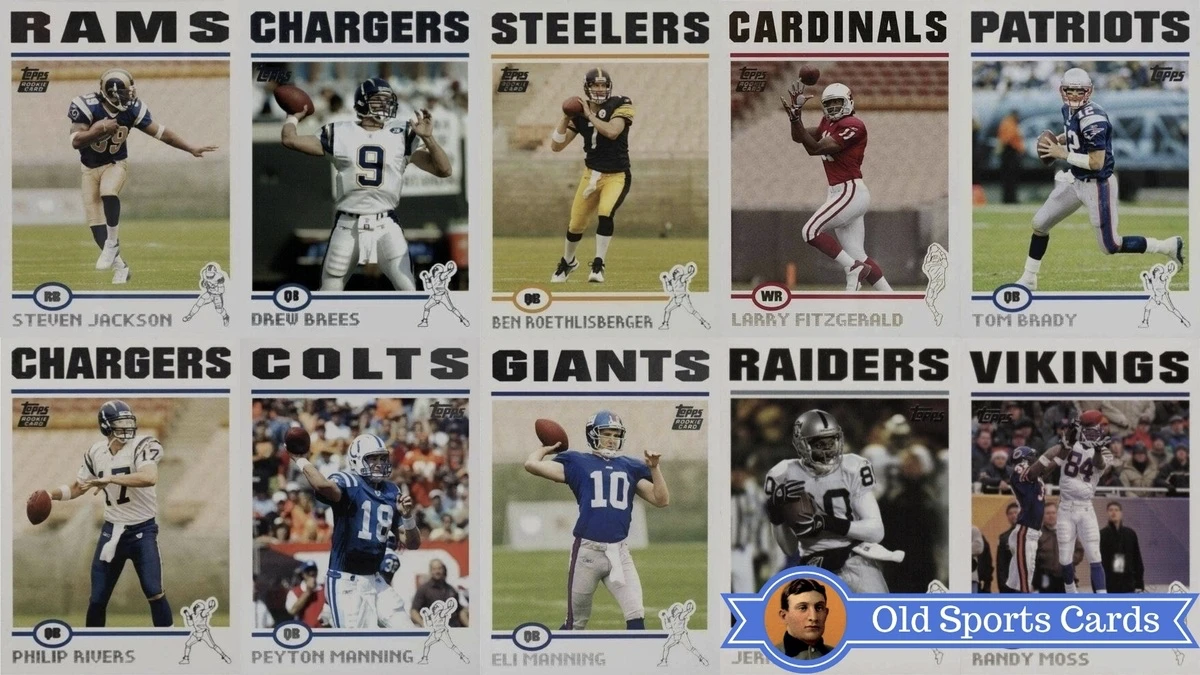
Clocking in at 385 cards in total, the 2003 Topps football card checklist contains multiple superstars and a fantastic rookie card class.
Though Andre Johnson is the only one of those rookies who has yet achieved Hall of Fame honors, other superstars like Jason Witten, Terrell Suggs, Anquan Boldin, Kevin Williams and Larry Johnson made their cardboard debuts in this set alognside him.
It may be overlooked in today’s market, but there are many great cards in this set…
Some collectors may shy away from the full-color borders.
But others really enjoy it.
Regardless, the player names stamped in gold foil offer an interesting aesthetic to balance out the design.
Overall, though it flies under the radar, there’s plenty to enjoy inside the set checkliSt. And in this guide, we’ll take a look at the 15 most valuable.
Let’s jump right in!
Stay On Top Of The Card Market
Weekly pricing updates, grading insights, and new card guides — straight to your inbox. For free.
Join thousands of collectors. Unsubscribe anytime.

Ross Uitts – Owner
- #1
2004 Topps #311 Ben Roethlisberger Rookie Card
Rookie CardPSA 10 Value $125Total PSA Population 2,276PSA 10 Population 681PSA 10 Grade Rate 29.9% (Set Avg: 38.7%)Selected 11th by the Pittsburgh Steelers in the 2004 NFL Draft, Ben Roethlisberger was originally slated to serve as emergency quarterback behind Tommy Maddox and Charlie Batch.
Those plans were scrapped a few weeks into the season.
Batch went down with an injury during the preseason and Maddox suffered ligament damage in his throwing elbow in Week 2.
Roethlisberger quickly answered the call.
Aided by the league’s second-best running game, the best offensive line in the NFL, and the game’s #1 defense, the Miami of Ohio product had it all.
He could have rested on all the talent around him, but that wasn’t Roethlisberger’s style.
Big Ben went 13-0 as a starter, becoming the first quarterback to win Offensive Rookie of the Year since its inception in 1957.
He completed 66.4% of his passes on the year for 2,621 yards, 17 touchdowns, and 11 interceptions, and finished fifth in the league in passer rating (98.4).
Most importantly, he was the game manager Pittsburgh needed on their way to a league-best 15-1 record.
In the postseason, Roethlisberger’s rookie status was much more apparent.
The Steelers barely sidestepped his two interceptions in a 20-17 Divisional Round win over the Jets but couldn’t overcome a trio of picks in a 42-28 loss to New England in the AFC title game.

- #2
2004 Topps #350 Eli Manning Rookie Card
Rookie CardPSA 10 Value $125Total PSA Population 1,513PSA 10 Population 480PSA 10 Grade Rate 31.7% (Set Avg: 38.7%)As the son of Archie Manning and younger brother of Peyton Manning, Eli Manning had big shoes to fill headed into the NFL.
He’d just completed a career at Ole Miss, leading his team to a ten-win season and an SEC MVP Award.
And that’s when the controversy began.
The San Diego Chargers had the number one pick in the 2004 NFL Draft.
But Manning made it clear that he wanted no part of San Diego and damaging his reputation in the process.
The Chargers drafted him anyway but immediately sent him to the Giants for QB Philip Rivers and two picks.
The deal changed the course of both franchise’s futures, but Eli wouldn’t start for the Giants right away.
Instead, he played backup for former MVP Kurt Warner who helped New York to a 5-4 start.
Looking to mix things up to salvage any hope of a playoff run, head coach Tom Coughlin turned to Manning from that point on.
And just like that, the Giants’ season took a nosedive.
After losing six straight, Manning and crew won the last game of the year to finish 6-10.
At that point, few would have predicted that Manning would be hoisting his first Super Bowl trophy just a few years later.
- #3
2004 Topps #360 Larry Fitzgerald Rookie Card
Rookie CardPSA 10 Value $90Total PSA Population 1,437PSA 10 Population 430PSA 10 Grade Rate 29.9% (Set Avg: 38.7%)The Arizona Cardinals had only one wide receiver worth his salt in 2003.
A year later, they’d have the makings of one of the NFL’s best WR tandems.
Arizona struck it big with Anquan Boldin in 2003, turning a second-round pick into the NFL’s Offensive Rookie of the Year.
The problem was that the offense was all Boldin and little else.
In 2004, the Cardinals remedied that by selecting Biletnikoff Award (Best WR) winner and Heisman runner-up Larry Fitzgerald with the third overall selection.
With Boldin and Fitzgerald at the top of the depth chart and Josh McCown under center, the Cardinals’ passing game seemed destined to improve in 2004.
Instead, Boldin suffered a right knee injury in training camp that sidelined him for the first six weeks of the regular season.
Now, Fitzgerald was suddenly in the same position Boldin was a year ago.
He wasn’t quite ready to answer the bell.
Fitzgerald converted on just 58 of his team-high 115 targets for 780 yards and eight touchdowns.
His 50.4% catch percentage was nearly 11 percent worse than his eventual career mark.
It was an inauspicious start to what will surely be a first-ballot Hall-of-Fame career.
- #4
2004 Topps #347 Sean Taylor Rookie Card
Rookie CardPSA 10 Value $70Total PSA Population 529PSA 10 Population 151PSA 10 Grade Rate 28.5% (Set Avg: 38.7%)Safety Sean Taylor was coming off a historic junior year for the Miami Hurricanes, where he led the nation in interceptions and set the school’s single-season record for interceptions returned for a touchdown.
As one of the most celebrated defensive players in the 2004 NFL Draft, multiple teams salivated at the chance to grab the crafty safety.
The Washington Redskins took him fifth overall.
Soon after, five of his former Hurricane teammates would join him as first-round picks, setting an NFL record for the most first-round picks from a single school.
Taylor played well off the bench during the first two weeks, flashing signs of incredible talent.
And by Week 3, Taylor had beaten out third-year safety Andre Lott for the starting role.
In 15 games (13 starts), Taylor recorded 78 tackles (61 solo), one sack, two forced fumbles, and four interceptions.
Taylor finished fourth in Defensive Rookie of the Year voting, while his former University of Miami teammate, Jonathan Vilma, won the award.
The standout safety would play three more years in the NFL, earning Pro Bowl honors in 2006 and 2007 (posthumously).
Unfortunately, Taylor died tragically after being shot during a home invasion in November 2027.
- #5
2004 Topps #327 Vince Wilfork Rookie Card
Rookie CardPSA 10 Value $60Total PSA Population 37PSA 10 Population 20PSA 10 Grade Rate 54.1% (Set Avg: 38.7%)University of Miami tackle Vince Wilfork opted out of his senior season and entered the NFL Draft.
Wilfork had found consistent playing time all three years but only became a starter during his junior year, where he found success as an elite defender.
And despite finishing with the top-ranked defense in 2003, the New England Patriots jumped on Wilfork with the 21st pick of the 2004 NFL Draft.
That made him the last (but certainly not least) of a record-setting six first-round picks coming via the University of Miami Hurricanes that year.
Eventually, Wilfork would become a five-time Pro Bowler and two-time Super Bowl champ.
However, his career in New England began similarly to his collegiate career: Wilfork played in all 16 games of his rookie season but only started in 6.
Despite the limited minutes, he finished the regular season with 42 combined tackles and recorded two sacks.
During the 14-2 Patriots Super Bowl run over the Philadelphia Eagles, Wilfork recorded three tackles in three games (1 start).
A Super Bowl ring was a great finish for the start of a solid career.
- #6
2004 Topps #85 Jerry Rice
PSA 10 Value $50Total PSA Population 35PSA 10 Population 19PSA 10 Grade Rate 54.3% (Set Avg: 38.7%)It took two decades to get Jerry Rice to stop.
The greatest wide receiver to ever live never was or would be a quitter.
He worked harder and studied more than anyone.
In 2004, his stubbornness was even more apparent.
After the 49ers parted ways with Rice in 2000, it would have been easy to call it a day.
He had just finished his age-38 season and had an unparalleled 16-year Hall-of-Fame career to look back on.
Instead, Rice moved across the Bay to Oakland.
He put together back-to-back 1,000-yard receiving seasons in 2001 and 2002, before losing a step or two in 2003.
He lost a few more steps in ’04.
Rice requested a trade at 42 years old instead of fading into the distance.
The Raiders gave him his wish, dealing him to the Seahawks for a conditional seventh-round pick.
Rice took on a more prominent role in Seattle, to uneven results (362 yards, three touchdowns) in eleven games, yet his 51.0% catch percentage was well below that of a top-three receiver.
Seattle parted ways with him after the campaign, yet Rice wasn’t satisfied.
He went to camp with the Broncos in 2005 before retiring when his potential role as a fourth receiver was laid out.
- #7
2004 Topps #275 Tom Brady
PSA 10 Value $50Total PSA Population 554PSA 10 Population 215PSA 10 Grade Rate 38.8% (Set Avg: 38.7%)Coming off their second championship in three years, the New England Patriots were laser-focused on solidifying their dynasty in the making.
Brady kept up his elite play, tossing a then-career-high in touchdowns with 28 and putting up 230.8 yards per game.
His 92.6 passer rating eclipsed his previous seasons, and his career-low in sacks was a testament to the Patriots’ offensive line and Brady’s increasing field awareness.
The improved Brady led his team to a 14-2 record, earning Pro Bowl honors for himself and a first-round bye for the Patriots.
In the Divisional Round against the Indianapolis Colts, Brady and crew got the best of Peyton Manning just as they had done the year before in the AFC Championship.
The Patriots soon faced a 15-1 Pittburgh Steelers juggernaut for the AFC title.
The Pat’s defense dominated en route to a 41-27 victory, forcing rookie quarterback Ben Roethlisberger to throw 3 interceptions on the night.
Brady locked in during Super Bowl XXXIX, throwing for 236 yards and two touchdowns against the Philadelphia Eagles.
Kicker Adam Vinatieri came up clutch in the 4th quarter (as he so often did), and the New England defense held on to maintain a narrow 24-21 victory.
- #8
2004 Topps #375 Philip Rivers Rookie Card
Rookie CardPSA 10 Value $50Total PSA Population 933PSA 10 Population 301PSA 10 Grade Rate 32.3% (Set Avg: 38.7%)Regardless of how well Drew Brees played in 2004, it was only a matter of time before Philip Rivers received the keys to the offense.
The Chargers weren’t about to waste a first-overall pick.
Even with the considerable draft capital received from the Giants for the rights to Eli Manning, San Diego had to put all of their eggs into Rivers’ basket.
So, 2004 was merely a formality, playoff berth and all.
Rivers sat behind Brees in 2004, patiently waiting his turn.
He saw garbage time action in two games, completing 5 of 8 passes for 33 yards and a touchdown.
The tension was palpable on the sidelines.
Brees took the selection of Rivers as a slight, even telling quarterbacks coach Brian Schottenheimer that it “would be the worst f—ing mistake this organization could ever make.” Maybe it was, and maybe it wasn’t.
Rivers had a Hall-of-Fame caliber career with eight Pro Bowls and a Comeback Player of the Year award.
However, he never won the big one.
Brees, on the other hand, won two Offensive Player of the Year awards with the Saints and hoisted the Lombardi in February of 2010, taking home Super Bowl XLIV MVP honors in the process.
- #9
2004 Topps #1 Peyton Manning
PSA 10 Value $40Total PSA Population 66PSA 10 Population 41PSA 10 Grade Rate 62.1% (Set Avg: 38.7%)Heading into 2004, the Indianapolis Colts and Peyton Manning were coming off a 12-4 season in which they won the AFC South and made the AFC Championship game.
Manning himself was the defending league MVP.
And he was out for revenge against the New England Patriots.
Manning had arguably one of the best individual regular seasons in NFL history, throwing an astonishing 49 touchdown passes on 284.8 yards per game and a 121.1 passer rating.
He almost unanimously won the NFL MVP award, dropping only one vote to Atlanta’s Michael Vick.
Finishing with a 12-4 record, the Colts found themselves in a Wild Card matchup against the Denver Broncos for the second time in a row.
And the results were similar.
After beating them 41-10 the year before, Manning and the Colts torched the Broncos’ defense, winning 49-24 in front of 56,609 fans at the RCA Dome.
Unfortunately for Manning, who had completed over 50 touchdown passes in 17 games, he couldn’t muster any in the Divisional Round against the Patriots’ elite defense.
Losing 20-3, the Colts went home without a Super Bowl yet again, despite Manning’s legendary numbers.
- #10
2004 Topps #152 Antonio Gates
PSA 10 Value $40Total PSA Population 9PSA 10 Population 3PSA 10 Grade Rate 33.3% (Set Avg: 38.7%)Antonio Gates did the unthinkable in 2004: he made the Chargers front office believe in Drew Brees, if only for a season.
San Diego’s management was convinced that Brees was a liability after a poor showing in 2003.
It’s why they pulled the trigger on a costly draft deal to secure Philip Rivers, numbering Brees’ days in sunny Southern California.
All of that changed thanks to Antonio Gates.
After a solid rookie year in 2003, Gates matured into the league’s most reliable tight end.
He snagged a team-high 81 receptions and converted on an impressive 71.1% of his targets.
Whenever Brees needed him, Gates was there.
The First-Team All-Pro had three more catches than the combined total of San Diego’s top wide receiver duo (Eric Parker, Keenan McCardell), amassing 964 yards and 13 receiving touchdowns.
No other NFL tight end had more than seven TD catches on the year.
The Brees/Gates connection was the heartbeat of a San Diego offense that improved from 16th in scoring in 2003 to 3rd.
The Chargers blew everyone’s expectations to bits, finishing 12-4 for the franchise’s first AFC West title in a decade.
- #11
2004 Topps #140 Randy Moss
PSA 10 Value $35Total PSA Population 18PSA 10 Population 10PSA 10 Grade Rate 55.6% (Set Avg: 38.7%)From the time the Minnesota Vikings drafted Randy Moss with the 21st pick of the 1998 NFL Draft, he was determined to make all the teams who passed on him pay.
And that he did.
During his first six seasons, Moss set the NFL on fire, leading the league in receiving touchdowns three times while being named a Pro Bowler five times and First-Team All-Pro three times.
Nobody could stop him.
And in 2004, his seventh with the Vikings, he showed no signs of slowing down, racking up eight touchdowns through his first five games.
However, a hamstring injury in Week 6 caused him to miss significant time or even sit out entirely over the next five games.
After returning in Week 12, Moss started to look like his old self in Week 14 when he roasted the Seattle Seahawks for 104 yards and a touchdown.
In 13 games, Moss totaled 767 receiving yards and 13 touchdowns.
And that was it.
Moss’s time in Minnesota ended, and the team traded him to the Oakland Raiders ahead of the 2005 season.
- #12
2004 Topps #191 Emmitt Smith
PSA 10 Value $35Total PSA Population 24PSA 10 Population 20PSA 10 Grade Rate 83.3% (Set Avg: 38.7%)Emmitt Smith’s final year as an NFL player often gets lost in time.
Just over a month after he hung up his cleats in Arizona, the league’s all-time rushing leader returned to Dallas to retire as a Cowboy.
Smith won three Super Bowls, an MVP award, and Offensive Rookie of the Year in 13 years with Dallas.
He was synonymous with the franchise, even when he left in 2003.
This makes his two-year stint with the Cardinals feel like an asterisk.
A fractured shoulder cost him six games in 2004, and he looked way off before and after.
In 2005, things were much different.
The 35-year-old superstar was healthy again and ready to make good on Arizona’s commitment to him.
Smith rushed 267 times for the ’04 Cardinals for 937 yards and nine touchdowns.
He wasn’t the All-Pro force of years past, but he was still pretty good.
Smith’s numbers were comparable to his final year in Dallas, and his TD count was his most since 2000.
The Cardinals hung around on the fringes of playoff contention for ten weeks before losing five of their last seven to finish 6-10.
Just like that, Smith was gone, and his time in Arizona was all but forgotten.
- #13
2004 Topps #181 Drew Brees
PSA 10 Value $35Total PSA Population 48PSA 10 Population 26PSA 10 Grade Rate 54.2% (Set Avg: 38.7%)San Diego Chargers QB Drew Brees made a lot of money in 2004.
It just so happens that the checks would come from a different organization.
Brees was a stopgap option headed into 2004, with Philip Rivers waiting in the wings.
He was, for a time, the future of the franchise.
Now, he was expendable.
Or, so the front office thought.
Brees put a rough 2003 way behind him, morphing into one of the game’s best quarterbacks over a single offseason.
“I could turn on the film and watch myself last year and say, ‘That’s not me.
That’s not the way I play,”‘ Brees said.
The former Purdue star dedicated himself to intense study, tweaking his footwork, and refining his progressions.
In ’03, he forced the issue and folded under duress.
In ’04, he kept his pulse low and made the right reads.
Brees’ numbers bore it out.
He upped his completion rate from 57.6% to 65.5%, ending the year with 3,159 yards and 27 touchdowns.
There’s no way the Chargers could have made it anywhere near a division title without the NFL Comeback Player of the Year (and first-time Pro Bowler) balling out.
Within two years, he’d be a New Orleans Saint.
- #14
2004 Topps #325 Steven Jackson Rookie Card
Rookie CardPSA 10 Value $30Total PSA Population 92PSA 10 Population 45PSA 10 Grade Rate 48.9% (Set Avg: 38.7%)Five years after the closing of the Greatest Show on Turf, the Rams found themselves in limbo.
St. Louis made the playoffs five times in six seasons from 1999 to 2004.
Two of those runs ended in the Super Bowl (’99, ’01), and one brought rings along with it (’99).
In 2006, the Rams were in year two of an eventual 12-year playoff drought.
They’d go through multiple identity crises along the way, eventually skipping St. Louis altogether to return to Los Angeles in 2016.
However, there was one constant for most of that dark period: Steven Jackson.
The Rams grabbed Jackson with the 24th overall pick of the 2004 Draft, earmarking the Oregon St. star as their future starting running back.
Not much was golden about the Rams at this time, except maybe this selection.
Jackson shattered multiple career franchise records, amassing eight consecutive 1,000-yard rushing seasons from 2005 to 2012.
In ’04, Jackson essentially split time with incumbent Hall-of-Famer Marshall Faulk.
He carried the ball 134 times in 14 games (three starts), racking up 673 yards and four TDs.
Jackson also served as a valuable receiver out of the backfield, with 19 catches for 189 yards.
- #15
2004 Topps #250 Brett Favre
PSA 10 Value $25Total PSA Population 62PSA 10 Population 44PSA 10 Grade Rate 71.0% (Set Avg: 38.7%)Brett Favre and the Green Bay Packers were back from a heartbreaking loss in overtime to the Philadelphia Eagles in which they failed to get a game-ending 4th and 26 stop.
Favre was his usual self, completing 64.1% of his passes for 4,088 yards and 30 touchdowns.
However, the impressive numbers weren’t enough to send Favre to a fourth consecutive Pro Bowl.
Favre also protected the ball well; his 12 sacks were a career low as a starter, and his 17 interceptions were pretty average for his career.
But that’s when the roller coaster ride that was Brett Favre picked up again.
Green Bay came into the season looking for redemption, and they got their chance after qualifying for the Wild Card round with a 10-6 record.
The 8-8 underdog Minnesota Vikings, a team Green Bay had already beaten twice, seemed like an “easy” stepping stone to the Divisional Round.
However, the Vikings took a commanding 17-3 lead in the first quarter and never looked back, winning 31-17 and sending Favre home.
It was arguably the worst postseason game of Brett Favre’s career, as he finished with a shockingly bad four interceptions in front of a stunned Lambeau crowd.

Ross’s Take
Whether you’re a fan of the design or not, there’s no denying the amount of star power found inside this set.
Big-name quaterbacks like Tom Brady, Peyton Manning, Drew Brees and Brett Favre along with superstars like Emmitt Smith and Jerry Rice are a huge draw.
But the rookie card class is the most impressive thing about this set.
Andre Johnson is the only Hall of Famer among them.
But there are other big-name rookies like Jason Witten, Carson Palmer, Terrell Suggs, Larry Jonnson, Kevin Williams, Willis McGahee, Dallas Clark and more who had impressive careers.
Like most sets of the era, Topps included several different subsets to boost collector interest: Weekly Wrap-Up (#291 – 310) Rookies (#311 – 385) Transaction (Throughout checklist) None of the cards in this set are going to break the bank when it comes to huge price points.
But there is a lot of great value packed within the 385-card checkliSt.
Love old cards? Get weekly updates from a fellow collector.
Pricing updates, grading insights, and new guides on the cards you actually care about — the junk wax era, vintage, and everything in between. One email a week. No fluff.
Free. No spam. Unsubscribe anytime.
Ross Uitts – Owner
