
15 Most Valuable 1993 Topps Finest Baseball Cards

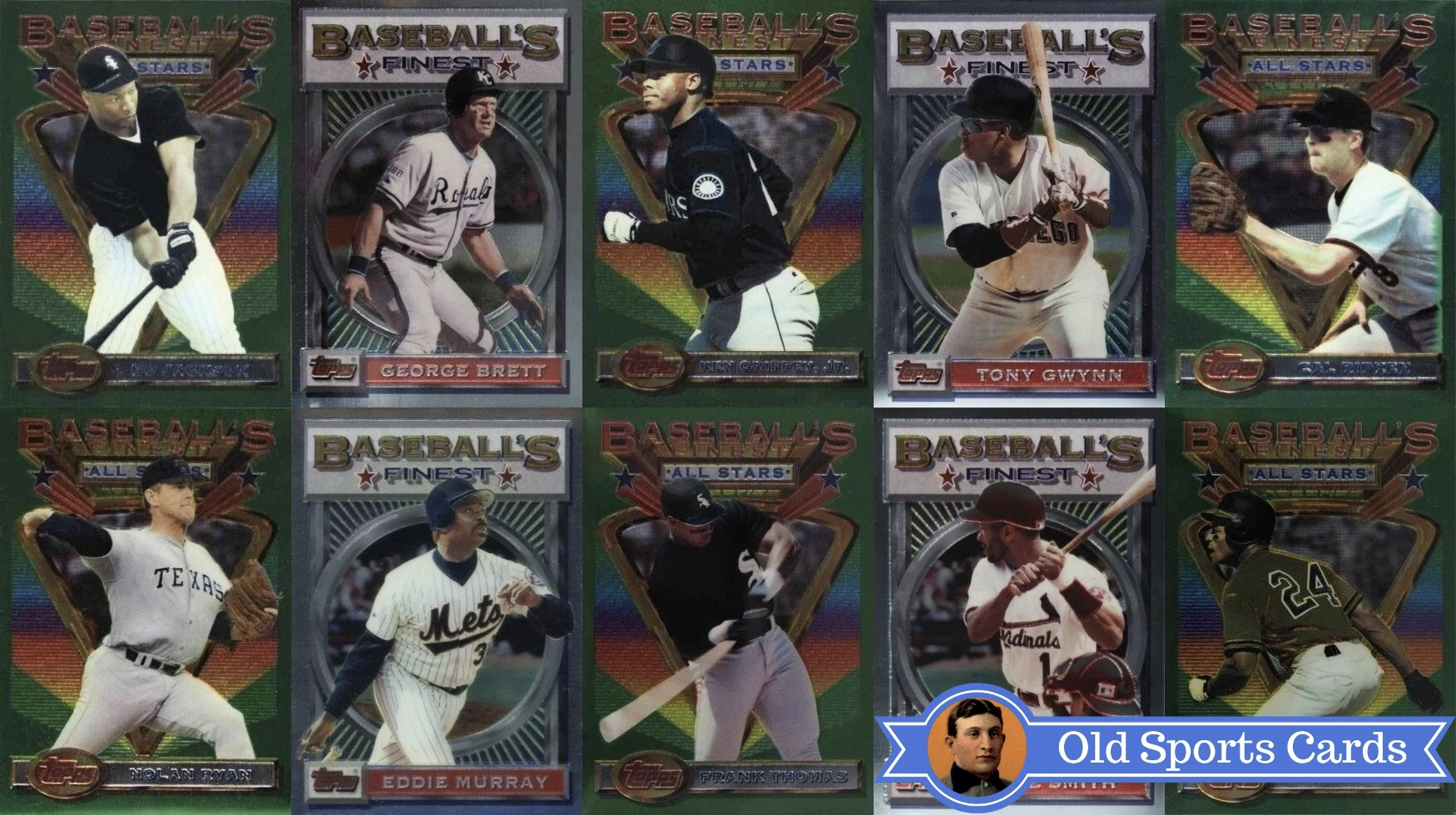
Every now and then, a set comes along that changes the course of hobby history.
The 1993 Topps Finest baseball set certainly fits that description…
Many of today’s products can trace their roots to to its 199-card checkliSt. Any set with cards printed on chromium stock, like Bowman Chrome and Topps Chrome, can tip its hat to 1993 Finest Baseball.
Collectors ripping packs of Finest in 1993 were practically dumbfounded when they first saw the chromium stock.
Furthermore, those lucky enough to pull a refractor parallel from one of those packs were even more stunned.
Today, it’s common to find these unique cards that refract light to create superior visual effects in many products.
But in 1993, nobody had ever seen anything like it.
It’s an understatement to say that Topps achieved its goal of standing out in the super-premium market with this set.
And in this guide, we’ll take a look at the 15 most valuable.
Let’s jump right in!
Stay On Top Of The Card Market
Weekly pricing updates, grading insights, and new card guides — straight to your inbox. For free.
Join thousands of collectors. Unsubscribe anytime.

Ross Uitts – Owner
- #1
1993 Topps Finest #107 Nolan Ryan
PSA 10 Value $2,200Total PSA Population 752PSA 10 Population 23PSA 10 Grade Rate 3.1% (Set Avg: 12.3%)If not for injury, Nolan Ryan and George Brett would have shared the field on the final day of the 1993 MLB season, the final game of Brett’s extraordinary career.
Ryan’s age-45 campaign, his 27th in the Bigs, was a trial.
Every part of his body seemingly had something wrong with it.
The Ryan Express was busted and rusted, and he had multiple IL stints with rib, elbow, and knee trouble.
It all piled up into the worst season of his career.
Ryan posted career worsts in a variety of statistical categories, including ERA (4.88), WAR (-0.6), strikeouts-per-9 (6.2), and innings pitched (66.1).
To add a cherry on top of it all, Ryan felt and heard a massive pop in his 17th-and-final start of the year.
The pop was a career-ending UCL tear.
It forced Ryan out of uniform without a say and robbed us of one last Brett/Ryan showdown.
Ryan may very well have followed him into retirement on his own, although nothing is for sure, considering the ageless one’s trademark stubbornness.

- #2
1993 Topps Finest #110 Ken Griffey Jr.
PSA 10 Value $1,350Total PSA Population 1,512PSA 10 Population 124PSA 10 Grade Rate 8.2% (Set Avg: 12.3%)Ken Griffey Jr. was already the most popular player in baseball going into the 1993 MLB season.
He’d leave the campaign in the same crossover territory as Michael Jordan.
Griffey’s ’93 campaign was an MVP-caliber showcase of diving catches and tape-measure bombs.
After hitting over 20 home runs in each of his previous three seasons, the 23-year-old turned the knob to eleven with a 45-homer barrage.
He fell just one shy of the MLB lead.
Eight of Griffey’s home runs came in eight consecutive games from July 20th to the 28th.
It tied an MLB record shared by Pittsburgh’s Dale Long (1956) and the Yankees’ Don Mattingly (1987).
“The Kid” singlehandedly drew over 30,000 walk-up tickets in Seattle on July 29th, yet couldn’t make it nine-for-nine, going 2-for-4 with a double.
“On that last swing, I tried so hard to do it for the fans here,” Griffey said.
“I didn’t want to let them down.”
- #3
1993 Topps Finest #77 Tony Gwynn
PSA 10 Value $325Total PSA Population 136PSA 10 Population 6PSA 10 Grade Rate 4.4% (Set Avg: 12.3%)Tony Gwynn’s ailing left knee didn’t stop him from hitting like a machine in 1993.
Gwynn entered the ’93 campaign coming off of two knee surgeries.
Criticism about his weight was thunderous.
Although he had missed at least a month of games in the previous two seasons, the San Diego Padres superstar cared little about what others had to think.
It showed at the dish.
Gwynn entered July, hitting .313 and on the fringes of the NL batting race.
He proceeded to hit .381 that month, followed by an absolutely bonkers .448 showing in August 26th contests.
The Hall-of-Fame right fielder hit safely in all but two of those games, posting multiple hits in over half of them (15).
Now at .358, the 33-year-old had a puncher’s chance to track down Colorado’s Andres Galarraga for a fifth batting title.
Gwynn’s knee would say otherwise, shutting him down after an injury against Atlanta on September 5th.
- #4
1993 Topps Finest #86 Rickey Henderson
PSA 10 Value $325Total PSA Population 228PSA 10 Population 28PSA 10 Grade Rate 12.3% (Set Avg: 12.3%)The late great Rickey Henderson played in and won his final World Series in 1993.
It was ostensibly a cameo appearance.
However, it was a title nonetheless.
Henderson ended his second stint with the Oakland A’s at the ’93 Trade Deadline, waiving his no-trade clause at the deadline for a move north of the border.
The deal sent Henderson from the AL West’s worst team to the AL East’s best: a Toronto Blue Jays super-squad seeking a repeat as world champions.
The Jays did just that.
However, it was despite a protracted Henderson slump.
The 34-year-old left fielder hit just .215 in 203 regular-season plate appearances for Toronto.
His 22 steals proved valuable.
However, his failing bat counterbalanced his impact on the basepaths.
Henderson was even worse in the postseason, posting a .170 average with three steals in 12 games.
Rickey got his ring, nonetheless.
He subsequently bolted in free agency, choosing to sign…
…with Oakland again.
- #5
1993 Topps Finest #96 Cal Ripken Jr.
PSA 10 Value $325Total PSA Population 465PSA 10 Population 44PSA 10 Grade Rate 9.5% (Set Avg: 12.3%)Cal Ripken Jr.’s consecutive games streak came this close to ending a few hundred games before Gehrig’s hallowed 2,130.
After dipping below 20 home runs in a rough 1992 campaign, the 32-year-old reconnected with his power stroke in ’93 for a 24-bomb showing.
It was enough for the 11-time All-Star to land his seventh Silver Slugger and receive down-ballot MVP mentions.
Yet, it almost proved an even bigger disappointment than his ’92 swoon.
On June 6th, the Baltimore Orioles rushed the mound as part of a benches-clearing brawl with the Seattle Mariners.
He heard a gunshot pop in his knee and landed at the bottom of the pile.
Ripken struggled to walk the next day.
Undeterred, he threw himself into hours of physical therapy and stretches before ultimately deciding to play that night.
The knee held up.
But it almost did the deed.
“The knee injury I suffered in the brawl was probably the closest I came to ending it,” Ripken said.
- #6
1993 Topps Finest #91 Bo Jackson
PSA 10 Value $275Total PSA Population 314PSA 10 Population 57PSA 10 Grade Rate 18.2% (Set Avg: 12.3%)Bo Jackson’s return to baseball was pure guts.
Jackson was wiped out of football on January 13th, 1991, by a career-ending hip injury.
The condition worsened as the months went on, developing into a degenerative disorder called avascular necrosis.
Basically, Jackson’s hip cartilage and bone were withering away.
Football was out of the question, and there also seemed little shot he’d get back on a baseball field, considering he was still on crutches by the time 1991 Spring Training rolled around.
Kansas City dumped Jackson onto waivers on March 18th, a jarring end after a meteoric rise to two-sport fame.
The Chicago White Sox wasted little time swooping in, offering Jackson an incentive-heavy three-year deal.
They got 23 games out of him in ’91 before he underwent a hip replacement in April 1992.
Jackson gritted through rehab and, somewhat miraculously, played 85 games for the Sox in 1993.
His numbers weren’t spectacular (.232/.289/.433 slash, 16 home runs), yet he was still rightfully named AL Comeback Player of the Year.
- #7
1993 Topps Finest #98 Don Mattingly
PSA 10 Value $250Total PSA Population 305PSA 10 Population 51PSA 10 Grade Rate 16.7% (Set Avg: 12.3%)While Don Mattingly wasn’t around to see the 1990s/2000s Yankees dynasty in full bloom, he played a vital role in planting the seeds.
Mattingly was the franchise’s rock during its leanest years, keeping Bombers fans engaged while the team scuffled away from the postseason scene.
Heading into 1993, Mattingly wasn’t the same hitter he was in the mid-1980s.
The former MVP was a league-average performer over the previous three campaigns.
Chronic back pain was the culprit, zapping Donnie Baseball’s power.
What Mattingly lacked in home run distance, he made up for as a teacher.
The six-time All-Star nurtured the next generation of Yankees stars, such as Paul O’Neill and Bernie Williams.
With the kids coming together under Mattingly’s wing, the ’93 Yankees posted their best record since 1987 (88-74) and their first second-place finish since ’86.
Mattingly had a refreshingly strong showing, earning a Gold Glove and his best hitting year (.291 AVG, 17 HR, 86 RBIs) since the Eighties.
- #8
1993 Topps Finest #112 Kirby Puckett
PSA 10 Value $250Total PSA Population 160PSA 10 Population 18PSA 10 Grade Rate 11.3% (Set Avg: 12.3%)Kirby Puckett’s most controversial All-Star selection led to his defining Midsummer Classic performance.
Puckett labored through the first half of the 1993 campaign, trending toward his worst season since 1985.
He was still voted in as the American League’s starting left fielder.
“A lot of people say I should not be here because my numbers are down,” Puckett said.
“But I went out there and played every day.” The 33-year-old made believers out of his doubters come July 13th.
In front of a packed house at Camden Yards, Puckett went 2-for-2 with a homer and an RBI double.
His heroics led the way for the Junior Circuit in a 9-3 win, making him the first All-Star MVP in Minnesota Twins history.
Not only that, Puckett’s two extra-base hits were his first in eight All-Star appearances.
He went his first 16 at-bats without a two-bagger or better before breaking out in Baltimore.
- #9
1993 Topps Finest #103 Barry Bonds
PSA 10 Value $200Total PSA Population 482PSA 10 Population 57PSA 10 Grade Rate 11.8% (Set Avg: 12.3%) - #10
1993 Topps Finest #63 George Brett
PSA 10 Value $150Total PSA Population 200PSA 10 Population 35PSA 10 Grade Rate 17.5% (Set Avg: 12.3%)George Brett is one of baseball’s greatest players.
Over 21 years with the Kansas City Royals, the Hall-of-Fame corner infielder swung, swiped, and screamed his way to 13 All-Star appearances, three batting titles, an MVP (1980), and a World Series championship (1985).
A fiery competitor remembered for his freak-out during the infamous Pine Tar Game, Brett joined the 3,000 Hit Club in the final days of the 1992 campaign.
By that time, Brett’s career was winding down.
League-average seasons in 1991 and 1992, as well as injuries, had him thinking about retirement.
He gave it one more go in 1993, posting a sub-average OPS+ (94) for the first time since his ’74 rookie campaign.
Rather than taking a new contract from a Royals franchise just happy to have him around, the 40-year-old announced his retirement and joined the front office.
“I always said I’d never play the game for money,” Brett said.
“The game deserves better than that.”
- #11
1993 Topps Finest #102 Frank Thomas
PSA 10 Value $150Total PSA Population 480PSA 10 Population 69PSA 10 Grade Rate 14.4% (Set Avg: 12.3%)Frank Thomas’ 1993 MVP season, his first of two consecutive, was a dominant display.
However, it should have been the second of three straight award wins.
(Or, the third of four.) Thomas finished just eighth in the ’92 MVP race despite leading the league in multiple categories, including OPS (.975), on-base percentage (439), and doubles (46).
He was even more dominant in ’91, placing third despite pacing the Majors in everything from walks (138) to OPS (1.006) to OPS+ (180).
The Chicago White Sox first baseman’s ’93 campaign was actually the weakest of the three.
He didn’t lead the league in any major statistical category and performed worse in nearly every metric…
…but one.
Thomas exploded for 41 homers on the year, up from 24 the year before.
It proved the difference in a unanimous MVP win.
“I’m glad I finally got one,” Thomas said.
“I thought I deserved it last season.”
- #12
1993 Topps Finest #122 Eddie Murray
PSA 10 Value $150Total PSA Population 34PSA 10 Population 7PSA 10 Grade Rate 20.6% (Set Avg: 12.3%) - #13
1993 Topps Finest #28 Ozzie Smith
PSA 10 Value $125Total PSA Population 97PSA 10 Population 29PSA 10 Grade Rate 29.9% (Set Avg: 12.3%)Ozzie Smith was named to 15 National League All-Star teams in the final 16 years of his Hall-of-Fame career.
The one exception?
1993.
Despite having one of his best first halves at the plate ever and flashing the glove like he always did, the beloved St. Louis Cardinals shortstop was outvoted for starting honors by Cincinnati’s Barry Larkin.
Puzzlingly, he was left off the squad entirely by Atlanta manager Bobby Cox.
Cox selected Pittsburgh’s Jay Bell for one of the two reserve shortstop spots.
The other player was one of his own: the Braves’ Jeff Blauser.
That’s not to say that Bell and Blauser didn’t deserve it.
However, retrospectively, it feels criminal that “The Wizard” saw his All-Star streak snapped.
Fans righted the perceived wrong in 1994, though, naming Smith as a starter with over 4 million votes, the most for a National Leaguer that year.
- #14
1993 Topps Finest #85 Greg Maddux
PSA 10 Value $125Total PSA Population 327PSA 10 Population 69PSA 10 Grade Rate 21.1% (Set Avg: 12.3%) - #15
1993 Topps Finest #199 Mike Piazza
PSA 10 Value $125Total PSA Population 666PSA 10 Population 92PSA 10 Grade Rate 13.8% (Set Avg: 12.3%)Of the nine catchers named AL or NL Rookie-of-the-Year, Mike Piazza and Carlton Fisk lap the field.
In a positional spot with a much steeper learning curve than any other place on the diamond, Piazza and Fisk exhibited zero rookie jitters.
So, which RoTY year was better?
It depends on what you look at.
Carlton Fisk’s 1972 opening with the Boston Red Sox was a more complete performance.
Fisk’s rookie year outpaces Piazza’s in WAR (7.3 to 7.0) and OPS+ (162 to 153).
He also won a Gold Glove.
Conversely, Piazza surrendered the most stolen bases in the NL (108) in his Dodgers debut.
(Piazza also nabbed the most would-be base stealers with 59.) On the other hand, Piazza was a breakout sensation in one of baseball’s biggest markets.
He outhomered Fisk 35 to 22 and hit .318, 25 points better than his Hall-of-Fame elder.
So, who was better?
Let’s call it a tie.

Ross’s Take
The “Junk Wax” era of the 80s and 90s brought overprinting and market saturation that ruined the values of many cards and sets over the long run.
Like anything, the simple economics of having a massive supply of something that outpaces demand always results in reduced prices.
Card manufacturers clearly saw this problem surfacing and soon deviated to create “super-premium” products like Flair (Fleer) and SP (Upper Deck).
The idea was to attempt to “manufacture” scarcity by limiting print runs or introducing other creative ways to make cards more rare.
Topps answered with 1993 FineSt. And they did so in a big way.
The “hobby firsts” that appeared in 1993 Finest Baseball speak for themselves.
It’s hard to say whether the chromium stock or refractor parallels had the bigger overall impact.
Many products still feature one or the other (or both).
But if I had to choose one, I’d have to go with the refractors.
Without them, you wouldn’t have all the different numbered refractors in a given set, encouraging some collectors to “chase the rainbow” and try to find them all.
And that concept of “manufactured scarcity” that rings loudly today can find many of its roots in this set.
Even in 1993, Topps knew the number of surviving 1952 Topps Mickey Mantles was limited.
They also knew the number of 1993 Topps Ken Griffey Jr. cards wasn’t.
But by limiting the number of 1993 Topps Finest to a relatively small number of 48,000 boxes, the number of 1993 Topps Finest Ken Griffey Jr. cards would be much smaller by default.
Furthermore, issuing just 241 refractors of each base card made those even more rare.
Today, some refractors in PSA 10 holders go for thousands of dollars, with the Nolan Ryan and Ken Griffey Jr. regularly fetching five-figure price tags.
It may seem bonkers, but it all goes back to the concept of “manufactured scarcity.” That’s why this set is so historic.
Love old cards? Get weekly updates from a fellow collector.
Pricing updates, grading insights, and new guides on the cards you actually care about — the junk wax era, vintage, and everything in between. One email a week. No fluff.
Free. No spam. Unsubscribe anytime.
Ross Uitts – Owner
