
25 Most Valuable 1952 Topps Baseball Cards

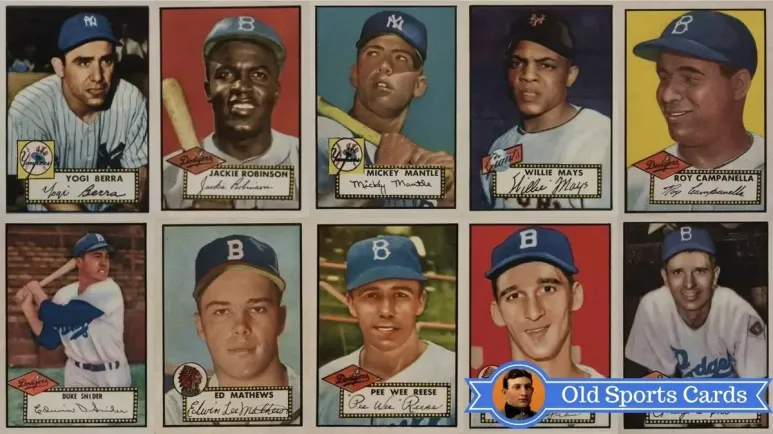
The 1952 Topps baseball card set is the most iconic postwar issue in the hobby.
Big names like Stan Musial, Satchel Paige and Ted Williams aren’t in the checklist, but fortunately, legends like Mickey Mantle, Willie Mays, and Jackie Robinson, to name a few, made the cut.
The set is also known for its many quirks.
The first 80 cards in the set exist with both red and black backs.
The checklist includes multiple errors, some of which we’ll get into on this liSt. The last of the six series (#311 – 407), otherwise known as the high numbers, shipped so late in 1952 that many retailers wouldn’t even accept them.
A disproportionate number of surviving high-series cards ended up in Canada and northern states, and co-designer Sy Berger was even rumored to have dumped some in the ocean!
No one can say definitively how many 1952 Topps baseball cards were printed, nor where they all ended up.
What we do know for sure: any 1952 Topps baseball card that survives today still has value.
And in this guide, we look at the 25 most valuable.
Let’s jump right in!
1952 Topps Baseball Set Snapshot
SET DETAILS
407
Ed Mathews, Hoyt Wilhelm, Minnie Minoso, Dick Williams
Mickey Mantle, Willie Mays, Jackie Robinson, Yogi Berra
GRADING ANALYSIS
325,202
TOTAL GRADED BY PSA
57,197
PSA 5 Population
17.6%
PSA 5 Grade Rate
MOST GRADED CARDS
1
#261 Willie Mays
1.0%
3,370
2
#88 Bob Feller
0.8%
2,518
3
#191 Yogi Berra
0.7%
2,326
Need Help Selling Your Sports Cards?
Fill out the form below and I’ll get back to you within 24 hours. No obligation.

Ross Uitts – Owner
- #1
1952 Topps #311 Mickey Mantle
PSA 5 Value $260,000 – $270,000Total PSA Population 2,130PSA 5 Population 186PSA 5 Grade Rate 8.7% (Set Avg: 17.6%)Things couldn’t have started much rockier for Mickey Mantle during his rookie 1951 campaign.
Though he shined during Spring Training, he soon struggled against major-league pitching, prompting legendary manager Casey Stengel to send him down to the Minors in June.
Back in Yankee pinstripes by late August, Mantle rebounded well, and his hot bat helped New York pull away from the Cleveland Indians to win the AL pennant.
That’s when things took a severe turn for the worse.
Mantle was chasing down a Willie Mays fly ball in Game 2 of the 1951 World Series when Joe DiMaggio called him off.
He slammed the brakes and caught his spikes on a rubber drainage cover, ripping his knee apart.
Things got even worse when Mickey’s father, Mutt, received an advanced Hodgkin’s disease diagnosis after falling on the sidewalk while trying to help his son to the hospital.
Both ended up watching the rest of the World Series from adjacent beds in Lenox Hill Hospital.
Mutt died shortly after, at 40, on May 6, 1952.
Now with his heart at its heaviest, Mantle played his sophomore season with something to prove.
Somehow, the 20-year-old center fielder set aside his woes for a brilliant effort.
Mantle earned his first All-Star nod and placed third in AL MVP voting, slashing .311/.394/.530 with 23 home runs and 87 RBIs, and finished the year with a .345 two-homer showing in New York’s seven-game Fall Classic win over Brooklyn.
Make no mistake: this is not Mantle’s rookie card.
That would be his 1951 Bowman issue.
Yet it’s the most iconic card in the toughest series Topps ever printed.
Despite being double-printed, the high numbers shipped so late in the 1952 season that retailers wouldn’t take them, which is why it’s still only the sixth most-graded card in the set.

- #2
1952 Topps #312 Jackie Robinson
PSA 5 Value $30,000 – $31,000Total PSA Population 1,583PSA 5 Population 161PSA 5 Grade Rate 10.2% (Set Avg: 17.6%)Jackie Robinson did absolutely everything for the 1952 Brooklyn Dodgers to get them back to the NL mountaintop.
Finishing as the NL’s most valuable position player by WAR (8.4) for the third time in four years, the 33-year-old second baseman was elite at almost everything.
Few statistical categories in the ’52 NL record books don’t list Robinson in the top ten.
He placed first in the Senior Circuit (and baseball) in on-base percentage (.440), second in OPS+ (149), third in stolen bases (24), third in runs created (104), third in walks (106), third in runs scored (104), and fourth in batting average (.308).
Add in his A+ defense at second, and the path to the pennant was clear.
The Series, however, was much murkier.
Brooklyn’s offense sputtered against the Yankees, scoring just 20 runs in seven games.
The Dodgers squandered a 3-2 Series lead, leaving Robinson a game short of his first championship.
For years, this card was criminally undervalued.
I think that applies to all of Jackie’s cards, for that matter.
Now, this card has soared in value to become the second-priciest card in the set, behind fellow high-number Mickey Mantle.
- #3
1952 Topps #407 Ed Mathews Rookie Card
Rookie CardPSA 5 Value $20,500 – $21,000Total PSA Population 1,024PSA 5 Population 105PSA 5 Grade Rate 10.3% (Set Avg: 17.6%)Eddie Mathews deserved better from his Rookie-of-the-Year caliber ’52 campaign.
Boston drew a grim 3,653 fans per game, nearly half that of the second-worst team (St. Louis Browns).
Whereas half the Majors drew over 900,000 fans during the ’52 season, Boston didn’t even crack 300,000 (281,278).
Only a smattering of people showed up every night, leading to their eventual move to Milwaukee in 1953.
It was not an ideal situation for a kid’s first Big League experience.
To Mathews’ credit, he blocked out the collective blues and put up one heck of a year.
The 20-year-old third baseman finished third in NL RoTY voting and earned some MVP votes, slashing .242/.320/.447 with 25 home runs and 58 RBIs in 145 games.
Mathews did strike out an MLB-worst 115 times, but some of that can be attributed to nerves and the circumstances surrounding the franchise.
This card is the most desirable rookie card in the set and is widely known as one of the toughest vintage cards to find in high grade.
Not only is it part of the elusive high-number series, it also bookends the set as the last card in the checkliSt. And, if you remember how kids used to wrap cards in a set sequentially with rubber bands, that means Mathews and Pafko (card #1) took the brunt of wear and tear from those bands.
- #4
1952 Topps #261 Willie Mays
PSA 5 Value $16,500 – $17,000Total PSA Population 3,370PSA 5 Population 346PSA 5 Grade Rate 10.3% (Set Avg: 17.6%)Willie Mays was everything for the New York Giants teams of the 1950s.
Just look at his first few years.
In 1951, Mays struggled early before gliding to the NL Rookie of the Year award and pushing the Giants to their first pennant in 14 years.
In 1952, the Giants pulled into first place again as April turned to May.
However, their season was turned upside down shortly after when Mays was conscripted into military service.
Oddly, the Army didn’t expect Mays to do much more than play baseball.
According to multiple sources, the future Hall-of-Famer played upwards of 180 games while stationed at Fort Eustis, Virginia.
The Giants and manager Leo Durocher could only worry and wait.
New York fell out of the pennant race in ’52 and went belly-up in 1953, finishing 70-84 for fifth in the league.
But when Mays came back, it was all fine and dandy again.
The ’54 Giants won the title with Mays as NL MVP, almost like nothing had ever happened.
Like Mantle, some confuse Mays’ ’52 Topps for his rookie card, though his first appearance was also in the 1951 Bowman set.
However, though Mays was arguably the better ballplayer, his ’52 Topps card will never rival Mickey Mantle’s in value.
One technical issue working against Mays’ card is that, unlike Mantle’s, it wasn’t part of the high-number series.
Perhaps more importantly, though, Mantle was the face of the Yankees during that era and, for years, became the de facto face of the entire hobby.
Fortunately, I think Mays’ ’52 Topps issue has steadily earned its rightful recognition as one of the hobby’s most important cards, as shown by its sharp rise in value in recent years.
- #5
1952 Topps #1 Andy Pafko
PSA 5 Value $7,000 – $7,500Total PSA Population 1,652PSA 5 Population 169PSA 5 Grade Rate 10.2% (Set Avg: 17.6%)Chicago Cubs fans have taken plenty of proverbial punches over the past century or so.
The trade that sent Andy Pafko away to the Dodgers may be one of the most hurtful.
In 1951, the Cubs dealt the beloved outfielder to Brooklyn as part of a blockbuster eight-player deal.
Pafko was perhaps the most popular player on a shallow roster, owing to his all-effort style and no-nonsense approach.
Yet, Cubs fans can’t have nice things, and Pafko was shipped to Brooklyn for a relative pittance.
He slotted in perfectly beside Hall-of-Fame Duke Snider in the outfield, posting two very strong years in ’51 and ’52.
In 1952, Pafko was an important piece to Brooklyn’s third pennant winner in six years, slashing .287/.366/.439 with 19 home runs, 85 RBIs, and a 120 OPS+ in 150 games.
He also played all three outfield positions and third base, giving his teammates crucial days of rest down the stretch.
Pafko isn’t a Hall of Famer.
And this isn’t a rookie card.
So what gives?
Pafko is on this list for one reason: his card was #1 in the set and suffered the same exposure to the elements and rubber bands as Eddie Mathews’ card.
Across both the base and “Black Back” variations, roughly 0.2% have reached PSA 8 or better with no PSA 9s and just one PSA 10, making it brutal to find in high grade.
- #6
1952 Topps #392 Hoyt Wilhelm Rookie Card
Rookie CardPSA 5 Value $3,400 – $3,500Total PSA Population 842PSA 5 Population 88PSA 5 Grade Rate 10.5% (Set Avg: 17.6%)Hoyt Wilhelm’s off-the-wall knuckleball was the ticket to his late-blooming MLB career.
Excluding a three-year tour during World War II (1943-45), Wilhelm toiled in the Minors year after year to get his shot.
He debuted for D-Level Mooresville in 1942 at age 19 and bounced around Jacksonville, Knoxville, and Minneapolis before finally surfacing with the Giants in ’52 at 29.
This version of Wilhelm was different from the kid the Giants scouted before WWII.
Rather than leaning on raw talent and potential, Wilhelm used sleight of hand to make short work of hitters.
After a strong Spring Training, manager Leo Durocher sent Wilhelm straight to the bullpen.
It wasn’t a demotion.
Durocher used Wilhelm in nearly every scenario, deploying him an MLB-high 71 times.
In his 159.1 innings, Wilhelm went 15-3 with NL bests in ERA (2.43) and ERA+ (152), mind-boggling numbers that earned him fourth in NL MVP voting and second in Rookie-of-the-Year voting.
Alongside Mathews, Minnie Minoso, and Dick Williams, Wilhelm’s card is notable as one of four Hall-of-Fame rookies in the set.
- #7
1952 Topps #314 Roy Campanella
PSA 5 Value $2,300 – $2,500Total PSA Population 944PSA 5 Population 134PSA 5 Grade Rate 14.2% (Set Avg: 17.6%)Roy Campanella caught a painful case of the post-MVP blues.
Campy’s ’51 explosion ended with him fourth in the NL in batting average (.325), third in home runs (33), and fourth in RBIs (108) while maintaining his reputation as one of the best game-managing catchers in the Majors.
It was a near-perfect year and an easy award win.
Fast forward several months, and things could not have been any different.
Campanella was attacked by an array of nagging injuries to start the year, culminating in a freak foul tip during a July game that chipped a bone in his elbow.
The 30-year-old catcher labored through it for a week and a half before he was finally sidelined and put in a caSt. It never fully got right, and Campy meandered his way to an atypical .269 regular-season average (with just 22 homers).
The good news was that the Dodgers still won the pennant.
The bad news is that Campanella could muster just six singles in a seven-game Series loss to the Yankees.
Unlike the trio of fellow high-numbers Mantle (#311), Robinson (#312) and Bobby Thomson (#313) that preceded him, Campy’s card was not double-printed.
You’ll also often find that yellow background to be faint or showing print defects.
Though fewer printed means fewer survive, PSA has given two Campy cards the lofty PSA 10 grade.
- #8
1952 Topps #333 Pee Wee Reese
PSA 5 Value $1,950 – $2,000Total PSA Population 833PSA 5 Population 94PSA 5 Grade Rate 11.3% (Set Avg: 17.6%)In an era where stolen bases were at a premium, Pee Wee Reese got his.
The Brooklyn Dodgers’ shortstop did everything to make the team go.
He was a great hitter for a middle infielder at the time, defended his position with zeal, and hustled to boost the Dodgers’ cause.
That includes an MLB-high 30 stolen bases in 1952, nearly double everyone on the leaderboards except a select few.
Reese knew how to raise a pitcher’s ire, whether he actually stole or faked it to get his teammates into better counts.
It was another instance of Reese leading by example.
The Dodgers pushed the envelope as Reese did, hitting and fielding their way to a third pennant win in six seasons.
Reese ended the year as an All-Star and MVP mention, slashing .272/.369/.365 in 660 plate appearances (559 at-bats).
He wasn’t done there, following it up with a .345 average and a homer in the Dodgers’ seven-game World Series loss to the Yankees.
As far as condition issues are concerned, Reese’s card suffered less from kids handling it than from bad factory cuts, making it tough to find well-centered.
- #9
1952 Topps #191 Yogi Berra
PSA 5 Value $1,900 – $1,950Total PSA Population 2,326PSA 5 Population 306PSA 5 Grade Rate 13.2% (Set Avg: 17.6%)He may not have won back-to-back MVPs, but you can argue that Yogi Berra still had the highest value of any player in the American League in 1952.
Wins say it beSt. 95-win New York looked a little weaker than earlier in their championship streak, yet still outran the Cleveland Indians for a fourth consecutive AL pennant.
The team’s pitching played the most important role, and Berra led his stable of hurlers to the stingiest runs allowed per game (3.6) in the Majors.
Not to mention, the 27-year-old catcher also hit .273 with a career-best (at the time) 30 home runs, a total that led everyone on the Bronx Bombers, including Mickey Mantle (23).
Berra wasn’t the same hitter in New York’s seven-game World Series dispatch of the hated Dodgers, posting just a .214 batting average in 30 plate appearances.
Still, he hit two big home runs and led the pitching to less than three runs allowed per contest (2.86).
Berra made his rookie card debut in the 1948 Bowman set and his Topps debut in the 1951 Red Backs set, but his ‘52 Topps is among his most desirable.
- #10
1952 Topps #400 Bill Dickey
PSA 5 Value $1,850 – $1,900Total PSA Population 777PSA 5 Population 78PSA 5 Grade Rate 10.0% (Set Avg: 17.6%)Sometimes overlooked, Bill Dickey was essential to the success of the New York Yankees dynasty that spanned from the 1930s through the 1950s.
Dickey won eight pennants and seven World Series titles in his seventeen years as Yankees catcher, functioning as an on-field extension of manager Joe McCarthy.
He made 11 All-Star teams and landed in the top 5 of the AL MVP balloting five times.
When Dickey returned from World War II in 1946, the Yankees were in flux.
McCarthy retired, and Dickey took over as player/manager for a short stretch.
When the new New York owner, Larry MacPhail, declined to offer the Hall-of-Famer a long-term deal until after the season, Dickey called it quits as manager (but continued playing) with 14 games left.
Everyone was better for it.
Dickey realized he had no desire to be a full-time manager and, instead, signed on as a member of Stengel’s coaching staff in 1949.
He functioned as a tutor and mentor to superstar backstop Yogi Berra (and later Elston Howard), and was on staff for six Series titles: 1949-53, and 1956.
Dickey’s card often suffers from poor centering, making high-grade copies tough to find.
- #11
1952 Topps #396 Dick Williams Rookie Card
Rookie CardPSA 5 Value $1,350 – $1,400Total PSA Population 655PSA 5 Population 82PSA 5 Grade Rate 12.5% (Set Avg: 17.6%)A career-threatening injury in 1952 turned out to be a blessing for young Brooklyn Dodgers utility player Dick Williams.
Williams’ career had already gotten off to a rocky start.
An MLB rule for returning servicemen forced teams to roster a player or risk sending him through waivers.
When the Cardinals and Pirates claimed Williams in 1951, the Dodgers kept him as a 26th man and “bench-jockey.” Williams played in just 23 games for the ’51 squad and was once again rostered in 1952.
His serviceman cause was set to expire in late May, but manager Chuck Dressen saw enough in the 23-year-old Swiss-Army knife to keep him around.
He played little until August, when he was given a full series of starts against St. Louis.
In the third game, Williams separated his shoulder in three places while diving to make a catch.
It became a devastating, nagging injury for years, but it also helped Williams find his calling as a future manager.
“I studied opposing pitchers,” Williams said in his autobiography.
“I studied strategy.
More than anything, I studied human nature.” This Hall-of-Fame rookie card is a must-have but can be quite tough to find in high grade.
- #12
1952 Topps #49 Johnny Sain Page Bio
PSA 5 Value $1,350 – $1,400Total PSA Population 74PSA 5 Population 17PSA 5 Grade Rate 23.0% (Set Avg: 17.6%)Like Joe Page, Johnny Sain had a pretty successful career as a Major League pitcher, primarily for the Boston Braves and New York Yankees.
Sain won 20 or more games in four different seasons, pacing the Majors in 1948 (his best season) with 24 wins, earning his second All-Star selection and a second-place finish in MVP voting.
He and teammate Warren Spahn were nearly unstoppable in 1948 and the duo was a big part of Boston’s march to the 1948 World Series.
To celebrate their accomplishments, sports editor Gerald V.
Hern ran his famous poem in the Boston Post, giving rise to the phrase “Spahn and Sain and Pray for Rain.” Unfortunately for Sain and Boston fans, the team could not bring home the World Series title that year.
However, Sain would later pick up three rings with the New York Yankees from 1951 to 1953.
As mentioned earlier, though, Sain sits alongside Joe Page in this set as one of the cards with a black-back version that contains the other’s stats and bio.
The “Page Bio-Black Back” variation of Sain’s #49 is highly desirable.
- #13
1952 Topps #369 Dick Groat Rookie Card
Rookie CardPSA 5 Value $1,200 – $1,250Total PSA Population 675PSA 5 Population 106PSA 5 Grade Rate 15.7% (Set Avg: 17.6%) - #14
1952 Topps #315 Leo Durocher
PSA 5 Value $1,100 – $1,150Total PSA Population 695PSA 5 Population 92PSA 5 Grade Rate 13.2% (Set Avg: 17.6%)Brought over from the hated Brooklyn Dodgers in a 1948 swap, Leo Durocher traded the trademark blue for orange with the same fire and weirdness that made him a fixture at Ebbets.
Laughing at one moment, yelling the next, and always aggressive in his managerial style, Durocher righted the Giants’ ship and led them to a new golden age.
Come 1951, New York was on the World Series stage for the first time since 1937.
(Cue the obligatory Bobby Thomson highlight.) Durocher and the Giants fell in six to the machine that was the New York Yankees, but there were still glory days to come.
New York finished with 92 wins in 1952, this time falling to second in the NL behind Brooklyn.
The team bottomed out in ’53 in a transitional year, but came right back in ’54 to win it all for the first time in twenty-one years.
- #15
1952 Topps #195 Minnie Minoso Rookie Card
Rookie CardPSA 5 Value $975 – $1,000Total PSA Population 1,591PSA 5 Population 211PSA 5 Grade Rate 13.3% (Set Avg: 17.6%)When you have an elite 1-2 punch in your lineup, you can do a lot with a little.
Case in point: the 1952 Chicago White Sox.
The Sox finished 81-73 on the year, improving to third in the American League for the first time since 1941.
And they did so with a below-par team batting average (.252) and the second-fewest home runs in the American League (80).
So how exactly did the White Sox thrive despite playing so many games against AL juggernauts New York and Cleveland?
Well, it was a pitching staff that allowed just 3.64 runs per game, and the contributions of Minnie Minoso and Nellie Fox.
Minoso slashed .281/.375/.424 in 147 games, adding 13 home runs, nearly 100 runs scored (96), and an AL-best 22 stolen bases.
He had the perfect complement in Fox to turn steals into runs, considering his .296 average and league-high 192 hits in 152 games.
Minoso also has rookie cards in the 1952 Bowman, 1952 Berk Ross and 1952 Red Man Tobacco sets, but his ’52 Topps issue is often considered his most desirable of the quartet.
- #16
1952 Topps #394 Billy Herman
PSA 5 Value $950 – $975Total PSA Population 644PSA 5 Population 75PSA 5 Grade Rate 11.6% (Set Avg: 17.6%) - #17
1952 Topps #11 Phil Rizzuto
PSA 5 Value $925 – $950Total PSA Population 1,039PSA 5 Population 160PSA 5 Grade Rate 15.4% (Set Avg: 17.6%)Phil Rizzuto wasn’t on his previous MVP level in 1952.
Still, he was an irreplaceable connective thread in the entire New York Yankees lineup.
Rizzuto regressed from his ’50 MVP high to a below-average hitter in ’52 (94 OPS+), slashing .254/.337/.341 with two homers and 43 RBIs in 152 games.
The 34-year-old shortstop did reach double-digit triples for the only time in his career (10), but his batting average was still 70 points worse than his ’50 campaign.
Regardless, Rizzuto still had one essential job he excelled at in the box: sacrifice bunting.
The Hall-of-Famer tallied 23 overall sacrifices, pacing the Majors for the fourth consecutive season.
He moved the guys over, and the sluggers got ’em home, a winning recipe for New York’s fourth straight pennant and World Series winner.
That’s not to mention Rizzuto’s defense, which remained the best in a game full of top-shelf, glove-first shortstops.
- #18
1952 Topps #33 Warren Spahn
PSA 5 Value $875 – $900Total PSA Population 1,502PSA 5 Population 237PSA 5 Grade Rate 15.8% (Set Avg: 17.6%)During his eight years with the original Boston Braves, Warren Spahn was bedeviled by a lack of run support.
It was never more glaring than it was in the team’s 1952 Massachusetts swan song.
Spahn was just as nasty as ever, posting his best WHIP (1.159) since leading the league in 1947.
The 31-year-old lefty also remained the game’s deadliest strikeout artist, topping the Majors in Ks for the third straight season (183).
Spahn’s 2.98 ERA matched his 22-win season the year prior.
Yet, he didn’t win 22 games in ’52.
Spahn went a disappointing 14-19 despite completing 19 of his 35 starts and twirling five shutouts.
That’s what happens when you play a lame-duck season in front of less than 4,000 fans a game, relying on an imbalanced lineup that placed second-to-last in the NL in runs scored (569) and batting average (.233).
- #19
1952 Topps #36 Gil Hodges
PSA 5 Value $850 – $875Total PSA Population 1,064PSA 5 Population 169PSA 5 Grade Rate 15.9% (Set Avg: 17.6%)The Brooklyn Dodgers were just a breath away from beating the Yankees in the 1952 World Series.
If only Gil Hodges had found a hit, maybe two, things could have been different.
It was a depressing end to a fantastic year for the 28-year-old first baseman.
Hodges posted a .254/.386/.500 slash line in 153 games with 32 home runs, 27 doubles, 87 runs scored, and 107 walks in 619 plate appearances (508 at-bats).
He was one of an impressive six All-Stars in the Dodgers’ starting lineup and placed 19th in the league MVP balloting.
If any team was tailor-made to finally get past the final bosses in the Bronx, it was this Dodgers team.
However, it wasn’t that easy.
The Yankees’ pitching staff shut down the majority of Brooklyn’s All-Stars, holding the Dodgers to just 20 total runs in seven games.
Hodges went hitless in 26 plate appearances, drawing five walks—a brutal slump that ultimately swung the series in New York’s favor.
Before his Hall of Fame induction in 2022, Hodges likely wouldn’t have made this liSt. Also of note, Hodges’ card is one of the few in the set with a horizontal layout.

- #20
1952 Topps #243 Larry Doby
PSA 5 Value $700 – $725Total PSA Population 1,202PSA 5 Population 162PSA 5 Grade Rate 13.5% (Set Avg: 17.6%)Larry Doby checked all the boxes for the 1952 Cleveland Indians, pulling them to within a hair of toppling the Yankees for the AL pennant.
Doby was the most valuable position player in the Junior Circuit per WAR (7.0), leading the league in home runs (32), runs scored (104), slugging percentage (an MLB-best .541), and OPS+ (163).
The 28-year-old would have undoubtedly landed at or near the top of the MVP ladder in today’s game, but had to settle for an All-Star appearance and a 12th-place finish.
The Hall-of-Famer even logged eight triples, his most since 1948.
One of those three-baggers came on June 4th at Fenway Park when Doby electrified the Red Sox faithful with a cycle: the last cycle in the American League until Mickey Mantle completed it five years later.
Incredibly, though Doby went 4-for-5 with six RBI, Cleveland still lost 13-11.
Doby was just the fourth Indians hitter to complete a cycle, and the first since Odell Hale in 1938.
Doby’s place on this list has less to do with any condition issues facing his ‘52 Topps card and more to do with his historical importance as the AL’s first African-American player.
- #21
1952 Topps #88 Bob Feller
PSA 5 Value $675 – $700Total PSA Population 2,518PSA 5 Population 346PSA 5 Grade Rate 13.7% (Set Avg: 17.6%)Bob Feller’s 1952 season was the opposite of his 1951 return to form.
In ’51, Feller returned to his early-1940s peak, leading the American League in wins (22) and winning percentage (.733) to keep the Cleveland Indians within striking distance of a pennant.
Cleveland finished second to the Yankees in ’51 and yet again in ’52.
However, Feller’s performance during the latter actually held the Tribe back.
Feller was more hittable than he’d ever been in his age-33 campaign, posting new career worsts in multiple statistical categories, including ERA (4.74) and WHIP (1.576).
Lacking his former movement and strikeout burst, the Hall-of-Fame righty posted a losing record (9-13) for the first time.
He also notched under 100 Ks (81), something he’d never done in a full MLB season.
If Feller had even posted a league-average ERA+, Cleveland would likely have erased New York’s two-game pennant win for the team’s first Series appearance in four years.
The yellow background on Feller’s card often shows the same kinds of fading and print defects that Campanella’s card mentioned earlier.
- #22
1952 Topps #37 Duke Snider
PSA 5 Value $625 – $650Total PSA Population 1,389PSA 5 Population 228PSA 5 Grade Rate 16.4% (Set Avg: 17.6%)In 1952, Brooklyn Dodgers center fielder Duke Snider was right on the precipice of becoming the game’s most feared power hitter.
The 25-year-old was already a multi-time All-Star and led the National League in hits two years before.
However, now Snider had grown into his body and looked more muscular, leaning over in the box.
The added muscle didn’t quite translate to 40-homer production just yet.
Snider slashed .303/.368/.494 with 21 home runs and 92 RBIs in 144 games.
In fact, it was Snider’s lowest HR production in a full season thus far.
This was just the calm before the storm.
And it wasn’t even that calm, considering Snider tied eighth for NL MVP and led the Dodgers to a pennant win and within one game of a Series triumph over the Yankees.
Yet 1953 would be different: a coronation, alongside Mickey Mantle and Willie Mays, as one of the best outfielders to touch MLB grass.
- #23
1952 Topps #59 Robin Roberts
PSA 5 Value $390 – $400Total PSA Population 934PSA 5 Population 187PSA 5 Grade Rate 20.0% (Set Avg: 17.6%)As Bob Gibson was to the late 1960s and early 1970s era of National League baseball, and Greg Maddux was to the mid-1990s, so was Robin Roberts to the first half of the 1950s.
Whereas Gibson had the heat and Maddux had the control, Roberts had the stamina.
He rarely seemed to tire on the mound, averaging a jaw-dropping 323 innings from 1950 to 1955.
The Philadelphia Phillies righty also posted at least 20 wins every year during that stretch while averaging just under 27 complete games per campaign.
In 1952, Roberts completed 15 of his final 16 starts, going 15-1 to help secure 87 wins and fourth place in the National League.
The 25-year-old’s scorching stretch clinched him MLB bests in victories (28), starts (37), complete games (30), and innings (330.0).
Without the game’s best starter, the Phillies would have sunk to the lower recesses of the NL standings.
Instead, they had the MVP runner-up and more generational greatness to come.
- #24
1952 Topps #307 Frank Campos Black Star on Back
PSA 5 Value $240 – $250Total PSA Population 149PSA 5 Population 19PSA 5 Grade Rate 12.8% (Set Avg: 17.6%)Frank Campos spent just three seasons in the Majors with the Washington Senators from 1951 to 1953.
He finished with 147 at-bats in 71 games, batting .279 with 41 hits, 13 RBI, and 13 runs scored before ending his professional career with the Double-A Chattanooga Lookouts in 1954.
Despite his modest Major League career, Frank Campos achieved hobby fame in the 1952 Topps baseball card set as the only player with a “black star” variation.
If you look at the bottom of the reverse of any 1952 Topps baseball card, you’ll see the phrase “TOPPS BASEBALL” in bold, red ink surrounded by a red star on either side.
However, for some reason, some of Campos’ cards were overprinted, creating a variation where the star to the right of “TOPPS BASEBALL” is black instead of red.
It’s considered the rarest variation in the set, creating a wild chase for any serious set completioniSt. Few hobbyists knew about the card until around 2006 and only 149 show on the PSA pop report as of this writing.
- #25
1952 Topps #48 Joe Page Sain Bio-Black Back
PSA 5 Value $190 – $195Total PSA Population 366PSA 5 Population 38PSA 5 Grade Rate 10.4% (Set Avg: 17.6%)Joe Page spent eight seasons in the Majors, seven with the New York Yankees from 1944 to 1950, followed by a one-off stint with the Pittsburgh Pirates in 1954.
During his time with the Yankees, Page was one of the game’s top relief pitchers, earning three All-Star selections, two top-four MVP finishes, and two World Series rings in 1947 and 1949.
From 1950 onward, however, Page struggled and was sent to the Minors in 1951 and 1952, then sat out the 1953 season and signed as a free agent with the Pirates in 1954.
He’d make only seven appearances for Pittsburgh that season before they released him.
And that was that: Page hung it up for good.
So why is he on this list?
Joe Page (#48) and Johnny Sain (#49) are two cards in this checklist with an interesting quirk: all of their red-back versions have correct backs, but some black-back versions of each appear with the other player’s stats and bio on the reverse.
Whether red-back or black-back, any Joe Page card with the correct stats and bio won’t make this liSt. But if you’re lucky to find the black-back variation with Johnny Sain’s stats and bio on the back, then you’ve got something.

Ross’s Take
I don’t think I’ve ever met a collector who doesn’t like this set.
Perhaps the only “negative” things are the absence of Ted Williams, Stan Musial, and Satchel Paige.
It’s hard to imagine ‘52 Topps baseball being any better, but having those guys in the set would be about the only way to do it.
Still, the checklist is the checkliSt. And it’s the set that launched Topps and sports cards into the mainstream and the ‘52 Topps Mickey Mantle remains a pop culture icon today.
One interesting thing that’s sometimes overlooked: scarcity doesn’t always correlate with high-grade difficulty.
For example, Pafko (#1) is incredibly difficult to find in top shape (PSA 8 or better), with just 0.2% of PSA submissions making that cut, as are cards of big names like Willie Mays (2.2%) and Phil Rizzuto (2.8%).
However, some of the scarcer high-series like Groat (7%) and Durocher (5.5%) are relatively easier to find in top grade.
I can only assume it’s because fewer kids owned and handled them, since many retailers originally declined the high-series cards and many didn’t surface until years later (see Alan “Mr. Mint” Rosen’s famous 1986 find of roughly 5,500 high-series survivors in Lowell, MA).
Despite all of the legendary cards on this list, though, some honorable mentions could have easily appeared as well: Monte Irvin, Richie Ashburn, Red Schoendienst, Johnny Mize, Bob Lemon, Early Wynn, and many more.
One other surprise you might find missing: Bobby Thomson.
His #313 sits in the same block as Mickey Mantle and Jackie Robinson and the “Shot Heard ‘Round the World” needs no introduction.
I had to draw the line somewhere, and he just didn’t make the top 25.
Overall, I can’t say enough about this set.
If you have any cards from this set and want to sell, please feel free to reach out to me!
